Author Topic: Expanded Bromosafrole Writeup  (Read 1687 times)

akcom

  • Dominant Queen
  • ****
  • Posts: 430
Expanded Bromosafrole Writeup
« on: March 03, 2011, 08:19:45 PM »
Bromination of Safrole
Reagents
100 mmol (16.21g) safrole
210 mmol (21.58g) NaBr
190 mmol (19.00g/10.33mL 98% conc.) H2SO4
40mL (38.43g) GAA (solvent)

Procedure
The reaction flask was charged with H2SO4 (190mmol) and chilled to 0C.  The GAA was added as such as rate that the temperature was kept below 5C.  The NaBr was then added portion-wise over five minutes.  The flask took on a tangerine orange appearance.  Once the addition was complete (exothermic), the safrole was added at a rate which maintained the previous temperature.  After the addition a brown/green color was noted, along with a thin deposit of what was assumed to be NaBr on the sides of the flask. Noxious fumes were evolved, the author would suggest sniffing them to get high.  The flask was left to stir on an ice bath for 24 hours.

Note: the safrole was not purifed or distilled from the sassafras oil.  According to the original author the phenolic compounds in the oil help to quench free radical side reactions. The oil known to be 89% safrole.


3 hrs - the flask has progressed to a black/purple color

« Last Edit: March 03, 2011, 11:22:54 PM by akcom »

xxxxx

  • Larvae
  • *
  • Posts: 8
Re: Expanded Bromosafrole Writeup
« Reply #1 on: March 03, 2011, 08:37:01 PM »
Nice one! Looking forward to hearing how this turns out for you. Are you going the iodosafrole route to MDMA after this? My NaI arrived yesterday so I will hopefully be able to continue with my photo writeup at the weekend.  Best of luck with this anyways!

Oerlikon

  • Dominant Queen
  • ****
  • Posts: 365
Re: Expanded Bromosafrole Writeup
« Reply #2 on: March 03, 2011, 09:29:40 PM »
I look forward on both of your experiments!
Welcome to my lab,
where you can choose your own dreams!

akcom

  • Dominant Queen
  • ****
  • Posts: 430
Re: Expanded Bromosafrole Writeup
« Reply #3 on: March 03, 2011, 10:59:20 PM »
Yes, I will be performing the finkelstein reaction after this to obtain the iodo.  It will be nice having someone else to compare notes with.

akcom

  • Dominant Queen
  • ****
  • Posts: 430
Re: Expanded Bromosafrole Writeup
« Reply #4 on: March 04, 2011, 05:33:57 PM »
Bromosafrole workup
The solution was removed from the freezer, where it had frozen (shocking).  Upon warming two layers were noticed: an upper layer which was lighter and a dark purple almost black lower layer.  Due to stirring, the salts on the bottom of the flask had taken on a purple shade as well.  The solution was decanted into a sep funnel and 2x volume of water was added.  The organic layer was drained and set aside.  The aqueous layer was then extracted twice with dichloromethane.
After extraction the organic layers had a green/gray color.

The combined extracts were then washed once with water (the water took on a vinegar-like odor), once with sodium bicarb (there was very little evolution of CO2), and once with brine.  After the workup, the product had a considerable green character, though not brown as noted by the original author.  The solvent was removed under reduced pressure and the the product stored.  TLC forthcoming.

Note: A more extensive work up was suggested by jon, but due to time constraints it was not used.  Another reaction will be tested using his workup shortly.
« Last Edit: March 04, 2011, 05:56:13 PM by akcom »

Wizard X

  • Lord of the Realms
  • Foundress Queen
  • *****
  • Posts: 1,224
Re: Expanded Bromosafrole Writeup
« Reply #5 on: March 04, 2011, 10:49:04 PM »
Bromosafrole workup
The solution was removed from the freezer, where it had frozen (shocking).  Upon warming two layers were noticed: an upper layer which was lighter and a dark purple almost black lower layer.  Due to stirring, the salts on the bottom of the flask had taken on a purple shade as well.  The solution was decanted into a sep funnel and 2x volume of water was added.  The organic layer was drained and set aside.  The aqueous layer was then extracted twice with dichloromethane.
After extraction the organic layers had a green/gray color.

If you did your research on the reagents your using, the Glacial Acetic Acid (GAA) is acting as your solvent with a freezing point of 16.5 °C (62 °F)

Acetic acid, CH3COOH is an organic acid that gives vinegar its sour taste and pungent smell. It is a weak acid, in that it is only a partially dissociated acid in an aqueous solution. Pure, water-free acetic acid (glacial acetic acid) is a colourless liquid that absorbs water from the environment (hygroscopy), and freezes at 16.5 °C (62 °F) to a colourless crystalline solid. The pure acid and its concentrated solutions are very corrosive.

Ref: http://en.wikipedia.org/wiki/Acetic_acid

Solvent properties. Liquid acetic acid is a hydrophilic (polar) protic solvent, similar to ethanol and water. With a moderate relative static permittivity (dielectric constant) of 6.2, it can dissolve not only polar compounds such as inorganic salts and sugars, but also non-polar compounds such as oils and elements such as sulfur and iodine. It readily mixes with other polar and non-polar solvents such as water, chloroform, and hexane. With higher alkanes (starting with octane) acetic acid is not completely miscible anymore, and its miscibility continues to decline with longer n-alkanes.[11] This dissolving property and miscibility of acetic acid makes it a widely used industrial chemical.

Ref: http://en.wikipedia.org/wiki/Acetic_acid#Solvent_properties
Albert Einstein - "Great ideas often receive violent opposition from mediocre minds."

akcom

  • Dominant Queen
  • ****
  • Posts: 430
Re: Expanded Bromosafrole Writeup
« Reply #6 on: March 05, 2011, 03:58:42 AM »
I guess its hard to convey sarcasm over the internet.  The astute observer would notice that I added H2SO4 and brought it to 0C THEN added AcOH (instead of adding AcOh -> 0C -> H2SO4) because this way colligative effects will prevent the solution from freezing in an icebath.
« Last Edit: March 05, 2011, 04:00:25 AM by akcom »

akcom

  • Dominant Queen
  • ****
  • Posts: 430
Re: Expanded Bromosafrole Writeup
« Reply #7 on: March 05, 2011, 04:52:57 AM »
Reaction #2
Reaction #2 was ran with similar parameters as reaction one (scale, etc) with one major change:  The flask was charged without a stirbar.  After adding the sassafras oil, the flask simply swirled a couple times and then put right in the freezer.  This was done in according to jon's original writeup which did not use stirring at all.

Comparison to Rxn 1
It was noted that the salt did not take on the purple appearance that was observed in the first reaction.  This is most likely due to the reduced interaction with the solvent.  The workup was notably different as well.

Reaction #2 workup
The reaction contents were dumped into a sep funnel and flooded with 2x volume H2O.  the mixture turned a milky orange/brown color and droplets of organic material were noted on the surface.  The sep funnel was left to sit for 10 minutes at which point there was very little separation.  Another portion of water was added, which did not help.  There was a barely perceptible organic layer on top.  ~75% of the water layer was drained, the small remaining about was extracted with DCM to yield an orang/brown organic layer, which was set aside.  The water layer was extracted twice more yielding increasing light solutions.
The organic extracts were combined and washed once with water.  This left the water looking fairly opaque.  The organic layer was then washed with sat. sodium bicard (no fizzing observed) which separated very quickly and was once again opaque.  The brine wash resulted in quick separation and a water layer that was just barely opaque.  The organic layer was now a orange/brown color, completely different from the results of the first reaction.  TLC forthcoming

jon

  • Foundress Queen
  • *****
  • Posts: 1,883
Re: Expanded Bromosafrole Writeup
« Reply #8 on: March 05, 2011, 09:12:51 AM »
that's funny i  never had a problem getting it to separate.

Wizard X

  • Lord of the Realms
  • Foundress Queen
  • *****
  • Posts: 1,224
Re: Expanded Bromosafrole Writeup
« Reply #9 on: March 05, 2011, 11:04:43 AM »
I guess its hard to convey sarcasm over the internet.  The astute observer would notice that I added H2SO4 and brought it to 0C THEN added AcOH (instead of adding AcOh -> 0C -> H2SO4) because this way colligative effects will prevent the solution from freezing in an icebath.

Reaction #2
Reaction #2 was ran with similar parameters as reaction one (scale, etc) with one major change:  The flask was charged without a stirbar.  After adding the sassafras oil, the flask simply swirled a couple times and then put right in the freezer.  This was done in according to jon's original writeup which did not use stirring at all.

Procedure.

The reaction flask was charged with H2SO4 (190mmol) and chilled to 0C.  The GAA was added as such as rate that the temperature was kept below 5C. The NaBr was then added portion-wise over five minutes.  The flask took on a tangerine orange appearance.  Once the addition was complete (exothermic), the safrole was added at a rate which maintained the previous temperature.  After the addition a brown/green color was noted, along with a thin deposit of what was assumed to be NaBr on the sides of the flask. Noxious fumes were evolved, the author would suggest sniffing them to get high.  The flask was left to stir on an ice bath for 24 hours.

Ice bath = 0-1 oC

Freezer will be -20 oC or less.
Albert Einstein - "Great ideas often receive violent opposition from mediocre minds."

jon

  • Foundress Queen
  • *****
  • Posts: 1,883
Re: Expanded Bromosafrole Writeup
« Reply #10 on: March 05, 2011, 02:09:43 PM »
yes sniffing those fumes do get you high.
 a very high hospital bill on a respirator very expensive

akcom

  • Dominant Queen
  • ****
  • Posts: 430
Re: Expanded Bromosafrole Writeup
« Reply #11 on: March 05, 2011, 02:18:35 PM »
jon, did you ever get a orange color like that?  I think the lack of stirring caused some problems.

salat

  • Dominant Queen
  • ****
  • Posts: 276
Re: Expanded Bromosafrole Writeup
« Reply #12 on: March 05, 2011, 05:06:51 PM »
I can't remember where but I recall seing something say if you saw orange you had Br2 - i'm not 100% positive on that, but I remember thinking I'd add the sulfuric more slowly next time. 

I also found this old thread at the hive where Rhodium explains a method for removing the Br2.

 
Quote
Re: OTC MDMA is now easy and cheap!!   Bookmark  Reply     

Acidify a concentrated NaBr (or KBr) solution with H2SO4, thereby getting aqueous HBr. Add H2O2 of any available concentration to oxidize the Hbr to Br2. You now have a dark red solution consisting of many things, but only the bromine is soluble in organic solvents like DCM, so just extract it from the aqueous phase.

It is a byzantine route to dry HBr you propose, but it is indeed creative.


Salat
Salat

akcom

  • Dominant Queen
  • ****
  • Posts: 430
Re: Expanded Bromosafrole Writeup
« Reply #13 on: March 06, 2011, 05:06:33 PM »
I won't be able to check the TLC until monday, but I will be following DrMethoxy's suggestion of 9:1 MeOH/DMK.  Until then I used jon's H2SO4 test.  Chilled H2SO4 to 0C, then added a drop of both reaction solutions.  Both took on a deep red hue and sat on top of the H2SO4 (indicative of the product), with the second one having a noticeable purple hue (indicating presence of the alkene).  Perhaps the second had a lower percent conversion, but we won't know for sure until tomorrow.

Btw, any recommendations on what to use when staining bromosaf (if its even necessary) would be appreciated.

akcom

  • Dominant Queen
  • ****
  • Posts: 430
Re: Expanded Bromosafrole Writeup
« Reply #14 on: March 10, 2011, 04:42:36 PM »
Yay for butterfingers.  Dropped and shattered one of the flasks (Reaction #1).  Interestingly though Rxn #2 has darkened significantly.  It had been kept at RT, but when this was noticed the flask was flushed with argon and is now sitting in a fridge.  TLC should be done tomorrow, will be taken against safrole for comparison.

jon

  • Foundress Queen
  • *****
  • Posts: 1,883
Re: Expanded Bromosafrole Writeup
« Reply #15 on: March 10, 2011, 11:15:55 PM »
i don't think you will have a problem with visualization, you will need to standardize rf values.
but i researched the kinetics of this reaction.
it takes 24-30 hours to go to completion and by that i mean 93% molar yeilds.
which is'nt bad considering that the two subsequent steps are nearly quantitative.


also orange is okay bromine is darker that is what hbr looks like in solution, you guys are way overthinking this shit.
« Last Edit: March 10, 2011, 11:17:43 PM by jon »

fractal

  • Subordinate Wasp
  • ***
  • Posts: 110
Re: Expanded Bromosafrole Writeup
« Reply #16 on: March 11, 2011, 12:04:58 AM »
HBr is clear or slightly yellow if there's a little Br present. The redder it is the more free Br there is.

Wizard X

  • Lord of the Realms
  • Foundress Queen
  • *****
  • Posts: 1,224
Re: Expanded Bromosafrole Writeup
« Reply #17 on: March 11, 2011, 12:41:42 AM »
i don't think you will have a problem with visualization, you will need to standardize rf values.
but i researched the kinetics of this reaction.
it takes 24-30 hours to go to completion and by that i mean 93% molar yeilds.
which is'nt bad considering that the two subsequent steps are nearly quantitative.

Since you've research the kinetics of the Hydrohalogenation reaction of safrole + HBr, I would like to see it?

Some initial help...

Hydrohalogenation is the addition of hydrohalic acids such as HCl, HBr or HI to alkenes to yield the corresponding haloalkanes


http://www2.chemistry.msu.edu/faculty/reusch/VirtTxtJml/addene1.htm

http://www2.chemistry.msu.edu/faculty/reusch/VirtTxtJml/react2.htm
Albert Einstein - "Great ideas often receive violent opposition from mediocre minds."

jon

  • Foundress Queen
  • *****
  • Posts: 1,883
Re: Expanded Bromosafrole Writeup
« Reply #18 on: March 11, 2011, 01:29:12 AM »
in  the case of allybenzenes 14 hours yeilded 70% conversion and it maxed out to 93% at 24 hours so somewhere between those timeframes is the (mol/unit time) curve.
if all your trying to do is be antagonistic i see no purpose in discussing this further

good to know this is an exothermic reaction though, in the future i will know that cooling will accelerate things.
« Last Edit: March 11, 2011, 01:30:59 AM by jon »

Sedit

  • Global Moderator
  • Foundress Queen
  • *****
  • Posts: 2,099
Re: Expanded Bromosafrole Writeup
« Reply #19 on: March 11, 2011, 01:42:01 AM »
this is an exothermic reaction though, in the future i will know that cooling will accelerate things.

The rate of a reaction doubles for every 50% increase in temperature meaning there is no reaction where cooling will accelerate things baring those with a critical temperature where some other product is formed such as Li[NH3]4 --heat--> LiNH2 or things like Safrol where strong acids and warm conditions will cleave the ether.
There once were some bees and you took all there stuff!
You pissed off the wasp now enough is enough!!!

Wizard X

  • Lord of the Realms
  • Foundress Queen
  • *****
  • Posts: 1,224
Re: Expanded Bromosafrole Writeup
« Reply #20 on: March 11, 2011, 01:47:09 AM »
in  the case of allybenzenes 14 hours yeilded 70% conversion and it maxed out to 93% at 24 hours so somewhere between those timeframes is the (mol/unit time) curve.
if all your trying to do is be antagonistic i see no purpose in discussing this further

good to know this is an exothermic reaction though, in the future i will know that cooling will accelerate things.

Honestly, I wasn't trying to be antagonistic. I thought you had a research paper with the hydrohalogenation reaction kinetics of safrole + HBr.
Albert Einstein - "Great ideas often receive violent opposition from mediocre minds."

jon

  • Foundress Queen
  • *****
  • Posts: 1,883
Re: Expanded Bromosafrole Writeup
« Reply #21 on: March 11, 2011, 02:11:22 AM »
no foul, it's stupid to argue on the internet anyway
that's all the data i have and honestly it's all you really need to know
run it for no less than a day.

akcom

  • Dominant Queen
  • ****
  • Posts: 430
Re: Expanded Bromosafrole Writeup
« Reply #22 on: March 11, 2011, 03:50:18 AM »
WizardX: you're confusing reaction kinetics (which is based on activation energy) with reaction thermodynamics (which is based on the change in gibbs free energy).

Sedit: that's a pretty interesting claim, can you provide any references?
dG = dH - TdS  Increasing the temperature of a reaction significantly can increase the T/\S term to the point that the forward reaction is no longer spontaneous.  Just because a reaction is exothermic does not always necessarily make it spontaneous.
« Last Edit: March 11, 2011, 03:53:44 AM by akcom »

Wizard X

  • Lord of the Realms
  • Foundress Queen
  • *****
  • Posts: 1,224
Re: Expanded Bromosafrole Writeup
« Reply #23 on: March 11, 2011, 03:56:05 AM »
WizardX: you're confusing reaction kinetics (which is based on activation energy) with reaction thermodynamics (which is based on the change in gibbs free energy).

Sedit: that's a pretty interesting claim, can you provide any references?
dG = dH - TdS  Increasing the temperature of a reaction significantly can increase the T/\S term to the point that the forward reaction is no longer spontaneous.  Just because a reaction is exothermic does not always necessarily make it spontaneous.

While chemical kinetics is concerned with the rate of a chemical reaction, thermodynamics determines the extent to which reactions occur.

http://en.wikipedia.org/wiki/Chemical_kinetics#Equilibrium
« Last Edit: March 11, 2011, 04:50:58 AM by Wizard X »
Albert Einstein - "Great ideas often receive violent opposition from mediocre minds."

akcom

  • Dominant Queen
  • ****
  • Posts: 430
Re: Expanded Bromosafrole Writeup
« Reply #24 on: March 11, 2011, 05:26:15 AM »
And the rate of the reaction is determined by the magnitude of the activation energy, not the overall change in energy.  The overall change in energy determines the equilibrium.  The data you provided was the over all change in energy, not the AE

jon

  • Foundress Queen
  • *****
  • Posts: 1,883
Re: Expanded Bromosafrole Writeup
« Reply #25 on: March 11, 2011, 05:56:18 AM »
the rate is variable for what kind of reaction it is.
first order
second order
rarely third order.
and a whole lot of other stuff i'd have to crack some books but, chemical kinetics are'nt that straightforward

akcom

  • Dominant Queen
  • ****
  • Posts: 430
Re: Expanded Bromosafrole Writeup
« Reply #26 on: March 11, 2011, 06:11:15 AM »
Certainly true, the reaction is dependent upon a number of factors.  But the arrhenius equation tells us that there is a relationship between the rate constant and the activation energy:

It also suggests a logarithmic relationship between the reaction rate constant and the temperature.
« Last Edit: March 11, 2011, 06:21:13 AM by akcom »

jon

  • Foundress Queen
  • *****
  • Posts: 1,883
Re: Expanded Bromosafrole Writeup
« Reply #27 on: March 11, 2011, 06:48:43 AM »
this is very true in organic reactions a rule of thumb is that the rate doubles every 10 Celcius
i have found this to be true especially in first order reactions.

this is oversimplifying things because rate can also be affected by concentration surface area and the like but it's a good rule to remember
« Last Edit: March 11, 2011, 06:50:57 AM by jon »

Wizard X

  • Lord of the Realms
  • Foundress Queen
  • *****
  • Posts: 1,224
Re: Expanded Bromosafrole Writeup
« Reply #28 on: March 11, 2011, 10:25:48 AM »
Activation energy can be thought of as the height of the potential barrier (sometimes called the energy barrier) separating two minima of potential energy (of the reactants and products of a reaction). For a chemical reaction to proceed at a reasonable rate, there should exist an appreciable number of molecules with energy equal to or greater than the activation energy.

http://en.wikipedia.org/wiki/Activation_energy

minima of potential energy (of the reactants and products of a reaction)


The rate of a reaction depends on the temperature at which it is run. As the temperature increases, the molecules move faster and therefore collide more frequently. The molecules also carry more kinetic energy. Thus, the proportion of collisions that can overcome the activation energy for the reaction increases with temperature.

http://chemed.chem.purdue.edu/genchem/topicreview/bp/ch22/activate.html

The hydrohalogenation reaction of safrole + HBr reactants at 0-1 oC react slowly over a period of 24 hours. At this 0-1 oC temperature, the activation energy is enough to break the bonds of the reactants, BUT the rate of the reaction is slow, requiring approx 24 hours for the hydrohalogenation reaction to complete 90%+ conversion.

At 0-1 oC temperature, the activation energy required for the cleaverage of the methylenedioxy ring with HX (X = Br or I) is inadequate, or negligible, thus the reaction rate is zero, or ultra slow.
Albert Einstein - "Great ideas often receive violent opposition from mediocre minds."

Sedit

  • Global Moderator
  • Foundress Queen
  • *****
  • Posts: 2,099
Re: Expanded Bromosafrole Writeup
« Reply #29 on: March 11, 2011, 01:52:59 PM »
Sedit: that's a pretty interesting claim, can you provide any references?
dG = dH - TdS  Increasing the temperature of a reaction significantly can increase the T/\S term to the point that the forward reaction is no longer spontaneous.  Just because a reaction is exothermic does not always necessarily make it spontaneous.

Its standard entry level college chemistry, Its a rule of thumb and surely to be broken and bent but non the lest it stands fairly solid. I learned this when I was like 10 years old. Odds are within the first couple chapters of your chemistry book you will see this graph mentioned.
There once were some bees and you took all there stuff!
You pissed off the wasp now enough is enough!!!

akcom

  • Dominant Queen
  • ****
  • Posts: 430
Re: Expanded Bromosafrole Writeup
« Reply #30 on: March 11, 2011, 08:10:37 PM »
The only relationship I've seen in the lab or read about in my gen chem book was the one mentioned by jon.  As I pointed out, the Arrhenius equation dictates a logarithmic relationship between temp and reaction rate.  I distinctly remember gen chem two lab where we graphed k against time and the relationship definitely was not a doubling in the reaction rate for a 50% inc in temp.

Sedit

  • Global Moderator
  • Foundress Queen
  • *****
  • Posts: 2,099
Re: Expanded Bromosafrole Writeup
« Reply #31 on: March 12, 2011, 05:56:45 AM »
If possible I will scan one of my books but I doubt I can since my new scanner feeds the paper thru and im not ripping the page out for this. I have just seen this rule so many times I take it as a general fact even if its wrong. If it is I would love to know but since I started studying chemistry they all mentioned this very fact that as a rule 50% incease in Temp = 100% increase in rate which is the cause of exponential runaways in some reactions whos exothermia is unstable to begin with.

PS: We need a chemical symbol chart that has things like the picture for temperature change and what now Akom use /\ but images would be nice inclusion to the forum.
« Last Edit: March 12, 2011, 05:58:44 AM by Sedit »
There once were some bees and you took all there stuff!
You pissed off the wasp now enough is enough!!!

jon

  • Foundress Queen
  • *****
  • Posts: 1,883
Re: Expanded Bromosafrole Writeup
« Reply #32 on: March 12, 2011, 07:12:14 AM »
dG = dH - TdS 


can you define the equation i remeber this vaugely from chem 1
delta gibb's free energy = delta enthalpy - (what is T and d?) i know S is entropy

T and S aren't terms in this equation btw

wizard you are dead on about the rate of hydrohalogenation being 24 hours.

akcom

  • Dominant Queen
  • ****
  • Posts: 430
Re: Expanded Bromosafrole Writeup
« Reply #33 on: March 12, 2011, 01:26:37 PM »
d is just delta. T is temp.
delta enthalpy - temp * delta entropy.  temperature is in kelvin

africanjuju

  • Larvae
  • *
  • Posts: 1
Re: Expanded Bromosafrole Writeup
« Reply #34 on: March 12, 2011, 09:48:28 PM »
That is one of the fundamental thermodynamic relations.  The d(variable) is the differential change in that property.  Use of this equation and related equations is really Thermo 2 information, which is based on highly idealized situations.  In real life the complexity of these organic reactions are based on a lot of other things.  Based on reactor geometry and type, reaction kinetics and such. 

that relationship, and the other related ones, are some of the most fundamental building blocks of understanding thermo.

Reasearch Thermodynamic Web if you're more curious.

Actual high level organic chemistry like this cannot be explained with such basic thermo
relations.

EDIT:mostly used for multi component vapor liquid equilibrium, and very interesting stuff.

akcom

  • Dominant Queen
  • ****
  • Posts: 430
Re: Expanded Bromosafrole Writeup
« Reply #35 on: March 25, 2011, 06:56:29 PM »
I've been extremely busy lately and unfortunately haven't had time to follow up with this reaction.  The bromosaf is still sitting in DCM.

TLC
I had a chance to TLC a few reactions today.  4:1 hexane/ethyl acetate.  Rf's are as follows:
Bromosafrole rxn, 2 large spots: 0.26 (minor),0.67 (major)
MDP2P (distilled) 1 spot: 0.28
Epoxide (distilled) 1 spot: 0.30

Unfortunately I did not have any safrole to TLC against, but I'm still fairly certain the impurity in the bromosafrole is unreacted safrole.  There were also three minor spots noted; the reaction most likely does not go to completion and also results in some side products.  Certainly not a big deal, but something to be aware of.  Hopefully I'll be able to work it up this coming week and see what sort of yields I get on amination.
« Last Edit: March 26, 2011, 02:39:02 PM by akcom »

T-cowboy

  • Pupae
  • **
  • Posts: 57
Re: Expanded Bromosafrole Writeup
« Reply #36 on: April 12, 2011, 08:42:12 PM »
Looking forward to the results!

T-cowboy

  • Pupae
  • **
  • Posts: 57
Re: Expanded Bromosafrole Writeup
« Reply #37 on: May 26, 2011, 01:53:45 PM »
I am having trouble with Pugsleys DMSO method, but my concern is that it maybe has to do with the fact that i use Kbr, instead of NaBr, can anyone verify this problem? Next i will use GAA, to see if it is because the DMSO, all reagents are 99%. Thanks!

salat

  • Dominant Queen
  • ****
  • Posts: 276
Re: Expanded Bromosafrole Writeup
« Reply #38 on: April 12, 2012, 05:17:54 PM »
Found these writeups laying around, seems to have a nice level of detail to them.  The stuff about lighting in the Finkelstein writeup probably applies to the Bromination too.

Bromination with HBr in GAA

RATIOS

2:1 NaBr/KBr to oil
0.5:1 H2SO4 (actually, just a hair less than equimolar)
?:1 GAA (see METHOD for determination)

METHOD

To determine how much GAA is needed, you must first compute the mass of HBr required based on the 2:1 molar ratio.  The mass of GAA is equal to the mass of HBr for a 50% concentration.  Remember to account for GAA’s density when determining volume.

Charge a flask with a stir bar, the GAA, and with vigorous stirring add the bromide in doses.    This is to prevent overloading/stalling the stirbar, which is a real pain to restart.  A pan or other container needs to be placed on the stirrer, under the flask, so a water/ice mix may conveniently be added without disturbing the stirring.

When all the bromide has been added, fill the pan under the flask with a water/ice mixture, and give the contents some time to begin cooling.  Take care not to OVER-COOL or the GAA will freeze!

Now add the sulfuric, being mindful that unless the flask is stoppered in some way, HBr gas will fume off vigorously.  Do this addition SLOWLY (like drop-wise) so the generated HBr has time to dissolve in the GAA.  The cooling helps reduce gas loss, so add the sulfuric in a measured way to keep the temp (and fumes) down.

When all has been combined and the solution has cooled about as much as it’s going to, firmly stopper the flask (tape the stopper in to be certain!), wrap in Al foil or otherwise place in a light-tight container.  Place the entirety into the fridge for a day or so.

WORK-UP

While the flask contents are still cold (like RIGHT AFTER you get it out of the fridge!), carefully decant the acid layer from the solids (salts).  Add only enough water to the salts in the flask to fully dissolve them, then extract once using a chlorinated solvent.  Discard the dissolved salt solution. 

The trick is to add EXACTLY enough water to solvate the salts… this minimizes the amount of water that dissolves in the solvent and saves a wash step.

Add one to two volumes of water (the colder, the better) to the acid you decanted at the beginning.  This will crash the bromo out of solution.  Add the chlorinated solvent used to extract the salts (above) to the water layer you just created to extract any bromo that might have been left behind.  Drain off the non-polar and add it to the bromo that fell out.  Extract the aqueous solution once more, but use about half as much solvent.  Add separated extract to the bromo.

To the now isolated bromo, add an equal volume of water and neutralize using bicarb.  You’re done when the bicarb no longer fizzes when added.  Separate the bottom (non-polar) layer and discard the top (aqueous) one.  Wash the non-polar layer with water and then with brine. 

Finally, distill off the solvent AT THE LOWEST PRACTICAL TEMPERATURE.  Temps much above ambient can adversely affect the bromo, so a vacuum is mandatory.


Finkelstein Conversion of Bromosafrole to Iodosafrole

RATIOS

1:1.1 Br to KI
n/a    Acetone (anh) – sufficient to ensure good mixing during stirring

METHOD

First, ELIMINATE all sources of UV or really bright lights (like flourescents, halogens, sunlight) before you expose the bromo. 

Weigh out the KI so it’s just a bit more than equimolar with the bromo compound you’re processing.  My suggestion is a 10% excess.  Since KI is hygroscopic and this reaction doesn’t like water, dry the KI as much as possible.  This will also skew the weight, so dehydrate before weighing. 

Place the bromo and a stir-bar in a suitably sized flask (RB recommended), add a bit of acetone and begin stirring.  Adjust stirring so the bromo is well agitated; add acetone if needed.

Now add the iodide, in small portions, being careful not to stall the stir bar.  Add acetone and/or adjust the stirring to maintain through agitation.  Leave it to stir vigorously for 30 minutes to an hour in a water/ice bath to keep it cool.

When the time is up, remove the acetone being ESPECIALLY careful to not heat the (now) iodo much above R.T.  Iodo is very easily decomposed by heat and energetic photons (like UV).

WORK-UP

At this point, you should have your iodo in the flask mixed with (what is now mostly) potassium bromide.  Isolate the iodo with an anhydrous solvent in which neither the bromide nor the iodide salts are soluble (but the iodo compound is).  BTW, the salts ARE soluble in acetone, which is why we had to get it out of the mix.  IPA would be a good choice, especially if you’re going to aminate your iodo next.


Noticed the discussion of time for prep of bromo and this evening I came across this bit from Weygand and Hilgetag (1972 ed).

In laboratory practice addition of HBr is usually effected in glacial acetic
acid at 0-15°, or HBr is led into the undiluted olefin or a solution thereof in
CHCI3 at about —20°. Volatile olefins are left for several days in a bomb-tube,
higher-boiling ones for about 24 h in normal apparatus.


So it may be that you need to leave it in a pipe bomb if it is one of the lower boiling point oils, but 24 hours is plenty for safrole IMLE.

« Last Edit: April 13, 2012, 03:25:13 AM by salat »
Salat

GreenD

  • Larvae
  • *
  • Posts: 6
Re: Expanded Bromosafrole Writeup
« Reply #39 on: April 14, 2012, 02:50:15 PM »
Hey guys.
Great work.

I have a few questions;
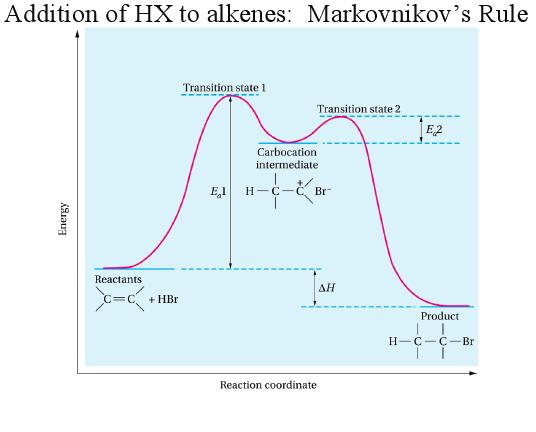
1. Why do we get the intended brominated compound (i.e. at the 2 position, rather than the 1 position of the propene)?
2. What is the reference source for the following reactions. I understand it would be a simple displacement reaction, and quite easy, but where are the references? I'm not familiar with finding things from the hive.

fractal

  • Subordinate Wasp
  • ***
  • Posts: 110
Re: Expanded Bromosafrole Writeup
« Reply #40 on: April 16, 2012, 01:43:51 PM »
Because the hydrogen adds to the double bond and the more stable secondary carbocation forms, nucleophilic bromide ion then bonds to it.... You should pick up an organic chem book, will answer all these basic questions for you. Displacement reaction? It's an addition reaction, just read an OC book.

mztx

  • Larvae
  • *
  • Posts: 6
Re: Expanded Bromosafrole Writeup
« Reply #41 on: May 07, 2012, 11:11:08 AM »
0.5:1 H2SO4 (actually, just a hair less than equimolar)

This is a oil / H2SO4 molar ratio?

So the molar ratio would be:
1:2:1.95:2.2 -> Oil:NaBr:H2SO4:KI (or KBr or NaI)


Polonium

  • Pupae
  • **
  • Posts: 70
Re: Expanded Bromosafrole Writeup
« Reply #42 on: May 07, 2012, 01:03:07 PM »
Are you going to be giving this a try, if so good luck. Those molar ratios seem about right. Im not sure where you got the 2.2 ratio of oil to KI. The KI is used to substitute the bromine for an iodine in bromosafrole. Thhe Finkelstein reaction requires just a slight molar excess of NaI. Use a 1:1.1 molar ratio of bromosafrole to NaI dissolved in dry acetone. Stir it for an hour or two and you should have almost quantitative conversion.

Check out salats writeup on the previous page. She has it laid out nice and clear. How do you plan on aminating the iodosafrole? I haven't tested it but I think there might be easier ways than drying to gas methylamine into dry IPA.

I don't see any reason why it wouldn't work to dissolve dry Methylamine.HCl in anhydrous IPA. Triethylamine, a nonnucleophilic base can then be added to the ice cold IPA to deprotonate methylamine, forming an dry, concentrated, solution of methylamine freebase in IPA?

I'm not sure if the methylamine will stay in solution once it is freebased, but I imagine it would as long as the alcohol is kept cold. Its something to test out anyways if you have those chems available. Good luck.

Edit:
Just found something similar discussed on the rhodium archive
Quote
Treatment of carbonyl compds with methylamine hydrochloride, NEt3 and Ti(IV) isopropoxide, followed by in situ Na borohydride redn. and straightforward aq. work-up, affords clean products in good to excellent yields. An equimolar mixture of methylamine hydrochloride and triethylamine is used as the mathylamine equivalent. This alleviates the use of excess gaseous methylamine.

A mixture of methylamine hydrochloride and triethylamine has been employed as the source of nucleophilic methylamine. The method conveniently avoids the use of gaseous methylamine, however, the overall reaction was slow.
https://www.erowid.org/archive/rhodium/chemistry/redamin.titanium.html
A source of nucleophilic methylamine which avoids the inconvenience of gaseous methylamine is exactly what we want.

Edit 2:
It appears that mephedrone is commercial synthesised from the 2-bromo starting material. Below is a writeup from the literature of the amination being carried out with MeNH2.HCl and Et3NH3 in DCM. The yields are are around 70% from the hydrobromide salt in this case. I don't see any reason why iodosafrole would not result in a greater yield. Also the author doesn't use an excess of methylamine which would help improve yield.

Quote
The title compound was prepared using the method reported by Camilleri et al. [9] with the following modifications: to a suspension of (±)-4 -methyl-2-bromopropiophenone (4.54 g, 20 mmol) and methylamine hydrochloride (1.35 g, 20 mmol) in dichloromethane (40 mL) was added triethylamine (5.58 mL, 40 mmol). The mixture was stirred at room temperature overnight and then acidified (pH ? 1) with 6 M hydrochloric acid (50 mL). The aqueous layer was washed with dichloromethane (3 × 50 mL), basified (pH ? 10) with 5 M sodium hydroxide (circa. 100 mL) and then re-extracted with dichloromethane (3 × 50 mL). The combined organic fractions were dried (MgSO4 ) and concentrated in vacuo to give a viscous yellow oil. The oil was dissolved in isopropanol (4 mL), treated with hydrochloric acid (3 M solution in butanol, 10 mL) and stirred at room temperature for 1 h. The mixture was diluted with diethyl ether (150 mL) and stirred to reveal
a pale yellow solid (circa. 30 min). The crude product was filtered, washed with diethyl ether and recrystallised from acetone to give (±)-4 -methylmethcathinone hydrochloride (1.09 g, 51.2%
from 2) as a colourless powder.

Synthesis, full chemical characterisation and development of validated methods for the quantification of (+/-)-4 '-methylmethcathinone (mephedrone) : a new "legal high".
Santali, Eman Y. ; Cadogan, Anna-Karina ; Daeid, Niamh Nic ; Savage, Kathleen A. ; Sutcliffe, Oliver B..
Journal of Pharmaceutical and Biomedical Analysis, Vol. 56, No. 2, 10.09.2011, p. 246-255.
DOI: 10.1016/j.jpba.2011.05.022


« Last Edit: May 07, 2012, 01:50:47 PM by Polonium »

salat

  • Dominant Queen
  • ****
  • Posts: 276
Re: Expanded Bromosafrole Writeup
« Reply #43 on: May 07, 2012, 07:04:07 PM »
I've read a lot of stuff on the Amination/SNi reactions.  I wish I remembered the half of it. 

One thing experience has taught is that any strong base (like fragments of NaOH or KOH) in the mixture screws the whole shebang.  There is a delicate balance of acid/base.  Like Edison we know what DON'T work.

Salat

mztx

  • Larvae
  • *
  • Posts: 6
Re: Expanded Bromosafrole Writeup
« Reply #44 on: May 08, 2012, 12:01:48 PM »
Thank you Polonium!

I am just curious. The lack of satisfactory writeups makes me reluctant to give it a try. I have very limited resources and only a little knowledge so who knows ???

The amination would be with NH3 (NH4Cl + NaOH + trap) gassed in dry IPA(tone/dry ice bath).

lugh

  • Global Moderator
  • Foundress Queen
  • *****
  • Posts: 876
Re: Expanded Bromosafrole Writeup
« Reply #45 on: May 08, 2012, 01:35:13 PM »
Quote
I am just curious. The lack of satisfactory writeups makes me reluctant to give it a try. I have very limited resources and only a little knowledge so who knows

The halogenation and amination of alkenes is the oldest and most discussed method:

http://127.0.0.1/talk/index.php/topic,828

http://127.0.0.1/talk/index.php/topic,1852

and from way back:

http://parazite.nn.fi/hiveboard/chemistrydiscourse/000189907.html

the amination is second order as described in the attached document  ;) Some more examples of substitution-elimination reactions in the chemical literature originally provided by another staff member of the Hive:

Reaction ID 66608
      Reactant BRN 1099914 4-(2-amino-ethyl)-phenol
      3198812 (S)-2-chloro-3-phenyl-propionic acid
      Product BRN 3152223 N-<4-hydroxy-phenethyl>-D-phenylalanine
      -------------------------
      Reaction Details
      Reaction Classification Preparation
      Ref. 1 2331342; Journal; Kanao; YKKZAJ; Yakugaku Zasshi; 66; 1946; 7;
      Chem.Abstr.; 1951; 7957;
      Reactant BRN 1098243 propylamine
      1719842 4-chloro-pent-2-ene
      Product BRN 1744057 <1-methyl-but-2-enyl>-propyl-amine
      -------------------------
      Reaction Details
      Reaction Classification Preparation
      Ref. 1 1225405; Patent; I.G.Farbenind.; DE 473215; FTFVA6;
      Fortschr.Teerfarbenfabr.Verw.Industriezweige; DE; GE; 16; 2919;
      Reaction
      Reaction ID 67615
      Reactant BRN 1101343 chloromalonic acid diethyl ester
      Product BRN 1761207 amino-malonic acid diamide
      -------------------------
      Reaction Details
      Reaction Classification Preparation
      Reagent alcohol
      ammonia
      Ref. 1 1216622; Journal; Conrad; Guthzeit; CHBEAM; Chem.Ber.; 15; 1882;
      607;
      Reaction ID 98746
      Reactant BRN 1209230 3-methyl-butylamine
      3198812 (S)-2-chloro-3-phenyl-propionic acid
      Product BRN 3207865 N-isopentyl-D-phenylalanine
      -------------------------
      Reaction Details
      Reaction Classification Preparation
      Ref. 1 2331342; Journal; Kanao; YKKZAJ; Yakugaku Zasshi; 66; 1946; 7;
      Chem.Abstr.; 1951; 7957;
      Reaction
      Reaction ID 163729
      Reactant BRN 1633740 tetradecylamine
      1731219 3-chloro-butan-1-ol
      Product BRN 1763537 3-tetradecylamino-butan-1-ol
      -------------------------
      Reaction Details
      Reaction Classification Preparation
      Ref. 1 1265648; Patent; Sowa; US 2874185; 1956;
      Reaction
      Reaction ID 168061
      Reactant BRN 1679227 octylamine
      1730782 2-chloro-propane
      Product BRN 1736554 isopropyl-octyl-amine
      -------------------------
      Reaction Details
      Reaction Classification Preparation
      Ref. 1 1261162; Journal; Grail et al.; JACSAT; J.Amer.Chem.Soc.; 74; 1952;
      1313;
      Reaction
      Reaction ID 179320
      Reactant BRN 1700961 3-chloro-non-1-yne
      Product BRN 1745692 1-hexyl-prop-2-ynylamine
      -------------------------
      Reaction Details
      Reaction Classification Preparation
      Reagent diethyl ether
      liquid ammonia
      sodium amide
      Ref. 1 1262373; Journal; Hennion; Teach; JACSAT; J.Amer.Chem.Soc.; 75;
      1953; 1653;
      Reaction
      Reaction ID 183457
      Reactant BRN 1706751 chloroacetyl-<2-chloro-propionyl>-amine
      Product BRN 1706872 alanyl-glycyl-amine
      -------------------------
      Reaction Details
      Reaction Classification Preparation
      Reagent water
      ammonia
      Ref. 1 1215409; Journal; Bergell; Feigl; HSZPAZ; Hoppe-Seyler's
      Z.Physiol.Chem.; 54; 1907/1908; 284;
      Reaction
      Reaction ID 186869
      Reactant BRN 1714829
      (+-)-2-<2-chloro-propionylamino>-2-<2-amino-propionylamino>-propionic acid
      Product BRN 1714818 (+-)-2,2-bis-<2-amino-propionylamino&gt;-propionic
      acid
      -------------------------
      Reaction Details
      Reaction Classification Preparation
      Reagent water
      NH3
      Temperature 40 øC
      Ref. 1 1242940; Journal; Price; Errera; Greenstein; ARBIAE; Arch.Biochem.;
      17; 1948; 53;
      Reaction
      Reaction ID 195302
      Reactant BRN 1718880 1,2-dichloro-propane
      Product BRN 605274 propane-1,2-diamine
      -------------------------
      Reaction Details 1 of 2
      Reaction Classification Preparation
      Reagent NH3
      Temperature 100 - 125 øC
      Pressure 5.14855*103 - 7.35508*103 Torr
      Other conditions in wss.-aethanol. Seifen-Emulsion
      Ref. 1 1253248; Journal; Barbieri; CHZEA6; Chem.Zentralbl.; GE; 109; II;
      1938; 413;
      Ref. 2 1253249; Patent; Barbieri; US 2113640; 1936;
      Ref. 3 1253246; Journal; Barbieri; CHZEA6; Chem.Zentralbl.; GE; 108; II;
      1937; 857;
      Ref. 4 1253250; Patent; Barbieri; US 2078555; 1934;
      -------------------------
      Reaction Details 2 of 2
      Reaction Classification Preparation
      Reagent water
      NH3
      Temperature 80 øC
      Ref. 1 1253251; Journal; Darzens; COREAF; C.R.Hebd.Seances Acad.Sci.; 208;
      1939; 1503;
      Reaction
      Reaction ID 198295
      Reactant BRN 1720345 (+)(S)-3-chloro-heptene-(1)
      Product BRN 1720339 (-)(R)-3-amino-heptene-(1)
      -------------------------
      Reaction Details
      Reaction Classification Preparation
      Reagent methanol
      NH3
      Temperature 50 øC
      Ref. 1 1236514; Journal; Levene; Rothen; Kuna; JBCHA3; J.Biol.Chem.; 120;
      1937; 788;
      Reaction
      Reaction ID 214270
      Reactant BRN 1732091 3-chloro-2-methyl-butan-2-ol
      Product BRN 1731865 3-amino-2-methyl-butan-2-ol
      -------------------------
      Reaction Details
      Reaction Classification Preparation
      Reagent water
      ammonia
      Other conditions unter intermediaerer Bildung von Trimethyl-aethylenoxyd
      Ref. 1 1214019; Journal; Krassuski; ZRKOAC; Zh.Russ.Fiz.-Khim.O-va; 40;
      1908; 160; CHZEA6; Chem.Zentralbl.; GE; 79; II; 1908; 580;
      Ref. 2 1214001; Journal; Krassuski; COREAF; C.R.Hebd.Seances Acad.Sci.;
      146; 1908; 238;
      Reaction
      Reaction ID 223489
      Reactant BRN 1739506 3-chloro-hex-1-yne
      Product BRN 1739400 1-propyl-prop-2-ynylamine
      -------------------------
      Reaction Details
      Reaction Classification Preparation
      Reagent diethyl ether
      liquid ammonia
      sodium amide
      Ref. 1 1262373; Journal; Hennion; Teach; JACSAT; J.Amer.Chem.Soc.; 75;
      1953; 1653;
      Reaction
      Reaction ID 230311
      Reactant BRN 1746378 2-chloro-tetra-N-ethyl-propane-1,3-diamine
      3598719 phthalimide; potassium salt
      Product BRN 1701125
      N%1&,N%1&,N%3&,N%3&-tetraethyl-propane-1,2,3-triyltriamine
      -------------------------
      Reaction Details
      Reaction Classification Preparation
      Other conditions anschl. Hydrolyse
      Ref. 1 1237586; Patent; I.G.Farbenind.; DE 553072; 1930; FTFVA6;
      Fortschr.Teerfarbenfabr.Verw.Industriezweige; DE; GE; 19; 1169;
      Reaction
      Reaction ID 245104
      Reactant BRN 1771085 N-<3-chloro-butyryl>-glycine
      Product BRN 1771950 N-<3-amino-butyryl>-glycine
      -------------------------
      Reaction Details
      Reaction Classification Preparation
      Reagent ammonia
      Temperature 37 øC
      Ref. 1 1227099; Journal; Abderhalden; Fleischmann; FEFOAG;
      Fermentforschung; 10; 204; CHZEA6; Chem.Zentralbl.; GE; 100; I; 1929;
      2318;
      Reaction
      Reaction ID 629525
      Reactant BRN 505933 ethylamine
      1679281 (+-)-5-chloro-hex-3t-en-1-yne
      Product BRN 1701677 (+-)-ethyl-<1-methyl-pent-2t-en-4-ynyl>-amine
      -------------------------
      Reaction Details
      Reaction Classification Preparation
      Reagent acetonitrile
      Ref. 1 1262439; Journal; Bell et al.; JCSOA9; J.Chem.Soc.; 1958;
      3195,3199;
      Reaction
      Reaction ID 686392
      Reactant BRN 605269 butylamine
      1739506 3-chloro-hex-1-yne
      Product BRN 1750898 butyl-<1-propyl-prop-2-ynyl>-amine
      -------------------------
      Reaction Details
      Reaction Classification Preparation
      Reagent water
      Ref. 1 1262375; Journal; Hennion; Nelson; JACSAT; J.Amer.Chem.Soc.; 79;
      1957; 2142,2145;
      Reaction
      Reaction ID 300239
      Reactant BRN 2012 2-(1(3)H-imidazol-4-yl)-ethylamine
      3198812 (S)-2-chloro-3-phenyl-propionic acid
      Product BRN 28629 N-<2-(1(3)H-imidazol-4-yl)-ethyl>-D-phenylalanine
      -------------------------
      Reaction Details
      Reaction Classification Preparation
      Reagent aq. NaOH solution
      Ref. 1 670007; Journal; Kanao; YKKZAJ; Yakugaku Zasshi; 66; 1946;
      Ausg.B,S.21; Chem.Abstr.; 1951; 7957;Reaction
      Reaction ID 633508
      Reactant BRN 505944 2-amino-ethanol
      2439204 <2-chloro-propyl>-phenyl sulfide
      Product BRN 3050471 2-<$b-phenylsulfanyl-isopropylamino&gt;-ethanol
      -------------------------
      Reaction Details 1 of 2
      Reaction Classification Preparation
      Ref. 1 1614848; Patent; Smith, Kline & French Labor.; US 2774770; 1951;
      -------------------------
      Reaction Details 2 of 2
      Reaction Classification Preparation
      Ref. 1 80429; Journal; Lamdan,S. et al.; JMCMAR; J.Med.Chem.; EN; 9; 1966;
      79-83;
      Reaction
      Reaction ID 778085
      Reactant BRN 741984 benzylamine
      1732262 1-ethylsulfanyl-2-chloro-propane
      Product BRN 3253689 <$b-ethylsulfanyl-isopropyl>-benzyl-amine
      -------------------------
      Reaction Details
      Reaction Classification Preparation
      Reagent sodium carbonate
      ethanol
      Ref. 1 1931997; Journal; Dawson; JACSAT; J.Amer.Chem.Soc.; 55; 1933;
      2070,2073;Reaction
      Reaction ID 1085063
      Reactant BRN 2131366 1,2,2,2-tetrachloro-N-benzyloxycarbonylethylamine
      3594034 glycine ethyl ester; hydrochloride
      Product BRN 2545300 C14H17Cl3N2O4
      -------------------------
      Reaction Details
      Reaction Classification Preparation
      Reagent Et3N
      Solvent CH2Cl2
      Ref. 1 38757; Journal; Weygand,F. et al.; CHBEAM; Chem.Ber.; GE; 99; 1966;
      1944-1956;Reaction
      Reaction ID 1165651
      Reactant BRN 385626 isobutylamine
      606150 N-(1,2,2,2-tetrachloro-ethyl)-formamide
      Product BRN 2442727 C7H13Cl3N2O
      -------------------------
      Reaction Details
      Reaction Classification Preparation
      Reagent Et3N
      Ref. 1 2747; Journal; Chamberlain,K.; Summers,L.A.; AJCHAS; Aust.J.Chem.;
      EN; 27; 1974; 1579-1583;Reaction
      Reaction ID 1222543
      Reactant BRN 505933 ethylamine
      2383945 C16H12ClNO2
      Product BRN 2751727 C18H18N2O2
      -------------------------
      Reaction Details
      Reaction Classification Preparation
      Reagent KI
      Solvent ethanol
      Ref. 1 400524; Patent; Man. Prod. Pharm.; FR 7059; 1969; FR; Chem.Abstr.;
      EN; 75; 5571; 1971;Reaction
      Reaction ID 1225599
      Reactant BRN 505944 2-amino-ethanol
      1737450 2-chloro-tetra-N-methyl-propane-1,3-diamine
      Product BRN 1923251 C9H23N3O
      -------------------------
      Reaction Details
      Reaction Classification Preparation
      Reagent NaI
      Solvent toluene
      Ref. 1 276183; Journal; Korshunov,M.A. et al.; JOCYA9; J.Org.Chem.USSR
      (Engl.Transl.); EN; 5; 11; 1969; 1893-1898; ZORKAE; Zh.Org.Khim.; RU; 5;
      11; 1969; 1947-1952;Reaction
      Reaction ID 1287632
      Reactant BRN 605269 butylamine
      2383945 C16H12ClNO2
      Product BRN 2759251 C20H22N2O2
      -------------------------
      Reaction Details
      Reaction Classification Preparation
      Reagent KI
      Solvent ethanol
      Ref. 1 400524; Patent; Man. Prod. Pharm.; FR 7059; 1969; FR; Chem.Abstr.;
      EN; 75; 5571; 1971;
      Reaction
      Reaction ID 1290438
      Reactant BRN 605292 (2-chloro-propyl)-dimethyl-amine
      741851 methylamine
      Product BRN 2343783 C6H16N2
      -------------------------
      Reaction Details
      Reaction Classification Preparation
      Reagent K2CO3, Cu
      Solvent H2O
      Ref. 1 174162; Journal; Elslager,E.F. et al.; JOCEAH; J.Org.Chem.; EN; 26;
      1961; 2837-2841;
      Reaction
      Reaction ID 1386440
      Reactant BRN 741851 methylamine
      1719769 (+-)-erythro-3,4-dichloro-butane-1,2-diol
      Product BRN 6090719 C6H16N2O2
      -------------------------
      Reaction Details
      Reaction Classification Preparation
      Solvent H2O
      Ref. 1 4963; Journal; Meyer,H.R.; Gabler,R.; HCACAV; Helv.Chim.Acta; GE;
      46; 1963; 2685-2697;
      Reaction
      Reaction ID 2137859
      Reactant BRN 2410916 (R)-1-phenyl-ethylamine
      5327618 (2S,3R)-3-chloro-4-pentene-1,2-diol
      Product BRN 5376547 (2R,3S)-3-isopropylamino-3-pentene-1,2-diol
      -------------------------
      Reaction Details
      Reaction Classification Preparation
      Yield 88. (BRN=5376547)
      Other conditions a) 5d, room temperature, 2) 20h, reflux
      Ref. 1 5649566; Journal; Jaeger, Volker; Stahl, Ulrich; Huemmer, Walter;
      SYNTBF; Synthesis; EN; 9; 1991; 776-782;
      Reaction
      Reaction ID 2274927
      Reactant BRN 3594034 glycine ethyl ester; hydrochloride
      5997675
      N-cyclohexyl-N-methyl-4-<3-(1-chloroethyl)-4-nitrophenoxy>butyramide
      Product BRN 6019289 C23H35N3O6
      -------------------------
      Reaction Details
      Reaction Classification Preparation
      Reagent 1.) NH3, 2.) N,N-diisopropylethylamine, NaI
      Other conditions 1.) CHCl3, 2.) EtOH, reflux, 48 h
      Note 1 Yield given. Multistep reaction
      Ref. 1 5747251; Journal; Venuti, Michael C.; Jones, Gordon H.; Alvarez,
      Robert; Bruno, John J.; JMCMAR; J.Med.Chem.; EN; 30; 2; 1987; 303-318;
      Reaction
      Reaction ID 3295064
      Reactant BRN 605259 isopropylamine
      5572984 C15H20ClNO3
      Product BRN 5678647 C18H28N2O3*ClH
      -------------------------
      Reaction Details
      Reaction Classification Preparation
      Reagent NaI
      Solvent ethanol
      Yield 42. (BRN=5678647)
      Other conditions Heating
      Ref. 1 5670746; Journal; Depreux, Patrick; Marcincal-Lefebvre, Annie;
      Brunet, Claude; EJMCA5; Eur.J.Med.Chem.Chim.Ther.; EN; 22; 1987; 75-78;
      Reaction
      Reaction ID 3730829
      Reactant BRN 741851 methylamine
      1227116
      8-chloro-1-(1-chloro-ethyl)-6-phenyl-4H-benzo<;f>&lt;1,2,4&gt;triazolo<4,3-a><1,4&gt;diazepine
      Product BRN 5628807 C19H18ClN5
      -------------------------
      Reaction Details
      Reaction Classification Preparation
      Reagent KI
      Solvent tetrahydrofuran
      methanol
      Time 18 hour(s)
      Yield 73. (BRN=5628807)
      Other conditions Ambient temperature
      Ref. 1 5697441; Journal; Hester, Jackson B.; Rudzik, Allan D.;
      VonVoigtlander, Philip F.; JMCMAR; J.Med.Chem.; EN; 23; 4; 1980; 392-402;
      Reaction
      Reaction ID 179320
      Reactant BRN 1700961 3-chloro-non-1-yne
      Product BRN 1745692 1-hexyl-prop-2-ynylamine
      -------------------------
      Reaction Details
      Reaction Classification Preparation
      Reagent diethyl ether
      liquid ammonia
      sodium amide
      Ref. 1 1262373; Journal; Hennion; Teach; JACSAT; J.Amer.Chem.Soc.; 75;
      1953; 1653;
      Reaction
      Reaction ID 186869
      Reactant BRN 1714829
      (+-)-2-<2-chloro-propionylamino>-2-<2-amino-propionylamino>-propionic acid
      Product BRN 1714818 (+-)-2,2-bis-<2-amino-propionylamino&gt;-propionic
      acid
      -------------------------
      Reaction Details
      Reaction Classification Preparation
      Reagent water
      NH3
      Temperature 40 øC
      Ref. 1 1242940; Journal; Price; Errera; Greenstein; ARBIAE; Arch.Biochem.;
      17; 1948; 53;
      Reaction
      Reaction ID 195302
      Reactant BRN 1718880 1,2-dichloro-propane
      Product BRN 605274 propane-1,2-diamine
      -------------------------
      Reaction Details 1 of 2
      Reaction Classification Preparation
      Reagent NH3
      Temperature 100 - 125 øC
      Pressure 5.14855*103 - 7.35508*103 Torr
      Other conditions in wss.-aethanol. Seifen-Emulsion
      Ref. 1 1253248; Journal; Barbieri; CHZEA6; Chem.Zentralbl.; GE; 109; II;
      1938; 413;
      Ref. 2 1253249; Patent; Barbieri; US 2113640; 1936;
      Ref. 3 1253246; Journal; Barbieri; CHZEA6; Chem.Zentralbl.; GE; 108; II;
      1937; 857;
      Ref. 4 1253250; Patent; Barbieri; US 2078555; 1934;
      -------------------------
      Reaction Details 2 of 2
      Reaction Classification Preparation
      Reagent water
      NH3
      Temperature 80 øC
      Ref. 1 1253251; Journal; Darzens; COREAF; C.R.Hebd.Seances Acad.Sci.; 208;
      1939; 1503;
      Reaction
      Reaction ID 198295
      Reactant BRN 1720345 (+)(S)-3-chloro-heptene-(1)
      Product BRN 1720339 (-)(R)-3-amino-heptene-(1)
      -------------------------
      Reaction Details
      Reaction Classification Preparation
      Reagent methanol
      NH3
      Temperature 50 øC
      Ref. 1 1236514; Journal; Levene; Rothen; Kuna; JBCHA3; J.Biol.Chem.; 120;
      1937; 788;
      Reaction
      Reaction ID 245104
      Reactant BRN 1771085 N-<3-chloro-butyryl>-glycine
      Product BRN 1771950 N-<3-amino-butyryl>-glycine
      -------------------------
      Reaction Details
      Reaction Classification Preparation
      Reagent ammonia
      Temperature 37 øC
      Ref. 1 1227099; Journal; Abderhalden; Fleischmann; FEFOAG;
      Fermentforschung; 10; 204; CHZEA6; Chem.Zentralbl.; GE; 100; I; 1929;
      2318;
      Reaction
      Reaction ID 249193
      Reactant BRN 1780706 2-chloro-octanedioic acid
      Product BRN 1780545 2-amino-octanedioic acid
      -------------------------
      Reaction Details 1 of 2
      Reaction Classification Preparation
      Reagent water
      NH3
      Ref. 1 1273303; Journal; Freidlina et al.; IASKA6; Izv.Akad.Nauk SSSR
      Ser.Khim.; 1959; 826,829; engl.Ausg.S.800,802;
      -------------------------
      Reaction Details 2 of 2
      Reaction Classification Preparation
      Reagent aq. NH3
      Ref. 1 86581; Journal; Nesmeyanov,A.N. et al.; TETRAB; Tetrahedron; EN;
      17; 1962; 69-77;
      Reaction
      Reaction ID 260252
      Reactant BRN 1812476 2-<2-chloro-propionylamino>-acrylic acid
      Product BRN 1708121 2-<DL-2-amino-propionylamino>-acrylic acid
      -------------------------
      Reaction Details
      Reaction Classification Preparation
      Reagent water
      NH3
      Temperature 5 øC
      Other conditions (anfangs bei 5grad)
      Ref. 1 1242941; Journal; Price; Greenstein; JBCHA3; J.Biol.Chem.; 171;
      1947; 479;
      Reaction
      Reaction ID 438705
      Reactant BRN 3198813 (+-)-2-chloro-3-phenyl-propionic acid
      Product BRN 1910407 phenylalanine
      -------------------------
      Reaction Details 1 of 3
      Reaction Classification Preparation
      Reagent <NH4>2CO3
      aqueous NH3
      Ref. 1 2344288; Journal; Jurkewitsch et al.; ZOKHA4; Zh.Obshch.Khim.; 28;
      1958; 227, 228; engl. Ausg. S. 226, 227;
      -------------------------
      Reaction Details 2 of 3
      Reaction Classification Preparation
      Reagent liquid NH3
      Ref. 1 2344288; Journal; Jurkewitsch et al.; ZOKHA4; Zh.Obshch.Khim.; 28;
      1958; 227, 228; engl. Ausg. S. 226, 227;
      -------------------------
      Reaction Details 3 of 3
      Reaction Classification Preparation
      Reagent aqueous NH3
      Ref. 1 2344289; Journal; Freidlina et al.; IASKA6; Izv.Akad.Nauk SSSR
      Ser.Khim.; 1959; 826, 827; engl. Ausg. S. 800, 801;
      Reaction
      Reaction ID 476624
      Reactant BRN 3299699 chloro-<3,4-dimethoxy-phenyl>-acetic acid amide
      Product BRN 3531358 amino-<3,4-dimethoxy-phenyl>-acetic acid amide
      -------------------------
      Reaction Details
      Reaction Classification Preparation
      Reagent chloroform
      ammonia
      Ref. 1 2333483; Journal; Hahn; Stiehl; Schulz; CHBEAM; Chem.Ber.; 72;
      1939; 1291, 1298;
      Reaction
      Reaction ID 994710
      Reactant BRN 1719482 4-chloro-pent-1-ene
      Product BRN 1734238 1-methyl-but-3-enylamine
      -------------------------
      Reaction Details
      Reaction Classification Preparation
      Other conditions (i) Mg, (ii) NH2OMe
      Note 1 Multistep reaction
      Ref. 1 49274; Journal; Silver,M.S. et al.; JACSAT; J.Amer.Chem.Soc.; EN;
      82; 1960; 2646-2647;Reaction
      Reaction ID 998404
      Reactant BRN 1725153 (-)(2S:3S)-3-chloro-2-hydroxy-succinic acid
      Product BRN 2046210 (2S,3R)-2-amino-3-hydroxy-succinic acid
      -------------------------
      Reaction Details
      Reaction Classification Preparation
      Reagent aq. NH3
      Ref. 1 106497; Journal; Kaneko,T.; Katsura,H.; BCSJA8; Bull.Chem.Soc.Jpn.;
      EN; 36; 8; 1963; 899-903;
      Reaction
      Reaction ID 1021571
      Reactant BRN 1752368 2-chloro-3-methoxy-propionic acid
      Product BRN 2498642 O-methylserine
      -------------------------
      Reaction Details
      Reaction Classification Preparation
      Reagent aq. NH3
      Ref. 1 86581; Journal; Nesmeyanov,A.N. et al.; TETRAB; Tetrahedron; EN;
      17; 1962; 69-77;
      Reaction
      Reaction ID 1707751
      Reactant BRN 1227116
      8-chloro-1-(1-chloro-ethyl)-6-phenyl-4H-benzo<;f>&lt;1,2,4&gt;triazolo<4,3-a><1,4&gt;diazepine
      Product BRN 5618264 C18H16ClN5
      -------------------------
      Reaction Details
      Reaction Classification Preparation
      Reagent KI, NH3
      Solvent tetrahydrofuran
      methanol
      Time 72 hour(s)
      Yield 31. (BRN=5618264)
      Temperature 25 øC
      Ref. 1 5697441; Journal; Hester, Jackson B.; Rudzik, Allan D.;
      VonVoigtlander, Philip F.; JMCMAR; J.Med.Chem.; EN; 23; 4; 1980; 392-402;
      Reaction
      Reaction ID 3154617
      Reactant BRN 5618531 C18H14Cl2N4
      Product BRN 5618290 C18H16ClN5
      -------------------------
      Reaction Details
      Reaction Classification Preparation
      Reagent NH3, KI
      Solvent tetrahydrofuran
      methanol
      Time 6 day(s)
      Yield 45.9 (BRN=5618290)
      Temperature 25 øC
      Ref. 1 5697441; Journal; Hester, Jackson B.; Rudzik, Allan D.;
      VonVoigtlander, Philip F.; JMCMAR; J.Med.Chem.; EN; 23; 4; 1980;
      392-402;Reaction
      Reaction ID 3789167
      Reactant BRN 773799 2-chloro-propionic acid
      Product BRN 635807 alanine
      -------------------------
      Reaction Details
      Reaction Classification Preparation
      Reagent aq. ammonia
      Time 5 hour(s)
      Yield 46. (BRN=635807)
      Temperature 70 øC
      Ref. 1 5746000; Journal; Ogata, Yoshiro; Inaishi, Morio; BCSJA8;
      Bull.Chem.Soc.Jpn.; EN; 54; 11; 1981; 3605-3606;
      ------------------
      -the good reverend drone


The end results from the effort applied  8)

Chemistry is our Covalent Bond

mztx

  • Larvae
  • *
  • Posts: 6
Re: Expanded Bromosafrole Writeup
« Reply #46 on: May 09, 2012, 08:22:56 AM »
Hi lugh,

I already know these threads and others scattered around the net.
Where I said "satisfactory writeups" I should have said "happy ending writeups". I regret the lack of precision in my writings generated by my linguistic deficiencies.

In other words, I have not found examples where newbies like me end up getting what they want.

Anyway thanks for reply and info.

salat

  • Dominant Queen
  • ****
  • Posts: 276
Re: Expanded Bromosafrole Writeup
« Reply #47 on: May 10, 2012, 04:45:14 AM »
Bright star's writeup gives you a good idea of the level of effort it takes to achieve what you want.

Been learning chemistry for about 2 years now (have a chemist on hand who teaches me stuff like distilling and insulating the condensor etc - he wrote the writeups I posted).  Finally to the point where when things go wrong I can figure out what to do, but can still make foolish mistakes that cost me weeks worth of work. 

I had to laugh at myself - once turned 50 ml oil into ~3 liters oil/water - not used to working at that small scale is all I can say.  Then finally got to the point where a bisulfite was the best option for purifying such a small amount and damned if I didn't wind up with flasks full of it.  (TCM contaminated with acetone)  Was easy enough to remedy but dang sulfur stinks.  It's like loaves and fishes with me.

There's too much to really writeup, stuff happens.  Like when I woke up to extract from a completed NaBH4 reaction with an organic solvent and got 3 layers.  Was so proud of myself for figuring it out - must have used too much GAA to neutralize it so added some base and voila 2 layers!  Aren't you mom's out there proud!!

Salat

Salat

Electro´S

  • Pupae
  • **
  • Posts: 95
Re: Expanded Bromosafrole Writeup
« Reply #48 on: June 04, 2012, 06:39:53 PM »
HI all!!!!
The last night i was dreaming about "the Jon method".
6 gr of oil was bad brominated, then the finkelstein swap was made and finally the iodo compound was aminated under Delepine.
The yield was so bad, but for the first time I product!!!  ;D
.................................
The end results from the effort applied :P
« Last Edit: June 05, 2012, 08:45:26 AM by Electro´S »

Sedit

  • Global Moderator
  • Foundress Queen
  • *****
  • Posts: 2,099
Re: Expanded Bromosafrole Writeup
« Reply #49 on: June 07, 2012, 04:47:27 AM »
Steric hindrance prevents the Delepine reaction from working correctly and this was proven back at the hive repeatedly. Use Methylamine instead.
There once were some bees and you took all there stuff!
You pissed off the wasp now enough is enough!!!

carl_nnabis

  • Subordinate Wasp
  • ***
  • Posts: 245
Re: Expanded Bromosafrole Writeup
« Reply #50 on: June 07, 2012, 09:01:52 AM »
Damned i just lost the full reply when automatically getting logged out!
Quote
In other words, I have not found examples where newbies like me end up getting what they want.

Anyway thanks for reply and info.
It is because they usually dont when they need to be spoon fed  ::)
I have not said you do, but you have to become more than just a newbee to actually have success, that involves you could answer some questions after looking for them yourself, and this is the effort that it takes to achieve what you want.
Bright star's writeup gives you a good idea of the level of effort it takes to achieve what you want.
Totally agreed

I have read everything i could get my hands on, nobody to ask, no one to talk about, and useing actual organic chemistry books borrowed from the library, and rhodiums archive too to get a look into both sides of praticing chemistry.
It could have made me able to compare what is bullshit and what is not, to success when i dreamed for the very first unbelievable time after nearly a year of theory (but i like the theoretic part as well and you should too).
Eventually, when i had a two year enduring training as a chemisty laboratory assistant a few years ago I possibly was able to do everything for the pratical part at the start of it because i have learned and teached it myself, that made me to realise how far I really got into it.
Actually I think to have such a forum behind his back would have made it a lot harder to start successful  8)

But back on topic:
The delepine reaction suffers from steric hinderance? But this contributes to the large molecule that hexamine is, I guess? Because delepine-alike reactions with an amine do not as you said so this is probably the case.
"It's like the drug trip I saw when I was on that drug trip!"

mztx

  • Larvae
  • *
  • Posts: 6
Re: Expanded Bromosafrole Writeup
« Reply #51 on: June 12, 2012, 12:39:14 PM »
Damned i just lost the full reply when automatically getting logged out!
Quote
In other words, I have not found examples where newbies like me end up getting what they want.

Anyway thanks for reply and info.
It is because they usually dont when they need to be spoon fed  ::)
I have not said you do, but you have to become more than just a newbee to actually have success, that involves you could answer some questions after looking for them yourself, and this is the effort that it takes to achieve what you want.
Bright star's writeup gives you a good idea of the level of effort it takes to achieve what you want.
Totally agreed

I have read everything i could get my hands on, nobody to ask, no one to talk about, and useing actual organic chemistry books borrowed from the library, and rhodiums archive too to get a look into both sides of praticing chemistry.
It could have made me able to compare what is bullshit and what is not, to success when i dreamed for the very first unbelievable time after nearly a year of theory (but i like the theoretic part as well and you should too).
Eventually, when i had a two year enduring training as a chemisty laboratory assistant a few years ago I possibly was able to do everything for the pratical part at the start of it because i have learned and teached it myself, that made me to realise how far I really got into it.
Actually I think to have such a forum behind his back would have made it a lot harder to start successful  8)
[...]

Thanks for the thoughts and opinions. I definitely put in place.

T-cowboy

  • Pupae
  • **
  • Posts: 57
Re: Expanded Bromosafrole Writeup
« Reply #52 on: June 22, 2012, 08:47:12 PM »
Polonium: Wouldnt water/heat be created in reacting triethylamine with methylamine.hcl`? Then i guess this route wouldnt be viable.

HOw would one go about that reaction?

Cold IPA-->Methylamine.hcl--->Triethylamine ( in situ freebase Meam) ?

carl_nnabis

  • Subordinate Wasp
  • ***
  • Posts: 245
Re: Expanded Bromosafrole Writeup
« Reply #53 on: June 22, 2012, 09:41:08 PM »
hmmm i dont have the specific pka in mind, but i guess triethylamine is a weaker base than methylamine and will not work for this one...
And even if it would work (it DOES NOT!) you would end up getting a cloud of methylamine gas puffing in the air and a chunk of triethylammoniumchloride and this is undesirable ;D
but try my method of choice for getting any dry solid salt of a gaseous amine in waterfree (better called "most-waterlessened-without-gassing"), it has to be dried using anhydrous K-/Na2CO3 afterwards.
I would first make an alcoholic lye of known concentration with best possible dried KOH (preferably KOH, its better soluble in alcohol than NaOH) in dry alcohol of avaibility (here MeOH=methanol is prefered albeit ethanol and IPA will work too).
The alcohol hasnt to be bone-dried to its maximum, so it is really convenient if its done with a mixture 1:2 of Na2CO3:Na2SO4 overnight.
because the KOH itself also has some drying properties too that should not be left out remember about this one! ;)
Now dissolve your dry amine salt you know how soluble they are as salt, chill both solutions in an ice bath, better some salt/ice bath (fertilizer salts get really cold if you need to get so deep), add your alcoholic lye to your alcoholic amine salt
slowly and you will get a precipitate or may not (in methanol never), filter off and:
use your now superfantastic-smellfreeproduced freebase-amine solution in most waterlessenest alcohol of known concentration as you would usual! ;)
For sure its the most conveniest way to do this in situ, way better than messing around with the gas.
simply calculate for example you want 1 mol methylamine freebase in 1 liter methanol you would dissolve KOH and methylamine in like a half liter both, one mol each like this:
MeNH2*HCl (68,52g/mol) + KOH (56,11g/mol) -> 31,06g MeNH2 (1mol) as freebase in alcohol...
and the side reaction gives 74,55g KCl (1 mol) + about 18g H2O
so thats why you have to dry the alcohol twice, before and after the freebase is in it, at least its really needed afterwards.
but hey better non-smelly drying, still way more practical and convenient than to create some fishycloud everyone will recognize, and as usual especially your neighbours may have to ask you some questions about ;) ;D

(BTW where are puke and fishy smilies to put in here for the case MeNH2 is mentioned?? ;D)
"It's like the drug trip I saw when I was on that drug trip!"

carl_nnabis

  • Subordinate Wasp
  • ***
  • Posts: 245
Re: Expanded Bromosafrole Writeup
« Reply #54 on: June 22, 2012, 11:08:02 PM »
Quote
Best practical Sn2 writeup I've seen
thank you! ;D
Quote
My only concern would be the KCl byproduct...
Sorry methanol is absolut non-otc to get here but if concentrated ethanolic lye is used in a good ice-bath and slow addition this one is covered;D
anyway, i prefer to use pre-dried denatured ethanol with maybe 1% H2O left, which dissolves like ~3,5 mol NaOH in a liter,thats like 150gram or such, maybe an option if its more easily avaible? Ethanol has to be warmed a bit to get the NaOH to dissolve complete. I usually would saturate it simply, warm up to get it in, and then cool it under 20°C, let stand one day undisturbed where it is around 20°Celsius, and then simply decant from everything thats left if there was anything.
just remember if you use it saturated that a few milliliter of this saturated ethanolic lye can free some few liter methylamine-gas from dried salt if spilled around.
Always remember the stronger caustic material is added to the lesser, not otherwise round if one has to do so, to avoid it from reacting violent ;D
 
And the sulfate/carbonate mixture (2 part sulfate, 1 carbonate) is only useful for the alcoholic freebase solution, as it helps drying especially for alkaline material. was from both anhydrous salt mixed just because i thought i wont hurt anyway so why not then? ;D
"It's like the drug trip I saw when I was on that drug trip!"

ImAMANGUYS

  • Pupae
  • **
  • Posts: 84
Re: Expanded Bromosafrole Writeup
« Reply #55 on: June 24, 2012, 01:41:30 AM »
hmmm i dont have the specific pka in mind, but i guess triethylamine is a weaker base than methylamine and will not work for this one...
And even if it would work (it DOES NOT!) you would end up getting a cloud of methylamine gas puffing in the air and a chunk of triethylammoniumchloride and this is undesirable ;D

As pollunium added refrences, what are your sources for your assertion that this documented amination doesnt work?

carl_nnabis

  • Subordinate Wasp
  • ***
  • Posts: 245
Re: Expanded Bromosafrole Writeup
« Reply #56 on: June 24, 2012, 03:47:44 AM »
i just guessed that triethylamine is a less strong base (pkB=3,25), but it actually just a tiny bit stronger than methylamine with a pkB=3,38, so my assumption was wrong and this would indeed work.
sorry for that mistake ;D
"It's like the drug trip I saw when I was on that drug trip!"

Wizard X

  • Lord of the Realms
  • Foundress Queen
  • *****
  • Posts: 1,224
Re: Expanded Bromosafrole Writeup
« Reply #57 on: June 25, 2012, 12:55:38 AM »
While triethylamine is commonly employed in organic synthesis as a base, and other applications, I would NOT consider it as a reagent to freebase methylamine.HCl

The cost, compared to NaOH or KOH and, the hazard (Explosive limits, exposure) isn't justified.
Albert Einstein - "Great ideas often receive violent opposition from mediocre minds."

Sedit

  • Global Moderator
  • Foundress Queen
  • *****
  • Posts: 2,099
Re: Expanded Bromosafrole Writeup
« Reply #58 on: June 25, 2012, 08:31:41 AM »
While triethylamine is commonly employed in organic synthesis as a base, and other applications, I would NOT consider it as a reagent to freebase methylamine.HCl

The cost, compared to NaOH or KOH and, the hazard (Explosive limits, exposure) isn't justified.

Its not about cost its about being able to free the methylamine without the creation of H2O.
There once were some bees and you took all there stuff!
You pissed off the wasp now enough is enough!!!

carl_nnabis

  • Subordinate Wasp
  • ***
  • Posts: 245
Re: Expanded Bromosafrole Writeup
« Reply #59 on: June 25, 2012, 09:21:38 AM »
Even then I would compared to the price of alkali hydroxides and a bottle of anhydrous drying agent vs that of triethylamine always prefer the first, water can be removed anyway while storing, if you dont have to use it immediately.
I know the triethylamine can be restored, yes but!
t-cowboy suggested ipa as solvent, i guess the triethylamine*HCl  is almost soluble in that as it is as freebase, so you have to deal with that too.  :-\
Better make some cool nitroalcohols with that Et3N ;D
"It's like the drug trip I saw when I was on that drug trip!"

salat

  • Dominant Queen
  • ****
  • Posts: 276
Re: Expanded Bromosafrole Writeup
« Reply #60 on: June 25, 2012, 05:09:37 PM »
I recall a thread in the hive archives where Rhodium advocated the triethylamine method.  The way Rhodium spoke about it sounded to me like an Aspie who has solved a problem and as a result is no longer interested in any other methods.

I did a quick search but can't find the thread right this moment and can't spend any more time on it.  I'm knee deep in packing lab glassware in hopes of finally moving.  Perhaps someone else knows the thread.

Salat

lugh

  • Global Moderator
  • Foundress Queen
  • *****
  • Posts: 876
Re: Expanded Bromosafrole Writeup
« Reply #61 on: June 25, 2012, 06:45:45 PM »
Chemistry is our Covalent Bond

Wizard X

  • Lord of the Realms
  • Foundress Queen
  • *****
  • Posts: 1,224
Re: Expanded Bromosafrole Writeup
« Reply #62 on: June 26, 2012, 06:01:50 AM »
While triethylamine is commonly employed in organic synthesis as a base, and other applications, I would NOT consider it as a reagent to freebase methylamine.HCl

The cost, compared to NaOH or KOH and, the hazard (Explosive limits, exposure) isn't justified.

Its not about cost its about being able to free the methylamine without the creation of H2O.

Please read and understand Dissolution (chemistry). http://en.wikipedia.org/wiki/Dissolution_(chemistry)
Albert Einstein - "Great ideas often receive violent opposition from mediocre minds."

carl_nnabis

  • Subordinate Wasp
  • ***
  • Posts: 245
Re: Expanded Bromosafrole Writeup
« Reply #63 on: June 26, 2012, 06:57:53 PM »
race fuel is avaible yes but mixed, i was talking about pure methanol. If there is something which really needs methanol, theres still these very expensive fuel cell energy storage thingys, that use methanol als hydrogen source, but you have to show up in person because methanol is like glacial acetic acid or hydroflouric acid not allowed to be sent through standard mail.
And really, when I would need some moew, i think i would simply drove to france or holland they have it as denatured alcohol pure instead ethanol like here ;D that would bee easier than to distill race car fuel ;D
there are many dozen other OTC alcohols so i dont care really ;D
they wont sell methanol pure only because its toxicity but i believe its more because of its use in biodiesel production.

anyway, you can use isopropyl alcohol in the sn2 halogen-amine swap, i do, it works good using 2-bromopropiophenone with methylamine, and this is essentially the same reaction there   
« Last Edit: June 26, 2012, 07:02:47 PM by carl_nnabis »
"It's like the drug trip I saw when I was on that drug trip!"

jon

  • Foundress Queen
  • *****
  • Posts: 1,883
Re: Expanded Bromosafrole Writeup
« Reply #64 on: June 26, 2012, 07:32:41 PM »
ipa is definitely the secret here

T-cowboy

  • Pupae
  • **
  • Posts: 57
Re: Expanded Bromosafrole Writeup
« Reply #65 on: July 01, 2012, 06:24:25 PM »
Trieethylamine.hcl is not soluble in IPA (cold) Carl_nabbis..

Source: wikipedia ET3N, Own experience.

carl_nnabis

  • Subordinate Wasp
  • ***
  • Posts: 245
Re: Expanded Bromosafrole Writeup
« Reply #66 on: July 01, 2012, 07:06:16 PM »
ok thx for the info it was new to me. but my opinion wont change, better make some cool nitroalcohol with it for norephedrine production ;D
"It's like the drug trip I saw when I was on that drug trip!"

jon

  • Foundress Queen
  • *****
  • Posts: 1,883
Re: Expanded Bromosafrole Writeup
« Reply #67 on: July 02, 2012, 01:13:21 AM »
Quote
HI all!!!!
The last night i was dreaming about "the Jon method".
6 gr of oil was bad brominated, then the finkelstein swap was made and finally the iodo compound was aminated under Delepine.
The yield was so bad, but for the first time I product!!! 

i've gotten quite familiar with these reactions and some say the delepine can't work on a secondary halide but after much reading i found oone exception: isopropyl iodidies.
the reacction really takes a month to complete so this informational is just for shits and grins but it does work in this special case.

pbinteger

  • Subordinate Wasp
  • ***
  • Posts: 124
Re: Expanded Bromosafrole Writeup
« Reply #68 on: September 18, 2012, 10:52:34 PM »
Salat

What specifically prevents one from using KI, GAA, & H2SO4 as reagents with Safrole to arrive at Iodosafrole. Why the extra step?
It is commonly known that one can arrive at Iodosafrole using NaI, and it would seem that the Iodide is all we're concerned with.

Polonium

  • Pupae
  • **
  • Posts: 70
Re: Expanded Bromosafrole Writeup
« Reply #69 on: September 19, 2012, 12:42:52 PM »
I think bromine is used for halogenation due to the relatively expense of iodine salts. It is much cheaper to do the bromination first and then perform the almost quantitative halogen swap to form iodosafrole