
Author Topic: Wet NaBH4 reductive amination  (Read 997 times)

Methyl Man

  • Subordinate Wasp
  • ***
  • Posts: 143
Re: Wet NaBH4 reductive amination
« Reply #60 on: April 21, 2011, 05:50:31 PM »
Okay, here we go. If I may, letters (and anyone else who can chime in) I'd like to ask some questions and clarify some things, line-by-line. That could be the easiest way here.

take 74.27g of methylamine.hcl (1.1mol), dissolve in the minimum amount of water and write it down.
add toluene (5-10 times the amount of water) then drop in 1mol of NaOH flakes (40g), slowly while in an ice bath.


I'm going to eliminate the ambiguous spread here, and just say 10x the amount of water, is that okay? And this could use stirring, right? You mention shaking, but not stirring (shades of James Bond). I'd like to do this all with clamped, set-up glass if possible.

And the ice bath mentioned, that can be set up in advance, correct? In other words, that first step of dissolving the amine in water can be done in glass that's already in said ice bath, right?

then add more NaOH, 6-8g per every ml of water present. So if you had to dissolve your amine in 50ml water, you must add 300-400g dry NaOH.

Again, the "6-8" is ambiguous to me as a layman; I have no idea why to choose one end of that spectrum over the other. Can we just go w/the maximum, and say 8g per mL?

Then add 150g more NaOH to account for the water formed by the reaction between OH(-) and MeNH3(+). Shake well and let sit in the ice bath till everything settles down.

Please describe what it was doing that it now has to "settle down." Exothermic action? Mild bubbling? Heavy frothing? I will need to know in advance. I'm also wondering again about stirring vs shaking. If this is a fixed glass setup, I'd rather be stirring, but maybe this is too much solids to be magnetically stirred...? Maybe it *has* to be swirled by hand? Those are the kinds of physical details I need to get a grip on. (Those ratios look to me like there's enough liquids that it could all be magnetically stirred, but I'm not sure)

If there isn't even any need for a condenser or addition funnel, I guess we aren't talking about any kind of clamped glass setup, just a flask on a stirplate, right? If it's going to be mag-stirred at any point, I can't pick it up and shake/swirl it because there will be a stirbar in there (unless I pull it out, of course). These kinds of aspects are obvious to the seasoned pro, but for someone like me, every little detail of this type has to be known in advance. And are we sure there's no need for a more anhydrous setup, like having all the flask necks stoppered except for one, with a drying agent plug in it?

Decant or filter your toluene, add to it some methanol and 0.9mol of your ketone, stir 30 minutes, then add 10~17g NaBH4 (depending on quality of NaBH4) in small portions in the ice bath, let stir extra 2 hours @ r.t. after addition of NaBH4 is done, and workup as usual. This works and is easy!

It's actually the whole reaction mixture that I'm decanting or filtering at this point, right? You say "decant the toluene" but I assume you really mean the entire mix since it is all intimate at this point. And what am I decanting away from---undissolved NaOH?

"Some" methanol is too vague, I'm afraid. Please give an amount, or an objective I can relate to (i.e. is the point to add enough MeOH to make the mix more easily stirrable?)

It will definitely be the greater amount of NaBH4 in my case because it is old NaBH4. I take it that it's added straight (dry), in small portions due to reactivity? It does visibly react, correct ? Maybe you could suggest something more specific as a way to add it (example "add portions of NaBH4 at a rate of roughly 0.5 g every 15 seconds until 17g has been added" or something like that). In the end though it will be more than 17g because we're going to scale this up to 100g ketone if we can.

If you will be kind enough to answer these questions (and help me adjust scale/amounts/moles to 100g ketone) I will then have more than enough to write up a very nice method!
« Last Edit: April 21, 2011, 05:55:00 PM by Methyl Man »
There's a methyl to my madness...
==+==+==+==+==+==+==+==+==+==

Shake

  • Dominant Queen
  • ****
  • Posts: 276
Re: Wet NaBH4 reductive amination
« Reply #61 on: April 21, 2011, 09:00:10 PM »
http://www.youtube.com/user/kosasihiskandarsjah#p/u/19/jcWYAnmm-QE

go to that guys you tube channel when you get a chance, that has some good animations that will help you understand what happens on a molecular level ie the 'dancing' as you put it lol.

i have no chemistry background either methylman but i dont think what you have been given needs much further explanation, might be your turn to just have some balls and common sense and get to work. IMO

instead of asking a thousand questions just write your synth up how you think it goes and post it and if there is any blatant errors someone might correct it for you. that sounds better and is more professional than asking to fill in blanks on your recipe.
« Last Edit: April 21, 2011, 09:13:54 PM by Shake »

letters

  • Subordinate Wasp
  • ***
  • Posts: 138
Re: Wet NaBH4 reductive amination
« Reply #62 on: April 22, 2011, 02:29:24 AM »
Hi Methylman. Im feeling quite nice today so here goes :
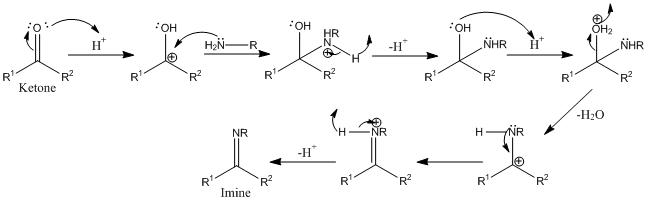
First of all have a look at the mechanism for imine formation. It is attached.
As you can see this reaction is acid catalyzed (requires protons, yet the number of protons used is equal to number of protons released). At first the carbonyl oxygen gets protonated (attracts a hydrogen) to generate the carbocation as detailed in the picture. This carbocation reacts with the lone pair of the amine to create the second intermediate. one of the hydrogens bonded to the amine donates its bonding electrons to the charged nitrogen (to "neutralize" it) and is released in the form of a proton (so far we've have 1 proton in, 1 proton out). then the oxygen's lone pair again attacks a proton to generate a charged H2O group (charged water species), which is a very good leaving group (since water is quite stable). This ion leaves the molecule, along with the bonding electrons giving off water as a byproduct. Again a carbocation is formed, "steals" the lone pair of the nitrogen to compensate for the charge and a double bond is created. Then another hydrogen bonded to the nitrogen leaves, leaving the bonding electrons to neutralize the charge formed on the nitrogen, giving you an Imine as a product! Plz note - Some of the arrows in the reaction scheme are double arrows pointing to product and starting material indicating some steps are reversible and are in the state of equilibrium. Im too tired to fix the image now, but the main thing to remember is that the water releasing step is an equilibrium step, meaning the more water you have in your reaction vessel, the slower the reaction will proceed (this is called Le Chatelier's principle, look it up, its in wikipedia iirc). This is the main reason most aq. reductive aminations wont proceed well.
Also please note, all the curved arrows indicate either atom or electron transfer. the dots around the N and O atoms are lone pairs of electrons which are reactive in most cases. When you see an arrowed mechanism, always look at where the arrow is starting (should be either a bond, or lone pair or atom - when specified as "leaving").

Once the imine is formed, sodium borohydride is added and donates most likely a species called a Hydride, which can be thought of as an H(-) ion. The general mechanism for hydride donation is believed to proceed via a planar complex formed between the boron atom and the reducible species. Then hydride transfer proceeds in 90degrees compared to the boron location. This is non proven, but widely acceptable.

Whats important here is the imine formation mechanism.

Quote from: Methyl Man
take 74.27g of methylamine.hcl (1.1mol), dissolve in the minimum amount of water and write it down.
add toluene (5-10 times the amount of water) then drop in 1mol of NaOH flakes (40g), slowly while in an ice bath.


I'm going to eliminate the ambiguous spread here, and just say 10x the amount of water, is that okay? And this could use stirring, right? You mention shaking, but not stirring (shades of James Bond). I'd like to do this all with clamped, set-up glass if possible.
yes x10 the amount of water is ok.  Stirring is good, but when dealing with large amounts of solids, mag stirring is usually not good enough and mechanical stirring is required (i.e. over head stirrer). shaking is simply because its easier and faster then setting up and dismantling the overhead stirrer

Quote from: Methyl Man
And the ice bath mentioned, that can be set up in advance, correct? In other words, that first step of dissolving the amine in water can be done in glass that's already in said ice bath, right?

this *should* be set up in advance. however sometimes heat is needed to get the amine in solution. it is best to set up an ice bath on the side, make your solution in a minimum amount of water then chill it in the ice bath. this is due to the fact that dissolution can be endothermic (depends on your salt)!.

Quote from: Methyl Man
then add more NaOH, 6-8g per every ml of water present. So if you had to dissolve your amine in 50ml water, you must add 300-400g dry NaOH.

Again, the "6-8" is ambiguous to me as a layman; I have no idea why to choose one end of that spectrum over the other. Can we just go w/the maximum, and say 8g per mL?

8g/ml is good! it really depends on the purity and dryness of your sodium hydroxide, but to be on the safe side more is better here!

Quote from: Methyl Man
Then add 150g more NaOH to account for the water formed by the reaction between OH(-) and MeNH3(+). Shake well and let sit in the ice bath till everything settles down.

Please describe what it was doing that it now has to "settle down." Exothermic action? Mild bubbling? Heavy frothing? I will need to know in advance. I'm also wondering again about stirring vs shaking. If this is a fixed glass setup, I'd rather be stirring, but maybe this is too much solids to be magnetically stirred...? Maybe it *has* to be swirled by hand? Those are the kinds of physical details I need to get a grip on. (Those ratios look to me like there's enough liquids that it could all be magnetically stirred, but I'm not sure)
I say settle, as in let all the solids which are suspended in the mixture to settle to the bottom. when you later pour your toluene/amine solution, youd want it to be absolutely base free (as this can cause to self condensation of the ketone, accompanied by usually a red color).

Quote from: Methyl Man
If there isn't even any need for a condenser or addition funnel, I guess we aren't talking about any kind of clamped glass setup, just a flask on a stirplate, right? If it's going to be mag-stirred at any point, I can't pick it up and shake/swirl it because there will be a stirbar in there (unless I pull it out, of course). These kinds of aspects are obvious to the seasoned pro, but for someone like me, every little detail of this type has to be known in advance. And are we sure there's no need for a more anhydrous setup, like having all the flask necks stoppered except for one, with a drying agent plug in it?
as written above, hand shaking of the mix is good enough. however, you should always clamp your flasks, no matter what you do with them.

Quote from: Methyl Man
Decant or filter your toluene, add to it some methanol and 0.9mol of your ketone, stir 30 minutes, then add 10~17g NaBH4 (depending on quality of NaBH4) in small portions in the ice bath, let stir extra 2 hours @ r.t. after addition of NaBH4 is done, and workup as usual. This works and is easy!

It's actually the whole reaction mixture that I'm decanting or filtering at this point, right? You say "decant the toluene" but I assume you really mean the entire mix since it is all intimate at this point. And what am I decanting away from---undissolved NaOH?
you should decant only the upper toluene phase! if any water (containing dissolved base) is carried over or solid base you WILL get self condensation of the ketone. so in essence, you should only decant the top clear layer toluene/amine. for an added measure, if you dont feel comfortable enough with plain decantation, just run it through a flutted filter paper in a funnel. remember, up until now, all we are doing is just creating a dry solution of the amine in the toluene.

Quote from: Methyl Man
"Some" methanol is too vague, I'm afraid. Please give an amount, or an objective I can relate to (i.e. is the point to add enough MeOH to make the mix more easily stirrable?)
There are a few points in adding methanol :
1. the reaction solvent needed for the imine formation should be of the polar (preferably protic) kind. This is in order to stabilize the charged intermediates formed during reaction.
2. to make sure that when you add your NaBH4 it will dissolve and be able to react with the imine present in solution. Without the methanol, the borohydride would most likely just stay out of solution, out of phase, and will not react. You can think of it as a phase transfer agent of sorts, transferring the BH4(-) ion and its relatives (BH3(-2), BH2(-3), etc..) into the reaction phase.
If I had to recommend a specific amount, id go with a volume that equals 5 times the weight of the ketone. I usually add it by "feeling". Experimentation is your friend. try it with various amounts seeing which amount reacts the fastest and yields best for you.

Quote from: Methyl Man
It will definitely be the greater amount of NaBH4 in my case because it is old NaBH4. I take it that it's added straight (dry), in small portions due to reactivity? It does visibly react, correct ? Maybe you could suggest something more specific as a way to add it (example "add portions of NaBH4 at a rate of roughly 0.5 g every 15 seconds until 17g has been added" or something like that). In the end though it will be more than 17g because we're going to scale this up to 100g ketone if we can.
It is added dry, in small portions. Visual reaction does take place - some frothing. Whatever color formed in the imine formation step gradually disappears to give a white/yellow opaque mix. very good stirring is needed here. If you have an overhead stirrer, this is a must for good yields in the larger batches.
A better way to judge the amount of portions and addition time is to follow the temperature. you should add your borohydride at a rate which is slow enough to keep the temp below 10degC. so start by adding say 0.5g once, watching the temp. it will rise on addition of the borohydride and will drop back when most of it has reacted or has gone into solution. adjust your amount till you hit the sweet spot - the rate at which the temp stay low, but it doesnt take you all day to add your borohydride.

Quote from: Methyl Man
If you will be kind enough to answer these questions (and help me adjust scale/amounts/moles to 100g ketone) I will then have more than enough to write up a very nice method!
100g mdp2p = ~562mmol.
so for that i would use ~674mmol methylamine.hcl (~45.5g), and 10.4 of NaBH4, added in small portions.

a very important note - START SMALL , do a few 5-10g batches. Get comfortable with the reaction and the borohydride. Write down notes about color formation, disappearance, temps, times etc... There are many variables and things you might do that will fuck it up the first time you try it, especially the decantation from the base. doing 100g batch of a reaction for the first time is bad, especially on a precious ketone like mdp2p.

Hope this helps. Dont hesitate to ask more questions!
« Last Edit: April 22, 2011, 02:32:44 AM by letters »

RoidRage

  • Dominant Queen
  • ****
  • Posts: 386
Re: Wet NaBH4 reductive amination
« Reply #63 on: April 22, 2011, 04:46:01 AM »
Thanks letters, that's exactly what this thread needed...not more dramas...


I appreciate Methyl Man's work, no matters his chemistry background, So I don't really cares helping out with stochiometry or anything...
« Last Edit: April 22, 2011, 04:48:46 AM by RoidRage »

Methyl Man

  • Subordinate Wasp
  • ***
  • Posts: 143
Re: Wet NaBH4 reductive amination
« Reply #64 on: April 22, 2011, 05:08:07 AM »
Thanks letters, wow that is some really great stuff. Your follow-ups were very illuminating. You definitely were feeling nice. Everything is getting clearer.

Okay I'm with you now on the decanting... now that you've elaborated, I see this part can just be done with a sep funnel, right? I was focusing so hard on other aspects that I forgot we were talking about mixing toluene and water (even though a small amount of water)... so, a separation in a sep funnel should be great here. I'm meticulous with the ol' sep funnel.

On the undefined portion of methanol--thanks, I will start off with your 5X ketone weight recommendation. Question though--this MeOH should be dry, no? And does it help if the toluene is dry, or is that pointless because it goes right on top of some water at that stage of things?

I hear you about not starting at 100g scale. That's probably a little overconfident... yet, I was under the impression that this thing doesn't throw nearly as many curves as the nitro Al-Hg. But 10g... ooh man that's tiny. If I get all my ducks in a row before I jump, I feel like I should nail it the first time. Maybe not with a killer yield, but at least a successful reduction. Tell ya what, I could start at about 50g ketone, that's a good compromise.  If the physical parameters you're describing are pretty accurate, I don't think I'll fuck it up. I more or less nailed the nitro Al-Hg my first time out by following the description in TS2, so I feel I should be able to handle this one, unless its subtleties are myriad and hard to spot.

It comes down to using our eyes. If I know what visible changes I'm looking for, I know whether things are working. If you remember any more visual cues you can advise me to look for, I'd love to note them.

Oh one last question please. Your description stops at the stage where I would need to add HCl to the reaction to destroy the boro. This task looks straightforward enough that I could lift the parameters for it straight from the "Wet NaBH4 reductive alkylation" text or any other NaBH4 reduction text that's out there. Agree?

cheers
MM
There's a methyl to my madness...
==+==+==+==+==+==+==+==+==+==

letters

  • Subordinate Wasp
  • ***
  • Posts: 138
Re: Wet NaBH4 reductive amination
« Reply #65 on: April 22, 2011, 12:03:07 PM »
Quote from: Methyl Man
Okay I'm with you now on the decanting... now that you've elaborated, I see this part can just be done with a sep funnel, right? I was focusing so hard on other aspects that I forgot we were talking about mixing toluene and water (even though a small amount of water)... so, a separation in a sep funnel should be great here. I'm meticulous with the ol' sep funnel.
Ive never used a sep funnel for this part. ive always used a properly sized earlenmayer flask and after everything settled i just poured the toluene off into the reaction flask. I usually leave a bit of toluene in the earlenmayer since for me a bit less amine is much better then having an alkali base present in the reaction mix. I say do it anyway you feel is more comfortable for you - sep funnel, RBF, earlenmayer, kitchen glass cup, whatever.

Quote from: Methyl Man
On the undefined portion of methanol--thanks, I will start off with your 5X ketone weight recommendation. Question though--this MeOH should be dry, no? And does it help if the toluene is dry, or is that pointless because it goes right on top of some water at that stage of things?
the methanol should be anhydrous, since we have already dried the toluene/amine solution and we dont want to introduce any more moisture.
the toluene should be dryish. if you feel your toluene isnt dry you have a few options - either dry it with a drying agent beforehand (mgso4, mol sieves, etc), dean stark it till all the water has been driven off or simply add more NaOH to compensate.

Quote from: Methyl Man
I hear you about not starting at 100g scale. That's probably a little overconfident... yet, I was under the impression that this thing doesn't throw nearly as many curves as the nitro Al-Hg. But 10g... ooh man that's tiny. If I get all my ducks in a row before I jump, I feel like I should nail it the first time. Maybe not with a killer yield, but at least a successful reduction. Tell ya what, I could start at about 50g ketone, that's a good compromise.  If the physical parameters you're describing are pretty accurate, I don't think I'll fuck it up. I more or less nailed the nitro Al-Hg my first time out by following the description in TS2, so I feel I should be able to handle this one, unless its subtleties are myriad and hard to spot.
it all comes down really to how much youve got... if youve got kilos of mdp2p lying around, by all means, carry a 100g batch on the first trial. however, it is a much better practice (regardless of the starting materials) to start small. sure youd have to "waste" a day or 2 or 3 on the initial experimentation, but in the end, when you scale up, you are facing much less problems and unknowns. If you can do TLC (which is highly recommended) you should follow the progress of reaction with it. This helps alot to know when to proceed, when to stop reaction, etc...

Quote from: Methyl Man
It comes down to using our eyes. If I know what visible changes I'm looking for, I know whether things are working. If you remember any more visual cues you can advise me to look for, I'd love to note them.

I have to disagree, our eyes are usually not enough. For example the colors I get can and probably will be different due to the different impurities present in my ketone and yours. this is why starting small is helpful - you can learn the shticks of this reaction without wasting precious starting materials.

Quote from: Methyl Man
Oh one last question please. Your description stops at the stage where I would need to add HCl to the reaction to destroy the boro. This task looks straightforward enough that I could lift the parameters for it straight from the "Wet NaBH4 reductive alkylation" text or any other NaBH4 reduction text that's out there. Agree?
Mineral acids are OK to quench the reaction, but sometimes they reduce yields dramatically, especially with a compound that contains acid sensitive moeities like that wonderful MD bridge. I always use glacial acetic acid to destroy the NaBH4, unless Im working with compounds which arent so touchy about conditions (like with plain phenylacetone). But in general you can probably choose any workup that you find, as they are all pretty much equal.

another note i forgot last night - when you quench with acid, you get a type of goo (borax or something similair) which gradually mostly goes back into solution. with the larger batches an overhead stirrer is an absolute must, since this goo can be hard on mag stirrers.

Quote from: RoidRage
Thanks letters, that's exactly what this thread needed...not more dramas...
I appreciate Methyl Man's work, no matters his chemistry background, So I don't really cares helping out with stochiometry or anything...

Dramas are useless in any thread. It does not contribute to the general knowledge and usually hampers progress. and im of the same mind as you - i dont mind helping out fellow chemists (maybe cooks is a better word here, since so many of the members here arent chemists), as long as the thread is kept civilized.


Methyl Man

  • Subordinate Wasp
  • ***
  • Posts: 143
Re: Wet NaBH4 reductive amination
« Reply #66 on: April 22, 2011, 03:40:56 PM »
Thanks for the once-again fabulous follow ups, letters.  8)

Actually it's quite possible that by the time I get into the actual doing, I will have the hands-on help of a buddy who, very luckily for me, is a PhD biochemist. He doesn't know the NaBH4 reduction, he's only done some performic route work many years ago, but he certainly knows TLC (I don't yet) and would be able to help out with that part once he knows the overview of the reaction (he will end up reading all this material with me to prepare). So I'll be in good hands at that point... I mean ironically, I'll know more about this particular reaction than he will, but he will know all kinds of supporting stuff that will help a lot (TLC is a great example).

cheers
MM
There's a methyl to my madness...
==+==+==+==+==+==+==+==+==+==

Methyl Man

  • Subordinate Wasp
  • ***
  • Posts: 143
Re: Wet NaBH4 reductive amination
« Reply #67 on: April 22, 2011, 09:56:10 PM »
Have no idea why you say that... the guy is a friend of mine and a brilliant scientist, he's done work on cutting-edge Alzheimer's drug research. Why on earth would a guy like that fail the performic? Do you always speculate aggressively on things you don't know about?  ::) ???

There's a methyl to my madness...
==+==+==+==+==+==+==+==+==+==

Wizard X

  • Lord of the Realms
  • Foundress Queen
  • *****
  • Posts: 1,224
Re: Wet NaBH4 reductive amination
« Reply #68 on: April 22, 2011, 11:07:41 PM »
Albert Einstein - "Great ideas often receive violent opposition from mediocre minds."

jon

  • Foundress Queen
  • *****
  • Posts: 1,883
Re: Wet NaBH4 reductive amination
« Reply #69 on: April 23, 2011, 11:16:27 PM »
this sort of reminds me of the roman centurion when asked to flank his troops said "he failed flank"
awww what the flank get the flank outta here
really guys can we keep the smallitics to a minimum that shit is for the shrommery of zoklet or some other kewl site.

Methyl Man

  • Subordinate Wasp
  • ***
  • Posts: 143
Re: Wet NaBH4 reductive amination
« Reply #70 on: April 23, 2011, 11:30:37 PM »
Yes indeed. I'll be back soon with a draft of the method incorporating all of letters' details. Fun stuff.
There's a methyl to my madness...
==+==+==+==+==+==+==+==+==+==

Methyl Man

  • Subordinate Wasp
  • ***
  • Posts: 143
Re: Wet NaBH4 reductive amination
« Reply #71 on: April 26, 2011, 09:48:00 PM »
Okay, I'm back. I've totally redrafted the thing, based on and incorporating all of letters' material. Letters, I hope you don't mind---let me know if you do---but I've incorporated a few passages from your reply posts (lightly edited). If you object, I can rephrase those parts.

And letters, it'd be really cool if you'd simply read through it and double check the amounts and confirm what the amounts should be where I've put question marks. I was unsure of the amounts that should go there due to molar math and stuff (yes, I'm handicapped :( ). I wrote it at the 100g ketone scale, since that's where I want to run it ultimately, but when I go to do it the first time I will probably scale it down 90% (10g ketone) as per your recommendation.

If you would, please give me an educated guess on the amount of GAA that will be needed for the dropwise addition, so people know how much to load the addition funnel with, etc. (I'm assuming you're talking about using undiluted GAA since otherwise you would have just said acetic acid.)

Naturally, anyone else should offer any other facts or tips they can see, as long as they won't force a major rewrite :)

Here it is (still a rough draft, but getting much closer):

----------------------------------------------------------------

A Non-Anhydrous Reductive Amination of 3,4-(Methylenedioxyphenyl)-2-propanone using NaBH4
by Methyl Man (with invaluable assistance from letters)

1.  To a 2-neck 2000 mL RB flask set in an ice bath and containing a stirbar is added 45.5g of methylamine hydrochloride which is then carefully dissolved in the minimum amount of water needed. Stirring is begun, and the amount of water used is recorded.

2.  Add an amount of dry toluene that is 10X the volume of water just used in the above step.  

3.  Slowly add [?]g of NaOH using a powder funnel.

4.  Then add additional NaOH in the amount of 8g for every milliliter of water used in Step 1. So for example if it took 50mL water to dissolve the methylamine, 400g dry NaOH would be added.

5.  Then add [?]g more NaOH to account for the water formed by the reaction between OH(-) and MeNH3(+).

6.  Unclamp the reaction flask, remove the stirbar, stopper the necks, and swirl/shake the contents well to mix thoroughly. Immediately check for and release any pressure buildups. Replace flask in the ice bath, clamp it again, and allow all solids to settle.

7.  After the mix has settled, unclamp the flask and decant the (upper) toluene phase into a separatory funnel, taking care not to let any of the lower aqueous phase contaminate it.  If you're like me you will fastidiously finalize the separation using the separatory funnel, avoiding all traces of the aqueous phase with extreme prejudice (this kind of hypervigilant separation is a personal quirk of mine; others may want to simply decant once and/or pour through a fluted filter). Cover or cap the vessel used to temporarily hold the toluene/amine phase to protect it from atmospheric moisture. Pour the aqueous phase into a beaker and set aside, out of the way.

8.  Clean out and dry the original reaction flask, place the stirbar back into it, and return the toluene/amine phase to it.

9.  Then add 500g dry MeOH and 100g ketone, and return it to the ice bath. Reclamp the flask, affix the thermometer, stopper the other neck, and begin medium stirring. Stir for 30 minutes.

10.  After 30 minutes, increase the stirring speed so that it's quite vigorous and add, via a number of small portions, 10.4g NaBH4 (or up to [?]g depending on the freshness/staleness of the NaBH4). Some frothing will be visible upon the additions (between additions, loosely restopper the neck).

NOTE: Judge the amount of the portions and the time between additions by monitoring the temperature. Add the borohydride at a rate which is slow enough to keep the temperature below 10°C. So start by adding say 0.5g once and then watching the temperature. It will rise on addition of the borohydride and will drop back when most of it has reacted or has gone into solution. Adjust the amounts until the sweet spot is found---the rate at which the temperature stays low, but doesn't take all day to add the borohydride.

Whatever color had formed in the imine formation step gradually disappears during the NaBH4 additions to give a white/yellow opaque mixture. Very good stirring continues to be needed here. If you have an overhead stirrer, this is a must for good yields in the larger batches. Otherwise (smaller to medium scale), increase stirring as much as is possible without stirbar instability.


11.  After the addition of the NaBH4 is complete, allow the mix to stir rapidly for two hours at room temperature.  

12.  When the reaction mixture has been stirred for the two hours, an addition funnel is filled with [?] mL of glacial acetic acid and attached to the flask. The residual borohydride is then destroyed by cautious dropwise addition of the acid until the gas evolution stops and pH 3 is reached (in other words, when gas evolution begins to visibly diminish, start testing pH). This is done with fume hood and mask, or outdoors with a breeze, as the gases evolved are highly toxic diborane and highly flammable H2.

NOTE:  When quenching with the acid, a type of goo (borax or something similar) forms which gradually goes mostly back into solution. With larger batches an overhead stirrer is an absolute must, since this goo can be hard on magnetic stirrers.

13.  A distillation apparatus is set up, and the alcohol is then removed by vacuum distillation. When the alcohol has finished coming over, the heat to the setup is turned off and the setup allowed to cool to room temperature. When cooled, the vacuum to the glass is released and the setup is dismantled.

14.  The remaining aqueous solution is transferred to a separatory funnel, diluted with 100 mL water, then extracted once with 50 mL DCM to recover any unreacted ketone. The DCM/ketone is appropriately labeled and set aside for future recovery.

15.  The aqueous solution is then taken to pH 12 to 13 with 25% NaOH and extracted twice with 50 mL toluene and then once with 75 mL toluene.

16.  The toluene extractions are combined and then washed twice with a small portion of distilled water to remove trace NaOH.

17.  The toluene/product is then dried with MgSO4 for an hour in the freezer, filtered, and gassed with dry HCl to form the crude salt (or optionally, salted by one's technique of choice).

18.  The crude salt is collected by filtration, dried of residual toluene, weighed, and then recrystallized with isopropyl and acetone (or by one's preferred solvent pair or method).

19.  Have a cold beer and a fat joint. You've earned it.
« Last Edit: April 26, 2011, 10:29:32 PM by Methyl Man »
There's a methyl to my madness...
==+==+==+==+==+==+==+==+==+==

beanhead

  • Larvae
  • *
  • Posts: 37
Re: Wet NaBH4 reductive amination
« Reply #72 on: April 26, 2011, 10:21:32 PM »
Great work methyl man :) you succeed. After doing the reaction several times you'll start to notice and experiment just because you're that familiar with it.

Go for it.

RoidRage

  • Dominant Queen
  • ****
  • Posts: 386
Re: Wet NaBH4 reductive amination
« Reply #73 on: April 26, 2011, 11:21:43 PM »
Nice job Methyl Man...I recognize that writing format from my beginnings  ;D


EDIT: By the way, I don't know about subsequents additions since I never ran the reaction, but at point 3, you would need 27.0g to liberate the methylamine base from it's salt  :)
« Last Edit: April 26, 2011, 11:47:09 PM by RoidRage »

Methyl Man

  • Subordinate Wasp
  • ***
  • Posts: 143
Re: Wet NaBH4 reductive amination
« Reply #74 on: April 27, 2011, 03:36:11 AM »
Thanks guys.

RR, thanks for that. Duly noted. We'll see whether Mr. Letters concurs, I'm giving him the first stab at all the amounts since his experience is what really drove this thing.
There's a methyl to my madness...
==+==+==+==+==+==+==+==+==+==

Methyl Man

  • Subordinate Wasp
  • ***
  • Posts: 143
Re: Wet NaBH4 reductive amination
« Reply #75 on: May 09, 2011, 04:03:45 PM »
Okay, well... it looks like the next post I was waiting for may not be forthcoming. I don't mean to be impatient, but I was hoping to get this wrapped up in a semi-timely manner.

Anyone else who feels inspired to is very welcome to help finish this off. I would appreciate it very much. What I'm asking for is for someone with the stoichiometry/molar knowledge to copy the method as posted in post #73 and plug in the "proper" amounts in places where there are question marks in brackets and paste it into a new post.

I really think this could be a winner if we get it finalized.
There's a methyl to my madness...
==+==+==+==+==+==+==+==+==+==

Shake

  • Dominant Queen
  • ****
  • Posts: 276
Re: Wet NaBH4 reductive amination
« Reply #76 on: May 17, 2011, 02:50:54 PM »
Hey methylman do a microwave reduction with your NABH4

look it up online there are some good refs on it ;) 

akcom

  • Dominant Queen
  • ****
  • Posts: 430
Re: Wet NaBH4 reductive amination
« Reply #77 on: May 19, 2011, 02:48:57 AM »
From a recently published article in Analytical Chemistry:

Emerging Use of Isotope Ratio Mass Spectrometry as a Tool for Discrimination of 3,4-Methylenedioxymethamphetamine by Synthetic Route

Hilary A. S. Buchanan,†
,† Wolfram Meier-Augenstein,‡
Helen F. Kemp,‡
William J. Kerr,†
and Michael Middleditch†
Quote
NaBH4 (Route 2)
To a well stirred solution of methylamine hydrochloride (3g, 44 mmol, 1.7 eq) in methanol (25mL) at -20C was added a solution of solid sodium hydroxide (1.8g, 45 mmol, 1.7 equiv) dissolved in methanol (35mL).  Addition was portionwise so as to keep the temperature of the solution at -20C in an acetone bath containing dry ice chips.  PMK (4.6 g, 25 mmol) was then added and the mixture allowed to warm to 0C.  Stirring was continued for 1 h.  To the solution was added sodium borohydride (0.46 g, 12 mmol), portionwise, so as to the keep the temperature at 0C.  The mixture was stirred overnight at 5C in a cryogenic bath.  Methanol was removed in vacuo and the residue dissolved in water (330mL).  The mixture was acidified with 32% aqueous HCl (pH 1) and extracted with DCM (3x 75mL) to remove excess PMK.  The aqueous phase was basified with 25% aq NaOH (pH 11) and the organics extracted with DCM (3 75mL).  A further 20 drops of 25% aq NaOH were added before the second and third DCM extractions respectively.  The combined organics were dried over MgSO4 and concentrated, resulting in clean MDMA (3.4g 68% yield).  The MDMA base was converted to the HCl salt according to the procedure details above.
Looks like it it doesn't have to be completely dry for decent yields.

jon

  • Foundress Queen
  • *****
  • Posts: 1,883
Re: Wet NaBH4 reductive amination
« Reply #78 on: May 19, 2011, 06:56:53 AM »
consider the source, a forensic chemist.
no it does'nt have to be bone dry but i don't think that would work.
just bubble it in.

akcom

  • Dominant Queen
  • ****
  • Posts: 430
Re: Wet NaBH4 reductive amination
« Reply #79 on: May 19, 2011, 11:45:33 PM »
jon, are you suggesting he just bullshitted the results?  I don't really pull from forensic journals often, so I don't know how scrupulous these guys are.