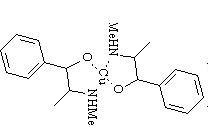
PSE combined with copper forms a complex with a charge of zero
Yes, there are probably also 2+ and 1+ charged chelates at lower pH, but at high pH charge becomes 0
which should release it from the grip of any polymers/surfactants or the like.
yes
This complex is soluble in ether, and that would be the preferred method of extraction.
Yes, it is soluble in ether but in water it is soluble too. The resolution value(or how it is called in extraction, i dont remember exactly) that is a ratio between concentrations in organic layer and water, may be not that high for this complex. If it is even 1/5 (ether:water), or even 1/25, it is sufficient to colorize ether layer, so for analysis it is ok. But for you it means using gallons of ether for complete extraction. I dont know what this resolution value can be even approximately, maybe it is sufficient enough and the substance can be fully extracted with several portions of ether. There should be data on resolution values for inner-complex compounds(chelates charged zero) in literature, but i am not sure PSE or EPH complexes are there. You may probably use similar hydrophobic structures to estimate resolution value. But the best way is to do it experimentally, by changing an ether layer for a new portion of clear ether. If resolution value is high enough, the colour would be much less then in previous portion. You can also add saline compounds to increase a resolution value. Still if there is no possibility to extract the chelate completely, it does not mean using it for isolation is impossible. For example, this can be used to get rid off other amines by extracting them at pH values when PSE complex is charged 1 or 2+ and thus not extracted.
Once extraction is complete, the complex would need to be treated with monosodium glutamate to break the PSE bond with copper, which would form another compound that wouldn't interfere with separation of the PSE.
Yes, this hopefully can be glutamate. Zero charged complex is still quite stable, maybe more stable then glutamate, better to try at pH values at which complex is charged 1 or 2+. You can try to find data on these complexes stability in books, if there is no such data on PSE - you can assume that stability of monoethanolamine copper chelates is quite similar. Btw, monoethanolamine, if you can find it, would definitely release PSE. Edetic acid as well.
What defines a complex? Does the Cu actually form a covalent bond with the PSE, or is something else happening. What are the chances of breaking this bond without damaging the PSE in some other way?
There are plenty of books about complexes, or having chapters dedicated to complexes. Better to start with inorganic chemistry books(basic theory, nature of bond, geometry(for inorganic ligands mostly) and analytical chemistry(chelates and their stability, inner complex compounds, resolution value etc). The bond is donor-acceptor, it is not covalent(otherwise, how valency of copper can be 4?). No chances of breaking down unless you use extreme conditions. Moreover, in complexes, ligands generally become more chemically stable then without metal, this should be fair for PSE as well. Of course there are exceptions, but without harsh conditions and oxidizers nothing should happen.
How likely is it that all of the Cu can be removed from the PSE? It wouldn't do to have traces remaining.
This is quite possible. That should depend on a method of breaking down copper complex, and a ligand used for that. If the difference between stability of these chelates is quite big, like 10^5, then there would be small trace of copper, if it is not that high (like 10^2) you can get about 1% of copper chelate in your PSE if you use equimolar amount of chelator. If you use 2 fold excess, then it should be 0,01% of copper chelate. But maybe simple recrystallizing can diminish it even more then using excess of chelator. Of course, better is not to administer such PSE or EPH or ephedrone, unless an appropriate analysis of copper presence is not been done(maybe flame analysis? it is having a rather low threshold of determination of copper if i'm not mistaken, better to inquire in literature what can be used). Otherwise it may be hazardous, maybe not that hazardous as Mn, but this should be inquired. Good question.