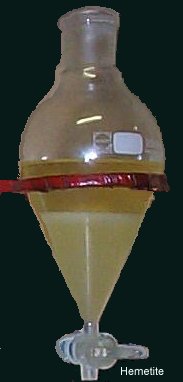
 Separatory Funnel Add to this a
separatory funnel and your a happening. Separatory funnels are often made from a
plastic two liter soft drink bottle, the top of a liquid dish soap dispenser is
the stop valve, or simply a small hole in the cap operated with your finger. You
must either squeeze the bottle lightly or provide a tube or hole to equalize the
pressure.
Separatory Funnel Add to this a
separatory funnel and your a happening. Separatory funnels are often made from a
plastic two liter soft drink bottle, the top of a liquid dish soap dispenser is
the stop valve, or simply a small hole in the cap operated with your finger. You
must either squeeze the bottle lightly or provide a tube or hole to equalize the
pressure. This reaction is exciting, and rapid. You must really focus your attention at
this point it is of primary importance, that you have your wits about you. It is
common to have a tired assistant sleep through most of the procedure, only to
wake up to watch the reaction fire off.
Injuries occurring, during the reaction can be avoided
1) never place the
flask on a hard or cold surface, rest the flask on a towel or something
soft.
2) there is no reason at all to place the flask directly on the burner,
hold it above or set it on the soft towel,
3) wear some heavy heat protective
gloves
4) wear clothes to protect you from spills, especially wear shoes and
eye protection.
Nothing like full body armor, just don't let your stuff be
hanging out bare
The flask used is often a flat bottom with a rubberized stopper, florence
flask, erlenmeyer, or a vacuum flask.
100 ml 1-2v oz , 2000 ml 2-4 oz The
flask can be almost any glass device such as a bottle,
The stopper has a hole in it, and is fitted with a 3 foot length of 1/2 inch,
clear, braided food grade plastic hose type tubing
The type of tubing you use
is variable, the main thing is it should be clean, fairly new, and in good
shape
A dirty deteriorating hose will give a product that is dirty, and may
contain particles of a deteriorated plastic hose
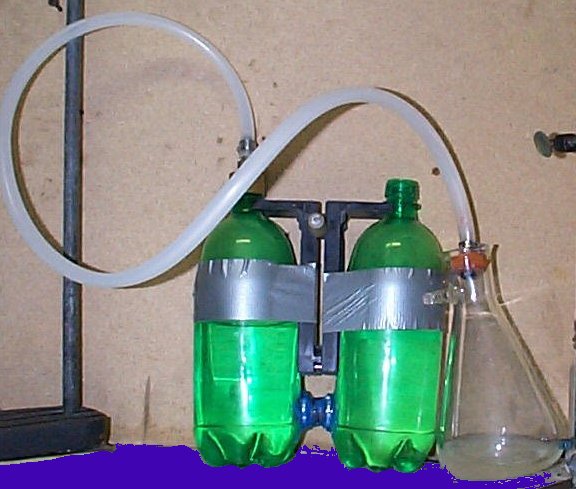
The tubing extends from the reaction flask to the push/pull unit which is a
gas trap, and pressure stabilizer.
The gas outlet may lead outside, or into
the sewer
I can easily picture the whole set up using three beer bottles and some
plastic aquarium tubing, this would probably be used with red Phos from match
strikers, sudafed tablets, and crystalize d iodine tincture
If that is the
best you can come up with, at this point then do it, as long as you make the
best product you can
In other words be proud of what you can accomplish, each
time you will improve, after 2 -3 runs you will hooking up some nice looking
pure white crystal meth.
Here are examples of the three basic push/pull
designs.
Push Pull Setup
1
Push
Pull Setup 2
Simple Gas
Collector Setup
Page 2 Top of
Page
The entire ephedrine cleaning procedure is here: Extraction of
Ephedrine
The cleanup of the ephedrine has become very important. Use
toluene or toluol
when using ephedrine with naphtha heat up the Naphtha, and
you will get a good yield of E . The heat allows the Charcoal lighter fluid to
hold much more E. To Top of
Page
Be prepared, the RP hitting the I2 will often start the reaction.
If it
does begin to go off, - Do Not Panic - put the stopper on and tape it into place
, watch the sides of the flask It may be full of vapors, If you can see only
total blackness in the flask, shake it down hard , and keep shaking it hard
until you can determine the level of the top of the reactants, if the mixture
starts to rise up too high, shake it hard, to shake it down.
This method
can be used on weak I2 , by adding the I2 first, then warm it up.
It is so
important to become familiar with the chemicals, especially when recycling.
Imagine If the RP is WEAK and The I2 is weak and the E is dirty, the only
possible way the reaction will work is to add extra RP and I2 Clean the E again
user morte heat and add peroxide 3% instead of water , adding an excess of the
weak chemical may work great
80% of the time, but it will screw you over 20%
of the time, because the bad chem will arrest the action
of the good chems.
So when adding an excess of RP or I2 it is best to add an excess of both I2 and
RP.
The worst thing to do is to run away, leaving it out of control, probably
will result in a fire , injuries, and your arrest.
if you can not get the
stopper on , place your wet towel over it , Quench it with water
Then get
you and the flask to an open area, away from all flammable, get it sealed or
water it down , the smoke and shit will stop with excess water.
The smoke
will die out no matter what , in a few minutes, You want to avoid the contents
that may be tossed out of the top of flask that is the real danger, since you
are not using heat the risk of fire is reduced but not gone,
If the
Phosphorus begins burning and spewing you have the most dangerous situation the
amount of smoke is unfathomable , get the hose immediately. The gasses are not
healthy, but a little will not hurt you
The fumes are not a deadly toxin,
but it is vaporous HI acid, and a little phosphine(not phosgene). Avoid
breathing the fumes
Keep the wet towel handy, always, and use it, if you
have trouble,
That towel will turn potential serious disaster, into a
laughable "won't do that shit, again" story
. I used to cook wearing
basically zero clothing, After considering what would happen if burning
phosphorus were to land on skin and the effect of broken glass on bare feet, I
now wear full body armor, with helmet
. Your chances of serious injury,
depend upon you
. If your high, stoned, clumsy, thick headed, or a goof
trooper you will get injured,
. You can watch someone move about the lab
area and know after a minute if they are a hazard.
They go back and forth,
can't find a thing, always blocking the way, slamming down flasks and bowls,
leaving towels and glassware anywhere. If your on top of the situation you will
probably have no injuries perhaps a minor cut or burn now and then.
. Enough
of that,
The RP and I2 concentrations determine the reaction rate, and
completeness of the reaction
The RP determines how quick the I2 will react,
(assuming there is enough I2)
More RP and the reaction will have a stronger
initial surge
More I2 the reaction will go to completion but discolors the
stash
Less RP the reaction is slow or may not fire at all
Less I2 the
reaction will be slower , incomplete turnover of the E , and possibly will fail
to react at all.
The thick yellow red fumes is a part of the reaction you
need to see for a short period of time. Too much of this fume is bad because it
indicated the destruction of ephedrine.
Additional RP
=-----------
Immediately after adding RP stopper the flask ,tape the stopper onto the
flask with 6-8 pieces of tape several over the top of the stopper and two around
the neck to seal the stopper on very well.
Mix by swirling rapidly a few
times, be quick.
If needed slowly inject a few mls of water, or peroxide(if
using recycled RP) to initiate the reaction.
Normal
reaction
--------------
A fuming red purple-green cloud will begin to fill
the reaction chamber
shake it and chill it When the rise, and bubbling
decrease a little, slowly inject a few mls of water to maintain the bubbling
Eventually added water no longer affects the reaction, do NOT ADD any more
water. Swirl any remaining reactants off the sides of the flask
You can heat
the flask until a slight bubbling is seen, but it may harm your yield.
If
you just like to be completely sure the E is used up add some of the fluid from
the P/P and heat the solution for 10 minutes this will react the remaining
E
Top of
Page
Normal but extra dry
-----------------------
If after adding the RP and
swirling to mix the RP, E, and I2 you have no fuming , no bubbling, and no
rising. Be glad!! you have made very dry chemicals .
Inject 2-3 ml of water
onto the reactants, this should produce a fuming cloud reddish-green , bubbling,
follow the normal reaction listed above.
If a dead reaction if nothing
still, then gently heat the flask. .
If nothing after adding the heat
then heat the mixture to a very slight bubbling, swirl and inject a capful
of H2O2 while it is still swirling.
If no fuming remove from heat, prepare E,
I2 and RP 1/3 the original amount.
carefully un-stopper flask
Add
I2
Add RP
Re stopper
Look for that initial cloud of reddish green
fumes, once you see it your home free
The rest of the reaction can be coaxed
by
heating it gently
sparse addition of water, or H2O2
stop when the
burgundy mud clears from the sides
Major failure - problems
Still
nothing Shut it down.
Look for wax on the RP - clean pills better
Check RP
and iodine by placing a gram of each in a flask add H2O2, if get a fuming cloud
the I2 and RP are OK So problem was too much water or E is screwed
up.
Solution Add more I2 and RP , add concentrated H2O2
or clean up the E
better and start over.
usually due to low concentrations of I2 and RP.
Top of Page ,
Dirty glassware, poor reagents, sloppy technique was all swept under the rug
until now. From this point on any screw ups affects your product in a big way.
So clean everything double good Dilute the reaction mix with an equal amount of
water
Filter the mix with the standard cotton balls and 4 coffee filters,
re-filter through the same RP and filters again, continue re-filtering until it
has no added clearing effect. This filtering should remove most of the iodine
and red-brownness. It may require re-filtering 3 or 4 times You end up with a
clear yellow or colorless solution that can have many different odors. Since
this is the final product waft some of the odor toward your nose. If you smell
the acrid HI you will have a low yield of good stuff, ephedrine odor is a
bummer, but the smell of meth is distinctive and makes you shudder at thought of
being so buzzed.
Add a non polar solvent (Coleman, Charcoal lighter
fluid, toluene, naphtha, ether, hexane ..etc) This protects your meth from
degradation due to high pH levels
|
|




