


|
Main Index Search Profile Send Private Check Private Who's Online FAQ Erase the Hive No Encryption Logout | | ||
|
| |||
| ||||
| 2571 Registered Users | You have 0 new messages | |||
  New: Encrypted Connection! |
|
Crystal Meth | Previous thread Forum index Threaded Next thread | |
|
|
|
| |||
| Subject | PART 5 OF 6: LARGE-SCALE, OLD-SKOOL METH | Reply | ||
| Posted by | Dick_Fitzbetter (Hive Bee) | |||
| Posted on | 11-27-00 09:17 | |||
Reductive Amination of 1-phenyl-2-propanone (P2P) In this section you pre-reduce the catalyst and reductively aminate both test and production quantities of P2P. The prudent chemist always runs a small test batch before using fresh chemical components. In addition, there is a requirement for a pre-reduction vessel for the catalyst. I will tell you flat-out that the literature on the subject of pre-reduction is wrong. First of all, this catalyst must be pre-reduced in distilled water, not ethanol. Dropping this catalyst into alcohol is an excellent way to start a fire. Although the catalyst is gradually reduced down to platinum during its exposure to hydrogen, only in very poor catalyst does this occur in less than three uses. In every case, however, it requires pre-reduction. The amount of pre-reduction required varies from batch to batch, and you must learn to tell from observation when the catalyst is ready for use. Test-Vessel Construction You must construct some simple equipment in order to run test-batches and pre-reduce catalyst in appropriate amounts. Fortunately, the equipment can be fairly simple because we are only required to provide agitation and low pressurization. Eliminating the requirement for heating simplifies things immensely. As you can observe in the accompanying picture, I constructed a vessel out of an old 3000ml reagent flask. It has the advantages of being narrow, thick-walled, and having a flat top. The bottom plate is 3/16" aluminum plate. The connecting rods are 3/16" all-thread found at the auto parts store. The top plate is 1/4" aluminum plate recovered from the scrapyard. The gauge is a -30"Hg to +30"Hg, liquid-filled, combination vacuum/pressure unit. These cost about $30 at industrial equipment supply stores. The pipe is common 1/4" NPT wrapped in Teflon tape. 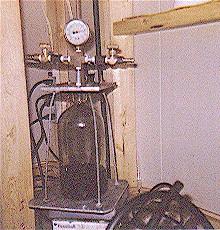 Everything is connected together with a brass 4-way fuel block with 1/4" NPT thread available at the auto parts store. The valves on either end are common gas valves found at welding equipment suppliers. You can use oxyacetylene valves as they are 1/4" NPT on one side and gas thread on the other. This allows you to make a direct connection between the hydrogen tank regulator and the vessel using the red hose of an oxyacetylene torch set. The same valve on the other end is fitted with a 3/8" nipple for pulling a vacuum. The rubber gasket used to seal the aluminum top-plate and the bottle-top is cut from 1/8" rubber gasket material found in the plumbing department of the hardware store. You will have to adapt this design to the equipment available to you. A 2000ml filter-flask can be made into an excellent vessel by sealing off the side-nipple (hose, screw, and clamps) and using a modified rubber stopper on the top opening. A smaller glass vessel is also required for pre-reducing 1g batches of catalyst. The vessel should be about 500ml or less in volume. This is necessary because of the physical limitations of attempting to pre-reduce tiny volumes of catalyst in a large vessel, especially considering the fact that you must determine visually the pre-reduction state of the catalyst. The bottom plate must be made of aluminum so a magnetic stirring bar can be used for agitation. The unit is placed on a stir-plate, the air evacuated, then charged with hydrogen and agitated until the catalyst is pre-reduced. Pre-Reduction of Platinum Dioxide Much of the existing literature concerning Adam's catalyst describes pre-reducing the catalyst in ethanol and/or allowing the catalyst to pre-reduce in situ. My experience indicates both techniques are wrong. Attempting to pre-reduce this catalyst in ethanol resulted in several small fires and explosions. Attempting to pre-reduce the catalyst in situ worked on only one batch of catalyst, and it was the poorest batch made. The procedure that works reliably, every time, is to pre-reduce in distilled water. The pre-reduction process involves exposing the catalyst to hydrogen gas under pressure, resulting in a change in both color and character of the platinum dioxide. Carefully weigh out 1g of catalyst on a triple-beam scale. Place the catalyst into a small (50ml) beaker and add 10ml of distilled water. Carefully pour the resulting slurry into the small pre-reduction vessel through a small funnel, chasing the slurry into the vessel with an additional 10ml of distilled water. Place a small Teflon-coated stirbar into the vessel and seal by carefully cinching down on the retaining nuts on the top plate. Make sure the hydrogen gas valve is closed and the vacuum valve with the nipple is open. Attach the 3/8" hose from your vacuum aspirator and pull a vacuum in the vessel to about 25"Hg. Close the vacuum valve and watch the gauge for a minute. If it doesn't move, your vessel is holding a vacuum. Now open the hydrogen tank valve and increase the pressure at the second stage of the regulator to 30psi maximum. Open the hydrogen inlet valve on the catalyst vessel, pressurizing to 30psi. Close the vessel hydrogen valve and watch the gauge for a drop in pressure. If there is a leak, you can find it rapidly using dishwashing soap mixed with water in a squirt bottle. Once the vessel is pressurized with no leaks, begin stirring as rapidly as possible. The catalyst will be thrown against the interior wall of the vessel as it splashes around. Adjust the position of the vessel on the stir-plate to maximize the splash. The catalyst will begin to turn from brown to black in color. After an additional amount of time, small particles of catalyst will begin "sticking" to the vessel wall, soon forming a "ring" of tiny black flakes or particles. Once most of the catalyst is in the "flake" form and all of the catalyst has turned from brown to black, it is pre-reduced. Over-reduction can easily take place, which drastically decreases the activity level of the catalyst and reduces its useful life. Avoid this! The catalyst will pre-reduce more quickly during warm weather, but the pre-reduction time varies more from batch to batch than with any other factor. You should use 20ml of distilled water for every gram of catalyst. Using less increases the chance of over-reduction while excessive water requires the addition of more ethanol to the reaction solution to maintain homogeneity, thus decreasing catalyst density and increasing reduction time. Typical pre-reduction times are 10-25 minutes. Once you’re satisfied that the catalyst is pre-reduced, make sure all hydrogen valves are closed and then slowly open the vacuum valve to release the excess hydrogen. Keep in mind that hydrogen reacts with oxygen to make water, with an accompanying release of energy. Be careful when opening hydrogen gas valves into an atmosphere containing oxygen. Once the pressurized hydrogen has been released, it is time to move the catalyst to the reaction vessel. The best way to do this is to partly fill the pre-reduction vessel with 95% ethanol, then pour the slurry into the reaction vessel using a funnel. Repeat until all the catalyst is picked up. You are now ready to make the product. Primary Reaction Vessel Construction The design of your primary reduction vessel should be tailored to your batch sizes and the quality of agitation you desire. I constructed an adequate reaction vessel using a section of 8" stainless-steel pipe found at the scrapyard along with some stainless plate and threaded fittings. .jpg) .jpg) In addition, a rocker was constructed using common steel plate, a gearmotor, and some pulleys purchased at the hardware store. A cyclic rate of 100 RPM was chosen arbitrarily (I guessed) and provisions were made in the design to allow me to swap pulleys and change the cyclic rate. A throw (rock) of 3" was determined to be the most I could expect, given the motor torque (32 in-lb) and the weight of the vessel when fully charged (about 10lb). The motor used is a gearmotor from a scrapped copier which you can readily find at electronics surplus houses, along with the required capacitor, for less than $100. A new gearmotor of the proper size will cost 4-5 times that much. These are very useful, reliable motors that I’ve used for many applications. Try to find ones with a machined face so they can be quickly mounted to brackets, etc. The resulting rocker provides a rocking rate of 110 rpm and completes a reaction in six hours. .jpg) .jpg) Our stainless reaction vessel has an internal capacity of 7000ml, of which only 3500ml is used when fully charged with a 6.5-mole batch. This batch size was selected because of equipment and time restrictions. You can squeeze a 3500ml reaction into a 5000ml round-bottom flask for solvent stripping and the resulting 900g of methamphetamine base divides conveniently into two 450g portions for crystallization, which will take about 4 hours to perform. This is a full day's work for one person, resulting in 2lb of product. An improved reaction vessel can be constructed using a paint shaker for optimum surface-area creation. These units hold 1 gallon paint cans, which, when full of paint, weigh much more than our reaction solution, eliminating concerns about exceeding any weight limitations on the machine. You may have a reaction vessel made which will fit into the machine clamps and have the following properties: • Be constructed of thin-wall 316 stainless steel and stand up to 100psi when sealed and will not collapse when a 29"Hg vacuum is pulled (this means a round body and thick ends) • Have a threaded opening of about 1.5-2" at one end to pour stuff into • Have an internal volume of at least 4000ml The best way to do this is to have a machine shop roll a sheet of 0.065-inch 316 stainless sheet into a cylinder and then weld the seam. End pieces are cut from 0.375-inch 316 stainless and tig-welded to the thin-wall pipe. Prior to welding to the cylinder body, one end-piece is drilled out and a 1.5" stainless coupling with NPT thread is welded on. The unit is then pressure tested to 100psi and vacuum tested to 29"Hg. The threaded coupling is fitted with a bushing that allows a gas fitting to be attached. Use Teflon tape to seal all threads, including the gas fittings. Leaks must be avoided! This one gallon (4liters) vessel can hold 3500ml of reactants with ease, resulting in the same product volumes obtained as when using the rocker. The improvement comes in the vigorous agitation provided by the paint shaker. By making sure the hydrogen inlet hose rises straight up from the vessel to avoid losing reactants into the hose, the reaction will reach completion in 3 hours instead of 6 using the same catalyst density of 1g/mole. In fact, with very little ingenuity, you can obtain a paint shaker that holds 5-gallon pails and construct a reaction vessel that will do 30-mole batches in a few hours, resulting in about 10lb of finished product after processing. The batch can also be processed in 22-liter glassware by reducing the ethanol volume slightly, but will require a high-volume vacuum source to do the distillation. The main drawback to doing huge batches is that if you make a mistake, you’ve just blown a whole lot of very valuable precursor material. A prudent chemist does not bite off more than he can chew in one day. Reductive Amination of P2P Using Adam's Catalyst While the catalyst is pre-reducing, the chemist must prepare a Schiff's base from his P2P and methylamine solution. For a 1-mole test batch using 1g of catalyst, pour 150ml of 37-40% methylamine solution into a 1000ml beaker along with a stirring bar. With stirring, 134g (1mole) of 1-phenyl-2-propanone is added. This should be done inside the fume cabinet to avoid the strong smell of decaying fish that accompanies methylamine solutions. Cover the beaker with a clean shop rag while stirring continues. In a separate container, measure out 250ml of 95% ethanol. 95% ethanol can be purchased as very strong vodka under various brand names (Everclear?). In a serious pinch, the chemist can use methanol instead of ethanol, although the reaction will take three times as long to complete with a similar yield. When the catalyst is ready, slowly add, with stirring, enough ethanol to clarify the solution. This should take about 125ml for a 1-mole batch, leaving 125ml to use in retrieving the catalyst from the pre-reduction vessel. Add the clarified P2P/methylamine solution to the reaction vessel and rinse the beaker with a dash of ethanol, adding the rinse to the reaction. You should now have a reaction vessel containing 20ml of water, 250ml of ethanol, 150ml of methylamine solution, and 135ml of P2P for a total volume of about 550ml. Keep this number in mind when designing a larger reaction vessel. Seal the reaction vessel, pull a 25" vacuum using a water aspirator, pressurize to 5psi with hydrogen, pull another 25" vacuum, and then pressurize to 25-30psi with hydrogen. Do not pull a vacuum harder than 25"Hg or the methylamine will boil off. Check for leaks. If no leaks are found, begin the agitation by turning up the stirring to full blast. Agitation is important because it creates surface area. For the reaction to take place, the catalyst, a molecule of our Schiff's base, and an atom of hydrogen must come into contact simultaneously. Since we are dealing with solid, liquid, and gas phase materials, this can be difficult. The splash, or agitation, is the single most important physical variable affecting this reaction. The more surface area you can create, the better the chances are of our three reactants meeting and making meth. At this point, you would like to know if the reaction is proceeding correctly and at what rate so you know when it's done. Our pressure/vacuum gauge along with our gas valve will provide this information. Once the reaction vessel is pressurized to 30psi, close the hydrogen valve and begin the agitation. The reading on the pressure gauge should drop over a short period of time. In my test vessel, a pressure drop of 10psi occurs in 11-16 minutes, depending upon how good the agitation is. Yours may be different. Once the pressure has dropped 10psi, open the hydrogen valve again and re-pressurize to 30psi. By precisely recording the amount of time it takes to cause a pressure drop of 10psi, you can tell whether the reaction is proceeding, has stopped for some reason, how well (quickly) it is going, and when it is done. This can be vital information if something is going wrong. Typically, a 1-mole reaction in my test vessel will use a 10psi gulp of hydrogen every 13 minutes for 10 gulps, and then begin to slow down as the reaction begins to have difficulty finding unused reactants. A total of 18 10psi gulps of hydrogen are required to complete a 1-mole batch in my test vessel. The last hydrogen gulp takes well over an hour to finish, with a total elapsed time of about 4-6 hours to complete the reaction. Using a known volume and pressure, you can actually calculate how many pressure drops it will take to use up a mole of hydrogen. With the reaction done, pour the reaction solution into a 1000ml beaker and rinse the vessel out with a little ethanol, adding the rinse to the beaker. Now remove the catalyst before processing. This is accomplished with a small (2") Buchner, Qualitative 5 filter paper, and a 1000ml filter flask. Capture the remaining particles of catalyst in the beaker with ethanol. At this point you must be on your toes because the catalyst in the Buchner will catch the alcohol on fire if it is not quickly quenched. This is done by pouring a layer of distilled water over the catalyst and allowing the vacuum suction to pull it through, taking the alcohol with it. .jpg) You must always keep in mind that this catalyst is very pyrophorric, meaning it will burst into flames or explode at the slightest provocation. Things you should never do with this catalyst at any time, but especially once it has been pre-reduced, are: • Allow it to fall freely through the air for more than a few inches • Allow it to come into intimate contact with flammable solvents such as ethanol, methanol • Expose it to open flame We have forced hydrogen atoms into the lattice structure of the platinum dioxide crystals, and that hydrogen reacts with oxygen both in the air and the platinum dioxide (reducing it over time to platinum). This reaction creates heat which will catch things on fire. A static charge of sufficient intensity, such as that picked up when falling freely through dry air, will cause the catalyst to explode, although not with an intensity that will damage anything but your dignity. Now that the catalyst is removed, pour the filtrate into a 1000ml round-bottom flask and distill the ethanol and methylamine off until the temperature reaches 90-92 C. Turn off the heat, attach an empty receiving vessel, then slowly apply a vacuum by gradually closing the bleeder valve on the water-aspirator system. When the temperature has dropped and the vacuum is down to 28-29"Hg, turn on the heat again and vacuum distill off the residual water until the condenser is clear, which will occur between 50-60 C. Remove the heat and allow the remaining meth base to cool a little. With fresh boiling stones and a clean receiver that has been weighed, reapply the vacuum and distill the meth base over a 10-degree range. Adjust the vacuum using the bleeder valve so that the meth base distills over at 95-105 C. Meth base is a clear, colorless liquid. If it is anything but clear and colorless, it contains contaminants. The accompanying picture shows the result of a 6.5 mole batch, which produces about 900g of meth base. Beautiful, isn’t it? .jpg) A one-mole batch of P2P with 100% conversion would result in 149g (one mole) of methamphetamine base, but the typical yield is 90-93%, resulting in 134-140g of base. Meth base will quickly react with carbon dioxide in the air to form the carbonate, so it is advisable to crystallize the base as soon as possible. Crystallization is performed by adding 450g (3 moles) of meth base to a 1000ml Pyrex beaker and placing the beaker on a stirring hotplate. Carefully drop in a Teflon-coated stirring bar and begin stirring. Now add 37% hydrochloric acid in 15ml portions. A graduated 15ml test-tube makes an ideal dispenser. A great deal of heat is generated as the acid reacts with the meth base and will result in boiling if added too quickly. Add 15ml of acid at 1 minute intervals, until 19 portions (285ml) have been added, then add acid in smaller portions and watch the color carefully. If the meth base was clean to begin with, it will turn light pink when the pH reaches 3-4. Test with pH strips (Colorphast 0-14 strips) or a meter. Stop adding acid when the pH reaches 3. Now we must boil off the water contained in the acid, as water solvates meth very efficiently. Turn the heat on the hotplate to 4.5 while stirring continues, and place a 150 C thermometer into the beaker on the bottom. .jpg) Over the next 1.5 hours, the temperature will climb to 110 C where boiling begins, then gradually rise as the water is boiled off. When the temperature reaches 130 C, turn off the heat and remove the thermometer. Using a dishtowel, grip the beaker with both hands and quickly pour it into a 5000ml plastic bucket containing 4.5 liters of acetone which has been frozen for 2 weeks. Retrieve the stir-bar with a chaser, replace the lid, and return to the deep freeze for 1 week to allow complete crystallization. Clean, freshly distilled acetone will retain about 1/4lb of product the first time it is used, which is why you should recycle your acetone. Alternatively, you can pour the hot methamphetamine hydrochloride into a 5-gal plastic bucket containing 4.5-gal of acetone that has been frozen for about a month (it takes a long time to pull the heat out of a large mass). The meth will crystallize the instant it hits the frozen acetone, although about 25% will remain in the acetone and must be frozen to crystallize. Paradoxically, dirty meth crystallizes better than pure meth because the crystals quickly grow around a particle of impurity, forming nice, large, hard crystals. The meth crystals are filtered out using a large Buchner, two 4000ml filter flasks, and a high-volume vacuum aspirator. An 18cm porcelain Buchner will hold a little over 1lb of filtered product. .jpg) Do not use Qualitative 5 filter paper for this filtration. I’ve found that the filters used in milk processing equipment are ideal at this point. A lot of money has been spent by the dairy industry over the years figuring out how to quickly filter solids out of mixed-phase solutions. These filters allow liquids, both water and oils, to pass freely while trapping the finest solids, making them ideal for rapid filtering. The problem with the fine paper filters is that oil-water mixtures plug them up very quickly. Milk filters do not have this problem and they are easy to find, cheap, and suspicionless. You will need to cut them to fit, but this is a small inconvenience. A suitable high-volume filtering setup can be easily made using 5 and 20-liter buckets, a round plastic plate, and some glue. .jpg) I was fortunate enough to discover a large Buchner being used as a planter by a nice old lady in my neighborhood. Happily paying her for a replacement, this treasure holds over 2lb of product and makes my life much easier. The point is that you can find useful equipment almost anywhere... Pure meth is more difficult to crystallize, and results in a light, flaky white product with a mild scent of marzipan (actually benzaldehyde). Empty the product into a large cake tray and let the acetone evaporate in the fume cabinet for a day or two, separating it as it dries. This product can be cut with powdered niacinamide (vitamin B3) at a 4:1 ratio (20% cut) to create a product that burns clean and is water-soluble. Never use vitamin B3 tablets to cut with, because they contain insoluble buffers that burn dirty. ô¿ô |
||||
|
| |||