


|
Main Index Search Profile Send Private Check Private Who's Online FAQ Erase the Hive No Encryption Logout | | ||
|
| |||
| ||||
| 2571 Registered Users | You have 0 new messages | |||
  New: Encrypted Connection! |
|
Crystal Meth | Previous thread Forum index Threaded Next thread | |
|
|
|
| |||
| Subject | PART 6 OF 6: LARGE-SCALE, OLD-SKOOL METH | Reply | ||
| Posted by | Dick_Fitzbetter (Hive Bee) | |||
| Posted on | 11-27-00 09:16 | |||
Laboratory Equipment and Procedures Unless you have spent many hours doing organic syntheses, there are many lab techniques and procedures that that will be unknown to you. This section attempts to cover some of the basics applicable to clandestine labs. Fume Hood You really should have a fume cabinet. Fortunately, they are easy to build. I constructed an integrated fume cabinet/lab that fits on a single sheet of plywood. Note the plastic sheeting used to seal the enclosure when noxious fumes are present. Not shown is the exhaust fan that runs continuously. Use a fan that moves at least 250cfm of air. 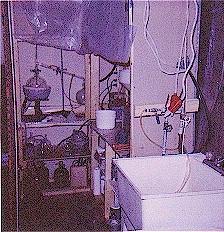 Aspirator and Other Vacuum Accessories A high volume aspirator is required for many of the procedures described in this document. Although industrial strength aspirators can be purchased, they can also be constructed from common pipe fittings found at the hardware store. Shown in the accompanying photograph is the one I use. .jpg) There is a lot of cut-and-try involved in building a homebrew aspirator, so purchase one if at all possible. Also required to complete an aspirator system are a pump supplying 50-70psi of water pressure and a reservoir of cold water. The pump can be a common 1/3 HP jet pump wired to a switch in the lab. These pumps are inexpensive, but are only good for about 200 hours of hard use, so keep a spare handy. The water reservoir must hold sufficient volume to prevent rapid heating of the water and be able to absorb solvents and fumes. A good reservoir size is about 100 gallons or two fifty-gallon drums connected together at the bottom and filled to 2/3 full. Water temperature is very important. The colder, the better. In sub-freezing temperatures, just add some plumbing antifreeze and your aspirator will pull a mighty vacuum. Unfortunately, as the water temperature rises, so does its vapor pressure, and this imposes a limit on the vacuum it can pull. To reduce the vapor pressure of the water, lower the temperature with a block of ice from the freezer. Another essential component of the system is the trap. .jpg) The trap keeps your mistakes during distillation from ruining the rest of the equipment. Placed between the aspirator and the vacuum hose, it collects any liquids not condensed into the receiver. It can be made using a 1-qt. Mason jar. Using a drill press, carefully drill two holes in the top that are just big enough to accept the base of a 3/8" brass nipple. Braze the nipples to the top. Using a gasket, seat the top on the jar. Screw the top down firmly and attach the vacuum lines (use 3/8" reinforced hydraulic hose, as this size fits the nipples on vacuum-takeoff glassware and doesn't collapse under a good vacuum). Place the vacuum trap somewhere that it won't get bumped. I built a 3-sided wood box lined with insulation. This is because the Mason jar will easily implode under a good vacuum. Check for leaks and use some pliable external house caulking to fix them. It is a good idea to change the water in the aspirator system daily, as solvents will attack the plastic pump impellors. The next requirement is a vacuum distribution system. The accompanying picture shows the vacuum input from the right, a distribution hose on top that attaches to glassware at the other end, a 0-29" Hg vacuum gauge, and an industrial strength 1/8" bleeder valve. .jpg) A more suitable bleeder valve is a needle valve with a 0.050 aperture. The entire assembly is located inside the fume cabinet. The vacuum inlet at the right comes from the vacuum trap and may be replaced as required with a vacuum pump hose. Distillation Tips Below are some tips that will make vacuum distillations go smoothly: • Always use Dow-Corning High Vacuum Grease or its equivalent on glass joints. Use sparingly and keep glass joints clean. • Use Teflon (PTFE) boiling chips. They typically come in 1-lb. cans. Use liberally, adding fresh boiling stones each time the vacuum is broken or the liquid cools down. • Wait until the vacuum is stabilized before applying heat, then use the minimum heat required. • Maintain a 30 C temperature differential between the water flowing through the condenser and the condensate. The condensation line in the condenser should be between 1/2 to 2/3 the way down the condenser. • Don't fill the distillation vessel more than half full. You can cheat a little bit on this one. Another "Don't" is excessive bumping; this is easily recognizable, and if it starts, stop the distillation immediately. Some heavier compounds like P2P and benzaldehyde are naturally "bumpy", so you'll have to exercise some judgement. • Don't get in hurry when doing large volume distillations; the condenser throughput rate is fixed, and adding more heat won't speed things up but WILL send some of your distillate into the vacuum system. Reference Materials The following books are essential to any clandestine lab: • Merck Index: This handy volume provides all the essential data on most compounds, including molecular weight, specific gravity, boiling and freezing points, common usages, and references pointing to manufacturing techniques. • Uncle Fester's Secrets of Methamphetamine Manufacture, 3rd and 4th ed., Loompanics: These comprehensive books provide the references and good pointers for those reading between the lines. • A college-level Organic Chemistry textbook: For a reference to common reaction mechanisms. • A Chemical Technicians Reference Handbook: A valuable reference for solvent characteristics and lab procedures. Keeping Out Of Trouble If you can observe all of the following tips, you MIGHT be able to cross over into a legal occupation with a good head start. • Work alone and keep your mouth shut! This is the most important advice I can pass on, and the most difficult to follow. It is tempting to share your secret success with your closest friend, perhaps even inviting him to help. Unfortunately, he might also feel compelled to tell his wife, who is secretly planning to leave him for a stockbroker, and wants some leverage to facilitate her stripping your friend of all his assets. Well, you get the picture... You can crow all you want, as I have in this document, once you've disposed of both product and equipment. • Do not talk business on the phone! Do not even call to make an appointment to talk. Every phone call, even local calls, are logged. Each log contains the originating phone number, the destination number, the time the call originated, and the completion time. From this seemingly innocuous record, Inquisition Agents can weave a pattern of times, places, and connections that will look bad in court, even if fictitious. Establish secure communications using PGP encryption software and anonymous remailers. • Never, ever, ever try to sell product while the lab is operating! This is like juggling rattlesnakes, and it's easy to get bit. • Don't make this a career! All of the Career Dope Cookers are in prison. Decide ahead of time how much dope you want to make, plan it carefully, do it, and then get out. Think of it as a temporary thing you are doing to get a leg up in life. Keep in mind that your first mistake will also be your last. There is no glory in becoming a headline, only grief. • Acquire and store all of your essential chemicals, supplies, and equipment before trying anything. This is the most dangerous activity, legally speaking, you will perform. If you attract some heat, you can wait it out without having an operating lab to conceal. Keep in mind that the drug inquisitors do not have the time to hang around where there are no labs to busts or assets to seize. After a few months, they will go away. • Use intermediaries to acquire chemicals, telling them you are just an intermediary also. Never tell anyone what you are doing. • Never front product. Once you do, you assume all of your buyer's risks. You are better off flushing your product down the drain. At least it can't come back to bite you in the ass. Also never trade for stolen property, or phony money, or guns. • Don't listen to your non-chemist customers on quality issues, no matter how emphatic or convincing they are. Users quickly build a tolerance for the product and feel the product is no longer full strength. In addition, many users grow to enjoy the jolt received from impurities present in much of the present street product. This jolt is just not there in pure meth. • Always act like an ignorant, low-paid middleman who has to pass messages on to his superiors. This allows you to feign ignorance on all quality issues or money disputes and agree with your customer. It also provides you with bargaining leverage, allowing you to claim that your puny cut will be gone if the price goes any lower. • Never flash cash, or start buying expensive items that are not compatible with your usual lifestyle. If you are renting, rent a nicer place or buy a modest house. Buy used cars and repair them to perfection instead of new, flashy cars.Invest the profits in stocks, T-bills, and other liquid assets. • Get into a legal business as quickly as you can and live happily ever after, knowing that you successfully defied the Inquisition and struck a blow for individual freedom. ô¿ô |
||||
|
| |||