Crystalization
Crystalization is a technique used to purify solid compounds. This success of this process is based upon the different solubility of the desired compound and impurites in a given solvent and also the fact that all compounds are more soluble in a hot solvent than a cold one. In general, the crude product crystals is dissolved in a minimal amount of hot (boiling) solvent. A boiling stick or stone can be added to ensure smooth boiling. At this stage, any material which does not dissolve can be removed by filtration. The hot solution is allowed to slowly cool and crystals of the desired material form while the impurities remain in the solvent. The crystals are usually collected by filtration. While this technique does result in some product loss, the resulting crystals are much more pure. This procedure is outlined below for crystallization of benzoic acid from water.
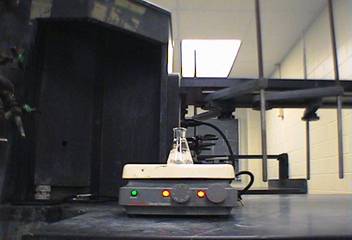
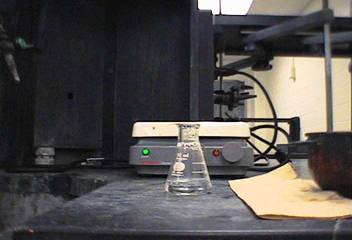
Above on the left, the powdered benzoic acid is added to water and boiled. Be
sure to add a boiling stick or chip to avoid boil overs. On the right the
benzoic acid has dissolved and the excess solvent was boiled off and the
solution was allowed to cool at room temperature.
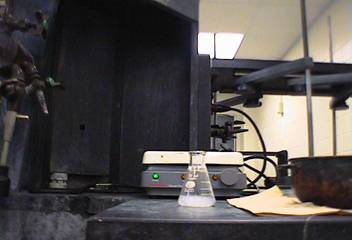
On the above left, the crystals have begun to form. After the crystals and
solvent has reached room temperature, the flask can be transfered to an ice
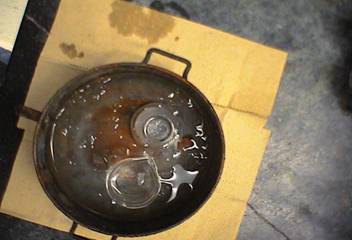
bath for further cooling. On the above right, the crystals and a wash solution
to be used during the filtration step are in the ice bath.
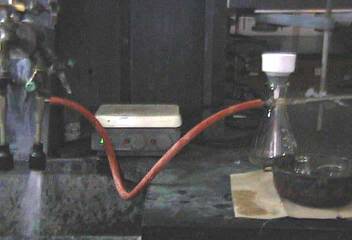
The filtration apparatus is shown above. Be sure to note that the water is
turned on all the way and the flask is clamped down. The crystals will be
poured on to the filter. Be sure that before adding the crystals some liquid is
added and filtered to ensure that the filter paper is secure. Wash the crystals
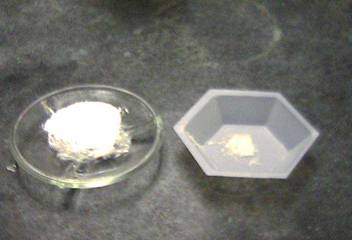
with solvent and allow to dry. On the right above is the starting benzoic acid
(hexagonal weigh boat), a powdery white substance, and the final crystals
(watchglass), shimery white flakes.
Return to the skills page.