Filtration
Filtration is a technique used to separate a solid from a liquid and is used in many labs. Though it can be done simply with gravity, more often vacuum filtration is employed because it is much faster. Pictured below is the typical apparatus set up for a vacuum filtration. Several points are worth remembering.. First, be sure to clamp your filter flask down, these flasks are easily upended. Also, be sure to use thick-walled vacuum tubing and not the thin walled tubing used for water lines in distillations. You should also turn the water on full blast to achieve the maximum vacuum.
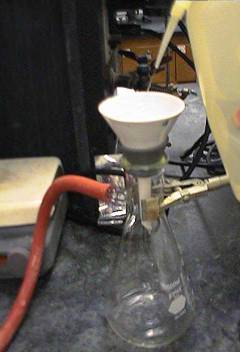
Once your setup is complete, place a piece of filter paper on the filter and wet it with the solvent that you will be pouring through filter. A mixture of a solid and a liquid can be separated by simply pouring through the filter. Solid that remains in your flask can be further transferred with the aid of a spatula or with a little more solvent.
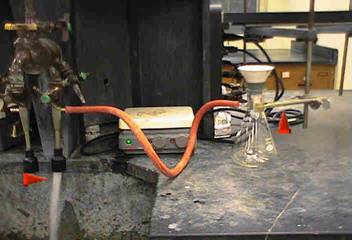 Please note the red arrows indicating that the flask is
clamped down to prevent spills and that the vacuum is maximized by the water
being turned on all the way.
Please note the red arrows indicating that the flask is
clamped down to prevent spills and that the vacuum is maximized by the water
being turned on all the way.
After filtration, the solid or crystals that you collect can be washed with a small amount of a solvent in which they have a low solubility. Often, a solvent cooled in an ice bath is a good choice. After washing, the apparatus can be dissasembled by breaking the vacuum by removing the vacuum tubing from either the sink or the flask. Just shutting off the water when your apparatus is still hooked up is not a good idea, the vacuum in the flask can draw water in from the sink.
Return to skills page.