J. Org Chem. 1984, 49, 1830-1832
Electrochemical Procedure for a Practical Preparation of Piperonal from Isosafrole
Sigeru Torii,* Kenji Uneyama, and Kyoji Ueda
Department of Industrial Chemistry, School of Engineering, Okayama University, Okayama 700, Japan
Received October 26, 1983Piperonal (3,4-(methylenedioxy)benzaldehyde) (
1), an important fragrance used as a soap additive and a synthetic precursor of Dopa, has been industrially prepared by ozonolysis
1 or chromic acid oxidation
2 of isosafrole
2. Because of the environmental pollution associated with chromium species and the requirement of a large quantity of electricity and a carefully controlled reaction temperature (0-5 ¡ãC) for ozonolysis, these demerits have prompted us to develop a nonpolluting and more economical process. Recently, several attempts employing ruthenium tetroxide oxidation combined with m-periodate
3 and air-oxidation under ¦Ã-ray irradiation
4 have appeared.
On the other hand, an electrochemical oxidation would be a promising method for a piperonal synthesis from isosafrole because an electrooxidative bond cleavage of carbon-carbon double bonds is possible in principle. For example, an electrochemical conversion of cyclic enol acetates to keto esters in a MeOH-AcOH-LiClO
4 system has been achieved in satisfactory yield.
5 However, the direct bond cleavage method leads in some cases to overoxidation of the product aldehyde to give the corresponding carboxylic acid, as observed in the conversion of methyl eugenol to 3,4-dimethoxybenzoic acid.
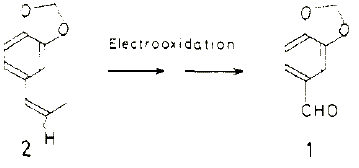
6 A plausible reaction pathway for the electrochemical carbon-carbon bond cleavage would be initial oxygenation of the double bond to the corresponding glycol or a derivative followed by C-C bond cleavage. We describe a two-step electrochemical procedure that leads to a highly selective preparation of
1 from
2 via
3a.
(https://www.thevespiary.org/rhodium/Rhodium/hive/hiveboard/picproxie_docs/000411126-file_4mg2.gif)Epoxidation of olefins is efficiently achieved by the halide ion mediated electrochemical oxidation in which bromide ion is found to be the most useful.
7 Thus,
2 was subjected to the electrooxidation in MeCN-H
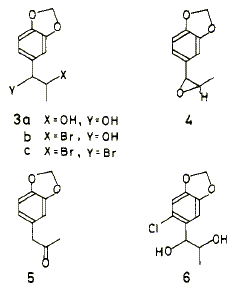
2O (7:2) containing 1.5-2.0 equiv of sodium bromide at room temperature. Platinum foils were employed as electrodes, and a constant current was passed (20 mA, 2.83 F/mol) in an undivided cell. The products were epoxide
4 (71% ) and glycol
3a (23%) after chromatography. Unlike the electrochemical epoxidation of isoprenoids, where the use of 0.1-1.0 equiv of sodium bromide was suitable to suppress the formation of the corresponding dibromide,
7 the use of more than 1 equiv of sodium bromide was required to provide
3a and
4 in good yield. Dibromide
3c was found to be spontaneously hydrolyzed to give
3b, which collapsed to the epoxide
4 under the electrolysis conditions. Epoxide
4 is unstable under the reaction conditions and suffers partial hydrolysis resulting in the formation of
3a.
8 After electrolysis, 1% aqueous sulfuric acid was added to the reaction mixture, which was stirred for 1 h to give
3a (98%) as a diastereomeric mixture (25:75 by NMR). The glycol
3a was subjected to acid-catalyzed dehydration (
p-TsOH- benzene), affording ketone
5 (84%), which is a precursor of methyl Dopa.
8,9The efficiency of the epoxidation is dependent upon the pH of the reaction solution. In a MeCN-H
2O-NaBr system, the solution at the end of electrolysis was alkaline. On addition of a small amount of an acid, a mixture of
4, 3a, and the corresponding bromohydrin
3b was obtained. Under more acidic conditions such as MeCN-H
2O-NaBr-H
2SO
4,
3b was obtained quantitatively. The nature of the halide ion is also important in the product selectivity. In contrast to the successful results obtained with bromide ion, the use of chloride or iodide ions resulted in a poor yield of
3a (39% for NaCl and 43% for NaI).
(https://www.thevespiary.org/rhodium/Rhodium/hive/hiveboard/picproxie_docs/000411126-file_rwqu.gif)The electrochemical carbon-carbon bond cleavage of glycols has been examined in MeOH-Et
4NOTs for cyclic glycols
10 and glycol monomethyl ethers
11 and in MeOH-NaOH for tetraphenylethylene glycol.
12 The related ¨¢-hydroxy ketones can be cleaved in MeOH-LiClO
4.
13 At first,
3a was subjected to electrooxidation both in MeOH-Et
4NOTs and MeOH-LiClO
4, affording
1 in 66% and 44% yields, respectively. When the halide ion promoted electrooxidation was examined, sodium bromide in MeCN-H
2O (9:1) provided a satisfactory yield (86%) of
1, while chloride ion gave good to moderate yields in aqueous acetonitrile [Ca(ClO)
2 (0.1 equiv) 85%; CaCl
2 (0.2 equiv) 71%; NaCl (0.3 equiv) 61%]. Interestingly, a two-layer system consisting benzene and water (6:4) including NaHCO
3 or NaOH greatly enhanced the desired bond cleavage. In aqueous NaHCO
3 (0.5 equiv to
3a)-benzene the yield of
1 was 62%, and 15% of the starting material was recovered after 6 F/mol when the reaction solution was found to be acidic. Also the yield increased with an increase of the NaHCO
3 concentration 1% of
1 with NaHCO
3 (equiv): 62% (0.5), 88% (1.9), 90% (3.7)]. Meanwhile, the use of an appropriate concentration of NaOH led to the quantitative formation of
1 [quantitative (1.0 equiv), 96% (2.0 equiv), 91 % (4.0 equiv)]. In contrast, upon electrolysis with NaBr or LiClO
4 instead of the base, the desired reaction proceeded very slowly (about 50% of
3a was recovered) and the yield of
1 was poor (16-19%) after 6 F/mol. In a benzene-water system
3a dissolves in the aqueous phase and the product
1 exclusively in the organic phase. Hence, the product
1 migrates into the benzene layer so that overoxidation of
1 can be avoided.
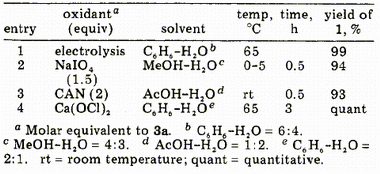
A comparison of the electrochemical and the conventional chemical oxidation of
3a is summarized in Table I. Among the oxidants employed, sodium periodate, ceric ammonium nitrate (CAN), and calcium hypochlorite provided satisfactory yields. However, the use of an excess of expensive reagents such as sodium periodate and CAN is disadvantageous for manufacturing piperonal. On oxidizing
3a with calcium hypochlorite in MeCN-H
2O-AcOH, as reported by Nwaukwa and Keehn
14 for several simple glycols, chlorination on the aromatic ring of
3a took place predominantly, leading to
6. In contrast, oxidation of
3a in a two-layer system of benzene-water provided
1 quantitatively when 2 equiv of hypochlorite were used. Electrooxidation of
3a in a benzene-water system including a small amount of sodium hydroxide also afforded
1 quantitatively. The electrolysis procedure is simple in operation and economical with respect to the reagents employed, and furthermore it requires no disposal of by-products (e.g., waste Ca compounds).
Table I. Electrochemical and Chemical Oxidations of Isosafrole Glycol 3a
(https://www.thevespiary.org/rhodium/Rhodium/hive/hiveboard/picproxie_docs/000411126-file_yxck.gif)
Experimental SectionThe
1H and
13C NMR spectra were measured in CDCl
3 with Me
4Si as an internal standard on a JEOL FX-9OQ spectrometer. The IR spectra were obtained with a JASCO IRA-1 spectrometer.
Electrolysis of Isosafrole (2). Preparation of 1-[3,4-(Methylenedioxy)phenyl]propane-1,2-diol (3a).A mixture of
2 (100 mg, 0.62 mmol) and NaBr (192 mg, 1.9 mmol) dissolved in MeCN (7 mL) and H
2O (3 mL) was electrolyzed in a beaker-type undivided cell (3 cm in diameter and 10 cm in height). A
constant current (20 mA, 2.83 F/mol) was passed for 140 min by using platinum foils (2 x 1.5 cm
2) as electrodes and a Metronix
Model 543B DC power supply. After the electrolysis at room temperature, 0.5 mL of 1% aqueous H
2SO
4 was added to the mixture, which was stirred for 1 h and neutralized with aqueous NaHCO
3. After evaporation of solvents under reduced pressure, the organic substances were extracted with ethyl acetate. The
extracts were washed with brine, dried (Na
2SO
4), and concentrated in vacuo to give a colorless oil, which was chromatographed (Mallinckrodt Silica CC-7 Special), affording
3a (116 mg, 98%) as colorless crystals
8 whose spectral data were identical with those reported. In an another experiment, after the electrolysis as mentioned above, the mixture was concentrated in vacuo and the organic substances were extracted with ethyl acetate. The usual
workup and chromatography provided
3a (28 mg, 23%) and
4 (78 mg, 71 %). The structure of
4 was identified spectroscopically by comparison with IR and
1H NMR spectra of the authentic sample prepared by mCPBA oxidation of
2.
92-Bromo-1-[3,4-(methylenedioxy)phenyl]-l-propanol (3b).A mixture of
2 (lOO mg) and NaBr (96 mg) dissolved in MeCN (7 mL)-1% aqueous H
2SO
4 (3 mL) was electrolyzed (20 mA for 125 min, 2.5 F/mol) in a similar manner as described above,
affording
3b9a (160 mg, quantitative yield) as a colorless oil: bp 110-112°C (0.02 mmHg); IR (neat) 3520, 3400 (OH), 1490, 1440, 1240, 1040, 790 cm
-1;
1H NMR (CDCl
3) ä 6.85 (br s, 1 H, Ar H), 6.77 (br s, 2 H, Ar H), 5.92 (s, 2 H, CH
2), 4.87 (d,
J = 4 Hz, 1 H, CHOH), 4.32 (dq,
J1 = 7 Hz,
J24 Hz, 1 H, CHBr), 2.54 (br s, 1 H, OH), 1.56 (d,
J = 7 Hz, 3 H, CH
3). Anal. Calcd for C
10H
11O
3Br: C, 46.35; H, 4.28. Found: C, 46.10; H, 4.20.
Electrolysis of 3a, Preparation of Piperonal (1).Glycol
3a (100 mg, 0.51 mmol) dissolved in benzene (6 mL) and 0.5% aqueous NaOH (4 mL) was electrolyzed at 65°C (18 mA for 3 h, 4 F/mol) in a similar manner as described above, affording
1 (76 mg, 99%) as colorless crystals whose spectral and TLC data
were consistent with those of an authentic sample.
Oxidation of 3a with NaIO4.A solution of NaIO
4 (82 mg, 0.38 mmol) was added to
3a (50 mg, 0.26 mmol) dissolved in MeOH (8 mL) at 0-5°C. The mixture was stirred at the temperature for 30 min. The usual workup provided
1 (36 mg, 94 % ).
Oxidation of 3a with CAN. Into a solution of
3a (100 mg, 0.51 mmol) dissolved in AcOH-H
2O (1:2,3 mL) was added CAN (587 mg, 1.07 mmol) dissolved in AcOH-H2O (1:2,12 mL). The mixture was stirred at room temperature for 30 min. The usual workup provided
1 (71 mg, 93% ).
Oxidation of 3a with Ca(ClO)2.A suspension of Ca(ClO)
2 (61 mg, 0.26 mmol) in benzene (2 mL)-H
2O (1 mL) was added to a solution of
3a (100 mg, 0.51 mmol) dissolved in benzene (4 mL)-H
2O (2 mL). After vigorous stirring at 65 °C for 1 h, Ca(ClO)
2 (183 mg, 0.77 mmol) suspended in benzene (2 mL)-H
2O (1 mL) was added again and the mixture was stirred for additional 2 h. After adding AcOEt and centrifuging a precipitate, the organic substances were extracted with AcOEt and the usual workup provided
1 (75 mg, 98%).
1-[2-Chloro-4,5-(methylenedioxy)phenyl]propane-l,2-diol (6).A suspension of Ca(ClO)
2 (60% purity, 92 mg, 0.39 mmol) in AcOH (0.12 mL)-H
2O (1.2 mL) was added drop wise to a solution of
3a (50 mg, 0.26 mmol) dissolved in MeCN (2 mL)-CH
2Cl
2 (1 mL). The reaction mixture was stirred at room temperature for 1 h. Ether extraction followed by usual workup and chromatography provided
6 (50 mg, 85%) as colorless crystals: mp 85-86°C: IR (CHCl
3) 3560 (OH), 3380 (OH), 1475, 1220, 1120, 1035, 935, 850 cm
-1;
1H NMR (CDCl
3) ä 6.96 (s, 1 H, Ar H), 6.80 (s, 1 H, Ar H), 5.97 (s, 2 H, CH
2), 4.86 (d,
J = 7 Hz, 1 H, CH), 3.84 (quint,
J = 7 Hz, 1 H, CH), 3.04 (br s, 1 H, OH), 2.64 (br s, 1 H, OH), 1.14 (d,
J = 7 Hz, 3 H, CH
3);
13C NMR (CDCl
3) ä 147.6 (s), 147.1 (s), 132.4 (s), 124.5 (s), 109.6 (d), 107.7 (d), 101.8 (t), 74.4 (d), 71.8 (d), 18.8 (q). Anal. Calcd for C
10H
11O
4Cl: C, 52.07; H, 4.81. Found: C, 52.26; H, 4.99.
1-[3,4-(Methylenedioxy)phenyl]-2-propanone (5). A solution of
3a (lOO mg, 0.5 mmol) and
p-TsOH (200 mg) dissolved in a distilled benzene (20 mL) was refluxed for 20 min. The usual workup gave
5 (75 mg, 84% ).
8,9Registry No. 1, 120-57-0;
2, 120-58-1;
3a, 62512-79-2;
3b, 57961-85-0;
5, 4676-39-5;
6, 89321-20-0; CAN, 16774-21-3; NaIO
4, 7790-28-5; Ca(ClO)
2, 7778-54-3.
References will be added during this week. From
https://www.thevespiary.org/rhodium/Rhodium/projects/typing/propenylbenzenes/isosafrole.electrochem.pdf (https://www.thevespiary.org/rhodium/Rhodium/projects/typing/propenylbenzenes/isosafrole.electrochem.pdf)
Now available (with refs) at
https://www.thevespiary.org/rhodium/Rhodium/chemistry/isosafrole.electro.html (https://www.thevespiary.org/rhodium/Rhodium/chemistry/isosafrole.electro.html)
References(1) (a) Harold. M. E. U.S. Pat. 3799940. 1974. (b) International Corp. Brit. Pat. 1092615. 1967. (c) Blair. E. A. U.S. Pat. 2916499, 1959. (d) Subluskey. L. A.; Harris, G. C.; Maggiolo, A.; Tumolo. A. L. Ado. Chem. Ser. 1959. 21. 149.
(2) (a) Davies. R. R.; Hodgson. H. H. J. Soc. Chem. Ind.. London 1943, 62. 90. (b) Farinacu. N. T. U.S. Pat. 2794813. 1957.
(c) Bogastskii, A.V.; Antonov. A. P.; Gavyevich, Y. V.; Titov, V. V.; Kalashnikov, V. Y. U.S.S.R. Pat. 490793, 1975.
(3) Khomoto. K.; Yoshioka. T.; Yamagata. M. Japan Kokai 55-87.739.
(4) (a) Baranova. N. M.; Yakusheve, A. D.; Kamarov. P. N. Maslo. Zhir. Promst. 1974. 30. (b) Komarov. P. N.; Baranova, N. M.; Atrarik, V. D.; Shikin, R. F.; Antonov, A. P.; Vereshchinokii, I. V. Fr. Pat. 2067557, 1971. (c) Kinoshita, S.; Sunada, T. Fr. Pat. 1383870, 1962. (d) Osaka Prefecture, Jpn. Pat. 22 463, 1962.
(5) (a) Torii. S.; Inokuchi, T.; Oi, R. J. Org. Chem. 1982, 47, 47; (b) Ibid. 1983. 48. 1944.
(6) (a) Fichter. F.; Christen. A. Helu. Chim. Acta 1925. 8, 332. (b) Fichter, F.; Rinderspacher. M. Ibid. 1927. 10, 102.
(7) (a) Leduc, J. A. M. U.S. Pat. 3288692. 1966. (b) Torii. S.; Uneyama, K.; Ono. M.; Tazawa. H.; Matsunami, S. Tetrahedron Lett. 1979, 20, 466. (c) Torii, S.; Uneyama. K.; Matsunami, S. J. Org. Chem. 1980, 45. 16. (d) Torii. S.; Uneyama. K.; Tanaka, H.; Yamanaka, T.; Yasuda, T.; Ono, M.; Khomoto. Y. Ibid. 1981. 46. 3312.
(8) (a) Fujisawa, T.; Deguchi, Y. J. Pharm. Soc. Jpn. 1954. 74, 975. (b) Lukaszewski, J. J. Assoc. Off. Anal. Chem. 1978, 61, 951.
(9) (a) Tsuji. J.; Nagashima. H.; Sato, K. Tetrahedron Lett. 1982. 23, 3085. (b) Uneyama, K.; Fujii, K.; Isimura. A.; Torii, S. Ibid. 1983, 24, 2857.
(10) Shono. T.; Matsumura. Y.; Hashimoto. T.; Hibino. K.; Hamaguchi. H.; Aoki. T. J. Am. Chem. Soc. 1975. 97. 2546.
(11) Shono. T.; Hamaguchi. H.; Matsumura. Y.; Yoshida. K. Tetrahedron Lett. 1977. 3625.
(12) (a) Kemula. W.; Grabowski, Z. R.; Kalinowski. M. Collect. Czech. Chem. Commun. 1960. 25. 3306. (b) Kemula. W.; Grabowski. Z. R.; Kalinowski, M. K. J. Am. Chem. Soc. 1969. 91. 6863. (c) Mihcielli. R. F.; Elving. P. J. Ibid. 1969. 91. 6864.
(13) Torii. S.; Inokuchi. T.; Yoritaka. K. J. Org. Chem. 1981. 46. 5030.
(14) Nwaukwa. S. O.; Keehn. P. M. Tetrahedron Lett. 1982. 23. 3135.