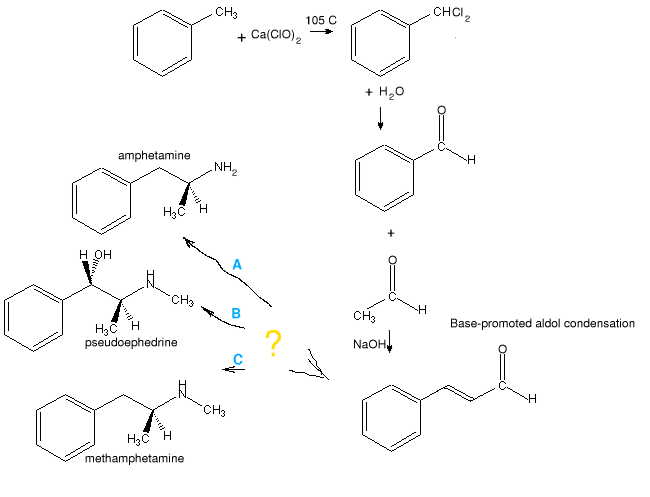
(https://www.thevespiary.org/rhodium/Rhodium/hive/hiveboard/picproxie_docs/000435394-file_pswu.jpg)1. Are there any likely problems with the aldol condensation?
Also, assuming the new aldehyde is then reduced completely after the condensation,
2. can a peracid-style epoxide be made to lead to B?
In your proposed aldol condensation, you will probably end up with a lot of by-products resulting from the acetaldehyde condensing with itself.
Epoxidizing cinnamic acid derivatives with oxone:
https://www.thevespiary.org/rhodium/Rhodium/pdf/cinnamic2epoxyacid.oxone.pdf (https://www.thevespiary.org/rhodium/Rhodium/pdf/cinnamic2epoxyacid.oxone.pdf)
https://www.thevespiary.org/rhodium/Rhodium/pdf/cinnamic2epoxyacid.oxone2.pdf (https://www.thevespiary.org/rhodium/Rhodium/pdf/cinnamic2epoxyacid.oxone2.pdf)
How are you suggesting to go from cinnamaldehyde to "B"? It implies that you manage to reduce the aldehyde to a methyl group, and making a methylamine group magically attach to the carbon next to it. I don't see that happen. The closest thing to your proposal is this, I think:
https://www.thevespiary.org/rhodium/Rhodium/chemistry/alpha-methylhydrocinnamic.html (https://www.thevespiary.org/rhodium/Rhodium/chemistry/alpha-methylhydrocinnamic.html)
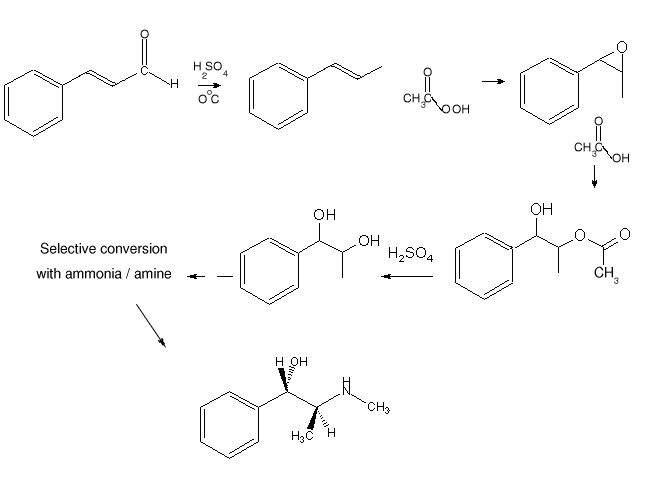
(https://www.thevespiary.org/rhodium/Rhodium/hive/hiveboard/picproxie_docs/000435394-file_em2e.jpg)Assuming the condensation works ok (and that was a bit of a concern- need to chase that up), it was envisaged first : dehydrate the aldehyde with freezing conc. sulfuric, then epoxidise it with peracetic (or the oxone route), but instead of carrying the Pinocol rearrangement all the way, stopping with the glycol and then (here's where it gets Novel ;D ) selectively aminating this, as mentioned here :
http://fb9-tc2.chemie.uni-oldenburg.de/forschung/forschungsprofil/page_english.html (http://fb9-tc2.chemie.uni-oldenburg.de/forschung/forschungsprofil/page_english.html)
(It's only mentioned, under the heading "Selective amination of multivalent alcoholes"; they mention using cobalt catalysts.)
If anyone knows anything that should be read on Selective Amination of vicinal diols ..... really haven't found much online- I'll be at a uni library tomorrow tho.
You need to study chemistry a lot more before you can devise novel
working synthetic routes.
dehydrate the aldehyde with freezing conc. sulfuricThere is no such reaction. To go from cinnamaldehyde to propenylbenzene you need to
reduce it, not "dehydrate" it (you are removing one oxygen atom, that is always a reduction).
Wolff-kishner reduction (https://www.thevespiary.org/rhodium/Rhodium/pdf/mw.wolff-kishner.pdf)
(https://www.thevespiary.org/rhodium/Rhodium/pdf/mw.wolff-kishner.pdf) might work, or else you can
convert it to allylbenzene (https://www.thevespiary.org/rhodium/Rhodium/chemistry/cinnamaldehyde.html)
(https://www.thevespiary.org/rhodium/Rhodium/chemistry/cinnamaldehyde.html) followed by
isomerization to propenylbenzene (https://www.thevespiary.org/rhodium/Rhodium/chemistry/isomerizafrole.html)
(https://www.thevespiary.org/rhodium/Rhodium/chemistry/isomerizafrole.html).
I don't know why or how you would go from phenyl-1,2-propanediol to (pseudo)ephedrine, if methamphetamine is your intended goal you should rather go directly from the phenyl-1,2-epoxypropane to P2P and
reductively aminate that to methamphetamine (https://www.thevespiary.org/rhodium/Rhodium/chemistry/p2p-meth.html)
(https://www.thevespiary.org/rhodium/Rhodium/chemistry/p2p-meth.html) directly instead of using your proposed detour.
I was actually thinking of methcathinone...
I am sure I wrote the aldehyde reduction down (ok, yes, it is a reduction, I will try to be disciplined) because I saw it in a reputable reference... it was an older book. Stupidly I cannot find/remember the reference, I wrote it down years ago and only have a folded printed page from PIKHAL on A4 with sketches on it. It was old stuff I dug up at a uni library after days buried in books. I'm going to try very hard to find it again. I am not for 1 second questioning your knowledge, I just can't see me writing this down unless I saw it used in a similar process. I'll get back on this. I thought it was rather odd myself when I saw it.
As you want to go for methcatione this might be exactly what you are after.
Patent US2597445 (http://l2.espacenet.com/dips/viewer?PN=US2597445&CY=gb&LG=en&DB=EPD)
It describes a way from benzaldehyde to methamphetamine, but if you swap the reduction as last step for an oxidation....
Of course the toluene has to be made to benzldehyde, but thats fairly covered.
I post some details and keywords later.
(at least for the searchengine ;D )
Thanks, that's very interesting and useful.
I'm a bit confused tho.
On
https://www.thevespiary.org/rhodium/Rhodium/chemistry/tcboe/chapter7.html (https://www.thevespiary.org/rhodium/Rhodium/chemistry/tcboe/chapter7.html)
it shows piperonal, or 3,4 methylenedioxybenzaldehyde, being condensed with nitro
ethane to yield a nitrostyrene- a three-carbon-long substituent.
In US Pat. 2,597,445 it uses a benzaldehyde with an alkali metal salt of 2-nitro
propane, yet still produces a 3-carbons-long ring substituent.
can you explain how this works?
One, having lent one's textbook to a friend, may probabaly be asking questions one normally wouldn't... one is endeavouring to reclaim it :)
What is meant by "an alkali metal salt of 2-nitropropane", in the patent? I know what an alkoxide is, but what's that?
take 2-nitropropane and react it with dilute NaOH and a salt with form. this is the sodium salt of 2-nitropropane. Be careful, salts of the nitrocompounds tend to be unstable (like to explode).
The reaction involved here is (i believe) the Hass-Bender reaction.
http://www.pmf.ukim.edu.mk/PMF/Chemistry/reactions/hass-bender.htm (http://www.pmf.ukim.edu.mk/PMF/Chemistry/reactions/hass-bender.htm)
The phenyl group always attaches to the corbon next to the nitro group. That way you have always a 2-carbon chain between phenyl and nitro.
When you said:
"The phenyl group always attaches to the carbon next to the nitro group."
that the phenyl group is always attatched to the carbon next to the carbon to which the nitro is attatched?
Does this method offer any benefit over the documented activated MnO2 RxN with toluene?