Novel Agonists of 5HT2C Receptors
Synthesis and Biological Evaluation of Substituted 2-(Indol-1-yl)-1-methylethylamines and 2-(Indeno[1,2-b]pyrrol-1-yl)-1-methylethylamines
Improved Therapeutics for Obsessive Compulsive DisorderMichael Bös, Francois Jenck, James R. Martin, Jean-Luc Moreau, Andrew J. Sleight, Jürgen Wichmann, and Ulrich WidmerJ. Med. Chem. 1997, 40, 2762-2769DOI:
10.1021/jm970030l (http://dx.doi.org/10.1021/jm970030l)
(https://www.thevespiary.org/rhodium/Rhodium/hive/hiveboard/picproxie_imgs/pdf.gif)
AbstractThe syntheses of a series of substituted 2-(indol-1-yl)-1-methylethylamines and 2-(indeno[1,2-b]pyrrol-1-yl)-1-methylethylamines are reported. The binding affinities of the compounds at 5HT
2C and 5HT
2A receptors (79% homology in the transmembrane domain) were determined. The ligands displayed selectivity for 5HT
2C receptors relative to 5HT
2A receptors. Compounds were functionally characterized both in vitro and in vivo as 5HT
2C receptor agonists.
5f,
5l,
5n,
5o,
5q,
14c,
14f,
14k, and
14m exhibited anticompulsive activity in an animal model of obsessive compulsive disorder.
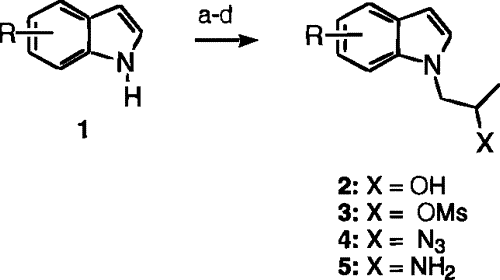
(https://www.thevespiary.org/rhodium/Rhodium/hive/hiveboard/picproxie_docs/000504079-file_pdok.gif)Scheme 1 (a) Propylene oxide, NaH, THF; (b) MsCl, NEt
3, CH
2Cl
2; (c) NaN
3, DMF; (d) PtO
2, H
2, EtOH.
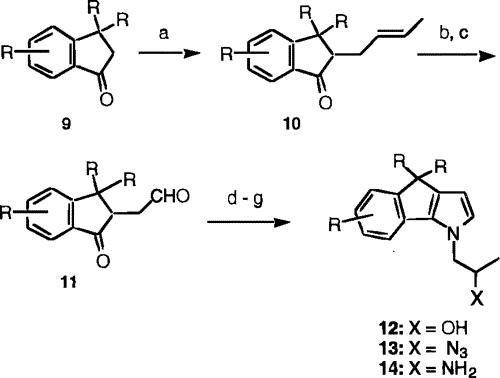
(https://www.thevespiary.org/rhodium/Rhodium/hive/hiveboard/picproxie_docs/000504079-file_slro.gif)Scheme 3 (a) 3-Buten-2-ol, p-TsA, 2,2-dimethoxypropane; (b) ozone, CH
2Cl
2-MeOH; (c) TFA, CH
2Cl
2; (d) 1-amino-2-propanol, p-TsA, toluene; (e) MsCl, NEt
3, CH
2Cl
2; (f) NaN
3, DMF; (g) PtO
2, H
2, EtOH.
This is reference #6, which I find interesting:
Synthesis and Pharmacological Activity of Fluorinated Tryptamine DerivativesAsher Kalir, Stephen Szara,
J. Med. Chem. 6, 716-719 (1963)(https://www.thevespiary.org/rhodium/Rhodium/hive/hiveboard/picproxie_imgs/pdf.gif)
AbstractThe synthesis of several fluorinated tryptamine derivatives in which the fluorine atom occupies the 5- or 6-position is reported. The 5-fluoro and unsubstituted tryptamines are more active than the 6-substituted derivatives in inducing spontaneous locomotion when administered to reserpinized white mice. Both 6-fluoro-N,N-diethyltryptamine and N,N-diethyltryptamine exerted peripheral activity when tested in humans, hut only the fluorine-free compound seemed to bear hallucinogenic properties. These results may be explained by change in the metabolic pathway of the tryptamines with substituted 6-position in the indole nucleus.
The effect of 6-fluorodiethyltryptamine was compared with diethyltryptamine (DET) in six patients and one normal volunteer. Both drugs were given intramuscularly in 1 mg./kg. doses. DET produced sympathomimetic autonomic symptoms, perceptual disturbances, hallucinations, mood changes, and difficulties in thinking and speaking. The 6-fluoro analog in the same persons produced the autonomic symptoms and mood changes without the perceptual and thinking disturbances so characteristic of hallucinogenic drugs.
Shulgin comments in
Tihkal #3: DET (http://www.erowid.org/library/books_online/tihkal/tihkal03.shtml)
(http://www.erowid.org/library/books_online/tihkal/tihkal03.shtml):
As a challenge to the hypothesis that hydroxylation at the 6-position of the N,N-dialkyltryptamines might play some role in the expression of the activity, this position was metabolically blocked by the insertion of a fluorine atom there, giving 6-F-DET. This compound, with DET as the control, was studied in some twelve hospitalized alcoholics at doses of about 60, 80 and 100 milligrams intramuscularly. It "does produce autonomic effects, pupillary changes, blood pressure changes; but it does not produce the drifting away into a dream world and other phenomena characteristic for the hallucinogenic activity." The experimenters considered its possible experimental role as an "active placebo" but nothing more was done with it.An active placebo mimics the side effects of the experimental drug, as using a standard "sugar pill" would be pointless in the case of psychedelic drugs - there is usually no question about you having taken the drug or not.
Indoline derivatives as 5-HT2C receptor agonistsJ. M. Bentley, D. R. Adams, D. Bebbington, K. R. Benwell, M. J. Bickerdike, J. E. P. Davidson, C. E. Dawson, C. T. Dourish, M. A. J. Duncton, S. Gaur, A. R. George, P. R. Giles, R. J. Hamlyn, G. A. Kennett, A. R. Knight, C. S. Malcolm, H. L. Mansell, A. Misra, N. J. T. Monck, R. M. Pratt, K. Quirk, J. R. A. Roffey, S. P. Vickers and I. A. CliffeBioorg. Med. Chem., 2004, 14, 2367-2370DOI:
10.1016/j.bmcl.2003.05.001 (http://dx.doi.org/10.1016/j.bmcl.2003.05.001)
(https://www.thevespiary.org/rhodium/Rhodium/hive/hiveboard/picproxie_imgs/pdf.gif)
AbstractA series of 1-(1-indolinyl)-2-propylamines was synthesised and evaluated as 5-HT
2C receptor agonists for the treatment of obesity. The general methods of synthesis of the precursor indoles are described. The functional efficacy and radioligand binding data for all of the compounds at 5-HT2 receptor subtypes are reported. A number of compounds were found to reduce food intake in rats after oral administration.
(https://www.thevespiary.org/rhodium/Rhodium/hive/hiveboard/picproxie_docs/000504079-Indoline.gif)____ ___ __ _
Cycloalkyl[b][1,4]benzodiazepinoindoles are agonists at the human 5-HT2C receptorAnnmarie L. Sabb, Robert L. Vogel, Gregory S. Welmaker, Joan E. Sabalski, Joseph Coupet, John Dunlop, Sharon Rosenzweig-Lipsonb and Boyd HarrisonBioorg. Med. Chem., 2004,DOI:
10.1016/j.bmcl.2004.02.100 (http://dx.doi.org/10.1016/j.bmcl.2004.02.100)
(https://www.thevespiary.org/rhodium/Rhodium/hive/hiveboard/picproxie_imgs/pdf.gif)
AbstractEvaluation of selected compounds from our Corporate Compound Library in a human 5-HT
2C receptor binding assay led to the discovery of WAY-629, a cyclohexyl[
b][1,4]benzodiazepinoindole (K
i 56 nM, E
max 90%), which is selective for the 5-HT
2C receptor versus other serotonin receptor subtypes, and dopamine, histamine, adrenergic, and muscarinic receptors. In addition, WAY-629 was active in vivo in a rat model of feeding behavior. An SAR study based on WAY-629 led to compound
11 (K
i 13 nM, E
max102%).
(https://www.thevespiary.org/rhodium/Rhodium/hive/hiveboard/picproxie_docs/000504079-benzodiazepinoindoles.gif)
2,3,4,5-Tetrahydro- and 2,3,4,5,11,11a-Hexahydro-1H-[1,4]diazepino[1,7-a]indoles: New Templates for 5-HT2C AgonistsMichael D. Ennis, Robert L. Hoffman, Nabil B. Ghazal, Rebecca M. Olson, Christopher S. Knauer, Chris L. Chio, Deborah K. Hyslop, Jeffery E. Campbell, Lawrence W. Fitzgerald, Nanette F. Nichols, Kjell A. Svensson, Robert B. McCall, Christopher L. Haber, Michelle L. Kageyc and Dac M. DinhBioorg. Med. Chem. Lett., 2003, 13(14), 2369-2372DOI:
10.1016/S0960-894X(03)00403-7 (http://dx.doi.org/10.1016/S0960%2D894X%2803%2900403%2D7)
(https://www.thevespiary.org/rhodium/Rhodium/hive/hiveboard/picproxie_imgs/pdf.gif)
Abstract: The design and synthesis of the novel 2,3,4,5-tetrahydro-1H-[1,4]diazepino[1,7-a]indole
5 is described. This azepinoindole has excellent affinity for 5-HT
2C (Ki 4.8 nM) and modest selectivity over 5-HT
2A (~4-fold). Several N- and C
11-substituted analogues of
5 were prepared, as were a number of biaryl indoline derivatives. The anxiolytic potential for the azepinoindole template
5 is demonstrated by activity in a mouse shock–aggression assay.
(https://www.thevespiary.org/rhodium/Rhodium/hive/hiveboard/picproxie_docs/000504079-BMCL_newtemplates5HT2C.gif)