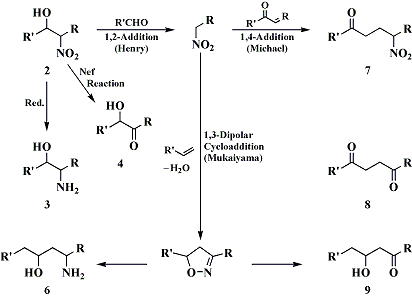
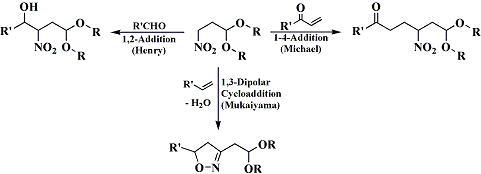
if one were to perform a "henry condensation" between thiobenzaldehyde ,PhC(=S)H, and nitroethane, if a decent yield of the nitro thiol would result, it would seem that this could be reduced with great ease to amphetamine, for example using urshibira Ni at low pressure.
is there any lit. examples of henry condensations with thials?
http://www.orgsyn.org/orgsyn/prep.asp?prep=cv9p0636 (http://www.orgsyn.org/orgsyn/prep.asp?prep=cv9p0636)
(https://www.thevespiary.org/rhodium/Rhodium/hive/hiveboard/picproxie_docs/000492497-file_npuc.gif)http://www.orgsyn.org/orgsyn/prep.asp?prep=V77P0236 (http://www.orgsyn.org/orgsyn/prep.asp?prep=V77P0236)
(https://www.thevespiary.org/rhodium/Rhodium/hive/hiveboard/picproxie_docs/000492497-file_mnrc.gif)
but these examples all appear to be regular henry condensations, i was looking specifically into henry condensations between a nitroalkane and a thial (thioaldehyde).
Googling for "thiobenzaldehyde" yields a hit,
http://www.csj.jp/journals/bcsj/bc-cont/bc69-3.html (http://www.csj.jp/journals/bcsj/bc-cont/bc69-3.html)
, where you can find a reference to a scientific article titled "Synthesis, Structure, and Some Reactions of (2,4,6-Tri-
t-butyl)thiobenzaldehyde, the First Stable Aromatic Thioaldehyde" from year 1995. This, and the fact that thiobenzaldehyde cannot be found in aldrich catalogue suggest that unsubstituted thiobenzaldehyde isn't a stable compound that could be used as a reagent. An interesting idea though. :)
thanks moo, too bad such an appealing route had to die an early death though.
maybe this method can bee revived with some modification.
for instance by henry condensing phenyl-nitroethane with thioformaldehyde.
the only possible complication i see is that thioformaldehyde exists primarily as a trimer, i don't how that would effect the henry condensation.