Preparation of chloroform as follows:
2 CH3COCH3 + 6 Ca(OCL) > 2CHCL3 + (CH3COO) 2Ca + 2 Ca (OH)2 + 3 CaCl2
500mls of H2O was added in small quantities to 200grms of Calcium Hypochlorite and mashed and stirred into milky suspension. Slurry was poured into a 1LRB and set up for reflux.
88mls of acetone was poured through the top of the condenser in 7 to 10 ml increments and a vigorous boiling started. Flask was shaken to mix acetone than dipped in ice water bath to control reaction. They weren’t lying when they said this was an exothermic reaction. When the reaction slowed it was taken out of ice bath and warmed in hot water bath to finish the halogenation.
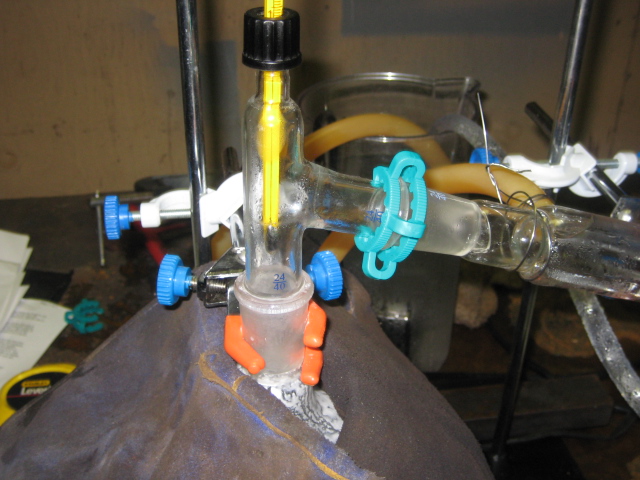
Flask was put back in ice water bath and the set up was changed to allow a simple distillation. Temperature started to rise and something came over at 41 *C Temp went up to 50* C than back down to 42* C WTF! Referred back to distillation notes and adjusted the thermometer bulb to sit a tad lower than bottom of the side arm and waited for condensate to appear on bulb. Still had issues on temperature not rising fast enough so I wrapped three welding gloves around the still pot and head. Eureka the temp went up to 61* C, fairly quickly! The temperature was actually controlled by removing a welding glove or two than putting them back to keep at 61*C.
In retrospect I don’t think the temp of still head was important as I made it out to be. The chloroform was on the bottom were the heat was and it was coming over well before the top of still head was at the correct b.p temperature. That is why I had something come over at 41*C.
The contents of the receiver flask were poured in a beaker and measured. 38mls of the theoretical 40ml were collected and sniffed. After I woke up…. just joking!!!! Seeing if yall are still with me. I noticed that there were a few drops of water on top of the chloroform.
Sample was poured into sep funnel and a equal volume of dilute NaOH was added and shook. A emulsion was created and a buddy of mine suggested NaCl to break the emulsion. As a last ditch effort I added NaCl and put it in sample jar before heading off to bar. This morning the sample had separated and the chloroform was sitting on top.
I put the contents back in sep funnel and let the lye water out and was left with about 27ml of less than ACS grade chloroform.
I grew as a chemist from going through the motions of this easy but enjoyable reaction. I already knew I could do it well before I did, but the experience gained was very valuable to me. I look forward to posting my next experiment. Thank you for taking the time to read fellas. D
2 CH3COCH3 + 6 Ca(OCL) > 2CHCL3 + (CH3COO) 2Ca + 2 Ca (OH)2 + 3 CaCl2
500mls of H2O was added in small quantities to 200grms of Calcium Hypochlorite and mashed and stirred into milky suspension. Slurry was poured into a 1LRB and set up for reflux.
88mls of acetone was poured through the top of the condenser in 7 to 10 ml increments and a vigorous boiling started. Flask was shaken to mix acetone than dipped in ice water bath to control reaction. They weren’t lying when they said this was an exothermic reaction. When the reaction slowed it was taken out of ice bath and warmed in hot water bath to finish the halogenation.
Flask was put back in ice water bath and the set up was changed to allow a simple distillation. Temperature started to rise and something came over at 41 *C Temp went up to 50* C than back down to 42* C WTF! Referred back to distillation notes and adjusted the thermometer bulb to sit a tad lower than bottom of the side arm and waited for condensate to appear on bulb. Still had issues on temperature not rising fast enough so I wrapped three welding gloves around the still pot and head. Eureka the temp went up to 61* C, fairly quickly! The temperature was actually controlled by removing a welding glove or two than putting them back to keep at 61*C.
In retrospect I don’t think the temp of still head was important as I made it out to be. The chloroform was on the bottom were the heat was and it was coming over well before the top of still head was at the correct b.p temperature. That is why I had something come over at 41*C.
The contents of the receiver flask were poured in a beaker and measured. 38mls of the theoretical 40ml were collected and sniffed. After I woke up…. just joking!!!! Seeing if yall are still with me. I noticed that there were a few drops of water on top of the chloroform.
Sample was poured into sep funnel and a equal volume of dilute NaOH was added and shook. A emulsion was created and a buddy of mine suggested NaCl to break the emulsion. As a last ditch effort I added NaCl and put it in sample jar before heading off to bar. This morning the sample had separated and the chloroform was sitting on top.
I put the contents back in sep funnel and let the lye water out and was left with about 27ml of less than ACS grade chloroform.
I grew as a chemist from going through the motions of this easy but enjoyable reaction. I already knew I could do it well before I did, but the experience gained was very valuable to me. I look forward to posting my next experiment. Thank you for taking the time to read fellas. D