Author Topic: In search of aluminum oxide  (Read 126 times)

Prepuce

  • Mighty Bhagwan
  • Subordinate Wasp
  • ***
  • Posts: 100
In search of aluminum oxide
« on: July 21, 2010, 06:04:08 AM »
I've been playing around with microwave ovens, looking for several things, one of which is a practical way to fire clay. I still haven't found one, but have made a little progress. I bought about 20 lbs. of aluminum oxide sand blasting media from Harbor Freight the other day, thinking it might work pretty well. I've read that aluminum oxide is a good microwave attracter. It did not work, and I couldn't get it to heat at all unless I mixed it with something else that would. It was black.

Oh, well, I thought, I'll mak it into Aluminum hydroxide and use it for chromatography. I wasn't sure how to go about it, but thought I had a pretty good idea. I washed it several times with water, then added some HCl. It began to liberate HS, so I flushed it and set it up again in a flask with an exhaust tube running into some NaOH. That worked well, and I kept adding HCl in small amounts until there was no more reaction

As I had it planned, the result of this was supposed to be AlCl3 in solution, and I hoped that most of the impurities would stay behind. Not sure about that, but after filtering I added NaOH with the idea that Al(OH)3 would fall out of solution. I got a hell of a precipitate, but something looked wrong. CRC said that Al(OH)3 is white, but this was dark green, and thick, almost like a colloid. Even though my original mass of aluminum oxide was small, every time I added more base there was more of the green precipitate formed, until the whole beaker was filled with it.

I washed this material with water over and over, but it retained the bulky, colloidal property. I decanted off most of the liquid, and then noticed that as it began to dry the material changed from dark, spinach green to reddish brown, not unlike rust. When completely dry it lightened, and now the color appears too light to be rust but I may be wrong. It does seem to have the ability to attract microwaves, but not so much so that it would make a good material for that purpose.

I looked it up in CRC and found that it matches the description given for ferric oxide, Fe2O3-2H2O. I had already noted that heating it with a propane torch drives out water, because the water would condense on the anvil part of my vise when I heated the red-orange powder with a propane torch. The material darkens, but then returns to the original state after some time.

I don't know what I did that caused this particular product to be produced.

A prologue to the story is that there was still some material from the original aluminum oxide that was not affected by the HCl. It's black and looks somewhat crystalline in the light. This must be the real aluminum oxide, because it does seem to attract microwaves well, and appears unchanged after getting it hot enough to melt a ceramic pot and a bit of aluminum. It remains a loose powder. The only trouble is that it should be a white powder, not black.

I posted this here to see if there are any comments. All are welcome.

PP
Support the never ending quest for new and better hedonicants. Send your gift today to:

 N & B H Foundation, Attn. Bhagwan SP
 University of Massachusetts at Los Angeles
 PO Box 6.02 X 10^23
 Houston, MD 884411

Vesp

  • Administrator
  • Foundress Queen
  • *****
  • Posts: 3,130
Re: In search of aluminum oxide
« Reply #1 on: July 21, 2010, 06:51:35 AM »
Aluminum oxide can be bought as a polishing powder, or in a suspended solution.
Bitcoin address: 1FVrHdXJBr6Z9uhtiQKy4g7c7yHtGKjyLy

lugh

  • Global Moderator
  • Foundress Queen
  • *****
  • Posts: 876
Re: In search of aluminum oxide
« Reply #2 on: July 21, 2010, 03:27:24 PM »
Aluminum oxide is available from pottery suppliers, the presence of iron will cause it to be yellow so there's something else involved  8)
Chemistry is our Covalent Bond

Sedit

  • Global Moderator
  • Foundress Queen
  • *****
  • Posts: 2,099
Re: In search of aluminum oxide
« Reply #3 on: July 21, 2010, 06:56:26 PM »
The Alumina you get from a pottery place is normaly quite pure. If needed you can request it to be pure because its a componate added to make fine porciline have a higher MP yet trace inorganic can affect the color and MP so muc that they need it very pure at times.
There once were some bees and you took all there stuff!
You pissed off the wasp now enough is enough!!!

Vesp

  • Administrator
  • Foundress Queen
  • *****
  • Posts: 3,130
Re: In search of aluminum oxide
« Reply #4 on: July 21, 2010, 07:13:07 PM »
It seems like it would be easy to purify, at least to aluminum hydroxide using NaOH by dissolving it all - filtering the impurities that did not dissolve, than neutralize it so the Al hydroxide precipitates again. Possibly take only the middle fraction that precipitates, as the first few grams that precipitate may be something else, as well as the last few grams.  This, however, would probably be a headache to do - but if needed, it ought to be able to be done.

Bitcoin address: 1FVrHdXJBr6Z9uhtiQKy4g7c7yHtGKjyLy

Prepuce

  • Mighty Bhagwan
  • Subordinate Wasp
  • ***
  • Posts: 100
Re: In search of aluminum oxide
« Reply #5 on: July 21, 2010, 07:35:49 PM »
Thanks for all the suggestions, they all make good sense. AT this point I'm sure I could get much better Al oxide than what I have, but the thing that keeps me going at it is the desire to get a handle on the chemistry. Especially when it should be such an easy thing to do.

Vesp, your suggestion sounds like it would be worth another try. I went the other way trying to do about the same by dissolving in HCl, but maybe using NaOH as the first step will make it easier to get rid of the iron.

PP
Support the never ending quest for new and better hedonicants. Send your gift today to:

 N & B H Foundation, Attn. Bhagwan SP
 University of Massachusetts at Los Angeles
 PO Box 6.02 X 10^23
 Houston, MD 884411

Naf1

  • Foundress Queen
  • *****
  • Posts: 753
Re: In search of aluminum oxide
« Reply #6 on: July 21, 2010, 09:24:44 PM »
http://en.wikipedia.org/wiki/Aluminium_oxide_(disambiguation)

You will notice the compound you want Aluminium(III)oxide [Alumina] is a white solid.
« Last Edit: July 21, 2010, 09:27:18 PM by Naf1 »

Sedit

  • Global Moderator
  • Foundress Queen
  • *****
  • Posts: 2,099
Re: In search of aluminum oxide
« Reply #7 on: July 22, 2010, 12:27:55 AM »
If you still have your Fe contaminated Alumina dont forget what I said before. Convert it to its sulfate and bubble air into it, Fe sulfate is highly unstable in solution. All the Fe will precipitate right out of the solution very quickly as the oxide/hydroxide. Filter and recover your aluminum sulfate solution and proceed basification from there.
There once were some bees and you took all there stuff!
You pissed off the wasp now enough is enough!!!

Prepuce

  • Mighty Bhagwan
  • Subordinate Wasp
  • ***
  • Posts: 100
Re: In search of aluminum oxide
« Reply #8 on: July 25, 2010, 08:26:55 PM »
I wish I had checked back here before I crushed up all those rubies. Oh, well.

Naf1, I did know that it should be white. That's what got me interested in trying to clean it up in the first place. Thanks for the link--sounds like the industrial process is a lot like what Vesp suggested.

Sedit, your idea sounds interesting so I'm going to try that, too.

Thanks to all for the responses.

PP
Support the never ending quest for new and better hedonicants. Send your gift today to:

 N & B H Foundation, Attn. Bhagwan SP
 University of Massachusetts at Los Angeles
 PO Box 6.02 X 10^23
 Houston, MD 884411

Vesp

  • Administrator
  • Foundress Queen
  • *****
  • Posts: 3,130
Re: In search of aluminum oxide
« Reply #9 on: July 25, 2010, 08:42:46 PM »
Let us know how it goes!
Especially if you get to the point to try it out for chromatography. I've always wanted to find a DIY/OTC improvised chromatography setup that can process a decent amount of chemical.
Bitcoin address: 1FVrHdXJBr6Z9uhtiQKy4g7c7yHtGKjyLy

Prepuce

  • Mighty Bhagwan
  • Subordinate Wasp
  • ***
  • Posts: 100
Re: In search of aluminum oxide
« Reply #10 on: August 02, 2010, 03:26:41 AM »
Will do, Vesp. I've been working on the problem for several years now, off and on. The Rhodium archives have several interesting suggestions along those lines, but it's always solvent availability that gets in my way.

I have had some success using paper chromatography, and I started a WD thread that I believe remains. Of course that's not a way of separating any significant volume of anything, but it's a process easily adapted to ghetto conditions and the need to check a substance for purity.

PP
Support the never ending quest for new and better hedonicants. Send your gift today to:

 N & B H Foundation, Attn. Bhagwan SP
 University of Massachusetts at Los Angeles
 PO Box 6.02 X 10^23
 Houston, MD 884411

Prepuce

  • Mighty Bhagwan
  • Subordinate Wasp
  • ***
  • Posts: 100
Re: In search of aluminum oxide
« Reply #11 on: August 02, 2010, 03:30:19 AM »
One other note on chromatography--there is a current thread on WD titled environmentally green separations or something similar. The author has worked out a way to do separations using ionic exchange resin that is sold inexpensively for water softening and fish tank conditioning.

In a way it's the reverse of column chromatography because the product remains in the stationary phase, but from what I've read it sounds as though it might be a viable method.

PP
Support the never ending quest for new and better hedonicants. Send your gift today to:

 N & B H Foundation, Attn. Bhagwan SP
 University of Massachusetts at Los Angeles
 PO Box 6.02 X 10^23
 Houston, MD 884411

Vesp

  • Administrator
  • Foundress Queen
  • *****
  • Posts: 3,130
Re: In search of aluminum oxide
« Reply #12 on: August 02, 2010, 04:31:51 AM »
I would very much appreciate seeing a link to that thread. I searched a bit but I am not seeing anything that involves reverse of column chromatography with resin, besides this one, which I am pretty sure isn't what you are referring too...
https://www.wetdreams.ws/forum/index.php?topic=19946.0

I think it might be this one? https://www.wetdreams.ws/forum/index.php?topic=19893.0

Doesn't sound to much like chromatography, at least not what I had interest in -- but I've yet to read the entire thread.
I am mostly interested in it for separating out various chemicals that are similar, not just an alkaloid from a non alkaloid.
 

Bitcoin address: 1FVrHdXJBr6Z9uhtiQKy4g7c7yHtGKjyLy

Sedit

  • Global Moderator
  • Foundress Queen
  • *****
  • Posts: 2,099
Re: In search of aluminum oxide
« Reply #13 on: August 03, 2010, 03:33:50 AM »
One other note on chromatography--there is a current thread on WD titled environmentally green separations or something similar. The author has worked out a way to do separations using ionic exchange resin that is sold inexpensively for water softening and fish tank conditioning.

In a way it's the reverse of column chromatography because the product remains in the stationary phase, but from what I've read it sounds as though it might be a viable method.

PP

IIRC sounds liek u should be talking to naf or no1uno
There once were some bees and you took all there stuff!
You pissed off the wasp now enough is enough!!!

Prepuce

  • Mighty Bhagwan
  • Subordinate Wasp
  • ***
  • Posts: 100
Re: In search of aluminum oxide
« Reply #14 on: August 05, 2010, 03:13:15 AM »
Vesp, the environmentally friendly extraction thread is the one I was thinking about, and you're right, it's pretty much suited only to a particular purpose. I mentioned it because I thought it was a novel idea. But again, the Rhodium archive has several suggestions that might fit the bill for you. Just search the archive for "chromatography" and you should find some. If you don't or can't let me know, and I'll find a forward those I've seen.

There are a couple that appeal to me because they work quickly, without the need for a long column.

PP
Support the never ending quest for new and better hedonicants. Send your gift today to:

 N & B H Foundation, Attn. Bhagwan SP
 University of Massachusetts at Los Angeles
 PO Box 6.02 X 10^23
 Houston, MD 884411

Naf1

  • Foundress Queen
  • *****
  • Posts: 753
Re: In search of aluminum oxide
« Reply #15 on: August 06, 2010, 12:20:18 AM »
http://aquariumpharm.com/Products/Product.aspx?ProductID=96

Product MSDS
http://cms.marsfishcare.com/files/msds/phos_zorb_1223091.pdf

I have been talking about ion exchange resins on this forum regarding extraction for some time, there has also been clandestine methods like kompot heroin that use them for a long time.  I was not aware there were ion exchange resins available for aquariums though? I do know they are available for water treatment, if you want some good reading on them the forensic drug analysis techniques frequently use columns filled with ion exchange resin to extract drugs from (urine, pills, plant matter, bodily tissue, hair, ect). Also if you have an extended release pill following that method wont work very well, as usually the time release part is also ion exchange resin. So one would add the crushed up pills to the resin (even crush them all up together resin/pills), then when you have absorbed the amine onto the resin wash with plenty (read volumes) of water then alcohol instead of trying to throw the pill powder out at this stage.... instead on a buchner filter save ALL the pill powder and resin just wash it well with alcohol and water. Then add only enough base to release your amine and filter the solution until it is crystal clear, after a clear solution is achieved I would keep basing to precipitate the free base which could be filtered out of solution.

Quote
Doesn't sound to much like chromatography, at least not what I had interest in -- but I've yet to read the entire thread.
I am mostly interested in it for separating out various chemicals that are similar, not just an alkaloid from a non alkaloid.

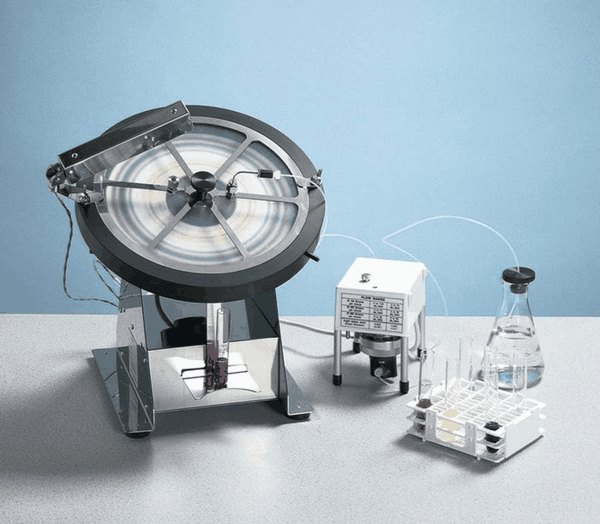
How about this bitch!

Only $25,000
Analtech CycloGraphâ„¢ I TLC System
http://www.coleparmer.com/catalog/product_view.asp?sku=3410600

The disc is basically an oversized TLC plate (just solid silica or alumina), and spins at a consistent speed. The sample is dropped into the middle (just off center) and the centrifugal forces make the bands travel outwards as they have to travel through the chromatography medium the different compounds present separate out into separate bands. There is a rim around the outside of the plate that catches the fluid as it spins off thereby allowing great separation! You can make the discs(rotor) thicker and can separate more compound at a time. You can separate a 2 gram sample in under 20 minutes!

http://www.harrisonresearch.com/chromatotron/specs.html

Preparative centrifugal chromatography device
http://www.freepatentsonline.com/4139458.html
« Last Edit: August 06, 2010, 12:31:45 AM by Naf1 »