Author Topic: Saponification of Tannic Acid. Quick and easy gallic acid synthesis  (Read 189 times)

solidstone

  • Subordinate Wasp
  • ***
  • Posts: 102
Saponification of Tannic Acid. Quick and easy gallic acid synthesis
« on: October 16, 2010, 07:10:19 PM »
I was browsing the literature on mescaline, and found a pretty efficient synthesis route via gallic acid.   gallic acid isn't impossible to get, however tannic acid is VERY cheap and even lower profile.

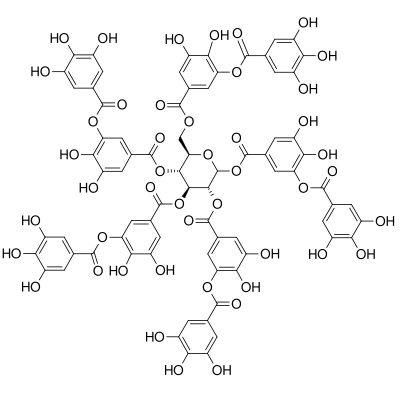
If you look at tannic acids structure its just a monstrous poly gallic acid ester.  So a simple saponification reaction should suffice to yield nearly pure gallic acid salt which should be easily converted back to the carboxylic acid.

As for the use of gallic acid I refer you to the quick reference found here: designer-drugs.com/pte/12.162.180.114/dcd/chemistry/mescaline.html

I thought this might be a quicker cheaper route to mescaline.

solidstone

  • Subordinate Wasp
  • ***
  • Posts: 102
Re: Saponification of Tannic Acid. Quick and easy gallic acid synthesis
« Reply #1 on: October 16, 2010, 07:47:15 PM »
A further explanation of where my mind is going with this:


Chemicals needed:
Tannic acid
NaOH
Sulfuric acid + Methanol -? dimethyl sulfate
K2CO3
MgSO4 (or other dessicant)
Na2S2O3 (over the counter)
Bromine or Chlorine gas (easily made from their salts)
HCl
Acetic acid + Chlorine gas(MnO2+HCL)-?chloro acetic +NaOH ? sodium chloro acetate + NaNO2 ? Nitro methane + H2O

All OTC and cheap


Methyl 3,4,5-Trimethoxybenzoate: A solution of gallic acid hydrate (29.9 g) in DMF (100 ml) was added to a suspension of K2CO3 (97 g) in DMF (200 ml) with vigorous stirring. Dimethyl sulfate (66 ml) was added dropwise to the above mixture at 20-25°C. After completion of the addition, the mixture was stirred at room temperature for 2.5 h. The above procedure was repeated using a further amount of K2CO3 (44 g) and Me2SO4 (30 ml), then the reaction mixture was stirred at room temperature for a further 4.5 h, poured into water, and extracted with Et2O. The ethereal solution was dried over K2CO3 and evaporated to dryness. Recrystallization of the residue from MeOH gave pale yellow prisms (32.7 g), mp 85-86°C.
3,4,5-Trimethoxybenzyl Alcohol: A solution of Methyl 3,4,5-Trimethoxybenzoate (9.86 g) in abs. benzene (40 ml) was added dropwise to Vitride (22 ml) under ice cooling. After the mixture had been stirred at room temperature for a further hour the complex was decomposed with 25% H2SO4 (290ml). The benzene layer was separated from the aqueous layer, which was extracted with benzene. The organic layers were combined, washed with 5% NaHCO3 aq.. and then dried over MgSO4. Evaporation of the benzene solution gave an oily product (7.84 g).

3,4,5-Trimethoxybenzaldehyde
A solution of 39.6 g (0.2 mole) of 3,4,5-trimethoxybenzyl alcohol in 250 ml of methanol was stirred and cooled to 0°C. Bromine (54 ml) was added with stirring over a period of one hr keeping the temperature at 0°C. The stirred mixture was allowed to acquire room tempterature gradually and stirred further for 2 hr. A saturated solution of sodium thiosulfate (about 30 ml) was added to effect complete decomposition of excess bromine. 3,4,5-Trimethoxybenzaldehyde was filtered off and recrystallized from benzene to give 31 g (80%) as colourless needles, m.p. 73-74°C.
Reference: J. Chem. U.A.R., 11, No. 3, 401-404 (1968)

3) 3,4,5-Trimethoxy-nitrostyrene.
A solution of 40 cc of nitromethane and 100 g. of trimethoxybenzaldehyde in 200 cc alcohol is cooled to 0 deg C and while it is stirred mechanically there is introduced a solution of 45 g. pure potassium hydroxide in 45 cc water and 90 cc methanol at the rate of about one drop per second, care being taken that the temperature does not rise. Fifteen minutes after the addition is completed the solution is poured into 500 cc concentrated hydrochloric acid mixed with sufficient fee to assure its presence throughout the slow addition and to maintain the temperature of -10 deg C. The precipitated nitrostyrene is separated by filtration and washing and may be purified by recrystallizing from 700 cc alcohol. The pale yellow plates which melt at 120-121 deg C are obtained in a yield of approximately 78% of theory.
4) Mescaline.
[A] APPARATUS
A cell of porous porcelain (PC) (external dimensions 75x160 mm) with a glazed rim is placed in a glass jar of 500 cc capacity, surrounded by a cooling bath. The anode is a lead or carbon rod, surrounded by a glass coil; the cooling water flows through the coil and discharges into the cooling bath. The cathode is a sheet of lead (220x90x2 mm.), which previous to each experiment is electrolytically coated with lead peroxide, in a bath of dilute sulfuric acid.
REDUCTION
The cathode liquor consists of a solution of 30g. 3,4,5-trimethoxy- nitrostyrene in 100 cc glacial acetic acid and 100 cc alcohol, to which 50 cc conc. hydrochloric acid has been added. The anode compartment is filled, to the same level occupied by the catholyte, with a solution of 25 cc conc. sulfuric acid in 175 cc water.
The reduction requires 12 hours, using a current of 5-6 amperes; the cathode current density should be about 3 amperes per square centimeter. The temperature is regulated by the flow of the cooling water and the catholyte should be kept at 20 deg C for the first six hours; the temp is then allowed to rise until it reaches 40 deg C at the end of the reduction.
When the reduction is complete, the catholyte is filtered, evaporated in vacuum and the residue taken up in 300 cc water Unreduced nitrostyrene is extracted sucessively with ethyl acetate and with ether. The crude mescaline hydrochloride solution in a separatory funnel is then treated with a cold concentrated solution of 100 g. of sodium hydroxide and the liberated base exhaustively extracted with ether. The somewhat concentrated and dried (potassium carbonate) solution is treated with a stream of dry hydrogen chloride and the separated hydrochloride twice recrystallized from absolute alcohol. The pure mescaline hydrochloride, thus obtained in 77% yield, forms white leaflets melting at 184°C.


For OTC Nitromethane I was thinking:

Chloroacetic acid is prepared industrially via two routes. The predominant method involve chlorination of acetic acid:
CH3CO2H + Cl2 ? ClCH2CO2H + HCl

The reaction of sodium chloroacetate with sodium nitrite in aqueous solution produces this compound:[2]
ClCH2COONa + NaNO2 + H2O ? CH3NO2 + NaCl + NaHCO3


*upon looking at this more I realized that a rough reducing agent is necessary to reduce the ester.  I am working on an electrolytic research project for university and am hoping this will cut out the need for LAH for reduction.

« Last Edit: October 16, 2010, 10:29:06 PM by solidstone »

director of sound

  • Larvae
  • *
  • Posts: 38
Re: Saponification of Tannic Acid. Quick and easy gallic acid synthesis
« Reply #2 on: October 19, 2010, 12:01:30 PM »
look into using vanillin, i bought a tester ammount in high vis just to see if it alerted anyone when i bought 500g on ebay. super simple  vanillin -> 5-iodovanillin; 5-iodovanillin -> 5-hydroxyvanillin; 5-hydroxy to the benzaldehyde then the nitrostyrene via nitromethane and ammonium acetate with an electrochemical reduction to mesc HCl. everything is easy to get besides the dimethyl sulfate and if you are going through the trouble to synth mesc you can easily make dimethyl sulfate... i too looked into gallic acid and its too much trouble. its by far easier to go from vanillin.


Vanillin to 5-iodovanillin

Vanillin (28.4 g, 200 mmole) was dissolved in 1N NaOH (200 ml) and warmed to 90°C to avoid precipitation of sodium vanillate. A 2 molar aqueous solution of NaI3.NaI (105 ml, 210 mmole I2) plus 3.55 molar aqueous H2SO4 (5 ml) was added over 3 hours with stirring. The iodine color was discharged, and a pale tan stirrable precipitate formed. The solution was then cooled to room temperature, acidified to pH 2-3 with 20% aqueous H2SO4, and extracted with 10% methanol/90% chloroform. The organic phase was dried (MgSO4) and the solvent stripped to yield 53 g (99%) of 5-iodovanillin, more than 95% pure as analyzed by nuclear magnetic resonance spectroscopy (NMR).

5-iodovanillin to 5-hydroxyvanillin

Vanillin (2.84 g, 20 mmole) was dissolved in 1N NaOH (20 ml) at 80°C., then a mixture of 2N (NaI3.NaI)/H2O (10.1 ml=20.2 mmole I2) plus 20% aqueous H2SO4 (0.5 ml=8 mole %) was added dropwise over 30 minutes. A tan precipitate formed. The reaction mixture was stirred an additional 3.5 hours. A 10% solution of Na2S2O3 (1.5 ml) was added to reduce excess iodine, then 50% aqueous NaOH (7.6 ml) was added (to make 4N in NaOH), plus copper dust (128 mg, 2 mmole, 10 mole %) added. The mixture was refluxed overnight, cooled to room temperature, filtered to remove catalyst, the pH was adjusted to 2 with 20% aqueous H2SO4, and the solution extracted 5X with 20% methanol/80% chloroform. A yield of 3.1 g (99%) of product was obtained, which NMR showed to consist of about 75% 5-hydroxyvanillin and 25% vanillin.

using concentrations of NaOH base ranging from 1N to 6N, using KOH and LiOH in place of NaOH as the base for the iodination procedure. All gave substantially equivalent results.

using from 5 to 10 mole % of cuprous oxide, cuprous chloride, cuprous iodide and copper dust, as the catalyst for conversion of the iodovanillin to hydroxyvanillin. Recovery of 5-hydroxyvanillin was 80-85% (remainder vanillin) with copper dust, from 70-80% with the copper oxide or salts.


3,4,5-Trimethoxybenzaldehyde from 5-hydroxyvanillin

Into a 1-l. round-bottomed flask equipped with a magnetic stirrer and a reflux condenser were placed: 50 g (0.298 mol) 5-hydroxyvanillin, 500 ml acetone, 91.0 g (0.716 mol) dimethylsulfate, 100 g (0.806 mol) finely ground Na2CO3.H2O, 10 ml of 10% KOH in methanol. Of course equimolar amounts of anhydrous Na2CO3 or K2CO3 can be used.

The heterogenous mixture was stirred under vigorous reflux for 24 hours, after which the reflux condenser was replaced with a descending condenser. The solvent was distilled at a bath temp. of ca. 100° until the distillation ceased. To the solid residue was added 400 ml of water and the heterogenous mixture was stirred VIGOROUSLY for 2 hours at room temperature followed by one hour at 0-5° (ice-cooling). The light brown crystals were filtered by suction, washed with 3*150 ml of ice water and air dried to constant weight. Yield 55.1g (94%), m.p. 72.5-74°. After distillation at 0.5mm/130°, there was obtained a 90% yield of 3,4,5-trimethoxybenzaldehyde, m.p. 73.5-75, VPC purity 99.3%. (This distillation is probably unnecessary, because the aldehyde is already quite pure).


refer to Shulgins mescaline synth for the nitrostyrene production (#96 in PIHKAL pg 702-703). ive posted the electrochemical reduction in my TMA-2 thread also.

solidstone

  • Subordinate Wasp
  • ***
  • Posts: 102
Re: Saponification of Tannic Acid. Quick and easy gallic acid synthesis
« Reply #3 on: October 19, 2010, 06:12:33 PM »
Not bad!  I've been meaning to get some vanillin to play with.  I think vanillin to piperonal(using triethylamine) to MDP2P looks promising.

I do want to figure out an electrolytic rig to do away with the need for LAH, it is a consistent fumbling point for me as I am unable to obtain it and if I was able to would be a bit frightened to use it.

Vesp

  • Administrator
  • Foundress Queen
  • *****
  • Posts: 3,130
Re: Saponification of Tannic Acid. Quick and easy gallic acid synthesis
« Reply #4 on: October 19, 2010, 06:15:44 PM »
Quote
I do want to figure out an electrolytic rig to do away with the need for LAH, it is a consistent fumbling point for me as I am unable to obtain it and if I was able to would be a bit frightened to use it.
And I think that is true for most people - Someone ought to start a thread on a way to replace it with electrolysis. That would be a revolutionary discovery.     ::)
Bitcoin address: 1FVrHdXJBr6Z9uhtiQKy4g7c7yHtGKjyLy

solidstone

  • Subordinate Wasp
  • ***
  • Posts: 102
Re: Saponification of Tannic Acid. Quick and easy gallic acid synthesis
« Reply #5 on: October 19, 2010, 06:36:42 PM »
I start a research project on the very same come january sponsored by two professors at my university, so hopefully I will have something conclusive by then.  I ought to be doing research on this now in preparation for my proposal.  Any suggestions of things I should take into account would be appreciated and considered.

If this works the tannic acid to mescaline would work nicely as would many other synthesis become accessible.

micro

  • Pupae
  • **
  • Posts: 70
Re: Saponification of Tannic Acid. Quick and easy gallic acid synthesis
« Reply #6 on: October 28, 2010, 06:47:53 PM »
If I'm not completely mistaken there is a thread on electrochemical reduction of P2NP to amphetamine in a diy electrolytic cell at SM.
The cell used lead electrodes and a mixture of sulfuric and acetic acid as the elektrolyte. IIRC the catholyte was at least sulfuric acid based.
It might have been buffered somehow and the whole system was cooled activly as loads of heat ware produced.
There is also a separate thread on a another forum that is circulating as pdf, IIRC it was from synthetical or something. I don't remember if it was tested with MDP2P.
Then there is also a thread on wd that has a translated hyperlab text.
The hyperlab text deals with some phenetylamine is I recall correctly, but the reduction was achieved electronically. The russians used ridiculous current densities.

 You cant ban electricity, thus electrochemistry and electrooxidation & reduction are sooner or later the future and present state of all amateur chemistry.
From pyro to phenetylamines.  

Well this is my 0.02€ on this subject. Hope you like it and find something useful thanks to it.
« Last Edit: October 28, 2010, 07:48:42 PM by micro »

solidstone

  • Subordinate Wasp
  • ***
  • Posts: 102
Re: Saponification of Tannic Acid. Quick and easy gallic acid synthesis
« Reply #7 on: October 28, 2010, 08:44:51 PM »
I believe in the book "Advanced Techniques in Amphetamine Manufacture" (Title?  I'll edit it when i get home), outlines electrochemistry as applied to MDP2P  I'll take a look tonight and try to upload the file and start an electrolysis thread.

I just got a nice Variac and an AC to DC power converter, so I'll start playing with all of that soon.  I'll have the Universities lab for my work come Febuary.

akcom

  • Dominant Queen
  • ****
  • Posts: 430
Re: Saponification of Tannic Acid. Quick and easy gallic acid synthesis
« Reply #8 on: October 28, 2010, 11:07:01 PM »
It would be really nice if someone could find/post that electrolysis pdf micro mentioned

solidstone

  • Subordinate Wasp
  • ***
  • Posts: 102
Re: Saponification of Tannic Acid. Quick and easy gallic acid synthesis
« Reply #9 on: October 29, 2010, 12:09:59 AM »
I have the book.  It's Uncle Festers Advanced pyschedelic amphetamine techniques, alas it is to large to upload and I am struggling to break the pdf into a more manageable size.

akcom

  • Dominant Queen
  • ****
  • Posts: 430
Re: Saponification of Tannic Acid. Quick and easy gallic acid synthesis
« Reply #10 on: October 29, 2010, 12:40:18 AM »
Any suggestions for working with dimethyl sulfate?  Or synthesizing it?

micro

  • Pupae
  • **
  • Posts: 70
Re: Saponification of Tannic Acid. Quick and easy gallic acid synthesis
« Reply #11 on: October 29, 2010, 03:36:33 PM »
There was a video on making diethyl sulfate on youtube, it should work as well with MeOH.
The guy did it outside in the snow. (He also later died from HCN exposure, reportedly suicide however, why the fuck? no one knows).
I'd suspect that the synthesis would be safest performed in a damn good fumehood.