
Author Topic: The First Rotary Evaporator  (Read 145 times)

lugh

  • Global Moderator
  • Foundress Queen
  • *****
  • Posts: 876
The First Rotary Evaporator
« on: October 21, 2010, 08:35:25 PM »
This may be helpful, the attached Deja Vu file describes the very first rotary evaporator ever constructed by Craig, Gregory and Hausmann of the Rockefeller Institute for Medical Research; published in Anal Chem 22 1462 (1950)  8)
Chemistry is our Covalent Bond

Vesp

  • Administrator
  • Foundress Queen
  • *****
  • Posts: 3,130
Re: The First Rotary Evaporator
« Reply #1 on: October 21, 2010, 08:50:09 PM »
Thank you, I had this on my mind recently! I was trying to find a simple way to go about it. Of course looking at the very first rotovap is a brilliant way to find a simple method.
Thanks for posting! much appreciated -- despite me never going to go through with this, it is still interesting.

« Last Edit: October 21, 2010, 08:52:15 PM by Vesp »
Bitcoin address: 1FVrHdXJBr6Z9uhtiQKy4g7c7yHtGKjyLy

lugh

  • Global Moderator
  • Foundress Queen
  • *****
  • Posts: 876
Re: The First Rotary Evaporator
« Reply #2 on: October 21, 2010, 11:13:17 PM »
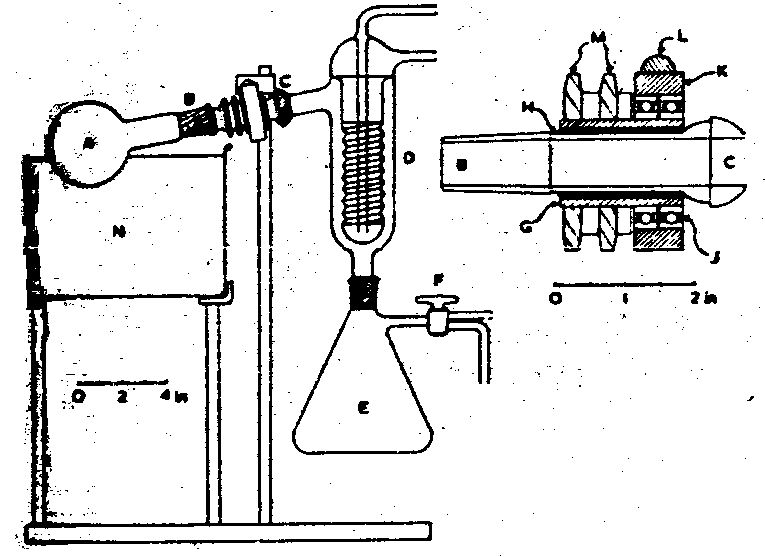
A description of how to build a rotary evaporator based on 1960 technology:

V C Runeckles of the Imperial Tobacco Company of Canada in Montreal Canada

Commercial rotary evaporators employing glass components throughout are available only as single units; multiple unit commercial evaporators having metallic parts are subject to corrosion and may cause sample contamination. To overcome these disadvantges a four unit, all glass apparatus has been constructed. This apparatus has performed satisfactorily for more than a year with periodic cleaning and oiling of the metal parts and chains and lubrication of the ball joints.

Design. Only a single unit is illustrated with a sectional view of the rotating glass connector. The sample flask, A, with a standard taper 24/40 joint is connected to the rotating borosilicate glass connector B. A vacuum seal is maintained by a 20/35 spherical joint, c, which is connected to the side arm of a Friedrichs condenser, D, modified so that the side arem, carrying a 20/35 female spherical joint, in inclined at 15º below horizontal. D is connected via a 24/40 joint to the receiver flask, E. A three way stopcock, F, is attached to the receiver side arm, and also connects to the vacuum line or to the atmosphere.

The rotating connector, B, is mounted within a brass sleeve, G, (1-in inside diameter) and is secured by a tight fitting rubber sleeve, H, which is cemented in place. Two ball races, J, are mounted on each sleeve to reduce wobble, and are in turn mounted in bracket K. A 1/2 inch side arm, L, on each bracket is attached to a vertical 1/2 inch support rod via a clamp. This allows the rotation of the connector assembly to any desired angle.

The multiple unit is chain driven by a motor mounted at one end at 15º below horizontal. Each unit is coupled to the preceding one. Three of the units have two sprockets, M, on sleeve G, and the last unit, a single sprocket. The four units are appropriately driven at 57 rpm by motor delivering about 131 inch/pounds torque.

A thermostatically controlled water bath, N, mounted to the rear of the units. Vertical support rods are mounted on a base board 4 1/2 inches apart and cross-braced for rigidity. To these are attached clamps for supporting the condensers and receiving flasks. This spacing permits the use of flasks up to 500 ml capacity.

In operation, a rotating vacuum seal is maintained at the spherical joint by high temperature vacuum grease (Apieson T). Standard ball (20/35) joints were selected in order to avoid constricting the vapor path between the flask and condenser. Joints of such a size require a torque of about 20 inch/pounds for rotation under a vacuum when cold and lubricated with Apiezon T. 


Construction using modern day technology can simplify the matter, one can make the intermediate adapter out of polytetrafluoroethylene and use an evaporating flask with a spherical joint spun by a rubber belt  ;D  The evaporating flask can have a glass tube on the bottom in which a tubular piece of polytetrafluoroethylene projects at 15º above horizontal so the flask is supported at both ends allowing a three liter flask to be used  8)
Chemistry is our Covalent Bond