
Author Topic: A stoner chemhacks guide to field cannabanoid fingerprint product explained, DIY  (Read 227 times)

overunity33

  • Subordinate Wasp
  • ***
  • Posts: 218
A stoner chemhacks guide to field cannabanoid fingerprint product explained, DIY
« on: November 12, 2010, 09:20:15 AM »


Ripped this off some random forum who ripped it elsewhere:
Quote
The Cannalytics - Cannabis Fingerprint kit (previously called Cannalyse) is a unique mini-laboratory for home use. The fingerprint kit also contains a unique standardized & high performance developing protocol for thin layer chromatography, specific for cannabinoids and a total-extraction specific for Cannabis. The cannabinoids will be separated and identified on special impregnated TLC-plates.

Only a minimal amount of sample (100 mg) is needed for total cannabinoid extraction.
The Cannalytics Kit contains enough for 12 individual tests.

Obrázek


98 pounds sterling
$166 US.

another site sells 12 tests for;
146 euros!

There has been alot of talk about these, so I am sure all you out there have heard of them. I am also sure you already know how valuble they could be, for example a breeding program, selecting prospective mother plants, testing potency of male plants!
But after forking out $200 after shipping from Europe, for 12 tests it limits you to using them solely for novelty testing or maybe selecting a mother from 10 different plants based on THC / CBD. Any decent breeding program will require hundreds if not thousands of tests.
I have seen out of all the conversations regarding this product only one person clever enough (or just not stoned enough) to ask could we not make these ourselves?
And the answer is a big 10-4, in fact before the people at Alpha Nova decided to sell these. The method they stole was and is used regularly (well not as much in the laboratory nowadays, the dye used is now known to be toxic). I never commented on this previously because for 50 tests it cost like $100 with shipping, so for the solvents and so fourth it contains and its relatively hassle free and a decent deal, in my eyes that did not amount to robbery, but now it is, so...


Lets examine just what you get, in depth.

Obrázek

12 eppendorf tubes
3 pipettes
12 TLC plates
Gloves
1 empty spray bottle
1 developing chamber (big jar)
1 fuel burner (small candle)
Instructions
Reference card
1 small bottle of solvent/devolping agent (75% chloroform + 25% 1,2-Dichloroethane)
1 small bottle of vizualizing agent (0.3%w/v aqueous solution of Diazo Fast Blue B salt)
Cotton wool balls (filter)
Capillary tube

As you can see the TLC plates, the solvent and the dye are the only things that one may have trouble with. If one purchases fast blue b salt from a dye company you get it in pound quantities relatively cheaply. For a 0.3%w/v solution with water is not using much! 1 pound of fast blue b salt would produce many liters of visualizing agent. Enough for many thousands of tests!

The procedure is to put a wieghed chopped up sample, into the eppendorf tube. The pipette is used to add the solvent. Close the lid and shake and let it rest for a predetermined amount of time, open the eppendorf tube and drop a cotton wool ball in. The cotton wool acts like a filter, a capillary tube is used to take sample and is then spotted on to the TLC plate. The spotted TLC plate placed in the developing chamber (big jar), and the solvent from above is carefully added until the bottom of the TLC plate is 3-5mm
under the level of the solvent. The developing chamber sealed, and the chromatogram is allowed to devolop for a predetermined time ( about 20 minutes). It has finished when the solvent front nears the top of the TLC plate. Take the plate out and let it dry.
Now you take that small empty spray bottle and fill it with the stuff from the other bottle (visualizing agent). Take the spray bottle and give the dry TLC plate a light spray, instantaneously the cannabinoids will be seen as in the first picture given.

You can also use fluorescent TLC plates and use ultraviolet light to visualize the plates. Putting a flame underneath reveals extra spots by pyrolysis. Iodine solutions work so does sulfuric acid but for the best results you need at least 75% chloroform in your solvent and fast blue b salt to visualize the spots.

note; When doing many tests, your tests have to be standardized. i.e every sample has to weigh exactly the same. Exactly the same amount of solvent has to be used every time. How long you leave the tlc plate in the developing chamber has to the same every time, so on and so forth you get it.

References, I wont even give any references to the literature that uses this and similar methods alot. Just take the patent that Alpha Nova filed for there ridiculously priced Cannalytics test.
http://www.google.com/patents/about?id=Ou2WAAAAEBAJ&dq=thc+fingerprint
The chemistry of the dye Fast blue B salt is also very interesting. Like why it changes color, in the presence of different cannabinoids.


Its just TLC really but seems like cannabis shops should perform these tests on every strain/batch they get in and have them displayed next to the buds.  It just seems really intuitive to pick a strain good for your needs based on an understanding of the different effects.  It makes it so much easier since those reagents compositions and comparative standards are known.

Vesp

  • Administrator
  • Foundress Queen
  • *****
  • Posts: 3,130
Re: A stoner chemhacks guide to field cannabanoid fingerprint product explained, DIY
« Reply #1 on: December 17, 2010, 08:49:25 PM »
Thread already exists (sorta) here: http://127.0.0.1/talk/index.php/topic,336.0.html
Bitcoin address: 1FVrHdXJBr6Z9uhtiQKy4g7c7yHtGKjyLy

ender

  • Larvae
  • *
  • Posts: 9
Re: A stoner chemhacks guide to field cannabanoid fingerprint product explained, DIY
« Reply #2 on: May 12, 2011, 03:41:12 AM »
Just a quick note on this test as shown above and in the earlier thread.  The above diagram showing spot position is some sort of typo in the packaging.  

Within the kit is a reference card showing the actual spot positions:


This was confirmed via GC/MS on another forum.

- ender


Sedit

  • Global Moderator
  • Foundress Queen
  • *****
  • Posts: 2,099
Re: A stoner chemhacks guide to field cannabanoid fingerprint product explained, DIY
« Reply #3 on: May 12, 2011, 03:47:49 AM »
I have seen yours and others work in that thread over at Blacklight Ender, I must say that is one of my favorites even though im not a huge fan of weed. It truely shows what its possible in a low level setting when it comes to home chemistry. I have even started to design a thread based on TLC so that the information of this forum can become more complete when people start posting there TLC results. Im attempting Blotter paper chromography but it really has nothing on the Silica plates. I want to work with paper because it will not put people off as much as making your own silica plates will.
There once were some bees and you took all there stuff!
You pissed off the wasp now enough is enough!!!

ender

  • Larvae
  • *
  • Posts: 9
Re: A stoner chemhacks guide to field cannabanoid fingerprint product explained, DIY
« Reply #4 on: May 13, 2011, 02:41:24 AM »
I haven't tried using paper chromatography, as I always keep my eye out for cheap silica gel plates that pop up on auction.  A onetime purchase can last a long time.

The thread you're referring to is flawed because it became apparent after a while that the packaging diagram couldn't be correct.  But by that time, the error of the packaging diagram had been repeated in several of the figures in the thread and that forum doesn't allow posts to be edited after an hour.   No way to go back and make corrections, and reposting corrected images gets redundant and confusing. 

I'd came to believe there must be an error in the packaging diagram and that lead me to finding someone on a cannabis forum that had actually purchased the Cannalytics test and provided the above reference card that comes in the kit.  I think that's the value of the kit more than the supplies to do the TLC.  As it is, it's very overpriced and a poor value.  You can assemble what you need for a fraction of the cost.

The reference card shown above might be correct for assignments but I think it's also misleading.  It over emphasizes the minor components.  For example, I don't think you'd see very many samples with a similar concentration of CBD & THC.  Such strains might exists but I don't think they're common.

In order to show the minor components, you'd have to spot samples at a fairly high concentration.  But then you'd have trouble resolving minor spots near the large THC spot.  Doing 2-D TLC allows higher sample loadings, without such a compromise in spot resolution.

I don't think the Cannalytics test is being sold anymore, but I could be wrong.  I seem to recall the company Alphanova was working on an improved test.

I believe demand for such a test kit clearly exists.  A lot of home growers would like a way to identify the chemical characteristics of strains.  People using medicinal cannabis in the states that have approved it would also have an interest in what exactly they're using.  It seemed the Feds were raiding testing labs set up to do cannabis analysis, even though medicinal cannabis had been approved on the state level.

http://blogs.westword.com/latestword/2010/02/that_dea_raid_at_the_medical_m.php

That's a case of a lab trying to be in compliance by seeking a testing license only to then be raided and closed down.  So the Feds are preventing people from having legitimate testing facilities where medical cannabis is legal on the state level.  That doesn't seem logical or in the best interest of people legally using medicinal cannabis does it?

Perhaps if the above lab had taken a more careful approach in seeking a license and not had cannabis samples in hand when the Feds came knocking it would have turned out differently.  On the other hand, maybe the Feds are simply engaging in what amounts to harassment, because they can't actually stop the states from passing medical cannabis legislation.

Within such a context, it would be of value to have a user friendly home testing kit that had some analytical value.  The Cannalytics test tries to be such a test, but it's not very good and overpriced.

- ender


Sedit

  • Global Moderator
  • Foundress Queen
  • *****
  • Posts: 2,099
Re: A stoner chemhacks guide to field cannabanoid fingerprint product explained, DIY
« Reply #5 on: May 13, 2011, 02:54:06 AM »
First things first and a little off topic, Yes the feds can stop the states from allowing the legalization of weed. All the states where its "legal" .... it really isn't yet and thats where many political issues have arisen. But thats neither here nor there.


I agree that the 2-D TLC(very non polar on one plane and something like H2O on the other plane) would be the best option and If possible would you be able to add a base washed sample TLC to that thread to ensure the lower RF streak is indeed acids from the plant? I know its an odd request but it would ensure we know what the materials present in the samples are without a doubt.

Paper TLC is not much different(although lower resolutiton) its just a matter of finding a good uniform paper( watercolor painters paper seems the most likely) its acid free and carrys substances perfectly. I have considered soaking this in Sodium silicate, adding HCl then Slowly decomposing it to yeild fiber supported silica gel... It sounds great in theory.

My main goal is to just ease most peoples fears of TLC. They act as though its some sort of magic when in reality its the simplest most efficent means a home chemist can check the progress of a reaction or the substances contained in a plant.
There once were some bees and you took all there stuff!
You pissed off the wasp now enough is enough!!!

ender

  • Larvae
  • *
  • Posts: 9
Re: A stoner chemhacks guide to field cannabanoid fingerprint product explained, DIY
« Reply #6 on: May 13, 2011, 03:19:04 AM »
Oh I totally agree.  TLC is actually a very powerful analytical technique.  It's quite common to find experienced synthetic chemists who poo poo the technique as just a simple crude means to check the purity of samples and the progress of a reaction, and this reflects what people have been exposed to in their education and work experience.

To some degree this is a cultural phenomena.  In European counties, TLC seems more accepted as a true quantitative technique.  In the USA, not so much. 

Perhaps this reflects the general availability of more expensive instrumentation in the states which in turn suppresses the development and use of the technique.  The knee jerk reaction that you must have a HPLC or GC/MS to answer every problem is short sighted in my opinion.  I became interested in TLC because it seemed something that was actually achievable as a resource to answer questions of interest on forums such as this one.

- ender

akcom

  • Dominant Queen
  • ****
  • Posts: 430
Re: A stoner chemhacks guide to field cannabanoid fingerprint product explained, DIY
« Reply #7 on: May 13, 2011, 03:38:57 AM »
Just as an aside I've found TLC to be used extensively here in the US.  I really think it depends on the institution, the professor, etc.

ender

  • Larvae
  • *
  • Posts: 9
Re: A stoner chemhacks guide to field cannabanoid fingerprint product explained, DIY
« Reply #8 on: May 13, 2011, 06:05:09 AM »
Well, my point was it's used more overseas than in the US, not that it isn't used in the US.

ender

  • Larvae
  • *
  • Posts: 9
Re: A stoner chemhacks guide to field cannabanoid fingerprint product explained, DIY
« Reply #9 on: May 17, 2011, 02:44:10 AM »
A quick Google search confirms that the Cannalytics TLC test kit is now being marketed as a "Updated and Improved" version.  The website now has much more extensive information including links to the user manual in pdf format.

The stated improvements are as follows:
_____________________________________________________

1. An updated user's manual, which presents a number of
changes in the process for testing and options for results.

2. A single test fluid has now replaced the extraction fluid and a
developing fluid combination.

3. The number of TLC plates will be increased to match the
number of plates needed to perform full cannabinoid analysis.

4. The plastic pipettes have been replaced with a 1ml - 1/100
glass pipette assembly which allows for a much more accurate
measurement.

5. The laminated photocopy sheet for measuring THC%, has
been replaced by two transparencies, to allow for more precise
comparisons.
_____________________________________________________

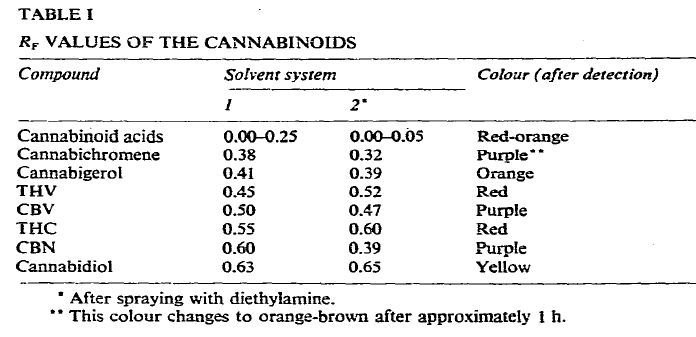
The Cannalytics test still appears to be similar to the method described in the following publication that uses untreated silica gel plates with chloroform/ 1,1 dichloroethane elutant.

Journal of Chromatography, 171 (1979) 509-511

Also see US Patent application 436093000  

That developing solution now appears to be also the extraction solution for the sample.

The rest of the changes are definite improvements, but shouldn't add substantially to the material costs.  They do increase the number of plates in the kit.

Remaining details can be found in the above sources for those that have a continuing interest.

It's entirely possible to assemble the components of the kit for much less than the kit costs.  Now that they also allow free access to the user manual on-line, the reference materials included with the kit can be easily found.

I do believe that there's much less use of analytical TLC in the USA than in European and Asian countries.  This probably arises from the greater assess to more costly HPLC and GC instruments in the US than a country such as India for example.

A random sampling of literature via a PubMed title search for the term "Thin Layer Chromatography" seems to indicate an almost 6x higher number of publications coming out of labs outside the USA.

I feel this bias is economically driven to a large extent, which in turn, suppresses the acceptance and use of TLC in the USA.   TLC is not traditionally taught as an analytical technique in US universities and remains mostly a qualitative technique.  TLC also requires a higher level of user skill and experience that is not required when using a HPLC.   Why learn a more difficult technique when there are much easier ways available which use high cost instrumentation that is commonly available in the US?  

There's other reasons of course.  I think HPLC had a significant lead time on development occuring in the 1970's and 1980's.  HPTLC was more in the 1980's to 1990's timeframe and only recently has been coupled with MS, while HPLC/MS systems have been available since the beginning of the 1990's.

- ender
« Last Edit: May 17, 2011, 02:51:17 AM by ender »