Author Topic: Synthesis of N-methyl-(3-methoxyphenyl)isopropylamine from phenylephrine  (Read 141 times)

Enkidu

  • Global Moderator
  • Foundress Queen
  • *****
  • Posts: 677
Synthesis of N-methyl-(3-methoxyphenyl)isopropylamine from phenylephrine
« on: December 14, 2010, 10:41:15 AM »
3-methoxymethamphetamine is a monoamine releaser that is not explicitly scheduled; however, it is a positional isomer of an internationally scheduled substance (4-methoxymethamphetamine). Some reports suggest that it is subjectively similar to MDMA. Phenylephrine is decongestant that has replaced pseudoephedrine in some products.

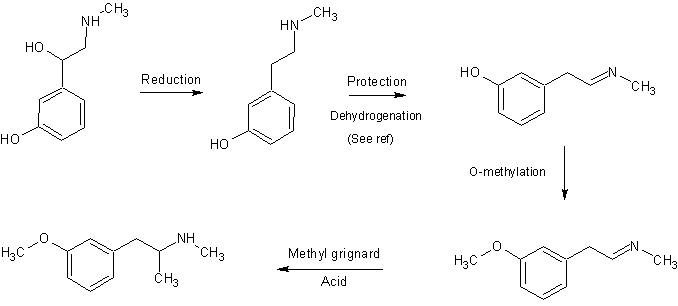
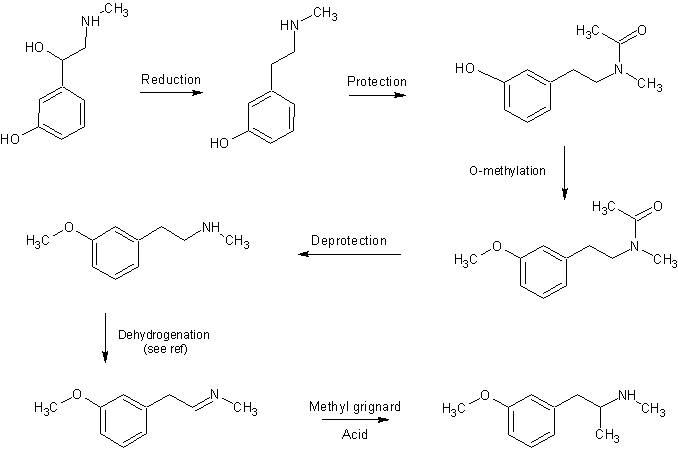
Here is my scheme: I've only included two references (both for the dehydrogenation), because the other reactions are well documented. That oxidation/dehydrogenation is the sticking point. Can anyone find better refs?

« Last Edit: December 14, 2010, 01:36:08 PM by Enkidu »

zzhuchila_clocker

  • Subordinate Wasp
  • ***
  • Posts: 167
Re: Synthesis of N-methyl-(3-methoxyphenyl)isopropylamine from phenylephrine
« Reply #1 on: December 14, 2010, 08:01:04 PM »
1-phenyl-2-aminopropanols are known to somehow undergo the similar rearrangement as corresponding diols do. i'll try to find a ref, or a place where i've seen it. this may save 2 steps.
As for shiff base, it may be methylated along with hydroxyl(protection should be needed), and may not survive while isolation and in aqueous media(in refs you mentioned more stable, ring conjugated imines are formed), so avoiding using methylamine would hardly be possible.
If it is hydrolysed while oxidation, and if oxidation is slow (starting material is present), then it may result in reaction of aldehyde with phenethylamine moiety to benzyl tetrahydroisoquinoline(ring is highly aqctivated by OH group).  In both papers only stable imines are made by this method, not a word about not conjugated ones - in second paper they are oxidized further to nitriles. Also no examples for OH group in phenyl radical, oxidation may occur. It seems scheme 3 is most possible then, i think..


« Last Edit: December 14, 2010, 08:24:39 PM by zzhuchila_clocker »
Who stuff the banks? Who staff the party ranks? More for Gore or the son of a drug lord?
None of the above, fuck it, cut the cord!
Lights out.. guerrilla radio
Turn that shit up

atara

  • Dominant Queen
  • ****
  • Posts: 256
Re: Synthesis of N-methyl-(3-methoxyphenyl)isopropylamine from phenylephrine
« Reply #2 on: December 14, 2010, 11:29:44 PM »
3-methoxymethamphetamine is a monoamine releaser that is not explicitly scheduled; however, it is a positional isomer of an internationally scheduled substance (4-methoxymethamphetamine). Some reports suggest that it is subjectively similar to MDMA. Phenylephrine is decongestant that has replaced pseudoephedrine in some products.

Here is my scheme: I've only included two references (both for the dehydrogenation), because the other reactions are well documented. That oxidation/dehydrogenation is the sticking point. Can anyone find better refs?


I suggested a route like this over at wetdreams.
The problem is, that phenylephrine is actually present in really tiny amounts in decongestants. Even from chemical suppliers it usually costs around $10/g, which is hard to justify considering the rather low potency of the final product.

The one other thing you might want to consider is that the formed imine is hydrolytically unstable, and so you ought to run the Grignard immediately after generating the imine, since the Grignard requires anhydrous conditions anyway.

This implies that you'll want to methylate the phenol before forming the imine, or you'll have to work with the phenolate salt to form the Grignard, which is going to be problematic due to low solubility in ether. Methylating a phenolate in presence of an amine requires a pretty selective reagent, though instinct says that quaternary ammonium compounds might work:
http://dx.doi.org/10.1016/j.tet.2008.10.024

Quote
1-phenyl-2-aminopropanols are known to somehow undergo the similar rearrangement as corresponding diols do. i'll try to find a ref, or a place where i've seen it. this may save 2 steps.

Now this is interesting!

Enkidu

  • Global Moderator
  • Foundress Queen
  • *****
  • Posts: 677
Re: Synthesis of N-methyl-(3-methoxyphenyl)isopropylamine from phenylephrine
« Reply #3 on: December 15, 2010, 02:54:26 AM »
Quite a bit of your post is unintelligible, zzhuchila.

Quote from: zzhuchila_clocker
As for shiff base, it may be methylated along with hydroxyl(protection should be needed)
Quote from: atara
The one other thing you might want to consider is that the formed imine is hydrolytically unstable, and so you ought to run the Grignard immediately after generating the imine, since the Grignard requires anhydrous conditions anyway. This implies that you'll want to methylate the phenol before forming the imine

No, I don't. First, the imine will not be alkylated at the nitrogen by DMS, DMC, or MeI. Thus, the imino function serves to protect the molecule from unwanted alkylation. Second, the imine is stable as long as no water is present. Even if the water of neutralization posed a problem, molecular sieves or azeotropic distillation could solve it.

Like I said, the oxidation of the amine to the imine is the sticking point. It IS possible, but I haven't seen good reagents proposed yet. Possibly Hg(OAc)2 as is suggested in Hudlickey's book.

Can you link me to your thread, atara?

zzhuchila_clocker

  • Subordinate Wasp
  • ***
  • Posts: 167
Re: Synthesis of N-methyl-(3-methoxyphenyl)isopropylamine from phenylephrine
« Reply #4 on: December 15, 2010, 01:33:33 PM »
maybe phenolate would be methylated faster then imine, but imine is also able to be methylated, maybe not in that extent(i mean, imino function is not used as a protection group to avoid methylation, afaik. nitrogen does not lose nucleophility).
about my above post, is something unclear? i meat practically same you said, that oxidation to imine is possible but there are no mentions of aliphatic imines formation in the refs you'd given, so some other methods or refferences are required.
What about 3-MeO-MCAT? is there any information about it? If OH group is first oxidized to C=O, then a-position of this ketone would be enolizable and possible to methylate, provided nitrogen is protected and the corresponding refferences found. If it is possible, then phenolic OH group and a-position can be methylated in one step. Nitrogen can be protected before oxidation, this would protect it from methylation as well. I wonder if a copper chelating of aminoketone would make protons in a-position acidic enough to be quantitatively abstracted by alkali and the resulting anion to be a nucleophilic enough to react with MeI. Otherwise, a nitrogen protection and a strong base deprotonation should be used
« Last Edit: December 15, 2010, 02:35:04 PM by zzhuchila_clocker »
Who stuff the banks? Who staff the party ranks? More for Gore or the son of a drug lord?
None of the above, fuck it, cut the cord!
Lights out.. guerrilla radio
Turn that shit up

Enkidu

  • Global Moderator
  • Foundress Queen
  • *****
  • Posts: 677
Re: Synthesis of N-methyl-(3-methoxyphenyl)isopropylamine from phenylephrine
« Reply #5 on: December 15, 2010, 02:39:19 PM »
maybe phenolate would be methylated faster then imine, but imine is also able to be methylated, maybe not in that extent(i mean, imino function is not used as a protection group to avoid methylation, afaik. nitrogen does not lose nucleophility).

http://en.wikipedia.org/wiki/Imine#Imine_reactions

Notice that alkylation at the nitrogen is conspicuously absent. An N-subbed ketimine acts more like a ketone than an amine. For further reading, I have attached a review about the chemistry of imines. If you want to continue to discuss this topic, please open a new thread. I don't want to muddy the waters here (more than they already are).

What about 3-MeO-MCAT? is there any information about it?

I looked, but I didn't see anything. My guess is that it would be of very low potency at the DAT. I'm also not 100% clear on the monoamine releasing abilities of the cathinones, i.e., whether they act as reuptake inhibitors and cocaine-type releasers solely or whether they exhibit a more amphetamine like pharmacologic profile.
« Last Edit: December 15, 2010, 02:52:59 PM by Enkidu »