


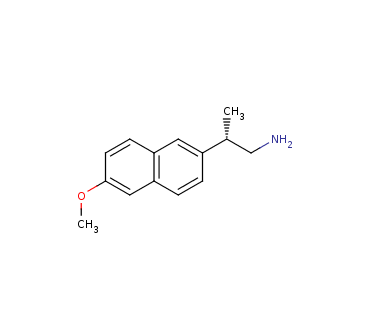
Some rudimentary experiments were performed on commercial Naproxen in an attempt to prepare a novel psychoactive material. A new method for borane reduction may have been devised.
Pihkal describes the Ganesha and 2C-G series, which have bulky carbon structures on the benzene ring. 2C-G-N is listed with a dosage of 20-40 mg and G-N seems not to have been tested. These and related materials are said to have quite long durations, and their activities are interesting but not phenomenomenal. Wikipedia claims that a beta-methyl group slows metabolism, and that b-methyl-PEA is a stimulant (although it doesn't seem too common).
About 1 gram of naproxen was extracted with ethanol, which works very well for that purpose, and partially dried to a fine chalky white paste. To this was added roughly 2/3 the volume of ammonium chloride and perhaps half that amount of sodium bicarbonate. The mixture was melted over an open flame in a crucible with stirring. Foaming developed immediately, though at no point was the scent of ammonia discernible. A white vapour soon formed, presumably ammonium chloride, accompanied the colour change to a light amber, at which point the dehydration was judged sufficient. The mass had taken on a peculiar heavy aroma, which was first described as "dank honey", but with an orientally floral quality to it.
Approximately a 6x6 square of aluminium foil was lightly dusted with boric acid and some magnesium turnings included, which was then rolled up and further compressed to about a cubic centimeter. The amount of H3BO3 was intended to leave an excess of metal from both the oxide and boride (to increase the likelihood of lower borides, higher borides being less prone to hydrolysis). This cube was then roasted to a viscous liquid blob, cooled and broken in half. Dark inclusions were likely magnesium boride.
About a third of the amide melt was dissolved in 91% Isopropanol, to which was added the two chunks of the boridiferous material and some granular 83% sodium bisulfate. A couple bubbles were immediately apparent, heating dramatically sped up the rate of gas evolution, likely a mixture of hydrogen and borane. The characteristic borane odour was noticed, somewhat like a bad fart, but was more profound after the water seemed to have been consumed, at which point some white fumes were observed to form on contact with the air (ossibly from isopropanol vapour), sometimes descending back into the test tube before dissipating. Gradually the amber solution turned to light yellow, and the tube submerged in cool water.
Later, the reaction was attempted again, but without inclusion of magnesium in the boride roll. The amide was re roasted to a somewhat darker colour, and the presumably amide scent was heavier. The gas evolution was far less extreme even with heating, and the odour was less obnoxiously fart like and more ham like. A water bath was used this time, although the experimenter walked away a trifle too long to find a dried tube. Although the solution did not become much lighter when the reaction was first observed, an attempt at re-extraction had a nihilistically weak colour.
The first solution continued to reek despite being partially boiled off. Finally its vapour was ignited, the greenish flame quickly became orange, and the stink was largely gone. On cooling in a freezer the concentrated solution produced some crystals of naproxen. The rest of the liquor however was diluted with water, the isopropanol boiled off, and made basic with bicarbonate of soda. This was imbibed and there was an amine taste (not ammonia) along with a lingering sweetness in the throat (probably naproxen).
We apologise for the poor quality of the notes! If the experimenter had thought this had a chance of actually working, I'm assured they would have been better.
The experimenter writes:
"Stimulation was noticed within the half hour and lasted perhaps two more, some visual fuzzy turbulence was experienced but mild. Heart beat doubled up once in a while. Could have been psychosomatic... My thinking seems to be louder if that makes sense."
The second attempt, imbibed several hours after the first, produced "no stimulation like the other sample seemed to, nor did it taste amine-ly. Some hours later (2? 3?) something seemed to happen, looking around in the dark gave me a paradoxical strobe-ing effect and objects flowed a tiny bit, but that was likely me just being tired [1:00 in the morning]. I don't feel quite the same to this day, [the next day] a little better actually, but if that really was an effect that's an outrageous latency.
"At higher levels the stuff might be quite pleasant even interesting if either of the two experiences were representative... Perhaps they both were and the first one inured me to it's stimulating action, or the dehydration did something funky to the structure? Who knows. "
[I'm told the second solution didn't have an amine taste, but wasn't fully neutralised either.]
This effect is allegedly comparable to a low dose of MDMA, which neither I nor the experimenter have tried.
As to the mechanism of the borane reduction, it seems that while diborane is desirable, itself produced from hydrolysis of the aluminium boride in low yield, tetraborane seems to have been effective as well, which is apparently the major product of the hydrolysis of magnesium boride (1% in HCl up to 11% in phosphoric acid). If I remember corectly, sodium bisulfate, on dissolution in alcohol gives Na2SO4 and the monoalkyl sulfate (in this case monoisopropyl sulfate).
According to a paper in references, tetraborane reacts with ethanol at -78 deg C to give di and triethoxy borane. The isopropoxy derivatives may form analogously, and the di and mono-isopropoxy borane, a likely intermediate, may be responsible for the reduction of the amide in solution. Tetraborane may even have been involved directly (enough escaped to be detected and give the experimenter a headache), although I have yet to see any reference to such tetraborane reductions.
Several improvements suggest themselves. Firstly, the use of anhydrous isopropanol, for obvious reasons. Secondly, perhaps the dynamics could be tweaked towards higher yield by using a different alcohol, butanol perhaps, allowing more of the mono and di-alkoxyboranes to form selectively, and stay in solution longer before evaporating. Thirdly, though the experimenter is under the impression that a combination of Mg and Al boride is optimal, a better quality and adjusted ratios might be best. The crude method above was obviously chosen for the sake of convenience. Fourthly, microwave heating would no doubt improve the dehydration to amide as has been pointed out in various places.
If this wasn't all delusion, illusion, or outright hallucination on the experimenter's part, we hope that this becomes a workable and convenient reduction for home chemists everywhere.
Pihkal describes the Ganesha and 2C-G series, which have bulky carbon structures on the benzene ring. 2C-G-N is listed with a dosage of 20-40 mg and G-N seems not to have been tested. These and related materials are said to have quite long durations, and their activities are interesting but not phenomenomenal. Wikipedia claims that a beta-methyl group slows metabolism, and that b-methyl-PEA is a stimulant (although it doesn't seem too common).
About 1 gram of naproxen was extracted with ethanol, which works very well for that purpose, and partially dried to a fine chalky white paste. To this was added roughly 2/3 the volume of ammonium chloride and perhaps half that amount of sodium bicarbonate. The mixture was melted over an open flame in a crucible with stirring. Foaming developed immediately, though at no point was the scent of ammonia discernible. A white vapour soon formed, presumably ammonium chloride, accompanied the colour change to a light amber, at which point the dehydration was judged sufficient. The mass had taken on a peculiar heavy aroma, which was first described as "dank honey", but with an orientally floral quality to it.
Approximately a 6x6 square of aluminium foil was lightly dusted with boric acid and some magnesium turnings included, which was then rolled up and further compressed to about a cubic centimeter. The amount of H3BO3 was intended to leave an excess of metal from both the oxide and boride (to increase the likelihood of lower borides, higher borides being less prone to hydrolysis). This cube was then roasted to a viscous liquid blob, cooled and broken in half. Dark inclusions were likely magnesium boride.
About a third of the amide melt was dissolved in 91% Isopropanol, to which was added the two chunks of the boridiferous material and some granular 83% sodium bisulfate. A couple bubbles were immediately apparent, heating dramatically sped up the rate of gas evolution, likely a mixture of hydrogen and borane. The characteristic borane odour was noticed, somewhat like a bad fart, but was more profound after the water seemed to have been consumed, at which point some white fumes were observed to form on contact with the air (ossibly from isopropanol vapour), sometimes descending back into the test tube before dissipating. Gradually the amber solution turned to light yellow, and the tube submerged in cool water.
Later, the reaction was attempted again, but without inclusion of magnesium in the boride roll. The amide was re roasted to a somewhat darker colour, and the presumably amide scent was heavier. The gas evolution was far less extreme even with heating, and the odour was less obnoxiously fart like and more ham like. A water bath was used this time, although the experimenter walked away a trifle too long to find a dried tube. Although the solution did not become much lighter when the reaction was first observed, an attempt at re-extraction had a nihilistically weak colour.
The first solution continued to reek despite being partially boiled off. Finally its vapour was ignited, the greenish flame quickly became orange, and the stink was largely gone. On cooling in a freezer the concentrated solution produced some crystals of naproxen. The rest of the liquor however was diluted with water, the isopropanol boiled off, and made basic with bicarbonate of soda. This was imbibed and there was an amine taste (not ammonia) along with a lingering sweetness in the throat (probably naproxen).
We apologise for the poor quality of the notes! If the experimenter had thought this had a chance of actually working, I'm assured they would have been better.
The experimenter writes:
"Stimulation was noticed within the half hour and lasted perhaps two more, some visual fuzzy turbulence was experienced but mild. Heart beat doubled up once in a while. Could have been psychosomatic... My thinking seems to be louder if that makes sense."
The second attempt, imbibed several hours after the first, produced "no stimulation like the other sample seemed to, nor did it taste amine-ly. Some hours later (2? 3?) something seemed to happen, looking around in the dark gave me a paradoxical strobe-ing effect and objects flowed a tiny bit, but that was likely me just being tired [1:00 in the morning]. I don't feel quite the same to this day, [the next day] a little better actually, but if that really was an effect that's an outrageous latency.
"At higher levels the stuff might be quite pleasant even interesting if either of the two experiences were representative... Perhaps they both were and the first one inured me to it's stimulating action, or the dehydration did something funky to the structure? Who knows. "
[I'm told the second solution didn't have an amine taste, but wasn't fully neutralised either.]
This effect is allegedly comparable to a low dose of MDMA, which neither I nor the experimenter have tried.
As to the mechanism of the borane reduction, it seems that while diborane is desirable, itself produced from hydrolysis of the aluminium boride in low yield, tetraborane seems to have been effective as well, which is apparently the major product of the hydrolysis of magnesium boride (1% in HCl up to 11% in phosphoric acid). If I remember corectly, sodium bisulfate, on dissolution in alcohol gives Na2SO4 and the monoalkyl sulfate (in this case monoisopropyl sulfate).
According to a paper in references, tetraborane reacts with ethanol at -78 deg C to give di and triethoxy borane. The isopropoxy derivatives may form analogously, and the di and mono-isopropoxy borane, a likely intermediate, may be responsible for the reduction of the amide in solution. Tetraborane may even have been involved directly (enough escaped to be detected and give the experimenter a headache), although I have yet to see any reference to such tetraborane reductions.
Several improvements suggest themselves. Firstly, the use of anhydrous isopropanol, for obvious reasons. Secondly, perhaps the dynamics could be tweaked towards higher yield by using a different alcohol, butanol perhaps, allowing more of the mono and di-alkoxyboranes to form selectively, and stay in solution longer before evaporating. Thirdly, though the experimenter is under the impression that a combination of Mg and Al boride is optimal, a better quality and adjusted ratios might be best. The crude method above was obviously chosen for the sake of convenience. Fourthly, microwave heating would no doubt improve the dehydration to amide as has been pointed out in various places.
If this wasn't all delusion, illusion, or outright hallucination on the experimenter's part, we hope that this becomes a workable and convenient reduction for home chemists everywhere.


 jo00945a015.pdf