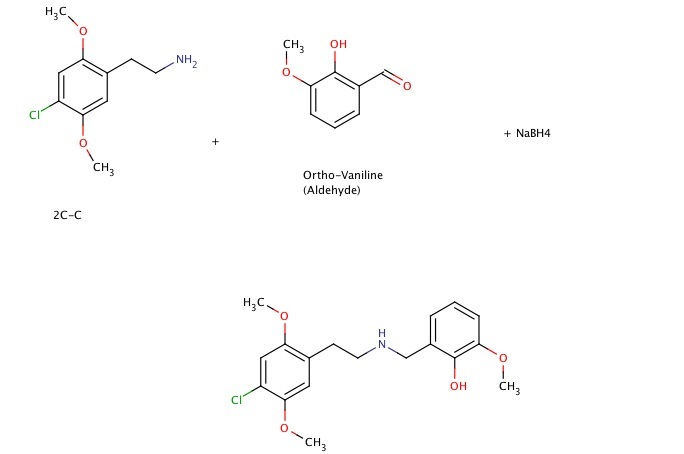
it would be practical to just buy the phenylethylamine and reductively aminate it with anisyl aldehyde.
yeilds are good 87% or so.
considering the potency of the stuff it would be logical to buy 2-CI for 125 bucks a gram for example and just do the one reaction.
it retails for between 4 and 10 grand a gram.
LSD prices.
also i'm curious about the n-benzyl-2-methoxyderivative of 5 methoxy tryptamine?
has anyone any pharmacological data on this?
i know it is a potent 5HTa agonist.
i was just wondering how potent it is and it's qualitative effects.
it looks like the closest phamacophore of lsd of all of these compounds and access to 5-methoxy tryptamine is easyly avalialble from melatonin
this is exemplary of how it could be done:
Method 7 (stepwise reductive alkylation)
In a baked dry flask (150 °C, 72 h) 0.35 g (1.84 mmol) 5-Methoxytryptamine under N2-atmosphere in 25 mL absolute MeOH is dissolved. A solution of 0.20 g (1.88 mmol) benzaldehyde in 1.0 mL absolute MeOH, are added at room temperature via syringe within 30 min dropwise and the Reaction solution is stirred at room temperature until the benzaldehyde has completely finished reacting(1.5 h).The DC inspection still shows unreacted 5-Methoxytryptamine, a few drops of the Benzaldehyde are added once again and stirred at room temperature until a quantitative reaction revenue is reached. The Imine formed in situ is reduced by addition of 0.21 g (5.52 mmol) Sodium Borohydride(NaBH4). After 1 h the reaction is terminated by carefully adding 10 mL water, MeOH is removed on a rotary evaporator, the residue is basified with NaOH (c = 3 mol ? L-1) (pH = 11) and extracted with CH2Cl2 (5 ×
30 mL). The combined CH2Cl2 phases are diluted with water (3 × 20 mL) and sat. NaCl
Sol (1 × 30 mL), dried over MgSO4, filtered and concentrated under vacuum. The isolated colorless solid is taken up in CH2Cl2 and cleaned via rotation planar chromatography (FM: CH2Cl2 + PE = 6 + 4, NH3-Atm.).
[2-(2,5-Dimethoxy-4-iodophenyl)ethyl]-(2-methoxybenzyl)amine (236)
The synthesis takes place via a gradual reductive alkylation analogous to Method 7 (Abschn. 5.3.2, P. 233) with 0.23 g (0.75 mmol) of the primary Amine 42 and 0.12 g (0.88 mmol) 2-Methoxybenzaldehyde in 20 mL absolute MeOH. After 5 h again a few drops of Aldehyde admitted, stirred for 12 h and reduced with 0.28 g (7.5 mmol) NaBH4. The resulting orange oil (0.45 g) will be dissolved in a little CH2Cl2 and then 45g of silica gel using flash chromatography.(FM: CHCl3 + MeOH (NH3) = 98 + 2).
Yield: 0.25g (0.59mmol) colorless oil (79% d. Th)
C18H22INO3 (Mr= 427.27) free Base
Crystalization as Hydrochloride:
A part of the free Base (0.20 g, 0.47 mmol) is dissolved in a little absolute Et2O and under stirring a solution of 1 mL i-PrOH/HCl (c ? 5 - 6 mol * L-1) in 10 mL absolute Et2O is added dropwise. The Reaction solution, is stored for 48 h at -18 °C, the colorless solid is centrifuged, washed with absolute Et2O and dried for 8 h in high vacuum (10-2 Torr, room temperature).
Yield: 0.20g (0.43mmol) colorless solid (92% d. Th)
DC: CHCl3 + MeOH(NH3)= 98 + 2 (RF=0.20)
Fp: 166*C