
Author Topic: Back to front - MDA via a-methylcaffeic acid  (Read 462 times)

no1uno

  • Global Moderator
  • Foundress Queen
  • *****
  • Posts: 681
Back to front - MDA via a-methylcaffeic acid
« on: April 19, 2011, 10:30:39 AM »
Ok, we have all had one or more encounters with trying to get that fucking methyl alcohol off vanillin (presumption). The difficulty is and will always be, that the vulnerable aldehyde is just that, vulnerable.

Now, I'm also presuming that most everyone here can also find (http://www.sciencemadness.org/talk/viewthread.php?action=printable&fid=10&tid=9706) Klute's sterling work on the condensation of Acetone & Vanillin to get the Zingerone, whereas if one used HCl/MEK one would presumably get the equivalent a-methyl-phenylbutanone. Now, peracid oxidations aren't high on my list of things to even contemplate with crap/no glass, but I'm bloody certain I've seen more than one paper where the hypochlorite oxidation of the methyl ketone would result in 3-methoxy-4-hydroxy-a-methylcinnamic acid. Now, there really shouldn't be any great difficulty in demethylating the a-methylcinnamic acid (if there is, reduction with boiling ethanol Ni/C should get rid of the double-bond).

That would give 3,4-dihydroxyphenyl-2-methyl-propanoic acid (or something like that - the a-methylcaffeic acid - http://en.wikipedia.org/wiki/Caffeic_acid - or the hydrocaffeic acid). Reduction (if the double bond is still there), then methylation with DCM/KI/etc. should give a bloody robust intermediate.

3,4-methylenedioxy-a-methylhydrocaffeic acid should form an amide easily enough, hypochlorite oxidation of that would be a bad idea as it would give MDA.

Attached there is an electrolytic procedure for reducing cinnamic acid in 90% yield, which should do. I'm waiting on a number of references, I know Woodruff & Conger used hypochlorite to reach a-methylcinnamic acid & they also made the amine by the Hoffman degradation of the hydrogenated amide. So that part is documented. I'll have a look around for a decent system for ether cleavage, but HI/HBr would do it (once the double-bond is gone). Simple, easy, no hard to get anything - or the need for massive amounts of equipment outlay.
« Last Edit: April 19, 2011, 11:38:40 AM by no1uno »
"...     "A little learning is a dang'rous thing;
    Drink deep, or taste not the Pierian spring:
    There shallow draughts intoxicate the brain,
    And drinking largely sobers us again.
..."

Wizard X

  • Lord of the Realms
  • Foundress Queen
  • *****
  • Posts: 1,224
Re: Back to front - MDA via a-methylcaffeic acid
« Reply #1 on: April 20, 2011, 01:02:57 AM »
I post this back in the Hive days. More here http://www.zoklet.net/bbs/archive/index.php/t-32584.html

"Caffeic acid (3,4-dihydroxycinnamic acid) from green coffee (unroasted) contains about 6% total Caffeic acid and Chlorogenic acid (hydrolysis of chlorogenic acid gives caffeic acid). It is also found in roasted coffee. Isolation from green coffee beans, J. Agr. Food. Chem Vol 8, pg 58 (1960) & roasted coffee, Arch. Pharm. Vol 293, pg 721 (1960). One kilo of ground coffee beans yields approx 50-55 grams of caffeic acid. Both caffeic acid and caffeine are freely soluble in boiling water..."

- WizardX


That just screams MDA from coffee beans does it not? :D If xxxxxxxx becomes scheduled the method in my last post should still be assessable though this I'd think. Anyways, after extraction I'd assume one could methylenate the caffeic acid like a catechol and subsequently hydrogenate the resulting product for 3,4-MD-phenylpropionic acid. I adapted a couple existing procedures (refs available) to hopefully result in the desired carboxylic acid...

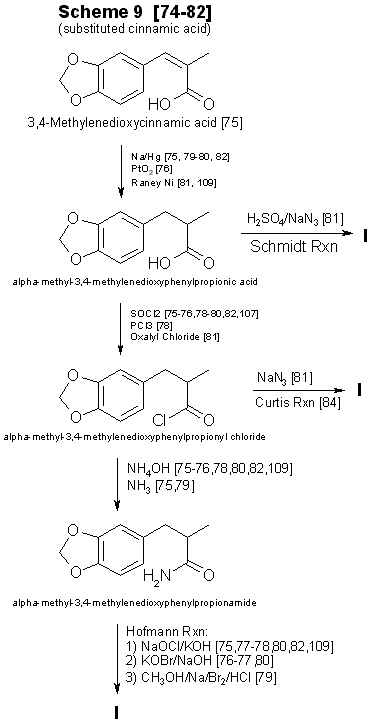
Experiemental:

A solution of 18 g of 3,4-dihydroxycinnamic acid, 12 ml of 50% aqueous sodium hydroxide and 20 ml of DMSO is heated to 98 C and stirred at that temperature for 30 minutes. This solution at 98 C. is then added over a 30 minute period to a refluxing solution of 12 ml of DCM in 30 ml of DMSO. Thereafter, the reaction mixture will be stirred at reflux for 1 hour. Steam is passed into the mixture to achieve steam distillation of the product. The distillate (100 ml) is extracted with 10 ml of DCM, and the extract washed once with 10 ml of water. The DCM solution should then be concentrated in vacuo at 40 C to yield product.


A soultion of 19 g of 3,4-methyenedioxycinnamic acid and 550 ml of 10% sodium hydroxide solution. The mixture is warmed to 90 C. 55 g of nickel-aluminum alloy powder is added in small portions. Addition should be complete within an hour and the mixture should be maintained at 90–95 C for 1 hour further. The mixture is then filtered, and the metallic residue is washed with 50 ml of hot 10% sodium hydroxide solution and two 50 ml portions of hot water in such a manner that the solid is always covered with liquid. The cooled filtrate and washings are added dropwise to 300 ml of concentrated hydrochloric acid at such a rate that the temperature does not exceed 80–85 C. Separation should begin as contents are cooled to room temp.


Notes:

1. I'm not sure if the COOH might interfere in the methylenation. If so, one might prepare 3,4-dihydroxyamphetamine and then methyenate as a last step. Maybee?

2. Cinnamic acid derivitives are notoriously hard to reduce. Our choice of catalyst seems limited to Na/Hg, Raney nickle or platinum dioxide. Possibly possibly possibly Pd/C.

Preparation of 3,4-dihydroxystyrene. http://www.freepatentsonline.com/5324804.html

200 g (1.11 mol) of caffeic acid are dissolved in 1.2 l of dimethyl formamide dissolved and the solution is stirred for 3 h at 150° C. After cooling to room temperature, the solution is poured on to 3 kg of ice, saturated with sodium chloride and extracted twice with ethyl acetate. The organic phase is washed with 2% NaHCO3 solution and then with water, dried over Na2SO4 and concentrated by evaporation, giving 120 g (80% ) of a highly viscous liquid which can be recrystallised from toluene. The substance is, however, sufficiently pure and can be further processed without recrystallisation.

Elemental analysis: calcd=C: 70.52, H: 5.97; found=C: 70.25, H: 6.02.

1 H-NMR (CDCl 3 /DMSO): ?=4.99; 5.03; 5.44; 5.51 ppm (dd, 2H); ?=6.47; 6.50; 6.53; 6.56 ppm (m, 1H); ?=6.66-6.74; 6.74; 6.89 (m, 3H); ?=8.53 ppm (s, 1H); ?=8.63 ppm (s, 1H).
« Last Edit: July 19, 2011, 12:43:06 AM by Enkidu »
Albert Einstein - "Great ideas often receive violent opposition from mediocre minds."

no1uno

  • Global Moderator
  • Foundress Queen
  • *****
  • Posts: 681
Re: Back to front - MDA via a-methylcaffeic acid
« Reply #2 on: April 20, 2011, 08:05:51 PM »
No, but one can get vanillin awfully easily

WizX, it is now known that there are at least two options when performing the methylenation of even 4-allylcatechol with DCM, the use of CuO with DMSO & DCM is said to provide better yields than are possible with vanillin (less prone to oxidation).

The 3,4-methylenedioxy-a-methylhydrocinnamic acid would be an absolute shoe in for a simple cheap route to MDA (via the Hoffman on the amide). Nothing hard to get, well HBr is not easily sourced here, but nothing overly complex. Transfer hydrogenation of that double bond using Aluminium-based/Al-Ni based catalysts should be easy enough.

In terms of simplicity, I don't think it could be beaten, certainly not easily... However simplicity comes at a price, I'd be expecting the overall yield to be in the region of about 1/4 (at best) based upon the starting vanillin. That said, vanillin is cheap (especially the synthetic one - which would be the best option anyway, natural vanillin contains ethyl, acetyl- etc). Vanillin is cheap as shit, aniline hydrochloride is two steps from benzoic acid, while pyridine hydrochloride is two steps from nicotinic acid, the simplicity & robust nature of the substrate suggests that this would allow the AlCl3/H2SO4 cleavage (if required). MEK isn't precisely expensive or is HCl, or for that matter hypochlorite bleach. This is a cheap & nasty route, which doesn't really look to optimize output, but which requires an absolute minimum of equipment (and no nitroethane).

PS Sinapinic acid would be the best of the "natural" product cinnamic acids IMHO - 3,4,5-trihydroxycinnamic acid, exhaustive methylation would give methyl-3,4,5-trimethoxycinnamate, ammonia gas passed through which would give 3,4,5-trimethoxycinnamide. CTH of that would give 3,4,5-trihydroxyphenylpropionamide, a Hoffman of which would give Mescaline.
« Last Edit: April 20, 2011, 08:17:37 PM by no1uno »
"...     "A little learning is a dang'rous thing;
    Drink deep, or taste not the Pierian spring:
    There shallow draughts intoxicate the brain,
    And drinking largely sobers us again.
..."

Wizard X

  • Lord of the Realms
  • Foundress Queen
  • *****
  • Posts: 1,224
Re: Back to front - MDA via a-methylcaffeic acid
« Reply #3 on: April 20, 2011, 11:34:18 PM »
WizX, it is now known that there are at least two options when performing the methylenation of even 4-allylcatechol with DCM, the use of CuO with DMSO & DCM is said to provide better yields than are possible with vanillin (less prone to oxidation).

The 3,4-methylenedioxy-a-methylhydrocinnamic acid would be an absolute shoe in for a simple cheap route to MDA (via the Hoffman on the amide). Nothing hard to get, well HBr is not easily sourced here, but nothing overly complex. Transfer hydrogenation of that double bond using Aluminium-based/Al-Ni based catalysts should be easy enough.

Caffeic acid, 3,4-Dihydroxy-cinnamic acid,

I'm not sure if the COOH on the caffeic acid will/might interfere with CuO, DMSO & DCM in the methylenation? The CuO will react with the COOH. If so, one might prepare 3,4-dihydroxyamphetamine and then methyenate as a last step. Maybe?

I concur, however, how do you propose to synthesize the 3,4-methylenedioxy-a-methylhydrocinnamic acid from Caffeic acid, 3,4-Dihydroxy-cinnamic acid?

Caffeic acid, 3,4-Dihydroxy-cinnamic acid,

3,4-(Methylenedioxy)cinnamic acid, http://www.chemblink.com/products/2373-80-0.htm 


Can anyone spot the error at http://www.erowid.org/archive/rhodium/chemistry/mda.dalcason.html

Albert Einstein - "Great ideas often receive violent opposition from mediocre minds."

Sedit

  • Global Moderator
  • Foundress Queen
  • *****
  • Posts: 2,099
Re: Back to front - MDA via a-methylcaffeic acid
« Reply #4 on: April 20, 2011, 11:50:21 PM »
I have been searching for a way for sometime now and perhaps this is a good time to ask, is there a means of Methylating that alkene. IE: place a methyl group across a double bond. I have seen many things that seem common sense but nothing specific to what im looking for.
There once were some bees and you took all there stuff!
You pissed off the wasp now enough is enough!!!

atara

  • Dominant Queen
  • ****
  • Posts: 256
Re: Back to front - MDA via a-methylcaffeic acid
« Reply #5 on: April 21, 2011, 08:53:48 AM »
From the methyleneated derivative of caffeic acid, my first guess is the catalytic cinnamic Hunsdiecker:

http://pubs.acs.org/doi/abs/10.1021/jo025868h

From the methylenedioxy-halostyrene, a number of routes are available. A Grignard reaction utilizing a methyl halide and a copper (I) salt produces isosafrole.

Basic hydrolysis produces methylenedioxyphenylacetaldehyde; an olefination gives safrole.

Methyleneations of this aldehyde exist, including the famous Wittig and less famous Corey-Chaykovsky reactions based on phosphonium and sulfonium/sulfoxonium ylides respectively, and a reaction using bis(iodozincio)methane described here -- titanium tetrachloride and zinc may sound at first like an attractive reagent mixture but TiCl4 or "tickle" as it is known is volatile highly toxic and hydrolytically unstable to the point of being pyrophoric and I'd frankly rather work with lead chloride, which is ironically a safer catalyst for the zinc olefination.

The "classic" Takai olefination uses iodoform and CrCl2, producing safrole-plus-an-iodine-atom which has no name because "iodosafrole" means something entirely different. The resulting safrole-plus-an-iodine-atom can be reduced quite easily to safrole. This is the most attractive option, considering the ease of generating iodoform (I2 / acetone / NaOH) and the safety of CrCl2 -- far superior to phosphines and titanium halides.

The problem with most methylations is that you have to use methylating reagents to accomplish them -- this is always harder than it should be. The Takai reactions -- chromium (II) couplings are interesting but perhaps hampered by the fact that iodinated reagents are absolutely required -- a rxn that with iodoform gives 87% yields gives only 32% yields with bromoform and nothing with chloroform.
« Last Edit: April 21, 2011, 09:41:53 AM by atara »

letters

  • Subordinate Wasp
  • ***
  • Posts: 138
Re: Back to front - MDA via a-methylcaffeic acid
« Reply #6 on: April 22, 2011, 03:22:36 AM »
atara : the catalytic hunsdiecker works well.
phosphonium wittig (or Horner-Wadsworth-Emmons variation) isnt that bad. triphenylphosphine is ok (for the wittig) and so are the dialkoxyphosphines (for the horner).
the horner can sometimes even be carried out under biphasic ptc conditions (orgsyn has a procedure iirc).

if it was the non alpha methylated you would want to make, id suggest a buchwald-hartwig amination of the halo-styrene followed by a quick hydrogenation of the double bond with pd. if you protect your amine with benzyl, you can unprotect and hydrogenate the double in a single reaction.

no1uno

  • Global Moderator
  • Foundress Queen
  • *****
  • Posts: 681
Re: Back to front - MDA via a-methylcaffeic acid
« Reply #7 on: April 23, 2011, 02:56:43 AM »
Not what I am talking about - check the attached files - the acid-catalyzed crossed aldol condensation between vanillin and MEK gives the expected a-methylphenylbutenone, which on oxidation with hypochlorite gives (as a methyl ketone) the a-methylcinnamic acid and chloroform. Reduction of this, followed by methylenation of the phenolic diol, would give a-methyl-3,4-methylenedioxyphenylpropionic acid. Form the amide from that (I think the ethyl ester would probably be a better bet - it is going to be a liquid at a much lower temperature, then a Hoffman reaction (hypochlorite again) directly to MDA.

The use of CuO and Methylene Chloride to achieve decent yields in the methylenation, the fact that if you have HI you can reduce the double-bond & remove the methyl ether in one go, plus the ease of access for each step's chemicals, make this a very, very OTC route. Personally I'd try the methylenation straight after forming the ester (post-reduction). The ester will be in the same phase as the DCM, thus removing the need for PTC, while it should not fuck with the CuO. Nice and back to front, there is no need to fuck around with peracids if adding chlorine and NaOH to the reaction mixture will do the job (albeit twice). The other stage in which methylenation 'could' be tried, is straight after forming the hydrocinnamamide - I strongly doubt the amide will interfere with either the methylenation or the CuO. I choose this route due to the simplicity of the various reactions, the ease with which the various components can be sourced (MEK is not precisely hard to find), Copper powder is available for fuck all, DCM is piss easy to find, so is chlorine, NaOH & dry hydrogen chloride gas.

It isn't as "nice" as safrole, no it ain't. Then again, there is no fucking around with "wackers", Pd-salts, Hg-salts and reductive amination.

« Last Edit: April 23, 2011, 08:53:31 AM by no1uno »
"...     "A little learning is a dang'rous thing;
    Drink deep, or taste not the Pierian spring:
    There shallow draughts intoxicate the brain,
    And drinking largely sobers us again.
..."

akcom

  • Dominant Queen
  • ****
  • Posts: 430
Re: Back to front - MDA via a-methylcaffeic acid
« Reply #8 on: May 30, 2011, 08:31:16 PM »
atara : the catalytic hunsdiecker works well.
phosphonium wittig (or Horner-Wadsworth-Emmons variation) isnt that bad. triphenylphosphine is ok (for the wittig) and so are the dialkoxyphosphines (for the horner).
the horner can sometimes even be carried out under biphasic ptc conditions (orgsyn has a procedure iirc).

if it was the non alpha methylated you would want to make, id suggest a buchwald-hartwig amination of the halo-styrene followed by a quick hydrogenation of the double bond with pd. if you protect your amine with benzyl, you can unprotect and hydrogenate the double in a single reaction.
I'm just curious and too lazy to search it, but is the BH amination of vinyl halide well known in literature?  What sort of ligands are they using to affect this?  I'd imagine there would be a number of competing reaction pathways you'd have to minimize via your ligand choice.

no1uno

  • Global Moderator
  • Foundress Queen
  • *****
  • Posts: 681
Re: Back to front - MDA via a-methylcaffeic acid
« Reply #9 on: June 03, 2011, 10:13:19 AM »
That Catalytic Hunsdiecker Reaction in DCM using Triethylamine as the catalyst (with N-bromosuccinimide) looks bloody tasty - it would give direct access in decent yields to 3,4-methylenedioxy-2-bromopropane which would shit all over a route to Safrole IMHO. Getting hold of the Tritheylamine and the Succinimide aren't precisely the easiest tasks (they'll either have to be bought or synthesized), but with the MD-2-bromopropane to hand (rapidly) then either ammonia/methylamine to give MDA/MDMA respectively. Nice find.
"...     "A little learning is a dang'rous thing;
    Drink deep, or taste not the Pierian spring:
    There shallow draughts intoxicate the brain,
    And drinking largely sobers us again.
..."

letters

  • Subordinate Wasp
  • ***
  • Posts: 138
Re: Back to front - MDA via a-methylcaffeic acid
« Reply #10 on: June 03, 2011, 10:27:51 AM »
akcom : i cant remember off the top of my head which ones are commonly used to affect the BH amination of vinyl halides, but from my experience with BH aminations, 3rd-4th gen. JOSIPHOS/adamantyl type ligands work for almost everything. ill try to dig up some refs from my collection and ul here.