Author Topic: Proposed tryptophan --> lysergic acid via ulhe imine  (Read 297 times)

heisenberg

  • Dominant Queen
  • ****
  • Posts: 268
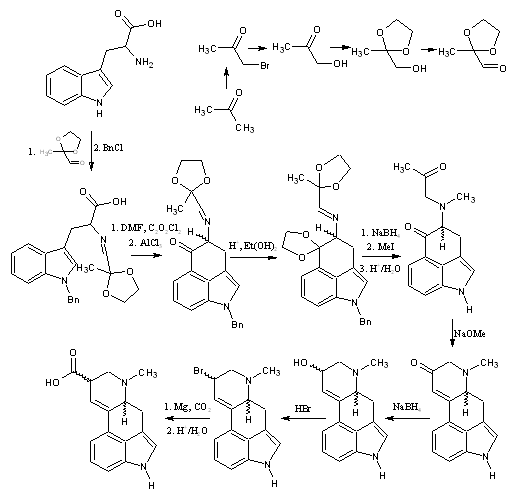
Proposed tryptophan --> lysergic acid via ulhe imine
« on: June 21, 2011, 08:45:20 PM »
The drawing assumes that racemic tryptophan is used, which probably wouldn't happen. L-tryptophan is both OTC and produces the correct chirality on one of the chiral centers of the final product, so the yield is only halved once.

1/2 mole of tryptophan would be about 100g, and 500ml of acetone could be reacted into about 1/2 mole of the (not sure on name) ethylene-glycol protected acetone 3-aldehyde. If a 60-80% yield average could be maintained over the subsequent steps, it could be a 1-15% conversion of tryptophan to 1:1 lysergic acid:isolysergic acid.

Here are procedures from rhodium and orgsyn for the first two steps of of the acetone product:

Quote
A 5-L, three-necked, round-bottomed flask is provided with an efficient mechanical stirrer, a 48-cm. Allihn reflux condenser, a thermometer, and a 500ml separatory funnel, the stem of which reaches nearly to the bottom of the flask.
Through the separatory funnel are introduced 1.6 1. of water, 500ml of pure acetone, and 372 ml of glacial acetic acid. The stirrer is started and the temperature of the water bath is raised to 70-80°C, so that the mixture in the flask is at about 65°C. Then 354 ml (7.3 moles) of bromine is carefully added through the separatory funnel. The addition, which requires one to two hours, is so regulated as to prevent the accumulation of unreacted bromine As a rule the solution is decolorized in about twenty minutes after the bromine has been added. When the solution is decolorized, it is diluted with 800 ml of cold water, cooled to 10°C, made neutral to Congo red with about 1 kg. of solid anhydrous sodium carbonate, and the oil which separates is collected in a separatory funnel and dried with 80g of anhydrous calcium chloride. After drying, the oil is fractionated and the fraction boiling at 38-48°C/13 mmHg is collected. The yield is 470-480 g. (50-51% yield). If a purer product is desired, the above product is refractionated and the fraction boiling at 40-42°C/13 mmHg is collected. The yield is 400-410 g. (43-44% yield).
The higher-boiling fraction contains a mixture of isomeric dibromoacetones.

Quote
In a 3-l. round-bottomed flask fitted with a 75-cm. Liebig condenser is placed 210 g. of potassium hydroxide (purified with alcohol) dissolved in 1.5 l. of anhydrous methyl alcohol. The solution is cooled to below 50° (Note 1), 300 g. of purified ethyl formate is added, and the mixture is refluxed for two hours (Note 2) and (Note 3).
Then 410 g. (251 cc., 3 moles) of bromoacetone (p. 88) is added, and the mixture is refluxed for sixteen hours on a water bath at 95–97°. At the end of the operation the solution is cooled to 0° in an ice-salt bath. The potassium bromide which settles is filtered on a cooled suction filter, and the filtrate is fractionated.
The fraction boiling at 23–35°/12 mm. is discarded, as it contains very little acetol. The main fraction distils at 35–47°/12 mm. and weighs 160 g. This material is refractionated, and the portion boiling at 40–43°/12 mm. is collected. The yield is 120–130 g. (54–58 per cent of the theoretical amount) (Note 4).

After this, the protection of the carbonyl could probably be done using ethylene glycol as the solvent with some sulfuric acid. After refluxing for a while, distill off the ethylene glycol, perhaps under vacuum and extract with ether(?). This product would then be oxidized with something like IBX in DMSO. If the solvent used to extract this product was also compatible with tryptophan and had > water boiling point, the final extract could be maybe used more easily in the next step.
I spent all my money on booze and hookers, the rest I wasted - Charles Bukowski

Bluebottle

  • Subordinate Wasp
  • ***
  • Posts: 125
Re: Proposed tryptophan --> lysergic acid via ulhe imine
« Reply #1 on: July 02, 2011, 01:42:20 AM »
I don't think you would get the benzyl group on the indole nitrogen without a fight (iirc that takes harsh conditions) and especially without quaternizing your imine. Speculatively, you might get away with protecting the amine as an amide (acetic perhaps) then on with the show but even then...

I have also read that strong acids can cause such an ergoline as towards the end to isomerise to a useless naphthalene, and I would think it almost certain under the conditions that it would bromine the alcohol. That would only work with HBr like that (or patent 2796419, with HCN and then hydrolysing to the acid, or with said bromo-carbon with NaCN is also mentioned therein) if it were an indoline yet to be dehydrogenated.

I think there are other brominating agents that might do the job selectively but I don't know what, I can look into that at leisure if you like.

edit: looking at the orgsyn prep of 1-benzylindole I'll retract my severity and state the obvious, (they used KOH BnBr and indole in DMSO) so it would be a simple matter to protect the amine as an amide, benzylate it, and hydrolyse the amide and benzyl ester and there ya go! I don't have the full report, but KF/Al2O3 might be workable as well - see attachment. Although wasn't it a pivaloyl protection they put on the indole in that paper? You'll still have to find a way around the other thing, but it's a beautiful approach.
« Last Edit: July 02, 2011, 06:36:30 PM by Bluebottle »
"And now we divide both sides by zero..."

andreas

  • Larvae
  • *
  • Posts: 3
Re: Proposed tryptophan --> lysergic acid via ulhe imine
« Reply #2 on: July 05, 2011, 12:43:56 AM »
For your br- , bcdmh would be ok I think? I have always favour it over NBS for price and efficiency (make into solution first)

As for your hypothesis, I remember a similar story posted at hyperlab.. until proven... I think you want to look at exposed carbon and electro state during raection... but tryptamines and indoles I have not experimented with greatly so I cannot speak from expense.

zzhuchila_clocker

  • Subordinate Wasp
  • ***
  • Posts: 167
Re: Proposed tryptophan --> lysergic acid via ulhe imine
« Reply #3 on: July 06, 2011, 07:30:30 AM »
I think, under treatment with AlCl3 your imine would immediately undergo a Pictet-Spengler cyclization. On the debenzylation steb, i don't see how it can occur there. Usually benzyl is removed by hydrogen. Also, i am afraid that a-position to carbonyl can racemize under treatment with acid/ethylene glycol, or AlCl3, due to enolizaion. If you want to convert C-Br into C-COOH by using Mg, there should be no acidic protons(because organomagnesium compound would be simply quenched by them), so indole NH position should be protected, better to remove Bn afterwards. And there is no guarantee that you won't get 1,4-elimination of amimo group from organomagnesium compound and get diene
ps: i'm not sure, if Koch-Haaf carboxylation can work on allylic alcohols, and if indole ring would survive under treatment with concentrated H2SO4, but both answers are OK, then this is a good option to convert C-OH into C-COOH directly
« Last Edit: July 06, 2011, 07:55:50 AM by zzhuchila_clocker »
Who stuff the banks? Who staff the party ranks? More for Gore or the son of a drug lord?
None of the above, fuck it, cut the cord!
Lights out.. guerrilla radio
Turn that shit up

Enkidu

  • Global Moderator
  • Foundress Queen
  • *****
  • Posts: 677
Re: Proposed tryptophan --> lysergic acid via ulhe imine
« Reply #4 on: July 06, 2011, 11:40:06 AM »
I think, under treatment with AlCl3 your imine would immediately undergo a Pictet-Spengler cyclization.
Yes, hinckley and I talked about this, and the indole would probably have to be reduced to the indoline first to prevent the unwanted cyclization.

On the debenzylation steb, i don't see how it can occur there. Usually benzyl is removed by hydrogen.
Borohydrides are a standard debenzylation reagent.

zzhuchila_clocker

  • Subordinate Wasp
  • ***
  • Posts: 167
Re: Proposed tryptophan --> lysergic acid via ulhe imine
« Reply #5 on: July 06, 2011, 07:29:21 PM »
Quote
Borohydrides are a standard debenzylation reagent.

Never heard about borohydride debenzylations. Neither does google(except one refference to indian paper). If you can provide some more information, that would be great. But it sounds unbelievable (no platinum or Pd, right?)
« Last Edit: July 06, 2011, 08:49:01 PM by zzhuchila_clocker »
Who stuff the banks? Who staff the party ranks? More for Gore or the son of a drug lord?
None of the above, fuck it, cut the cord!
Lights out.. guerrilla radio
Turn that shit up

Enkidu

  • Global Moderator
  • Foundress Queen
  • *****
  • Posts: 677
Re: Proposed tryptophan --> lysergic acid via ulhe imine
« Reply #6 on: July 07, 2011, 12:13:05 AM »

zzhuchila_clocker

  • Subordinate Wasp
  • ***
  • Posts: 167
Re: Proposed tryptophan --> lysergic acid via ulhe imine
« Reply #7 on: July 07, 2011, 09:00:03 AM »
yes, i found the same paper also. too strange, only one refference for such a simple and useful reaction.
Who stuff the banks? Who staff the party ranks? More for Gore or the son of a drug lord?
None of the above, fuck it, cut the cord!
Lights out.. guerrilla radio
Turn that shit up

atara

  • Dominant Queen
  • ****
  • Posts: 256
Re: Proposed tryptophan --> lysergic acid via ulhe imine
« Reply #8 on: July 14, 2011, 02:07:40 AM »
There is much work on this method due to Rebek et al. and I suggest you look at his paper for more information on the cyclization of tryptophan, which is performed using an azlactone intermediate instead of directly; this has the additional requirement that the indole be hydrogenated to indoline before cyclization, which serves to prevent any Pictet-Spengler-sort of reaction.

http://its.goofyti.me/u/http://www.erowid.org/archive/rhodium/pdf/ergot-tryptophan.pdf

Variants of Rebek's methods (including yours) are proposed on boards like this with some frequency. It is far rarer to see them attempted.

heisenberg

  • Dominant Queen
  • ****
  • Posts: 268
Re: Proposed tryptophan --> lysergic acid via ulhe imine
« Reply #9 on: July 15, 2011, 07:40:10 PM »
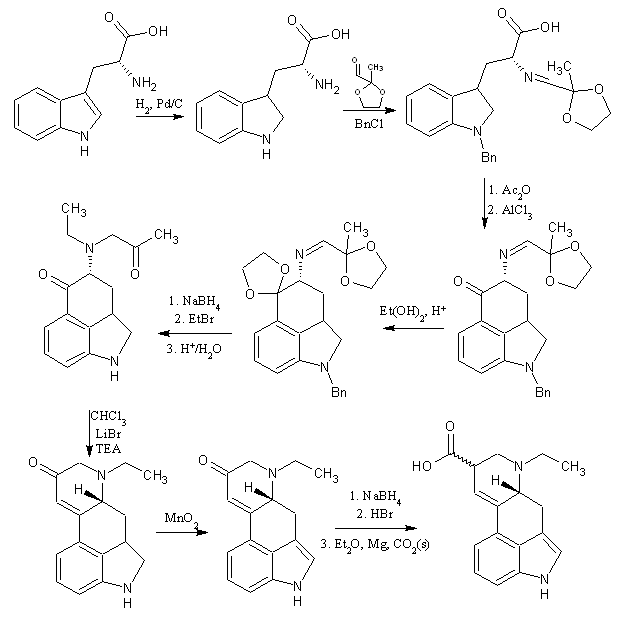
Here's an updated scheme (also changed to make the ethyl analog) that should avoid any pictet spengler reactions. Very similar reactions can be seen in both Rebek and Szantay's papers.
I spent all my money on booze and hookers, the rest I wasted - Charles Bukowski