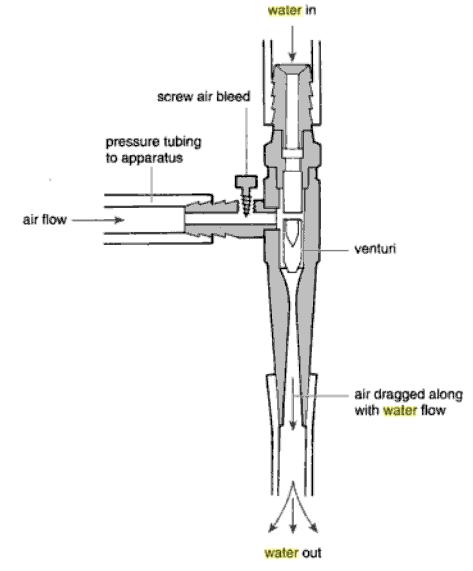
I've been thinking on this, the "apparent" restriction upon the vacuum attainable with an Aspirator is the vapor pressure of the motive liquid/gas...
An aspirator runs on essentially the same principles as the oil diffusion pump.
What if an aspirator were run on recirculating liquid that had minimal vapour pressure? Water has a nominal vapour pressure of 2,333Pa, while ethylene glycol has a vapour pressure of 10.66Pa and 1,4-Butanediol has a vapour pressure of 1Pa. There are, of course, liquids with substantially better numbers than that, but ethylene glycol is not precisely hard to find and would prove or disprove the theory.
It would also open the door to high-vacuum in a space limited, low energy type application.
An aspirator runs on essentially the same principles as the oil diffusion pump.
What if an aspirator were run on recirculating liquid that had minimal vapour pressure? Water has a nominal vapour pressure of 2,333Pa, while ethylene glycol has a vapour pressure of 10.66Pa and 1,4-Butanediol has a vapour pressure of 1Pa. There are, of course, liquids with substantially better numbers than that, but ethylene glycol is not precisely hard to find and would prove or disprove the theory.
It would also open the door to high-vacuum in a space limited, low energy type application.

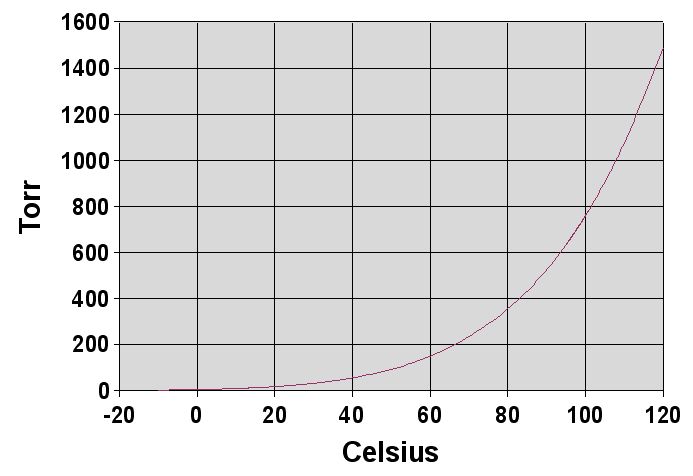
 VAPOUR PRESSURE.pdf

 ,
, 


 ) seem to be quality stainless steel, at the right price
  although I guess shipping wouldnt be more than $5-10 max.