Author Topic: Synthesis and Activity of 3,4-methylenedithioamphetamine?  (Read 222 times)

Polonium

  • Pupae
  • **
  • Posts: 70
Synthesis and Activity of 3,4-methylenedithioamphetamine?
« on: April 19, 2012, 02:31:36 PM »
This is just something I have been playing around with in my head for a while. I am curious as to what research has been done on phenethylamines containing hetrocyclic aromatic backbones. A number of active analogs have been created by altering the 5 membered methylenedioxy ring in MDA. These analogs such as 6-APB[1] and 5-API[2] have 5 membered rings containing both oxygen and nitrogen atoms, forming furan and pyrrole rings respectively. Both of these modifications have resulted in a similar or significant increase in potency.

My question is have any sulfur containing analogs of MDA been synthesised and if so have they any activity in humans? Shulgin et. al has synthesised a range of thiophenethylamines (2C-T's and ALEPH's) which have some unique characteristic. They also exhibit a much increased activity. For example 2C-O-4 (http://isomerdesign.com/PiHKAL/read.php?domain=pk&id=35) is inactive where as the thio analog is active at <10mg. From what I can see David E. Nichols theorizes that thiophenethylamines should be more active as they are easily subjected to oxidative metabolism.

Quote
The ability of a compound to produce hallucinatory disturbances may be lost when the 4-substituent is resistant to oxidation. The concept that facile oxidation of the 4-function might be involved in the production of hallucinations by psychotomimetic amphetamine derivatives may receive support through study of an amphetamine derivative with a 4-substituent that is unusually susceptible to oxidative metabolism.

The sulfur atom would appear to be an excellent choice for such a substituent. Metabolically, it should retain the chemical properties of oxygen in reactions such as S-demethylation but should allow the formation of sulfoxides and sulfones as products of oxidative metabolism12. The lipophilicity, electronic character, and size of sulfur also seem ideal.

David E. Nichols & Alexander T. Shulgin - Sulfur Analogs of Psychotomimetic Amines, J. Pharm. Sci. 65(10), 1554-1555 (1976)

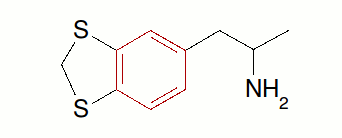
An interesting first choice would be the 3,4-methylenedithioamphetamine where both oxygen atoms in MDA are substituted with sulfur atoms. benzene-1,2-dithiol (17534-15-5) appears to be commercial available. Pardon my naivety but I see know reason the desired 3,4-methylenedithiole could not be synthesised from this starting material analogously to the synthesis of MDA from catechol.

Proposed Synthesis:
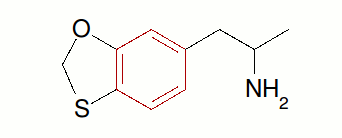
I have no references for the methylation of thiols ATM, but I don't see why I can't be methylated with dibromomethane in the presence of a PTC as is possible with substituted catechol's[3]. Please correct me if I am completely wrong. Either way it is possible to form the 1,3-benzodithiol by some means. Once benzodithiol has been obtained it should be possible to obtain the respective phenylpropan-2-one by Friedel-Crafts alkylation with 2-Nitropropene.[4] Finally this P2P can be subjected to reductive amination by the known means to the desired amine. It should be possible to obtain 3,4-methyleneoxathioamphetamine by just starting with the 2-hydroxythiophenol instead and methylating to 1,3-benzoxothiole?? (Unsure of correct IUPAC name).

I'm not sure why more research hasn't been done into these sulfur based analogs considering the potency and effect of the 2C-T's.  These substances should also be legal, at least under the UK Misuse of Drugs Act. Please let me know what you think of this. Do you think these would be active and if so do they look worthwhile synthesizing?


3,4-methylenedithioamphetamine (MDTA?)


3,4-methyleneoxythioamphetamine


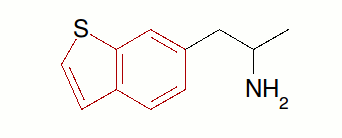
6-(2-aminopropyl)benzothiophene

Edit: It appears that 1,3-benzothiophene-5-carbaldehyde (CAS#: 10133-30-9) is commercially available. This should make this analog very easy to synthesize. Simply condense with nitroethane and then reduce as standard to the amine.


References:
[1] 6-APB - http://en.wikipedia.org/wiki/6-APB
[2] 5-API - http://en.wikipedia.org/wiki/5-%282-Aminopropyl%29indole
[3] PTC Methylenation of Catechol (Using Adogen 464) - http://www.erowid.org/archive/rhodium/chemistry/methylenation.html#PTC1
[4] Synthesis of MDP2P From 1,3-Benzodioxole by Friedel-Crafts Alkylation with 2-Nitropropene - http://www.erowid.org/archive/rhodium/chemistry/mdp2p.nitroalkylation.html
« Last Edit: April 20, 2012, 09:56:06 AM by Polonium »

myCH3

  • Pupae
  • **
  • Posts: 77
Re: Synthesis and Activity of 3,4-methylenedithioamphetamine?
« Reply #1 on: April 19, 2012, 05:50:46 PM »
Your the man, I was just talking to my roomate about those yesterday,  how crazy is that.  I was wondering why none of the rc companies had tried for those seems like a legitimate option? 

Polonium

  • Pupae
  • **
  • Posts: 70
Re: Synthesis and Activity of 3,4-methylenedithioamphetamine?
« Reply #2 on: April 20, 2012, 11:54:28 AM »
Okay, I'm going to propose a synthesis. Please let me know what you guys think. These analogs seem very interesting! If we got enough interest we could potentialy get someone to do a custom synthesis of these legal compounds.

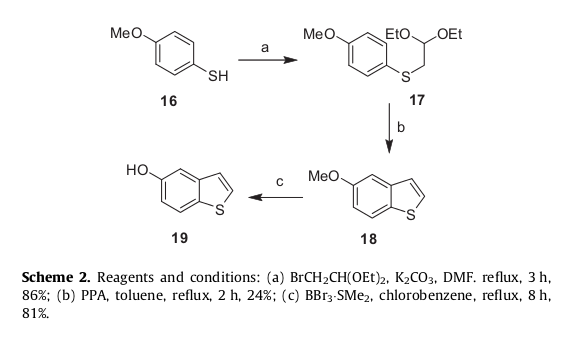
I did a literature review regarding the synthesis of benzothiophene's and came across the following paper where 5-methoxy benzothiophene is synthesized in 2 steps from 4-methoxythiophenol. Here is an excerpt:

Quote
5-Hydroxybenzothiophene was prepared according to our reported procedure for the synthesis of 5-hydroxybenzofuran10(Scheme 2). Thus, 4-methoxythiophenol 16 was reacted with bromoacetaldehyde diethyl acetal and K2CO3 in dry DMF at reflux to furnish 17 in 86% yield which was directly used in the next reaction without further purification.
Compound 17 was converted to 5-methoxybenzothiophene 18 by treatment with polyphosphoric acid (PPA) in toluene at reflux in 24% yield. Demethylation of 18 with BBr3.SMe2 in dry chlorobenzene at reflux provided 5-hydroxybenzothiophene19 in 81% yield.


Synthesis and biological evaluation of novel small non-peptidic HIV-1 PIs: The benzothiophene ring as an effective moiety,
Lucia Chiummiento, Maria Funicello, Paolo Lupattelli, Francesco Tramutola, Federico Berti, Francesca Marino-Merlo,
Bioorganic &amp; Medicinal Chemistry Letters, Volume 22, Issue 8, 15 April 2012, Pages 2948-2950, ISSN 0960-894X,
DOI: 10.1016/j.bmcl.2012.02.046.


Proposed Synthesis:

I propose a similar synthesis could be employed. I am not sure if the activating p-methoxy is critical to this reaction as I cannot find the mechanism. If it is not critically it should be possible to start with 4-bromothiophenol. This is then refluxed with bromoacetaldehyde diethyl acetal [1] and K2CO3 in dry DMF as outline in the paper. bromoacetaldehyde diethyl acetal is easily prepared and its synthesis is outlined below. This compound is then cyclised by refluxing with polyphosphoric acid (PPA) in toluene.

It seems pretty straight forward to me. Once you have your 4-bromothiophene it should be possible to either substitute the bromine to the more reactive iodine or proceed directly with the SN1 substitution of a halogen of an enolate. This is outlined on the Rhodium Archives where bromobenzene is converted to P2P by reaction with an acetone enolate (Enolate phenylacetone synthesis FAQ 1.0. I'm not sure how well this reaction has been tested practically but it looks like there is the literature to back it up. Everyone knows we can get whatever amphetamine we like from here by the known methods.

In that paper, the benzothiophene analog showed significantly more activity although I'm not really sure what they were actually testing. Either way the thiophene hetrocycle should be more hydrophobic which should also increase any activity by being more lipophilic as a result??. Please correct me where I am making silly mistakes!

Quote
Alkylation at indole nitrogen leads to inactive compounds, most likely due to steric reasons, and the replacement of nitrogen with oxygen is not effective. However, the more hydrophobic ben-
zothiophene containing compound is significantly more active than the parent indole molecule, and the enhanced activity is consistent with a reduced desolvation penalty.

tl;dr

To summarize, it appears possible to synthesize 1,3-benzothiophene-5-(propan-2-one) from 4-bromothiophenol in 3 steps using relatively accessible reagents and techniques. There is defiantly loads here that is unknown here and need to be confirmed experimentally. Any ambitious chemist want to try and be the first to sample a brand new potential psychoactive?

Quote
Preparation of Bromoacetaldehyde diethyl acetal:
It is obtained by bromide, alcoholysis of vinyl acetate. Mixing vinyl acetate and ethanol at -10 °C. Slowly dropping bromine to maintain -5 °C under stirring. Gradually heated to 60 °C maintained for 1h, cooled to 10 °C, and 1 times the amount of ice water added. Add ammonia to make pH = 6 and double the amount of ice water to separate oil. Collect distillate under 71-76 °C (2.67kPa) by vacuum distillation to get the product.
http://www.lookchem.com/Bromoacetaldehyde-diethyl-acetal/
« Last Edit: April 20, 2012, 12:06:18 PM by Polonium »

Polonium

  • Pupae
  • **
  • Posts: 70
Re: Synthesis and Activity of 3,4-methylenedithioamphetamine?
« Reply #3 on: April 20, 2012, 01:59:53 PM »
Sorry to double post but I just found a promising paper. It appears benzothiophene based amines can affect the norepinephrine and serotonin systems. In this case the compounds are reuptake inhibitors, but now we know benzothiol rings don't just make the drugs inactive!

Quote
Benzothienyloxy phenylpropanamines, novel dual inhibitors of serotonin and norepinephrine reuptake.
Bioorganic & Medicinal Chemistry Letters, Volume 14, Issue 21, 1 November 2004, Pages 5395-5399
J.R. Boot, G. Brace, C.L. Delatour, N. Dezutter, J. Fairhurst, J. Findlay, P.T. Gallagher, I. Hoes, S. Mahadevan, S.N. Mitchell, R.E. Rathmell, S.J. Richards, R.G. Simmonds, L. Wallace, M.A. Whatton
DOI: 10.1016/j.bmcl.2004.08.005

Graphical Abstact:
A series of benzothienyloxy phenylpropylamines have been prepared and are demonstrated to be inhibitors of both serotonin and norepinephrine reuptake.


I also found an article by the same group regarding the synthesis of benzyl substituted benzothiophenes with the aid of microwave irraditation.

Quote
An improved synthesis of substituted benzothiophenes using microwave irradiation
Tetrahedron Letters, Volume 45, Issue 52, 20 December 2004, Pages 9645-9647,
Daniel Allen, Owen Callaghan, Frederic L. Cordier David R. Dobson, John R. Harris, Terry M. Hotten, W. Martin Owton, Richard E. Rathmell, Virginia A. Wood

Abstract
An easy and high-yielding method for the synthesis of substituted benzothiophenes using microwave irradiation is described.

I found a reference for someone doing the exact reaction I outline for p-bromothiopheol in my earlier post. Unfortunatly it appears an EWG in the para position does indeed adversely affect the reaction. Yeilds for the p-bromo substrate are 13% compared with >70% yield for the o-bromothiophenol.  It might be possible to create the p-thioamphetamine first and then form the thiophene ring or have a more activating substitutent at the para position for the ring formation. The article is attached anyways.

Quote
A new synthesis of thiophenes and thiapyrans. Part VII: Bromothionaphthenes and 5-nitrothionaphthene
Proceedings of the Indian Academy of Sciences, Section A, 36 (5). pp. 405-410.
Rabindran, K. ; Sunthankar, A. V. ; Tilak, B. D. (1952)
DOI: 10.1007/BF03172327


In relation to the synthesis of 3,4-methylenedithioamphetamines, its appears a fairly similar route to MDA from catechol or 3,4-Dihydroxybenzaldehyde can be applied. I have been referred to the following reference where 1,2-benzene-dithiol is methylated to 1,2-(ethylenedithio)benzene by the addition of dibromoethane. I can't post the full PDF, but I can post excerpts if anyone wants to see more. It is claimed this also works for dibromomethane yielding 1,2-(methylenedithio)benzene. This leads me to believe the reaction in PTC Methylenation of Catechol on the Rhodium Archives should work analogously for the sulfur analog. This is chemistry we know and it has been tested in a clandestine environment. It is definitely possible.

Quote
Synthesis of tris(ethylenedithio)benzene, tris(methylenedithio)benzene, and tris(ethyleneoxythio)benzene as candidates for the preparation of organic ferromagnets
René Lapouyade and Jean-Pierre Morand
J. Chem. Soc., Chem. Commun., 1987, 223-224
DOI: 10.1039/C39870000223

Relevent Excerpt:
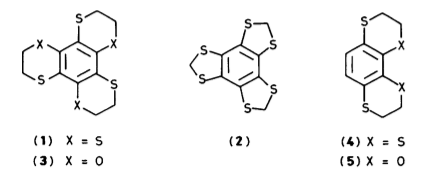
In an attempt to shorten the synthesis of (1) and (4) we added 1,2-dibromoethane to 1,2-dithiolato- and 1,3,5-trithiolatobenzenes in hexamethylphosphoramide (HMPA) and obtained respectively 1,2-(ethylenedithio)benzene and all the 1,3,5-trisubstituted benzenes containing (2-bromoethylthio)- and/or (vinylthio)- substituents. The formation of 1,2-(ethylenedithio)benzene from 1,2-dithiolatobenzene led us to try the reaction of hexathiolatobenzene with dibromoethane and dibromomethane as an expedient route to (1) and (2) (Scheme 3). Convenient access was effectively provided to (1) (32%) and (2) (38%) by this route.


If anyone thinks this is a worthwhile endeavor please contribute your opinions and ideas.
« Last Edit: April 20, 2012, 03:10:51 PM by Polonium »

Polonium

  • Pupae
  • **
  • Posts: 70
Re: Synthesis and Activity of 3,4-methylenedithioamphetamine?
« Reply #4 on: April 21, 2012, 02:05:12 PM »
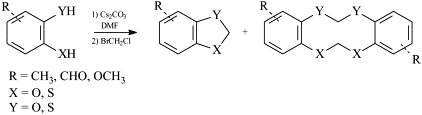
Apologies for the extra posts. Just found the following reference which describes the synthesis of 1,3-benzodioxole, 1,3-benzodithiole and 1,3-benzoxathiols from 1,2-benzodiol (catechol), 1,2-dimercaptobenzene and 2-Hydroxybenzenethiol respectively. The scheme involves heating the substrate at 110c with bromo-chloromethane in dry DMF with cesium carbonate as a catalyst.

This reaction is almost identical to the methylenation reactions on the Rhodium Archive. (http://www.erowid.org/archive/rhodium/chemistry/methylenation.html) The yield of the 1,3-benzodithiol in the paper was 98%. This seems very straightforward. Unfortunately the  1,3-benzoxathiols is only formed in approx. 30% yields. Either way this is a very accessible approach to these potentially active analogs.

Quote
A Re-examination of the Methylenation Reaction
Maria Grazia Cabiddu, Enzo Cadoni, Stefania De Montis, Claudia Fattuoni, Stefana Melis and Michele Usai
Tetrahedron Vol.59 (2003) pp.4383-4387
DOI: 10.1016/S0040-4020(03)00619-7

Abstract:
A re-examination of the methylenation reaction of 1-hydroxy-2-mercapto-, 1,2-dihydroxy- and 1,2-dimercapto substituted benzenes by bromochloromethane with cesium carbonate shows that these substrates give mixtures of five- and ten-membered benzocondensed heterocyclic compounds and in some cases even dibenzodioxines.


Quote
Relevent Excerpts:
We decided to apply this reaction protocol to 1,2-dimercaptobenzene (1h): 1,3-benzodithiole (2h) (98%) was obtained almost exclusively beside traces amount of unknown products.
The same reactions performed in acetonitrile and at different concentrations gave analogous results. At the end we can deduce that when the benzene ring bears two equally nucleophilic groups (benzodioles and dimercaptobenzenes) the main product is the one with a five-membered ring;
when the groups have a different nucleophilic power the main product is the ten-membered ring.

General method of methylenation of compounds
To a suspension of the starting compound 1a – h (50 mmol), cesium carbonate (24.4 g, 75 mmol) and anhydrous N,N-dimethylformamide (120 mL), was added dropwise bromo-chloromethane (9.6 g, 75 mmol) and the resulting mixture was vigorously stirred under a nitrogen atmosphere and then
heated at 107 – 1108C for 2 h. The mixture was poured into water, the organic layer separated and the aqueous layer extracted with ether and then with dichloromethane, because ether is able to extract only the monomeric product while the dimeric ones are extracted by dichloromethane.
The organic phases were dried (Na2SO4). The solvent was evaporated in vacuo and the residue was analysed by HPLC.


Please let me know what you think guys!!
« Last Edit: April 21, 2012, 02:17:04 PM by Polonium »

embezzler

  • Subordinate Wasp
  • ***
  • Posts: 228
Re: Synthesis and Activity of 3,4-methylenedithioamphetamine?
« Reply #5 on: April 21, 2012, 08:15:40 PM »
I have done a bit of looking and this seems a worthwhile endevour ( I refer to the end point as I have not dug much into the synthesis of sulphur compounds before). The p-thiomethyl analogue of amphetamine appears to be active as expected but also appears to be free of the neuronal toxicity of p-chloroamphetamine at least to neurons and this is in spite of its 2x potency factor. I am still looking for further details and will post them when I am done.
All that we see or seem is but a dream within a dream...

atara

  • Dominant Queen
  • ****
  • Posts: 256
Re: Synthesis and Activity of 3,4-methylenedithioamphetamine?
« Reply #6 on: April 22, 2012, 03:23:11 AM »
Sulfur doesn't act, electronically, very much like oxygen. It is more similar to carbon. I would expect the dithia analog of MDMA to behave much like IAP, if it is not extremely toxic. 4-thio substituted phenethylamines tend to be monoamine oxidase inhibitors, which is very dangerous, and a thioacetal does not act like an acetal (in particular, it is difficult to hydrolyse). The thioalkyl 2C's avoid this somewhat because the methoxy groups inhibit binding to MAO.

Benzothiophenes have serious hepatotoxicity concerns! This problem was encountered with BTCP, a really fun stimulant that causes serious liver damage.

http://pubs.acs.org/doi/abs/10.1021/tx0341409