Author Topic: Why not strait to Iodosafrole? Why always Bromo to Finklestein?  (Read 1414 times)

pbinteger

  • Subordinate Wasp
  • ***
  • Posts: 124
Re: Why not strait to Iodosafrole? Why always Bromo to Finklestein?
« Reply #40 on: October 24, 2012, 01:41:05 PM »
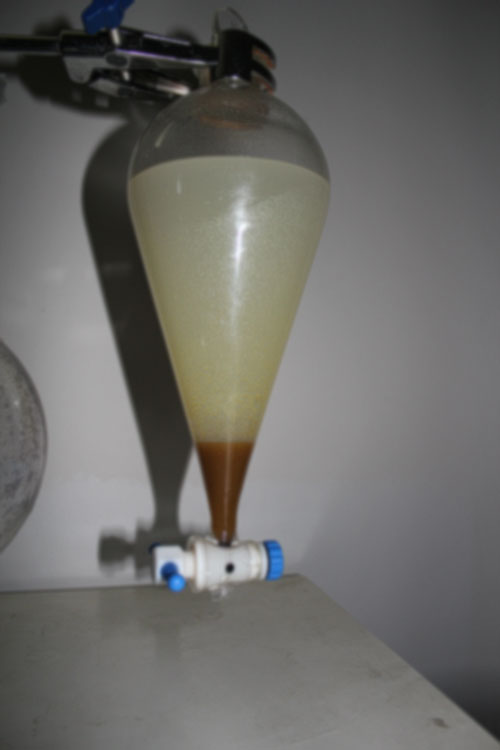
as of this AM -- the separation is very distinct -- but the solvent / oil layer is just yellow and smells like safroley DCM.
I think that this reaction didn't really proceed, and I'm really confused as to why...
Could it have been the freezer temp? -10c?
« Last Edit: October 24, 2012, 01:47:22 PM by pbinteger »

ImAMANGUYS

  • Pupae
  • **
  • Posts: 84
Re: Why not strait to Iodosafrole? Why always Bromo to Finklestein?
« Reply #41 on: October 24, 2012, 02:06:32 PM »
To chip in, Ive experienced similar results. One of the questions that plagues my mind is how does one know when to remove from the freezer and start workup? This may be a problem as i've read almost every halosafrole thread from here to pnaut and can find a time estimate for reaction time but Jon hasnt seemed to mention how one can visibly notice the reactions complete before decanting.

As for reaction temp, it cant run too slow if the temp is too low, but it runs fastest and most efficiently at 0-1 *C for 24 hours. This is most commonly the temp given by those who advocate this rxn.
« Last Edit: October 24, 2012, 02:15:55 PM by ImAMANGUYS »

pbinteger

  • Subordinate Wasp
  • ***
  • Posts: 124
Re: Why not strait to Iodosafrole? Why always Bromo to Finklestein?
« Reply #42 on: October 24, 2012, 02:53:00 PM »
Counfounding!

Thanks for the feedback -- I let this run for 48 hours because of reduced temps. It seems like the red / burgundy was just color of solution in GAA and once that was based out it just went back to safrole -- at least I've got my safrole back...

I just need to identify where I went wrong.

ImAMANGUYS: you've attempted this reaction before? did you just get unreacted safrole back out of it?
What was your workup technique?
Others have said Bicarb is not the best -- because it creates emulsions from hell.
I did get some emulsion last night but it broke fairly easily with brine and sitting still.


ImAMANGUYS

  • Pupae
  • **
  • Posts: 84
Re: Why not strait to Iodosafrole? Why always Bromo to Finklestein?
« Reply #43 on: October 24, 2012, 04:48:07 PM »
ImAMANGUYS: you've attempted this reaction before? did you just get unreacted safrole back out of it?
What was your workup technique?
Others have said Bicarb is not the best -- because it creates emulsions from hell.
I did get some emulsion last night but it broke fairly easily with brine and sitting still.

To be honest, I'm probably not the person you should be asking as i'm experimenting myself as well. But I'll share a small writeup I did with you if you want to compare results, then maybe someone with success at this method will chip in. I'm starting to become curious about how many members have had success with it. To answer your questions and for comparison here ya go.

BromoSafrole Attempt 1

Reactants:

(10ml, 0.067 mol) Safrole
(14.58g, 0.1417 mol) NaBr
(6.869ml, 12.64g, 0.1289mol) H2SO4
(24.82ml) GAA 40% w/w

Writeup:

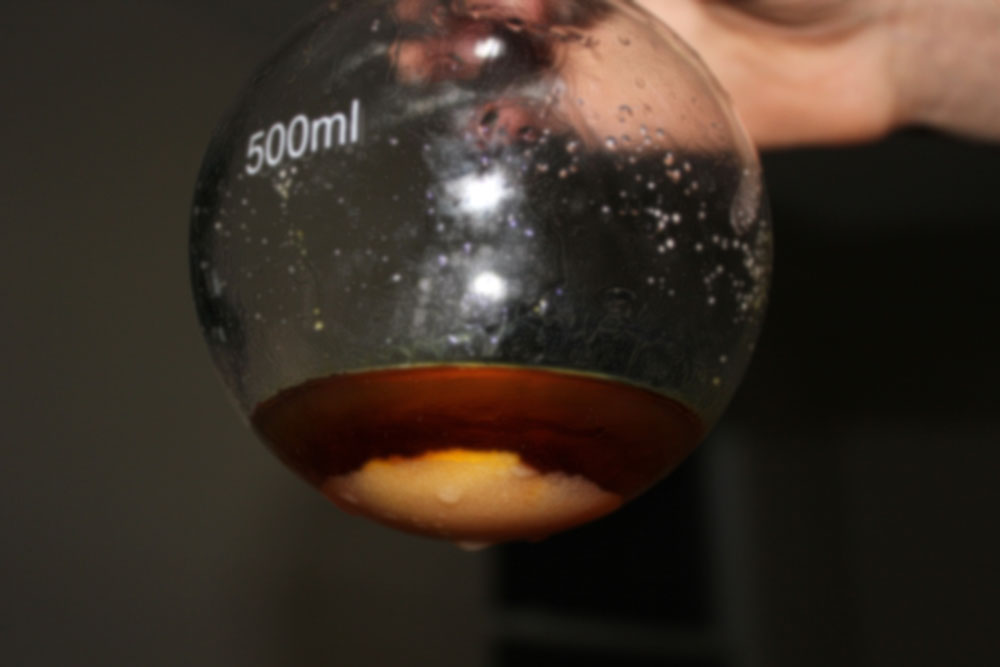
To a 500ml flask was added 24.82ml GAA. To this, 14.58g NaBr was added and stirred vigorously. This mixture was cooled till the GAA began to freeze, at which point the 6.869ml H2SO4 was added drop wise. An orange hue was noted. The color was expected due to the off-clear sulfuric acid used, and the small amounts of Br2 formed. This solution:

Equation: H2SO4 + NaBr = NaHSO4 + HBr

was mixed and left to cool for 30 minutes in a salt water ice bath. Temp approx 0*C. The flask was removed and the 10 ml of safrole was added all at once, a slightly green color (colors off in the pic) was noted.
(SEE PICTURE 1)
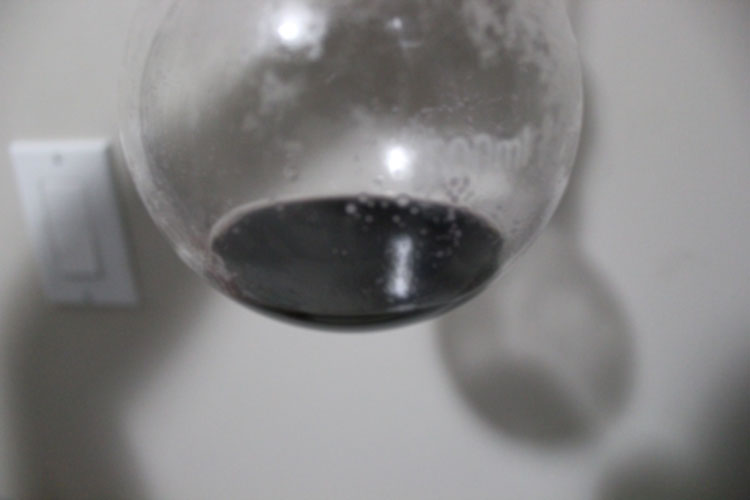
This mixture was left undisturbed in a salt water ice bath for the next 24 hours. The temp of the ice bath varied between -1C to 2C during this time, not exceeding or descending below these numbers. The flask was removed from the bath, at which point a blue-purple hue was observed. Because no indication has been described on the forums about how to tell the reaction has completed, and i've read about successful purple hues in the past, I assumed it was done. In honesty, I don't know how you can tell without decanting and testing on cold H2SO4. This after 24 hours.
(SEE PICTURE 2)
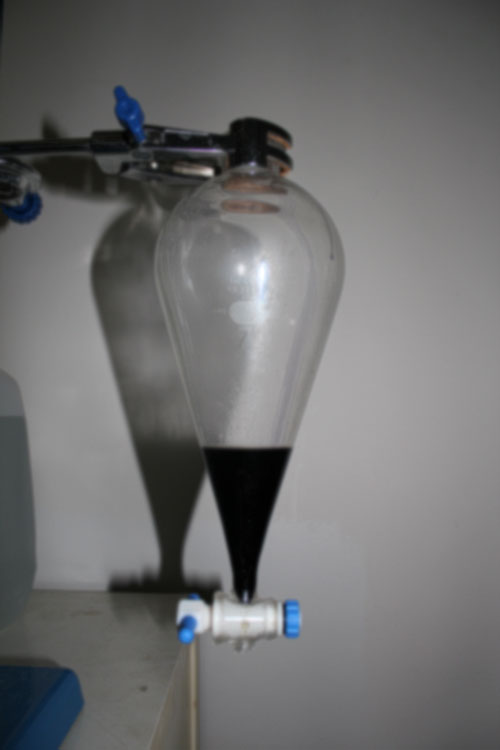
Workup was done quickly after pics were taken and the flask had been removed from the bath. The liquid was decanted from the salts:
(See PICTURE 3)
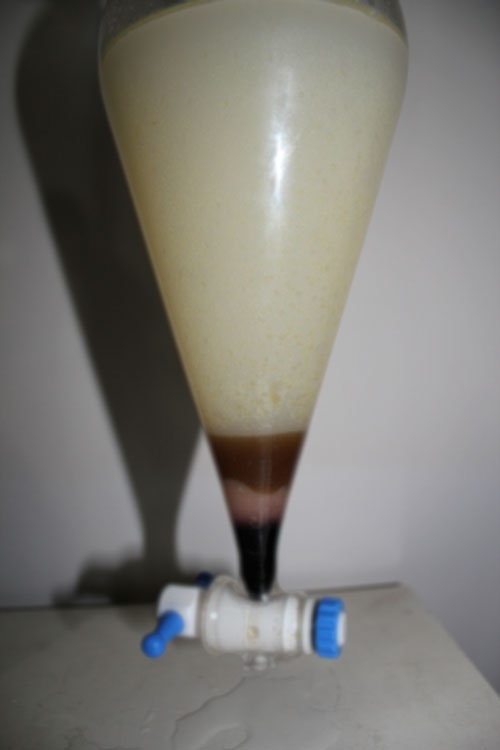
The first water was, quenching the mixture, resulted in a number of layers:
(SEE PICTURE 4)
Which upon standing and stirring, resulted in two layers:
(SEE PICTURE 5)
The mixture smelled of safrole, and the water layer remained milky.

I removed the bottom carmel colored layer and washed with sodium bicarbonate, at which point bubbling and fizzing did occur. Like directions indicate, I added till no fizzing was noted. I did another water wash, at which point the oil was yellowish brown.

When tested on Cold H2SO4, the mixture sat on top for a few a good 15 seconds before releasing tiny bits of purple. Maybe it just wasn't given enough time to react?

From the smell and color, it was a failed workup or reaction.

Hopefully someone with more experience can bring us both insight. Until then good luck my friend!

« Last Edit: October 24, 2012, 05:20:57 PM by ImAMANGUYS »

pbinteger

  • Subordinate Wasp
  • ***
  • Posts: 124
Re: Why not strait to Iodosafrole? Why always Bromo to Finklestein?
« Reply #44 on: October 25, 2012, 04:39:27 AM »
WOW! I can't thank you enough for the feedback. It's very helpful to be able to compare my results with someone else who has tried this.

I've been washing the yellow layer with more brine and it seems to be forming more layers now -- there is a milky upper layer and a darker yellow (slightly green) lower layer.

I want to get it fully washed / separated before rotovapping it and testing it for iso-safrole, or halosafrole.

I will post some more pics soon.


ImAMANGUYS

  • Pupae
  • **
  • Posts: 84
Re: Why not strait to Iodosafrole? Why always Bromo to Finklestein?
« Reply #45 on: October 25, 2012, 04:55:27 AM »
No problem at all. Wish I could be of more. The final product is apparently dichromatic red and green with a syrup like consistency. So if that's what you're starting to see you may have the goods. Let me know at least. I'd be interested.

pbinteger

  • Subordinate Wasp
  • ***
  • Posts: 124
Re: Why not strait to Iodosafrole? Why always Bromo to Finklestein?
« Reply #46 on: October 25, 2012, 07:27:31 PM »
Another update:

After all washes and extractions were complete a clear yellow solution of DCM and oil was stored in refrigeration overnight over anhydrous mgso4.

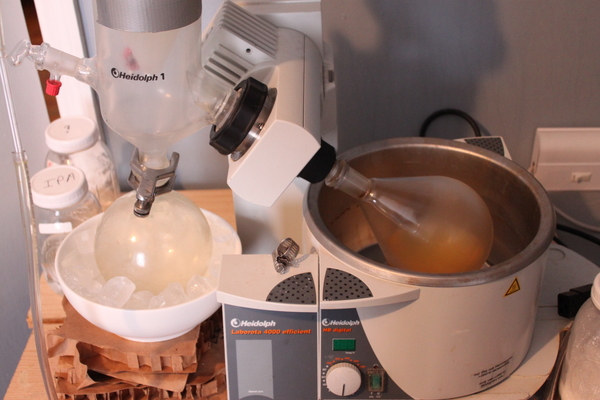
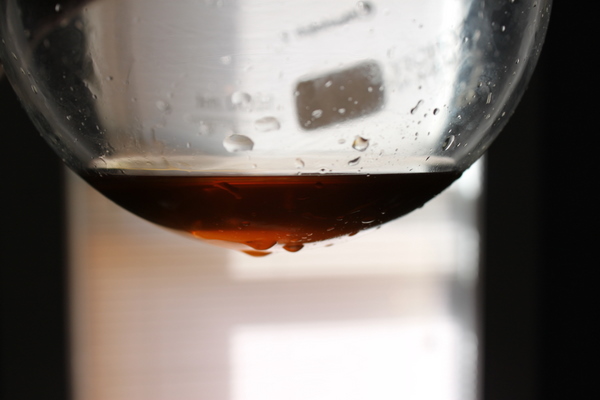
The next day the solution was rotary evaporated under hard vacuum with a dry ice acetone condensor. The DCM came over leaving behind a golden yellow oil that smelled of safrole.

The volume of the oil was ~48mL (most of what went into the rxn)

After this a small volume of h2so4 was chilled ice cold, and .5mL of the oil was dripped onto the surface of the acid.

The result was an immediate color change to deep dark red and then dark purple after several minutes.

I think there is some isosafrole in this and some just plain unreacted safrole.

The only thing I can think of is that the temperature was too cold to let the reaction run to completion and it stalled..

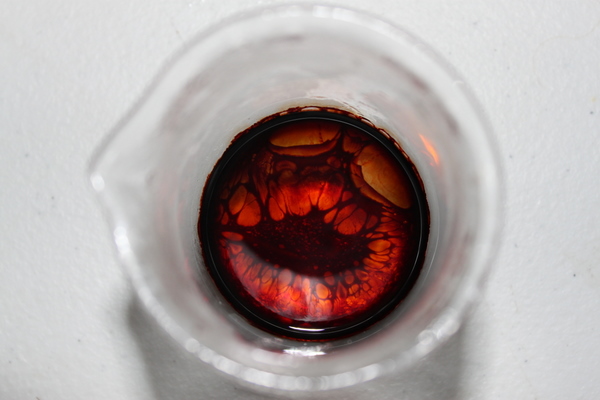
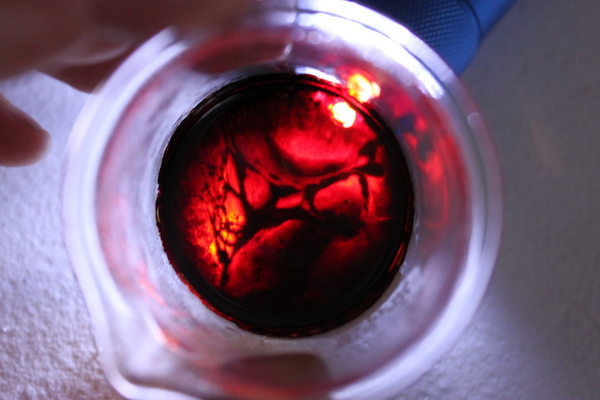
Pictures are attached.
I'll be running this again on Monday with slightly different stoich and higher temps...

sigh....

pbinteger

  • Subordinate Wasp
  • ***
  • Posts: 124
Re: Why not strait to Iodosafrole? Why always Bromo to Finklestein?
« Reply #47 on: October 26, 2012, 04:24:19 AM »
jon -- I mean you no disrespect -- I believe you are a brilliant chemical mind but...

I want to see some real numbers.  if we really want to be precise, the concentration of HBr w/w should be the weight of HBr over the weight of all other solvents combined..not just GAA.  the H2SO4 breaks down to HSO4 and H2O...so should we be counting that in?

We are all assuming that 1.1 moles NaBr react with 1 mole of H2SO4...
only about 10% of the HSO4 gives a useable proton
that is why it is 1.1% but the solvent mix becomes rather complicated...not just GAA..  expressing as a w/w% is just confusing the issue

it is an attempt to relate this prep to the old published versions using HBr 70% in water...but it is not a very accurate means of describing things.


jon

  • Foundress Queen
  • *****
  • Posts: 1,883
Re: Why not strait to Iodosafrole? Why always Bromo to Finklestein?
« Reply #48 on: November 02, 2012, 02:52:42 AM »
man i done told you already i make my hydrobromic acid in-situ so i can have it dry 47% in gaa aint gonna cut it dude.
i did a lot of work on this i know my shit

i'm going to help you because i see a lot of effort coming from you.
just do this:
 do your calculations like this: you strive to achieve 40% hbr in gaa to brominate safrole at 0C using 1.9 gmoles of nabr just dump in 1.8 moles of h2so4 to the gaa containing the 1,9 moles nabr it will fume so cover and cool then add your safrole and do nothing to it then talk to me tommorow just put it in the freeze.

« Last Edit: November 02, 2012, 04:49:28 AM by Wizard X »

ImAMANGUYS

  • Pupae
  • **
  • Posts: 84
Re: Why not strait to Iodosafrole? Why always Bromo to Finklestein?
« Reply #49 on: November 02, 2012, 04:29:40 AM »
do your calculations like this: you strive to achieve 40% hbr in gaa to brominate safrole at 0C using 1.9 gmoles of nabr just dump in 1.8 moles of h2so4 to the gaa containing the 1,9 moles nabr it will fume so cover and cool then add your safrole and do nothing to it then talk to me tommorow just put it in the freeze.

Hello again Jon,

Im attempting the bromination as well at the moment and have three questions if you wouldnt mind clarifying what you have found works best as ive failed to completely brominate a few times already. But i won't give up and so i'd at least like help as i push forward on your improvements on this process.

1. For temps of the reaction, do you mean (0*C) or the freezer (~10*C)? I see varied answers on the topic and we all know it affects reaction time.

2. Do you suggest pure saf? Your older posts seem to lean more towards straight oil.

3. Because factors differ such as temp, saf purity, stirring vs nonstirring, and actual conc. of HBr in the solution, how does one judge when the reaction is nearing completion? Is there a typical visual indicator you've come to rely on?

Thanks again, I don't plan on giving up easily.

Best Wishes,

ImAMan
« Last Edit: November 02, 2012, 12:48:49 PM by ImAMANGUYS »

jon

  • Foundress Queen
  • *****
  • Posts: 1,883
Re: Why not strait to Iodosafrole? Why always Bromo to Finklestein?
« Reply #50 on: November 02, 2012, 04:47:04 PM »
no stirring do nothing it always worked best some of you guys overthink shit.
temps can be warmer than that for a while 0C is optimal but no it can go higher while it cools.
i always use straight sassafras oil never safrole the workup purifies it by removing tepines the acetic acid wash does this at 25% conc. so i start with dirty and wind up clean it's really ealagant when you think about it it takes time (me 6 months) to fully optimize this you gotta be persistent.


you can know for sure your shit is reacted by chilling sulfuric acid in the freeze to 0 then taking an aliquot of this if it floats you are done if you see a little purple it needs more time,
« Last Edit: November 02, 2012, 04:55:48 PM by jon »

ImAMANGUYS

  • Pupae
  • **
  • Posts: 84
Re: Why not strait to Iodosafrole? Why always Bromo to Finklestein?
« Reply #51 on: November 03, 2012, 12:45:51 AM »
no stirring do nothing it always worked best some of you guys overthink shit.
temps can be warmer than that for a while 0C is optimal but no it can go higher while it cools.
i always use straight sassafras oil never safrole the workup purifies it by removing tepines the acetic acid wash does this at 25% conc. so i start with dirty and wind up clean it's really ealagant when you think about it it takes time (me 6 months) to fully optimize this you gotta be persistent.


you can know for sure your shit is reacted by chilling sulfuric acid in the freeze to 0 then taking an aliquot of this if it floats you are done if you see a little purple it needs more time,

Sounds great. I suppose you mean an aliquot of the brominating solution, peachy. Didn't think too test before decanting. Kinda foolish of me.

After some of my acids arrive I'll post a detailed workup with pics to show others visually how its done.

jon

  • Foundress Queen
  • *****
  • Posts: 1,883
Re: Why not strait to Iodosafrole? Why always Bromo to Finklestein?
« Reply #52 on: November 03, 2012, 12:55:27 AM »
wash  some sassafras oil with 20 percentish acetic acid and watch it turn white clear even  then take that into some solvent wash with water brine and use a little drying agent filter evvap dcm and take a congealing point and see how close it is to pure safrole hairsplittling close that's what happens in the workup same deal that's why this process is Ninja!

pbinteger

  • Subordinate Wasp
  • ***
  • Posts: 124
Re: Why not strait to Iodosafrole? Why always Bromo to Finklestein?
« Reply #53 on: November 04, 2012, 10:25:49 PM »
hello All,

I think I've had success -- with a little help from another forum member on some adjustments to my stoich, and keeping the temperatures higher...

The workup this time was very different.
After the final brine wash (which broke an emulsion from hell took 2 brine washes to break it)
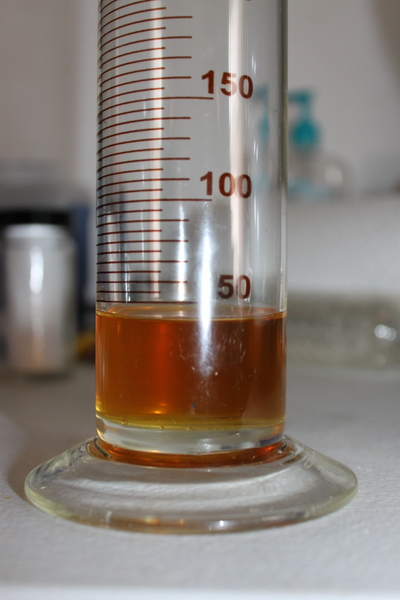
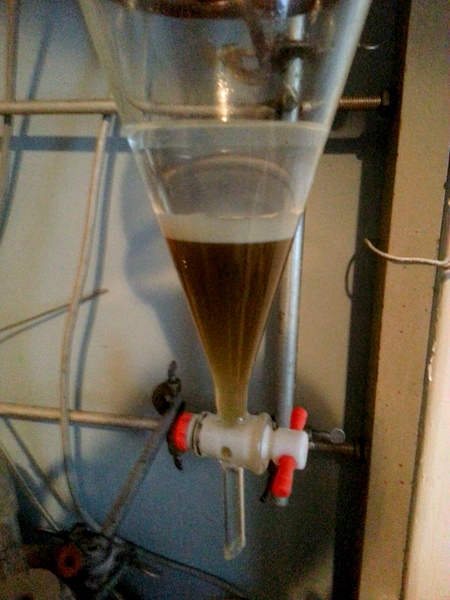
The solvent / oil layer is a deep green color that gets darker with concentration.
I've pulled out 2 extractions that both have this quality. I just performed the cold h2so4 test with some of this green DCM solution. It immediately went to a deep blood reddish & brown color and floated on the top. After 40 seconds it had darkened a bit but no purple was noticed and it was still floating on the top.
I think this run was a success with ~95% yields...

Here are the numbers used:
50g raw safrole
66.30g NaBr
57.45g H2so4
71.08g GAA

The GAA was added to a 1L 2 neck RB with a stir bar -- to this the NaBr was added in 3 increments and allowed to stir vigorously for 1 hour.
The vessel was cooled down to ~5c over a salt ice bath, and monitored with a thermometer during a very slow dropwise addition of the h2so4.
Once all of the h2so4 was added the color changed to a deep orange.
Fresh ice was added at this time and aluminum foil to protect from light and further drop the temperature.
Once the temp fell to 0c the Safrole was added at once and the ice bath / vessel were placed in a cooler with a thin layer of ice overnight.
After some dreaming and some more information from a voice in my head I decided to refresh the ice and resume stirring at a medium rate.
This was left covered with foil -- refreshing the ice every few hours for the remainder of the 24 hour period.

Workup was exactly as described by jon with one adjustment -- I poured the initial decanted material over ice to create a clear separation on the first wash...

the picture is of the product in solvent after the final brine wash.
« Last Edit: November 04, 2012, 10:47:07 PM by pbinteger »

ImAMANGUYS

  • Pupae
  • **
  • Posts: 84
Re: Why not strait to Iodosafrole? Why always Bromo to Finklestein?
« Reply #54 on: November 05, 2012, 12:10:18 AM »
So you ended up going with a 66% w/w HBr in GAA, it wasn't too high of a concentration?

As for as my mathematics are concerned:

57.45gH2SO4*(1moleH2SO4/98.079gH2S04)*(1moleHBr/1moleH2S04)*(80.91gHBr/1moleHBr) =

47.39321gHBr

and then:

47.39321gHBr/71.089821gGAA= 66% w/w concentration.


fractal

  • Subordinate Wasp
  • ***
  • Posts: 110
Re: Why not strait to Iodosafrole? Why always Bromo to Finklestein?
« Reply #55 on: November 05, 2012, 12:37:51 AM »
You mean 40%, you're missing something.

( 47.392g HBr/ (47.392g HBr + 71.08g GAA))=.4

jon

  • Foundress Queen
  • *****
  • Posts: 1,883
Re: Why not strait to Iodosafrole? Why always Bromo to Finklestein?
« Reply #56 on: November 05, 2012, 12:46:15 AM »
that's the stuff it's bichromatic it's green in solution and burgandy when you concentrate it.
you only finished the easy part the hard part is the amination that takes skill lemme tell ya

ImAMANGUYS

  • Pupae
  • **
  • Posts: 84
Re: Why not strait to Iodosafrole? Why always Bromo to Finklestein?
« Reply #57 on: November 05, 2012, 01:20:58 AM »
You mean 40%, you're missing something.

( 47.392g HBr/ (47.392g HBr + 71.08g GAA))=.4

*Facepalm* (explains alot)

Thanks Mate.

I'll post my results soon too after the readjustments  :P Embarrassing Stuff.

pbinteger

  • Subordinate Wasp
  • ***
  • Posts: 124
Re: Why not strait to Iodosafrole? Why always Bromo to Finklestein?
« Reply #58 on: November 05, 2012, 01:35:14 AM »
jon,

I've got my 99% IPA and my 3A molecular sieves ready for the amination... I think I can do it this time.

I'm going to simplify my gas generator -- I'm going to try to make it as similar to what you described in the p-naut thread.

but first... the Finklestein....

which I'll write-up next. I've got big huge rocks of KI so I'm going to grind them up... Also I know I need to be patient and stir vigorously for at least 30 minutes with the KI...

I'll keep you all updated.


jon

  • Foundress Queen
  • *****
  • Posts: 1,883
Re: Why not strait to Iodosafrole? Why always Bromo to Finklestein?
« Reply #59 on: November 05, 2012, 01:54:33 AM »
the problem is getting that ki out you can evaporate it down some but it will bump like crazyy then flood with water i could just stir using a glass rod and get good results it really did'nt even take 30 minutes that's just conservative estimate more like 10 minutes you can see the crystal structure change you'll soon see.
i use plastic gatorade bottels as gas generators it's all just technique nothing to do with having fancy labware i see people with nice equipment here that i envy but little understanding of what they are doing