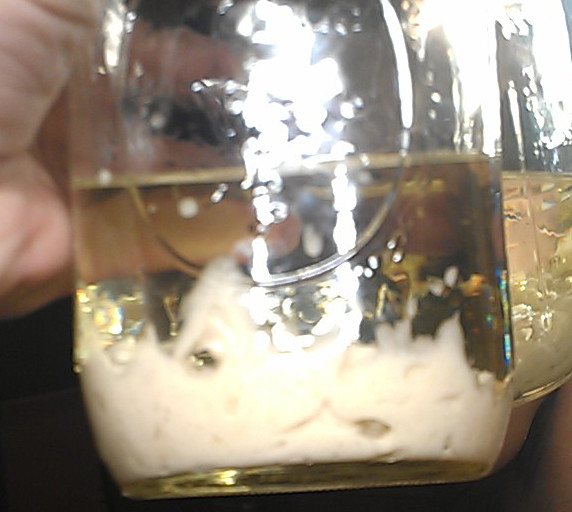
Next question = did you shake it up after adding the solvent = you got an emulsion = dont shake it swirl it .
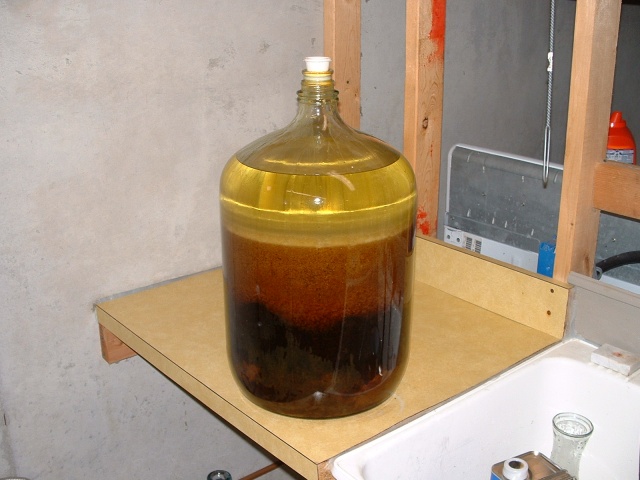
The picture at the bottom of this post shows a water extract that hasnt been defated ...... there are 2 emulsions between the water and the solvent . Notice how much there is = LOADS . Some people say defat and others say it doesnt need to be done because the PH and a long gentle cooking time will oxidise the unwanted crap wich will then precipitate out when the PH is adjusted to PH 7.2 .
Heres a method ...... that i havent tested ..... maybe you can compair what you have done with what it says there and then you can see if / what you could have done differently ...... and why you got the white gunk ---- >
Extracting Pure Mescaline From Peyote or San Pedro Cactus
The isolation of mescaline from cacti containing this alkaloid is not difficult to perform and is perhaps one of the most rewarding alchemical processes that one can attempt. The chemicals required for this process are readily avilable and their purchase arouses no suspicion or interest on the part of government agencies [This may no longer be true, use reasonable caution when purcahsing any chemicals]. The equipment employed is not expensive or particularly complicated or can be constructed very easily from ordinary household items. The entire process can be carried out in any kitchen in a matter of hours by following the instruction below and in the final stages one can verify the success of the procedure by actually watching the crystals of mescaline precipitate in the solution.
One kilo (2.2 lbs.) of dried peyote buttons may yield between 10 and 60 grams of pure white needle crystals of mescaline depending upon the potency of the plants used. On the average the yield is about 20 grams. The usual underground price for a kilo of dried peyote ranges between $125 and $250 (25› to 50› per button). From Indians in the southwestern USA the price is closer to $50 (10› per button). The street price for a gram of pure mescaline is $20 to $30 - if one is lucky enought to find it. One can obtain from a kilo of peyote $200 to $1200 worth of mescaline. If San Pedro is employed one may anticipate a yield of 3 to 12 grams of mescaline per kilo of dried cactus. One can legally purchase a kilo of dried San Pedro for $5 to $10 and from it extract $60 to $250 worth of mescaline. The above prices are in 1977 dollars. Neither peyote or mescaline are commonly available these days, but San Pedro cactus is still legally avialble in most cactus stores.
PROCESS In NO CASE should any aluminium cookware, containers, or utensiles be used at any point in the process. Stainless Steel is the best bet. Grind a kilo of the cactus, place this in a large pressure cooker, cover with distilled water and boil for 30 minutes. Strain the liquids and save them. Return the pulp to the pot add more water and boil again for 30 minutes. Strain the liquids and combine with the first strainings. Repeat this process about five times or until the pulp no longer has a bitter taste. Discard the pulp and reduce the volume of the combined strainings by boiling in an open pot. Do not use aluminum ware.
When the liquids have been concentrated to the thickness of cream (about 1 quart) stop the boiling and stir in 400 g of sodium hydroxide [Carefully and slowly, it will react with the liquid]. This makes the mescaline more soluble in benezene and less soluble in water. If a large separatory funnel is avilable pour the liquids into it and add to this 1600 ml of benezene [Carefully again]. Shake the funnel well for 5 minutes and let stand for 2 hours. If a separatory funnel is not available the process can be carried out in a one gallon jug with a siphon attached. After standing for 2 hours the water layer will settle to the bottom and the benzene layer will float to the top. Between the two layers will be a thin emulsion layer of mixed water and benzene. Drain off the water and emulsion layers if you are using a separatory funnel or siphon off the benzene layer if you are using the makeshift jug siphon aparatus. Be certain that neither the water or emulsion layers get into the benezene layer when separating. If any of these layers do get into the benzene during the separation, pour everything back into the separator, let stand and repeat the separation more carefully. It is better to leave some benzene layer in the water and emulsion than to get the water or emulsion in the benzene. Nothing will be wasted. All of the benzene which contains the mescaline will eventually be salvaged.
Sometimes the layers will fail to separate properly. If this is the case immerse the funnel or jug in a deep pot of hot water for two hours. This will break up the emulsion and bring about the separation. Prepare a solution of 2 parts sulfuric acid and 1 part water. (Never add water to the acid or it will splatter; add the acid a little at a time to the water by pouring it down the inside of the graduate or measuring cup containing the water.) Add 25 drops of the acid solution one drop at a time to the benzene extracts. Stopper the jug and shake well for 1 minute. Then let it stand for 5 minutes. White streaks of mescaline sulfates should begin to appear in the benzene. If these do not appear, shake the jug more vigorously for two or three minutes and let it settle for another 5 minutes. I have found that when extracting mescaline from San Pedro it is sometimes necessary to shake the mixture more thoroughly and for a longer time to get the mescaline streaks to form. This is probably because of the lower mescaline content in the plant. This would also apply to any peyote that does not have a high mescaline content. After the streaks appear add 25 more drops of the acid solution in the same manner, shake as before and let settle for 10 minutes. More streaks will appear. Add 15 drops of acid, shake and wait about 15 minutes for more streaks to form. Add 10 drops, shake and wait about 30 minutes. Test the solution with wide range pH paper. It should show that the solution is between pH 7.5 and 8. Allow the mescaline sulfate crystals to completely precipitate.
Siphon off as much of the benzene as possible without disturbing the crystals on the bottom of the jug. The next steps are to salvage any mescaline still in the water and emulsion layer. Combine the benzene siphonings with the water/emulsion layer, shake these well together for 5 minutes and let settle for 2 hours as before. Carefully remove the benzene layer, treat it again with acid, precipitate the crystals and siphoned benzene with the watery layer and repeat this again and again until no more crystals precipitate. Siphon off as much benzene as possible without drawing crystals through the siphon.
The next step involves removing the remaining benzene from the crystals. There are two methods to choose from. The first is the quickest, but requires ether, which is dangerous and often difficult to procure. Shake up the crystals with the remianing benzene and pour it into a funnel with filter paper. After the benzene has passed through the filter rinse the jug with 100 ml of ether to salvage any crystals in the jug and pour the ether over the crystals in the fitler. After the ether has passed through the filter repeat the rinsing with another 100 ml ether. Then let the crystals dry. If ether is not available or if you do not wish to use such a highly combustible substance, the precipate and residual benzene can be poured into a beaker. The jug should be rinsed several times with a little benzene and added to the beaker so that no crystals are left behind. The beaker is then placed in a heat bath until all of the benzene has been evaporated.
The next step is to purify the mescaline sulfate crystals. After either of these methods has been carried out dissolve the dry crystals in 200 ml of near boiling distilled water. Add a pinch of activated charcoal (Norite) and filter while still hot through #2 filter paper. The hot water which contains the mescaline will pass through the filter. The Norite absorbs impurities from the mescaline. After the liquids have passed through the filter pour a little more hot water over the filter to rinse through any remaining mescaline which may have impregnated the filter paper.
Add 10% ammonia solution a few drops at a time to the hot filtrates until the solution registers between pH 6.5 and 7. Place a boiling stone in the solution and reduce its volume to 75 ml by boiling. Remove the boiling stone and allow the solution to cool to room temperature. Place the solution in a freezer or in a refrigerator turned up to the coldest possible temperature and the solution to cool almost to freezing. Tiny white needle like crystals will form around the bottom and sides of the beaker. Break up the crystals with a glass stiring rod while the solution is still ice cold and pour through a filter. Mescaline sulfate is insoluble in near freezing water and will not pass through the filter. Rinse the beaker with fresh ice water and pour this over the filter. The crystals will now be pure white and can be dried under a heat lamp or in an oven at 250ø F. More mescaline can be salvaged from the water that has passed through the filter by boiling these liquids down to about 20 ml. adding Norite while hot, filtering through #2 paper as before, chilling the filtrate to near freezing once more, filtering while cold, rinsing with ice water and drying the crystals. This repetition should obtain at leat 2 more grams of mescaline sulfate. If large volume mescaline extraction is being conducted it would be worthwhile to repeat this salvaging procedure several more times.