Author Topic: DIY Overhead Stirrer  (Read 321 times)

Douchermann

  • Dominant Queen
  • ****
  • Posts: 397
Re: DIY Overhead Stirrer
« Reply #20 on: August 26, 2009, 05:39:32 AM »
Hmmm, that's actually quite interesting, lugh.  I still recommend a fan blowing a light draft across the motor, if sparks are an issue.  That would be an almost certain way to keep any flammables below the LEL

Speaking of LEL, does anyone else get frustrated when they try to explain to people that a full tank of gas will not explode, even if a lit match is thrown in the gas tank?

lugh

  • Global Moderator
  • Foundress Queen
  • *****
  • Posts: 876
Re: DIY Overhead Stirrer
« Reply #21 on: August 26, 2009, 12:11:22 PM »
Quote
Speaking of LEL, does anyone else get frustrated when they try to explain to people that a full tank of gas will not explode, even if a lit match is thrown in the gas tank?
For combustion to occur one needs:

1) Fuel

2) Oxygen

3) enough heat for ignition ( in exemplia a spark)

 :-X
Chemistry is our Covalent Bond

Douchermann

  • Dominant Queen
  • ****
  • Posts: 397
Re: DIY Overhead Stirrer
« Reply #22 on: August 26, 2009, 07:15:32 PM »
Haha exactly, but none of my friends seem to understand that.  They base all of their reality off of movies.  There are a few smart ones mixed in there however hahaha.

Prepuce1

  • Pupae
  • **
  • Posts: 96
Re: DIY Overhead Stirrer
« Reply #23 on: September 05, 2009, 09:49:19 AM »
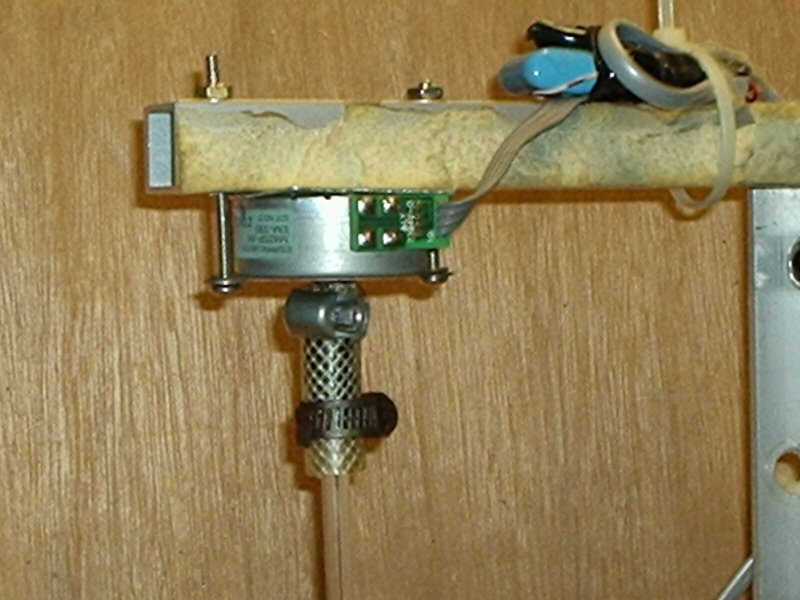
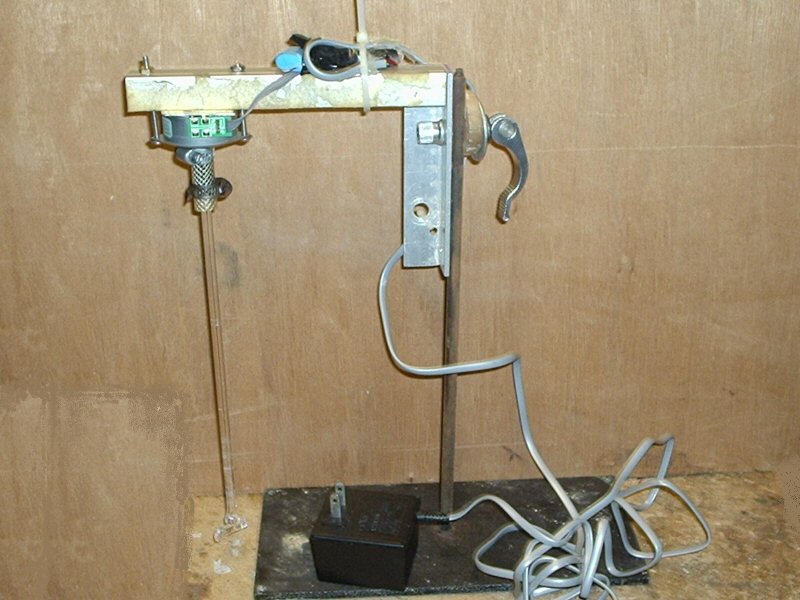
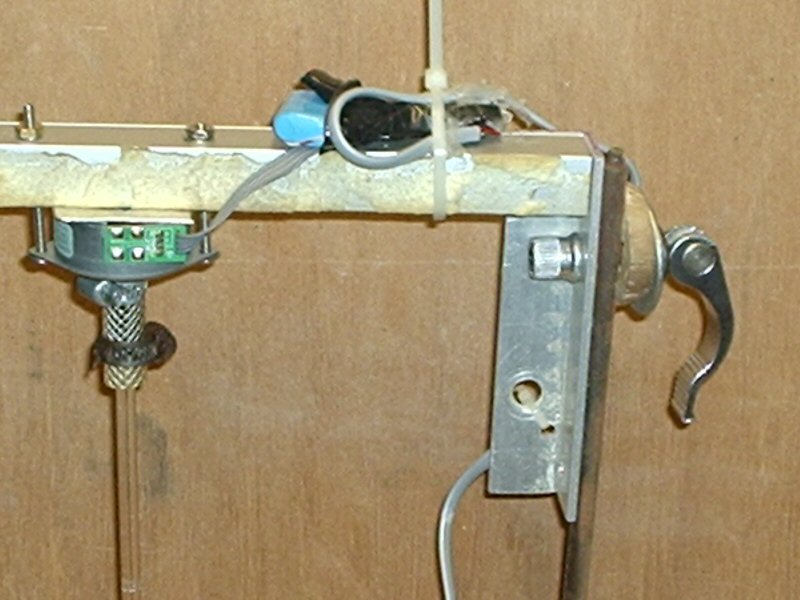
As luck would have it I ran across the pictures I had of the prototype, so if I can figure out how to get thiem into this post you can see them. You may note that the prototype showed me a few problems that I fixed in the write up.

The first of these was mounting the motor under the support arm. This puts it in the path of heat and fumes, so it would be much better to have it on top of the bar, with a plate directly underneath to block whatever might drift up. (Stepper motors don't have brushes so there's not a fire risk, but they don't like too much heat or corrosive fumes.)

The other correction that comes to mind is the placement of the capacitor. This is a no-brainer and I don't know why I originally put it where it is. It should be back away from the stand and protected inside a container of some sort.

PP

« Last Edit: September 05, 2009, 09:51:28 AM by Prepuce »

Prepuce1

  • Pupae
  • **
  • Posts: 96
Re: DIY Overhead Stirrer
« Reply #24 on: October 02, 2009, 04:09:33 AM »
Since this isn't available anymore:

Simple Gas-Tight Stirrer Bearing . . .

. . . One can mold these from shredded polyethylene containers  ;)

Lugh, the more I thought I about it the more uses I liked this idea. So much so that I decided to make a few, because I could think of all sorts of uses for them.

I know that polyethylene is molded by the use of heat and pressure, and can be heated to reform it. The only trouble is that when it "melts" it doesn't become liquid, it just becomes malleable. I made a form by casting a rubber stopper in plaster of paris, but found no easy way to get the softened plastic into the form with enough force that it wasn't loaded with bubbles or gaps.

Have you made these? If so, do you have any tips on doing so?

Thanks,
PP

badger

  • Larvae
  • *
  • Posts: 24
Re: DIY Overhead Stirrer
« Reply #25 on: March 11, 2010, 10:26:46 PM »
Prepuce, being that your motor is running on AC current, a simple dimmer switch might be the answer to your problem.  Try to find a high amp rated one though, as I can't imagine the basic ones are rated much higher than a couple amps, and a strong enough motor will sure as hell fry that with no problem.

Thanks for the suggestion, but because it's a stepper motor that wouldn't work. In fact steppers are ordinarily run with digital signals and require a particular bit pattern to function. The capacitor on the second set of inputs causes a phase shift of the sine wave, making the motor turn.

So, what you'd actually want would be a trimmer capacitor (variable capacitor, the capacitor equivalent of a dimmer switch). They don't really go up beyond the picofarad range, however.

What was the actual total capacitance of the circuit? Ceramic caps that are physically large in size are often of fairly low capacitance, with a high voltage rating. If the caps have markings like "103" on them, that tells us what their values are.

As far as digital signals go, I know that the Arduino community (www.arduino.cc) has a lot of members doing things with digital control of stepper motors. With an Arduino and a potentiometer you could easily regulate the speed of the stirrer.

mumbles

  • Larvae
  • *
  • Posts: 42
Re: DIY Overhead Stirrer
« Reply #26 on: May 10, 2010, 03:52:42 AM »
Swim has used a very simple overhead stirrer made out of 2x retort stands + 2x clamps holding one of those flexable drill cords with a HDPE stirrer paddle. Works well you just need a clamp or some electrics to control the speed of the drill. Its fast as hell so lids are useful.