Author Topic: DIY Overhead Stirrer  (Read 321 times)

Prepuce1

  • Pupae
  • **
  • Posts: 96
DIY Overhead Stirrer
« on: August 13, 2009, 06:27:47 PM »
The following are instructions on building an overhead stirrer from parts you may have lying around, or which can easily be acquired for next to nothing. The heart of the stirrer is a stepper motor—also easily available.

Stepper motors can be found in a lot of old computer hardware. Printers, floppy drives, scanners all have them. They look like small electric motors but have four or more wires coming out of them. The only constraint is that you need one with four wires, and that’s essential. The motors in hard drives (unless they’re ancient) aren’t steppers and can’t be used.

Note that this stirrer will have no speed control, but the force can be controlled by the shape of the stirrer blade. A larger stir blade will do more than a small one. Torque is pretty good, and should suffice for most purposes. When choosing or making the blade, make sure it’s going to fit into the container you want to stir.

Parts List
•   Stepper Motor
•   2” piece of braided nylon hose
•   Large capacitor – not the kind in a cylindrical metal can. These are usually shaped as a round, flattened ceramic disk, sometimes rectangular with rounded corners, and usually have two leads. There are really no other electronic components that look like this, so you can be fairly sure you have the right thing if they fit the description. Yellow, orange and blue are the most common colors. Get the largest in size that you can find, and don’t try to use tiny ones—they won’t work. You may need to use two. Capacitors can be found in virtually every electronic circuit. Those found in an old monitor, microwave, stereo or computer power supply should be good.
•   Glass or metal rod, depending on your application. Metal allows a large stirring paddle because it can be made to fold up next to the rod. The disadvantages of metal are obvious. The disadvantage of glass is that it would be difficult to make the paddle fold up.
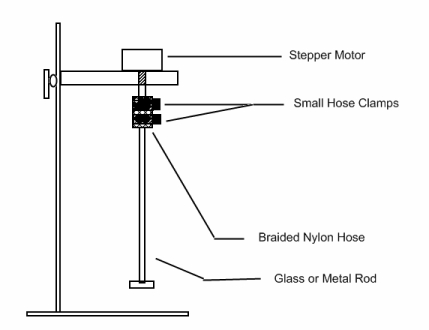
•   Support hardware – whatever you can cobble together. For the prototype a flat piece of aluminum was attached to a clamp from a kids scooter that allows the motor to be conveniently raised an lowered on a stand. See Figure 2.
•   Transformer (wall wart) rated at approximately 12 VAC. You can probably get away with voltage as low as 6 and as high as 15. Find the label on the stepper motor if you can, to see the voltage rating. It’s not critical but try to match that, or come as close as you can. Higher voltage = more torque, but more heating of the motor.

AC transformers aren’t as common as DC, so read the label on the body to make sure you don’t use DC by mistake. If you can’t find an AC transformer you can modify one made for DC if you’re comfortable with electronics.

Equipment and supplies
•   Ohm meter. Harbor Freight sells a digital multi-meter for $5, less when they’re on sale.
•   Soldering iron, flux and solder, or small wire nuts.
•   Electrical tape or shrink wrap.

Wall Wart Modification (Only needed if you can’t find one designed for AC.)
Unplug the unit and open it up. You will see wire attached to the wall plug going to a transformer. On the other side of the transformer there will be two copper wires coming out, attached to some electronic components. Cut these wires at a point before they reach the electronics. The wires may appear to be bare copper, but they are not. They’re coated with a hard plastic insulation that must be removed on roughly the last half-inch. That’s most easily done with a piece of sandpaper. Get it shiny bright or you’ll have trouble with the connections. Now attach an insulated wire to each of these connections. Solder them together or use a small wire nut. Insulate with electrical tape or shrink wrap.

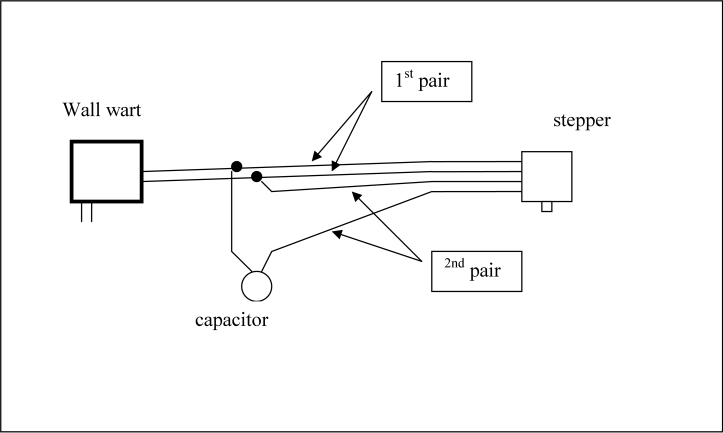
The Wiring The wiring is easy. With an ohmmeter, check the wires coming out of the stepper motor. There are two pairs where one wire is connected to the other. You need to identify the pairs. We’ll call one pair the 1st pair and the other the 2nd. (Flip a coin to decide which is which, but label them once you decide.)  In Figure 1 the top two wires coming from the stepper have been designated the 1st pair. The third and forth are the 2nd. Notice that they originate from the same place, one wire leading to the second pair is connected through the capacitor. Insulate all the connections with electrical tape or shrink wrap.


Figure 1. Wiring

At this point you’re ready to test the circuit. Plug in the wall wart and the stepper motor should begin to turn. If it does not, the capacitor is probably connected to the wrong wire of the second pair, so swap them and try again.

If it still doesn’t turn you probably need a larger capacitor. If you don’t have one, add another in parallel with the first. Keep adding capacitors until the motor turns. (Don’t use tiny little ones or you may never get there.) Keep in mind that you still have to check after each attempt to ensure that the capacitor is connected to the correct wire in the second pair.

Once you’ve verified your wiring it’s time to mount the motor. Place it on top of the support to protect it from heat and fumes. You might want to build an enclosure of some sort, but make sure it’s got adequate ventilation.
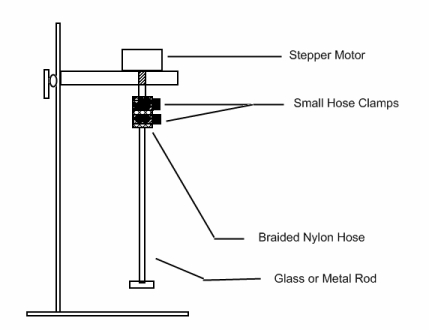

Figure 2. Example Mounting

Cheers,
PP
« Last Edit: August 13, 2009, 07:25:30 PM by Sedit »

Vesp

  • Administrator
  • Foundress Queen
  • *****
  • Posts: 3,130
Re: DIY Overhead Stirrer
« Reply #1 on: August 13, 2009, 08:15:24 PM »
Nicely detailed. Have you built this? I'd like to hear how it works.
Bitcoin address: 1FVrHdXJBr6Z9uhtiQKy4g7c7yHtGKjyLy

lugh

  • Global Moderator
  • Foundress Queen
  • *****
  • Posts: 876
Re: DIY Overhead Stirrer
« Reply #2 on: August 14, 2009, 02:24:10 AM »
That design should work but speed control is very helpful  ;) An easier way to construct one is to secure an industrial quality drill in a suitable clamp and control the speed with a router speed control  ;D
Chemistry is our Covalent Bond

Prepuce1

  • Pupae
  • **
  • Posts: 96
Re: DIY Overhead Stirrer
« Reply #3 on: August 14, 2009, 04:48:34 AM »
Nicely detailed. Have you built this? I'd like to hear how it works.

I have built it and I used to have pictures but must have lost them in a hard drive crash. It worked well, but as Lugh said, it would be nice to have speed control. (I would have included that but it makes the circuit lots more complicated.) Even so, I used a glass stirring rod that I fitted though a rubber stopper with a little Vaseline for grease. It had enough torque that I had no trouble stirring anything I tried it on. I never made a metal stirring rod, but that's the best way to go. You can't made a very big paddle with glass or you can't get it into flasks, but a small paddle means a relatively small vortex.

I stopped using it somewhere along the line because I just didn't need an overhead stirrer. It's getting to the point where I could use one now, though, so I'm going to put it back together.

PP

Prepuce1

  • Pupae
  • **
  • Posts: 96
Re: DIY Overhead Stirrer
« Reply #4 on: August 14, 2009, 04:51:20 AM »
That design should work but speed control is very helpful  ;) An easier way to construct one is to secure an industrial quality drill in a suitable clamp and control the speed with a router speed control  ;D
Thanks, Lugh. As a matter of fact it does work.

The industrial drill is a good idea. I have one, but if I used it in my lab what would I use to mix cement?  ;D

PP

Vesp

  • Administrator
  • Foundress Queen
  • *****
  • Posts: 3,130
Re: DIY Overhead Stirrer
« Reply #5 on: August 14, 2009, 06:17:01 AM »
If you don't mind a totally obnoxious questionable overhead stirrer, there is always the blender: http://127.0.0.1/talk/index.php/topic,254.0.html

It has speed control, but who knows when it will fail, how long it can last, etc. It only takes about 8 dollars and 10 or 20 minutes to make, however.
Bitcoin address: 1FVrHdXJBr6Z9uhtiQKy4g7c7yHtGKjyLy

2bfrank

  • Guest
Re: DIY Overhead Stirrer
« Reply #6 on: August 15, 2009, 03:44:36 AM »
THIS is a total disgrace, me with the following comment,but anyone know where something like this couldbe obtained in the CLOSE TO AUSTRLIA PART OF THE WORLD>> I havent got time,, I am serious,, Id pay, if someone here for instance could make one and do so confinentantly that it will hang in there for a while. and definately be made with accessible issues not messed up with.. THAT isn't usualy the case but it can happen.. jut thought id ask.

2b

lugh

  • Global Moderator
  • Foundress Queen
  • *****
  • Posts: 876
Re: DIY Overhead Stirrer
« Reply #7 on: August 17, 2009, 03:10:28 AM »
Since this isn't available anymore:

Simple Gas-Tight Stirrer Bearing
The problem of operating mechanical stirrers in closed vessels is commonly solved by the use of clumsy mercury seals or of relatively expensive stirring glands. A most inexpensive and satisfactory solution is to employ a standard-taper, hollow polyethylene stopper. One was filled with water and run at 1500 rpm. for 3 days without leakage. Bearings of this type have given excellent service in Grignard reactions. Of course, where the reaction mixture would dissolve or soften polyethylene, the use of such bearings is impractical.

One can mold these from shredded polyethylene containers  ;)
Chemistry is our Covalent Bond

Prepuce1

  • Pupae
  • **
  • Posts: 96
Re: DIY Overhead Stirrer
« Reply #8 on: August 17, 2009, 06:07:50 AM »
Lugh, that sounds like a pretty good idea. Polyethylene is naturally slippery. However, I've had better luck with a regular rubber stopper, although it probably doesn't seal as well. The trouble I've had with polyethylene is that it melts at too low a temperature, doesn't hold up well to acids, and is attacked by xylene. Of course I wrap rubber stoppers with teflon tape before I use them with xylene, or anything else for that matter.

On another topic, there's an advantage to using a stepper motor that I forgot to mention.  It's that they are the only motors I'm aware of that operate with good torque at low speeds. The only option with others is to use gears or some other mechanical means of speed control.

To be honest, I was planning to use speed control with this design until I realized how difficult it was going to be to change the frequency of the AC input. Then I thought I could just design a simple variable frequency sine wave oscillator, and was surprised to discover that this too was not as easy as I had assumed.

As the design stands varying frequency is the only way to control the speed. I've looked at a variety of digital control methods and rejected them all because of complexity. If anyone knows a simple means to do it I'd appreciate a reply or a PM. By simple, I mean something that most people would be able to build.

PP

Prepuce1

  • Pupae
  • **
  • Posts: 96
Re: DIY Overhead Stirrer
« Reply #9 on: August 17, 2009, 06:15:35 AM »
If you don't mind a totally obnoxious questionable overhead stirrer, there is always the blender: http://127.0.0.1/talk/index.php/topic,254.0.html

That was one of the first posts I read when I joined the board. I think it's a pretty clever idea, although I didn't understand how you attached the stir rod. It's noisy because it has gears to reduce the speed of the motor and retain torque, but if it's an older mixer you might take a look at the gears to see if they need lubrication. That might quiet them down a bit.

It should last a reasonably long time, but if you've ever noticed most of these things make lots of sparks. You wouldn't want to use it near a flammable liquid.

PP

Douchermann

  • Dominant Queen
  • ****
  • Posts: 397
Re: DIY Overhead Stirrer
« Reply #10 on: August 17, 2009, 06:30:43 AM »
Prepuce, being that your motor is running on AC current, a simple dimmer switch might be the answer to your problem.  Try to find a high amp rated one though, as I can't imagine the basic ones are rated much higher than a couple amps, and a strong enough motor will sure as hell fry that with no problem.

Vesp

  • Administrator
  • Foundress Queen
  • *****
  • Posts: 3,130
Re: DIY Overhead Stirrer
« Reply #11 on: August 17, 2009, 06:31:10 AM »
Oh, I attached the stir rod by cutting off the metal mixing part, and putting a rubber tube from the ground off metal end, attached to glass, and then for structural support, I put a bic pen tube over the rubber and super glued it.
Bitcoin address: 1FVrHdXJBr6Z9uhtiQKy4g7c7yHtGKjyLy

Prepuce1

  • Pupae
  • **
  • Posts: 96
Re: DIY Overhead Stirrer
« Reply #12 on: August 24, 2009, 03:28:37 AM »
Prepuce, being that your motor is running on AC current, a simple dimmer switch might be the answer to your problem.  Try to find a high amp rated one though, as I can't imagine the basic ones are rated much higher than a couple amps, and a strong enough motor will sure as hell fry that with no problem.

Thanks for the suggestion, but because it's a stepper motor that wouldn't work. In fact steppers are ordinarily run with digital signals and require a particular bit pattern to function. The capacitor on the second set of inputs causes a phase shift of the sine wave, making the motor turn.

Vesp: I think I get it now on the attachment. I was thinking that the cut off end was the one at the bottom.

Your stirrer is a clever idea, and I'd try it myself if I could think of something to do about the sparks.

PP

Vesp

  • Administrator
  • Foundress Queen
  • *****
  • Posts: 3,130
Re: DIY Overhead Stirrer
« Reply #13 on: August 24, 2009, 03:37:35 AM »
Is this the same type of motor that is often found in electric pencil sharpeners?
Bitcoin address: 1FVrHdXJBr6Z9uhtiQKy4g7c7yHtGKjyLy

Douchermann

  • Dominant Queen
  • ****
  • Posts: 397
Re: DIY Overhead Stirrer
« Reply #14 on: August 24, 2009, 06:40:17 AM »
@Prepuce - Perhaps switching to an AC motor would simplify this issue.  I agree, digitial motor controllers are complex (square waves and whatnot).  There are plenty of high-torque AC motors in existence - take corded drills for example.  Granted most are gear reduced, but nevertheless, generate ample speed to supply ample torque at the proper ratio.  I Imagine one could find brushless AC motors that can supply high-torque as well.

@Vesp - most of the motors in pencil sharpeners that I have seen are just basic AC motors, no stepper motor, no capacitor.

eesakiwi

  • Larvae
  • *
  • Posts: 14
Re: DIY Overhead Stirrer
« Reply #15 on: August 25, 2009, 08:46:01 AM »

I have a bunch of AC motor controllers.
 They only power motors that have brushes in them though..  Arrh 'Sparks!'

 Easy to find, a large NZ/Aussie electronics store sells them as 'kits' too.
 They work very well, mostly I have used them to lower the speed of drills when drilling large holes thru metal.

 Anyway.. About the stirrer seals.
 I pulled a electric gluegun apart a few days ago & relised theres a 'stepped' high tempature rubber bush inside them, easy to see, its bright orange.

 This is the best pic I could find, the bush is charred a bit, but thats because the 240V shorted out, not from use.
http://hawk.diamondage.co.nz/research_docs/blown_glue_gun_sml.jpg

Douchermann

  • Dominant Queen
  • ****
  • Posts: 397
Re: DIY Overhead Stirrer
« Reply #16 on: August 25, 2009, 05:56:53 PM »
Hmmm, that's quite interesting.  Have to find a mini glue gun though, because I believe a stirring rod of similar diameter to a regular size glue stick might be a bit cumbersome.  If all else fails, maybe a fan directing any vapors away from the brushes could work?  A well seated brush will generate very few sparks, but a spark is still a spark regardless.

lugh

  • Global Moderator
  • Foundress Queen
  • *****
  • Posts: 876
Re: DIY Overhead Stirrer
« Reply #17 on: August 26, 2009, 01:20:51 AM »
This thread from the Hive provides a better solution:

Posts 1 - 10 of 10         Subject: Electric Motor Explosion Proofing


          lugh
(Moderator)
07-12-02 19:19
No 331864
                  Electric Motor Explosion Proofing Modification
(Rated as: excellent)       
From Ind Eng Chem  675 (1926):

To prevent sparks from the motor igniting volatile solvent fumes, the principle of the Davy lamp was applied. The air holes at the brushes were covered with 50 mesh copper gauze, welded on. The motor was then run free and under load in explosive mixtures of benzene, gasoline vapor and natural gas. No explosions occured, although the brushes were sparking badly. Under similar conditions the same unprotected motor invariably detonated the gas mixtures. It should be noted that this modification gives no protection from the improbable event of a spark between the shaft and bearings, but this is a rare occurance.

SWIL would test this in a small test chamber before trying it with diethyl ether or hydrogen laugh SWIL sees no reason brazing couldn't be used to attach the mesh either smile    


          MescalToad
(Stranger)
07-13-02 03:26
No 331997
                  j3al7o82       

Good luck!    


          Fully_Auto
(Hive Bee)
07-19-02 16:54
No 334718
                  ?       

Can someone please explain why adding copper mesh to the open spaces on a motor will prevent it from detonating explosive gasses even though sparks are still forming.

I looked up Davy lamp on google but I still don't understand. Is the copper just absorbing and displacing the heat?  Why won’t an electrical spark ignite the gasses present?


          goiterjoe
(Title on BackOrder)
07-19-02 17:00
No 334723
                  heat absorption       

the copper mesh absorbs the heat out of the electrical sparks and prevents the gasses that are present from hitting their autoignition temperature.  A davy lamp won't work in the presence of vapors such as gasoline that are already at their autoignition temperature normally.  I doubt it would work for something like hydrogen or methane either.
All paths are the same: they lead nowhere    


          Fully_Auto
(Hive Bee)
07-19-02 17:23
No 334738
                  Thanks goiterjoe       

That's what I assumed.

Does the motor have to be grounded in order for this to work?


          goiterjoe
(Title on BackOrder)
07-19-02 17:33
No 334748
                  corrections       

apparently this will work fine for hydrogen and methane, since they have ignition temperatures well above ambient temperatures.  why wouldn't you want to use a grounded motor?  It shouldn't make any difference unless you have a problem with voltage fluctuation on the utility lines that service your house, like from lightning strikes or conductor faults.
All paths are the same: they lead nowhere    


          lugh
(Moderator)
07-19-02 17:47
No 334760
                  Davy Lamp       

The Davy lamp was invented for using in coal mines to protect the miners from the ingition of firedamp smile The articles states it was tested in natural gas, also known as methane or firedamp, so that's not an issue. It appears it would be okay to use around diethyl ether as well, see:

http://www.physics.purdue.edu/reports/demo/heat/Ht-12.html


http://tfk.factmonster.com/ce6/sci/A0842924.html

The Davy lamp is based upon the principle that to be ignited a substance must first be heated to its kindling temperature and that if such heating is prevented combustion will not occur. The flame in the lamp is surrounded by a metal-gauze screen that distributes the heat over a large area so that the maximum temperature of the screen is below the ignition temperature of the flammable gas mixture (e.g., firedamp).


          Fully_Auto
(Hive Bee)
07-19-02 18:13
No 334776
                  Very interesting       

Thanks for taking the time to respond to my ramblings. smile    


          platcat
(Stranger)
07-21-02 17:49
No 335550
                  davy lamp ?       

Is swip to understand the exxxxpensive equipment he was pricing can be substituted with a 20" window fan
which has the motor housing blanketed in copper gauze?? Is the brazing/welding done for a reason or can swip use nylon tie straps?If nessessary swip will solder to keep heat at minimum. Swip  is dreaming of a visit to mart mart for some scrubbing pads. If he gets the right answer.lol. the copper kind that is!! that will solve another pricy problem. Good work Bee'ssmile
"The crux of the biscuit is the apostrophe"FZ
Are we there yet?    


          lugh
(Moderator)
07-21-02 19:37
No 335577
                  50 mesh       

You need to use 50 mesh copper gauze, that's not going to be real cheap, but it would allow you to use such a fan more safely if you follow the directions exactly. Copper scrubbing pads are not a suitable substitute, forget about the zip ties also frown


 ;D   
Chemistry is our Covalent Bond

Sedit

  • Global Moderator
  • Foundress Queen
  • *****
  • Posts: 2,099
Re: DIY Overhead Stirrer
« Reply #18 on: August 26, 2009, 01:24:17 AM »
That is very good news thanks for sharing Lugh. It seems odd just like the post suggest that copper mesh would prevent an explosion but ill have to look more into the physics of the Davy lamp.

Good stuff.
There once were some bees and you took all there stuff!
You pissed off the wasp now enough is enough!!!

Vesp

  • Administrator
  • Foundress Queen
  • *****
  • Posts: 3,130
Re: DIY Overhead Stirrer
« Reply #19 on: August 26, 2009, 01:32:59 AM »
Also if you have the ability, which in most of the cases you may not..
why not attach a tube to the reaction and pull a very light flow of air though it via an aspirator. This would cause the reaction vessel to suck in air, and prevent any fumes going to the mixer. Instead the fumes will be sucked into the aspirator and mixed with the water and tossed out.
Bitcoin address: 1FVrHdXJBr6Z9uhtiQKy4g7c7yHtGKjyLy