"I know about the Japanese paper in question (to the best of my knowledge I'm the one who found it)..."
Yes I gave you credit in my post above, something like' thanks to no1uno for uncovering that gem.
"I was also involved in the said discussion with Nicodem"
I also know this, the link that I used for the paper above came from your original post at SM, this also confused me more as to why you were saying alanine and benzaldehyde wont participate in an Akabori. After being in the Akabori thread about alanine and benzaldehyde reflux to produce PPA?

?
"Quite frankly, we have 3 procedures, using essentially the same reagents (variations relate to the existence or non-existence of the a/N-methyl or both)."
There is not three procedures, there is the older accepted Akabori with 16% yields, then there is the newer Akabori including hydrolysis of the formed oxazolidine to double the yield to 48%. Thats really one procedure with a modification to increase yield. Now Nicodem tried to tell you and here is excerpt from one his responses to you!
"There is however an important, even though mostly formalistic, consequence (unless the oxazolidine forms only when using N-methylalanine but not with alanine, which is however unlikely). Namely, the Akabori reaction gives a much better yield when the correct stoichiometry is accounted for. Much of the fame of its low yields is thus due to using the wrong stoichiometry in calculating the yield and/or the belief of having used alanine as the limiting reagent. For example, CycloKnight always used substoichiometric amounts of benzaldehyde in his experiments, even in those cases where he believed of having used an excess of it (unless I missed some example while rapidly skimming trough the start of the thread). So it is yet to see what the yields are when using alanine as the limiting reagent (maybe this is explained in that paper, but since I don't understand Japonese…)."
That was a direct cut and paste from a Nicodem post from here;
http://www.sciencemadness.org/talk/viewthread.php?tid=5979&page=6"I sincerely doubt Nicodem would be quite so certain of the fact that the desmethyl precursor's would proceed by the exact same reaction as the N-methyl variant."
About half way the page, where you said the same thing. And he tried to tell you then.
And one more Nicodem quote for you! This was written to YOU by Nicodem, regarding this whole conversation.
"Seems like I have to say everything three times before you actually get to read it. I must say that your old habits die hard. So I'll try one more time, more concisely, before I give up.
You say "if alanine reacts with one mol of benzaldehyde to give an azlactone" and I say: benzaldehyde and alanine do not react to give an azlactone!
Please read the text concerning the scheme where that compound 193 is mentioned and more so the chapter on the synthesis of azlactones from N-acyl-amino acids. I already told you that once you read it you should clear up your confusion.
Besides, why don't you just try to draw the condenstation between alanine and benzaldehyde so that you can see it can not give any azlactones unless the reaction involves an oxidation (always check the oxidation states of the left and right side of the equation!).
Benzaldehyde has nothing to do with the Erlenmeyer or related reactions, utmost it can be used as an aldehyde in a condensation reaction to prepare the 5-benzylidene derivatives, but not for the synthesis of the azlactone itself.
First of all the conditions are anything but similar and the products are not even closely related. Not to even mention that in the Erlenmeyer reaction benzaldehyde has no role while in the Akabori reaction one equivalent is necessary in order to form the amine/imine for the alpha-CH group activation so that this can participate in the condensation with another equivalent of benzaldehyde as well as to allow the decarboxylation of the -COOH group.
In short: for the cyclization of N-benzoyl-alanine you need zero equivalents of benzaldehyde; while for the formation of the oxazolidine end product of the Akabori reaction you need two equivalents of benzaldehyde. (your homework: draw the reactions and balance the equations)
I really can not explain better. It is your turn to read all the posts all over again, do some reaction drawing and some reading, because I really can not explain in any simpler words. "



 ), you need to look for a synthesis of N-methylalanine, one route to which would be via the reductive amination of pyruvic acid with methylamine. In that respect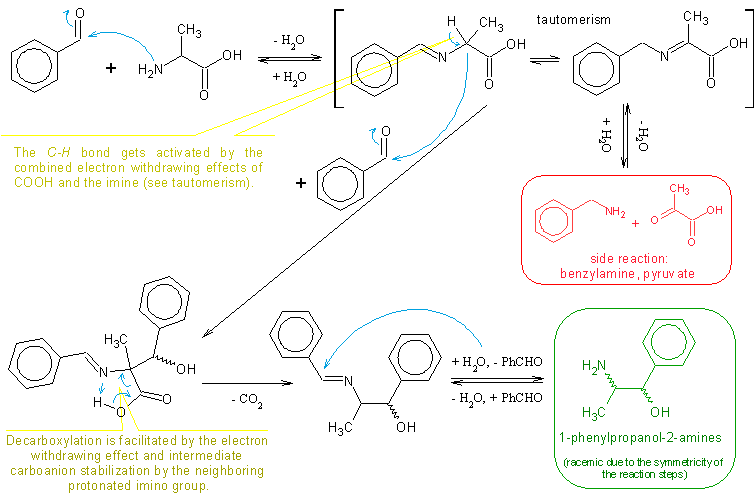


 ).
).


