Author Topic: P2P identification questions  (Read 308 times)

Locked

  • Subordinate Wasp
  • ***
  • Posts: 192
P2P identification questions
« on: October 02, 2009, 06:54:16 PM »
I found these notes by the main lift at Telluride and thought someone here might be able to make sense of them.

"short vigreux fractional distill on post lead acetate PAA cook
yield cleaned up was 4.5L from 10Kg PAA
cooks were scared of the reaction and could have probably got more yield
corrected for altitude, sorta, 23"-24+" vac collected from 154 till rapid increase, off the heat at 166, yellowish at end
The oil is not yellow, hardly tinted, clear. Does not smell like cat piss. Cant remember MDP2P well, but it never smelled like cat piss
This smells nice-ish.
it eats styrefoam
Everything and anything could be wrong with this. It could be great.
PAA was Asian 99+%. All equipment except the ghetto rigged dual aspirator/big asspump was professional."

So what have the lifties made? 1-phenylpropan-2-ol(Wouldn't the BP be higher)? Are the internet accounts of "cat piss" smelling yellow p2p dirty? Are these lifties a bunch of ass clowns or the real deal?

lugh

  • Global Moderator
  • Foundress Queen
  • *****
  • Posts: 876
Re: P2P identification questions
« Reply #1 on: October 03, 2009, 03:12:40 AM »
Chemistry is our Covalent Bond

jon

  • Foundress Queen
  • *****
  • Posts: 1,883
Re: P2P identification questions
« Reply #2 on: October 03, 2009, 03:13:56 AM »
well if you know anything about distillation you should use a vigreux column and fractionate the shit and you would'nt be asking questions like
"why does my pee-2pee smell like pee?"
well because either you failed to convert phenylacetic acid or just did'nt fractionate it right.

i think the workup there calls for some acid base chemistry before you even distill it probably why you need to wash with a basic solution and do it right.

lugh

  • Global Moderator
  • Foundress Queen
  • *****
  • Posts: 876
Re: P2P identification questions
« Reply #3 on: October 03, 2009, 03:22:41 AM »
Read this also:

http://www.erowid.org/archive/rhodium/chemistry/p2p.phenylacetic.html

the cat piss smell is characteristic of impure PAA, pure PAA has a pleasant odor  8)
Chemistry is our Covalent Bond

Locked

  • Subordinate Wasp
  • ***
  • Posts: 192
Re: P2P identification questions
« Reply #4 on: October 03, 2009, 06:23:47 AM »
Super cool lugh!

Benzyl acetate, diphenylethane & diphenylmethane all higher bp's. Rhodium's site still rocks out.

I believe the lifties were having trouble because the no formal training scooter trash with the biggest mouths on the net, and smallest brains by the proof of posted pics, say, and you can read and see for yourself even on Rhodium's site, that p2p is yellow and smells like cat piss. As I read it, theirs did not.

The lifties should use a vigreux? I'm pretty sure that's what it says in the first line of their note. Careful reading also notes that it was done under vacuum. Pretty standard. The note has what looks like semen obscuring the part about rigged capillary bleed, actually too big so the open end had to be covered with ACS grade electrical tape and hardly pierced with a calibrated ACS grade hotel sewing kit needle. Sorry jon for not including that part.

I would also hope that if the lifties had failed to convert PAA that they would know the smell of that, since they started with it.

And what is the smell of that? On the bottom of their note it also said "Phenylacetic acid does have an odor, but all uninitiated said it smelled good upon first sniff, weird honey-ish. Time changed their opinion, like with many of the E intermediates, good at first but bad with exposure. This confusion over the netwide "knowledge" that PAA smells bad lead to the ditching without workup of a now fairly certain phenylacetic acid cook from the oxidation of phenylethanol with sodium dichromate/sulfuric."

So jon, after reading the lifties brief but descriptive note, and only wishing to help and share, how would you suggest they do it right?

Please don't just fire from the hip. Take your time... aim.

Some acid base chem? Please enlighten us. You might quickly dredge some posts about mdp2p written by people who know shit, so that you might pretend to, then post. Or if you actually have no experience or understanding of this reaction and no wish to help, please keep it down. Chimp style automatic poo throwing is distracting.

Remember, spreading shit on the net is infectious. People type without knowledge and then it is wikipedia neTrue and some fucker in nebraska blows up his trailer because of a failed bananadine extraction. Perhaps you could help with a writeup of that.

Oh, also in the note, but not included, was the part, "Xtaldoc rocks! Much love to Hudlickey, Rhodium, Shulgin and Vogel. Oh, and Organic Syntheses website adding to real collective knowledge."

jon

  • Foundress Queen
  • *****
  • Posts: 1,883
Re: P2P identification questions
« Reply #5 on: October 03, 2009, 06:31:31 AM »
yep wash the acids out with 5% naoh then water then brine and back extract it's a  fucking pain.
reason why you subject ketone to heat with trace amounts of bases and watch it polymerize up to some pretty colored tars don't want any bases flaoating around in the ketones hell swij is retarded he knows that just having fun back in the 90's remember those days?

jon

  • Foundress Queen
  • *****
  • Posts: 1,883
Re: P2P identification questions
« Reply #6 on: October 03, 2009, 06:44:06 AM »
put it like this familiar with hydrogen bonding? well carboxylic acids tend to hydrogen bond to other things like carbonyl groups for example so you could run an excellent distillation have all your theretical plates worked out i don't care it's still going to carry over sort of like an azetrope.

Locked

  • Subordinate Wasp
  • ***
  • Posts: 192
Re: P2P identification questions
« Reply #7 on: October 03, 2009, 08:37:05 AM »
Now we are getting somewhere. Thank you for your input, jon.

Also under foul smudges were, "Worked up Xtaldoc like, except don't start catching distillate until after the reaction starts. might be subtle if you go slow and steady. collect from 175-180 pot temp and up."

From only taking a quick look at what is going on, why don't people pull hard vac+heat and dump the moisture and excess acetic first before putting it to the coals?

Locked

  • Subordinate Wasp
  • ***
  • Posts: 192
Re: P2P identification questions
« Reply #8 on: October 12, 2009, 12:39:04 AM »
I found another note.

"Just in case anyone feels like trying the bisulfite addition, give it a chance to form the crystals.
Lifties always go big, so 2x Eleusis Sodium Bisulfite was tried.
P2P poured into the prepped mix
It did not instantly go into solution
Hit 8 on the stirrer of destruction and turned away
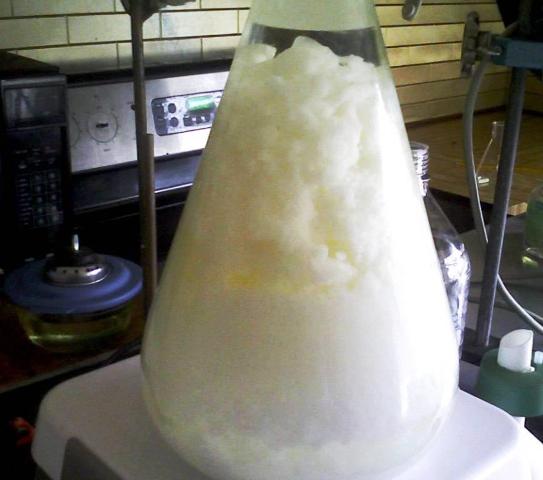
Flask was one white solid a minute later
A better technique might be to stir quickly, then wait a moment
60something g of p2p is all the lifties are wasting on this silliness"

Anyone with experience have a better tech for growing big pretty crystals out of this stuff?

Can this stuff be melted easily and recrystallized better? I think vogel or SM or some know it all says just ether wash and go, but I think the lifties have a solid flask full. At least it isn't oxidizing as fast as liquid. I am sure they know to base, brine, dry and distill it back to goodness.

What is the consensus on the life expectancy of clean distilled p2p in the freezer? SWIM remembers mdp2p being good for quite a while treated the same, despite the doom and gloom predictions of others.

If someone felt putting p2p away for a rainy day, would forming big bisulfite addition crystals and storing under vac or argon at low temps be the ticket?

Vesp

  • Administrator
  • Foundress Queen
  • *****
  • Posts: 3,130
Re: P2P identification questions
« Reply #9 on: October 12, 2009, 01:23:02 AM »
I don't have any sources so please double check this, but I've heard the adduct of benzaldehye is more stable then benzaldehyde itself. I would assume this would go for other adducts as well. Anyone have experience or reference to this?
Bitcoin address: 1FVrHdXJBr6Z9uhtiQKy4g7c7yHtGKjyLy

lugh

  • Global Moderator
  • Foundress Queen
  • *****
  • Posts: 876
Re: P2P identification questions
« Reply #10 on: October 12, 2009, 02:24:05 AM »
The bisulfite adducts are usually more stable than the parent compounds ;) In the case of benzaldehyde, the adduct is much more stable :P Pure p2p and mdp2p are quite stable when frozen, and pretty stable at room temperature 8)
Chemistry is our Covalent Bond

ChesireCat

  • Larvae
  • *
  • Posts: 30
Re: P2P identification questions
« Reply #11 on: November 14, 2009, 05:30:23 AM »
Concentration of the bisulfite reagent plays key in the resulting size of the adduct crystals. Having experienced first hand what Stirbar describes and ultimately deciding the procedure was more trouble than it was worth I toyed a bit with things in search of a more practical and efficient process. I use 1.5 times as much alcohol and H2O as described in the "Purification of Keytones" FAQ.  Do expect 10-15 minutes of stirring before seeing the adduct precipitate from solution.

CC

Locked

  • Subordinate Wasp
  • ***
  • Posts: 192
Re: P2P identification questions
« Reply #12 on: November 14, 2009, 08:00:53 AM »
It's nice to hear one can just start out with that amount of alcohol.

I love crystals and had been messing around with that beaker, first to get my stirbar out of it, and second to actually make crystals so they could be filtered from liquid.

This stuff melts into solution, so heating and stirring and pouring in additional water/alcohol doesn't hurt anything. In my case it was done after distilling so it was more for verification of =O product then purifying.

Locked

  • Subordinate Wasp
  • ***
  • Posts: 192
Re: P2P identification questions
« Reply #13 on: January 30, 2010, 05:41:37 PM »
In furthering work for pure insanity, I have come across a possible work up addition to the classic Xtaldoc post PAA+Lead Acetate steps.

As lugh kindly pointed out, Rhodiums site has had http://www.erowid.org/archive/rhodium/chemistry/p2p.phenylacetic.html

in that our friends on the side of the cheap blue windbreakers tested and said that methyl benzoate and benzyl acetate are the close BP products that could be there. From the look of their test, a lot of methyl benzoate. Not ethers, they are esters and easy to deal with.

I propose that the post reaction, pre distillation mix is already sitting on NaOH and water to deal with all the acetic acid, why not turn up the heat and reflux for a bit and let a base catalized hydrolisis turn methyl benzoate into sodium benzoate (get your benzoic acid back for coke!)& methanol, and benzyl acetate to phenylmethanol and acetic acid.