Sed my friend, Mez thinks you just may have hit the nail of the proverbial head. Sorry it took so long as it was quite a few days ago when mez said a post would be made. But could not sit still after those references were provided detailing the close connection the temperature plays on the conversion of N-chloroamide. Yes, temperature does play a huge role in the Hoffman rearrangement, but the question that still remains, is where?
Quote from Nicodem at scimad
"The Hoffman rearrangement is not made like described in the first post of this thread...And it is necessary to first let the hypochlorite form the N-chloroamide at a low temperature since at above 50°C the disproportionation of NaOCl to NaCl and NaClO3 occurs rapidly. Only after this induction period at <20°C is the reaction mixture heated to 60-80°C in order for the N-chloroamide to rearrange."
Also a quote from a JAC article.
Quote
Whitmore and Thorpe, J. of the Amer. Chemical Society, Vol 63, April 1941, p1118
"It was necessary to allow several hours for the formation of the N-chloroamide before heating to degradation temperature. With this modification it was possible to prepare methylamine...consistently in 78% yield."
After performing this procedure a half dozen times it became clear that modifications would be needed in order to achieve better results. The first of those trials was done in the manner laid out by Eleusis in his FAQ using an open face stainless steel container. Mez quickly discarded the idea due to both in inability to control the smells innate to this process, but also because one thing that was recognized from the outset was the need to keep both the hypochlorite solution and that of the acetamide very cool, which if one reviews Eleusis’ synth, it does not (as least in regards to preparation involving the hypochlorite). Mez proceeded with the synth laid out by Rhodium and if you remember sed, the first few attempts were abysmal at best. The 3rd seeming to have hit pay dirt up to the point of having his hcl sucked backed into his boiling flask, and he was about 3 seconds away from having new textured wallpaper since his glassware was about to be the product of a hail mary pass
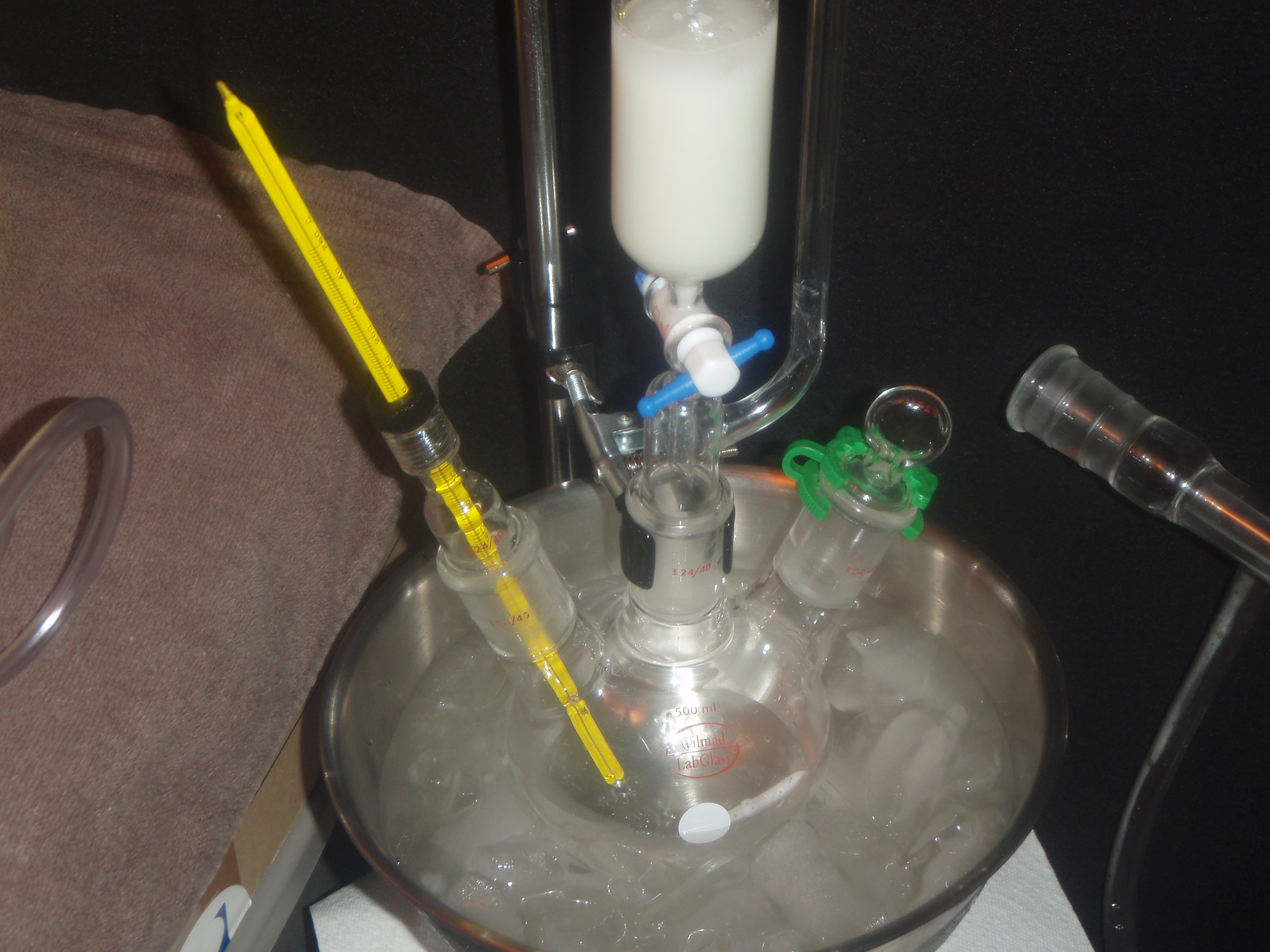
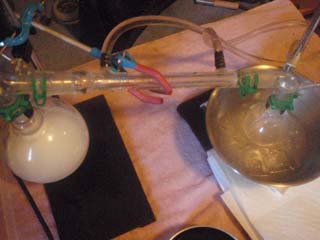
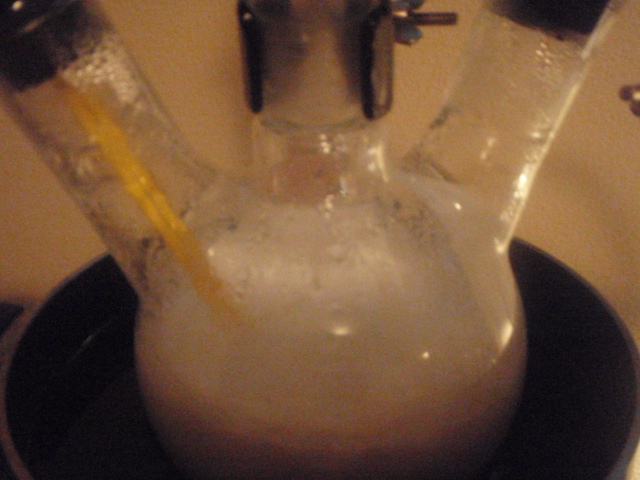
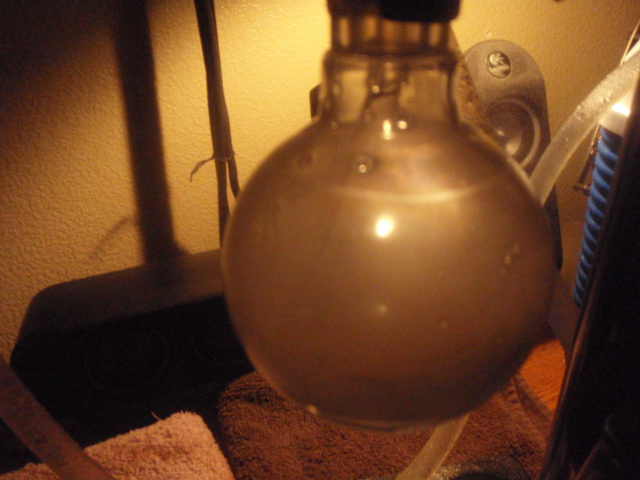
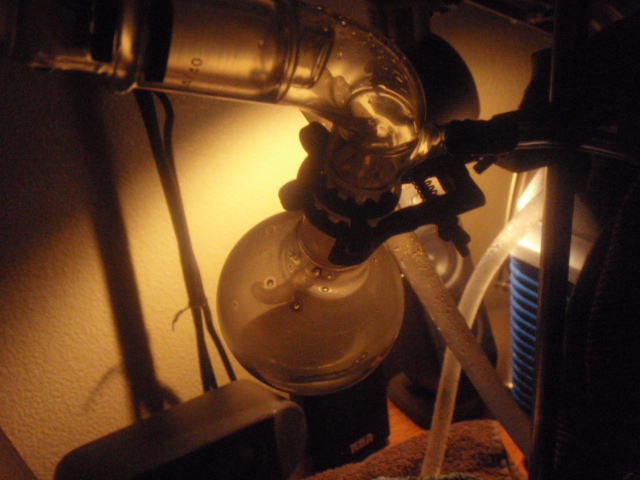
Still Mez did not let this stop him from making a few minor modifications listed below should it bee of any help to anyone, 1st pic below is addition of hypochlorite, 2nd basic dist. setup, 3rd inside view, 4th collectiion of methylamine gas, 5th the dreaded suckback, and 6th well that should need no explaining. The synth was carried out as written which for your viewing pleasure is:
Preparation of Methylamine Hydrochloride
The apparatus for this experiment should be set up before any materials are mixed.
A 500-mL distilling flask is fitted with a two-hole stopper carrying a thermometer and an inlet tube for air. The bulb of the thermometer should dip below the surface of the liquid, and the air tube should reach almost to the bottom of the flask. The distilling flask is attached to a condenser bearing an adapter. Two 250-mL Erlenmeyer flasks containing 35 mL each of 6 N HCl are placed in series as receivers. The first is fitted with a two-hole stopper. A glass tube attached to the adapter should dip below the surface of the HCl in the first receiver. The second receiver is connected to the first by means of another glass tube leading from above the acid solution in the first receiver to below the acid in the second.
To 16.4 g. of "H.T.H." in an Erlenmeyer flask is added 50 mL of water, and the mixture shaken until practically homogeneous. A small amount of material will remain undissolved. The solution is cooled to about 0°C in an ice-bath and 10 g. of crushed ice added.
The distilling flask is disconnected, and a cold solution of 10 g. of acetamide in 20 mL of water poured into it With the distilling flask immersed in an ice-bath, 100 g. of crushed ice is first added to the solution, followed by the addition of the cold "H.T.H." solution in three or four small portions with shaking after each addition. The temperature of the mixture should not rise above 0°C. More ice may be added to the reaction mixture if necessary. If the mixture should warm to more than 10°C (due to insufficient cooling), it should be discarded and the experiment repeated.
The flask is allowed to remain in the ice-bath for five to ten minutes. At the expiration of this time the flask is fitted to the condenser and a solution of 24 g. of NaOH in 40 mL of water at room temperature is added. The stopper is immediately replaced, and a current of air passed through the mixture during the remainder of the manipulations. The current of air should be sufficient to produce thorough mixing of the contents of the flask and to prevent bumping, yet not strong enough to cause much loss of the methylamine from the receivers.
By heating the flask the temperature of the mixture is raised rapidly to about 60°C. Between 65°C and 75°C the N-chloroacetamide decomposes with liberation of considerable heat, which, if not controlled, is likely to cause the contents of the distilling flask to bump over into the condenser. Consequently, the temperature is increased carefully from 60°C to 65°C and the flame removed. From this point the temperature will increase without the application of external heat. The current of air passing through the mixture is regulated so that it is just sufficient to prevent bumping. If the temperature rises to 80°C the flask is cooled in a bath of crushed ice and water. The temperature is held between 70°C and 80°C for five to ten minutes or until heat is no longer spontaneously generated.
The contents of the distilling flask are then heated to boiling and distilled until 75 to 100 mL of distillate has been collected. The contents of the two receivers are combined, placed in a large evaporating dish, and evaporated over a wire gauze until the volume of the solution is about 15 mL The dish is then transferred to a water bath and the contents evaporated to dryness.
synth provided by rhodium
What was done differently was first off the hypochlorite solution was made well over a day prior, allowed to almost freeze solid and then maintained in the fridge until moments prior to use. The acetamide solution was also maintained in the cooler at the same time. During the addition of the hypochlorite solution, the temperature was never allowed to climb over 0 degrees, this was aided by a reasonably high speed of mixing by magnetic stirrer and the addition of a liberal amount of ice, more liberal than what one would think, but mez would take no chances. The final solution was allowed to sit on ice and temperature maintained for almost 90 minutes after the last of the hypochlorite solution was added. Everything proceeds as listed in the synth except for what may or may not be a small matter. A formation of methylamine gas is seen at the outset of the reaction but very shortly after suck back began to occur in the first of the collection flasks. The answer to why this happens as it did with Eleusis also evades mez, but one thing is for certain, it will occur anytime the temperature is decreased. During the reaction it is simple remedied by turning the temperature up very quickly, aiding in this it may be smart to have something on hand, say a butane hand torch, which can give you very quick boost in the heat department provided you are careful in its application, however as the reaction progresses or in this case during the reactions initial period where it is frowned upon to allow the reaction to climb past 80 degrees, the use of the extra heat will either bee of no use or detrimental to the process as a whole. His remedy was to cautiously turn the vacuum adapter flask and all so that the tube used in this process was no longer submerged under the hcl solution. The reaction proceeds with the collection of the required amount of distillate mentioned in the synth. Ok, mez may bee lying....He fell asleep and when he woke up 2 hrs later no more solution was being carried over so he figured "hey, it’s gotta be done"....
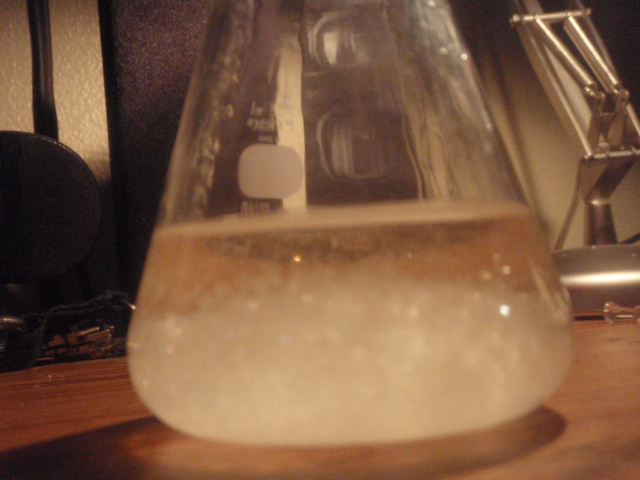
Also upon final extraction it was decided this use iso instead of etoh. The literature all point to iso being of much value and for some odd reason something very absent the whole time was this fish smell that everyone alludes to. Mez had heard the reasoning behind why this process specifically may not have this problem but after trying to ignite a small quantity and getting not even a spark doubt began to surface. So he spent another day drying iso to a level that one could be comfortable with and proceeded to see what the boiling iso could tell him. It appeared that none had dissolved and again mez’ glassware was about 2 seconds from wallware. Took a breath and decided to finish this thru, decanted hot iso through filter and before the iso had barely settled into bottom of catch container this began to happen...ok mez is new at this but look way down at the bottom and to the right, it would bee number 6.
Sorry for the long write up but though many people frown on hand holding newbies, but his choice to find help in his questions requires what and what had not been done. If his material is considered hand holding many apologies to the offended but really now…….
The yield was appx 6.9 gm on the pre-purified product. The verdict is still out on the final return as from what is heard the iso is still in evap mode, but one can’t help and think a significant portion will bee lost as the weight of the undissolved remaining product appeared to bee quite significant (maybe ammonium chloride)? What is the general consensus on which point is cooling the most crucial? Mez is confused over the usage of N-chloroamide and N-chloroacetamide. If the term being used refers to N-chloroamide then one would be led to believe cooling of your hypochlorite solution is required which is what was done as already mentioned. However if one goes on Rhodium’s terminology and N-chloroacetamide is the term to bee used and you factor in the JAC article, then we are talking about a whole different area such as post addition of hypochlorite solution, taking your solution and maintaining a very cool temperature over a period of time prior to introduction of NaOH solution? Which interestingly enough embraces a view that Eleusis had presented in his faq (kind of). Any insight would be of much appreciation as a rerun of this procedure is very much within possibility and the idea this time is to not only incorporate what has been learned but also step up in amount being run.
Much love and respect
Mez
Btw, this will be posted on 2 sites, one which is my home and the other which is quickly gaining a spot in the ol’ crystalline heart. Had to mention this since some frown on cross-site contributions, Mez on the other hand believes not only is all the help appreciated, but a firm believer in building up the archives for those that follow.
Quote from Nicodem at scimad
"The Hoffman rearrangement is not made like described in the first post of this thread...And it is necessary to first let the hypochlorite form the N-chloroamide at a low temperature since at above 50°C the disproportionation of NaOCl to NaCl and NaClO3 occurs rapidly. Only after this induction period at <20°C is the reaction mixture heated to 60-80°C in order for the N-chloroamide to rearrange."
Also a quote from a JAC article.
Quote
Whitmore and Thorpe, J. of the Amer. Chemical Society, Vol 63, April 1941, p1118
"It was necessary to allow several hours for the formation of the N-chloroamide before heating to degradation temperature. With this modification it was possible to prepare methylamine...consistently in 78% yield."
After performing this procedure a half dozen times it became clear that modifications would be needed in order to achieve better results. The first of those trials was done in the manner laid out by Eleusis in his FAQ using an open face stainless steel container. Mez quickly discarded the idea due to both in inability to control the smells innate to this process, but also because one thing that was recognized from the outset was the need to keep both the hypochlorite solution and that of the acetamide very cool, which if one reviews Eleusis’ synth, it does not (as least in regards to preparation involving the hypochlorite). Mez proceeded with the synth laid out by Rhodium and if you remember sed, the first few attempts were abysmal at best. The 3rd seeming to have hit pay dirt up to the point of having his hcl sucked backed into his boiling flask, and he was about 3 seconds away from having new textured wallpaper since his glassware was about to be the product of a hail mary pass
Still Mez did not let this stop him from making a few minor modifications listed below should it bee of any help to anyone, 1st pic below is addition of hypochlorite, 2nd basic dist. setup, 3rd inside view, 4th collectiion of methylamine gas, 5th the dreaded suckback, and 6th well that should need no explaining. The synth was carried out as written which for your viewing pleasure is:
Preparation of Methylamine Hydrochloride
The apparatus for this experiment should be set up before any materials are mixed.
A 500-mL distilling flask is fitted with a two-hole stopper carrying a thermometer and an inlet tube for air. The bulb of the thermometer should dip below the surface of the liquid, and the air tube should reach almost to the bottom of the flask. The distilling flask is attached to a condenser bearing an adapter. Two 250-mL Erlenmeyer flasks containing 35 mL each of 6 N HCl are placed in series as receivers. The first is fitted with a two-hole stopper. A glass tube attached to the adapter should dip below the surface of the HCl in the first receiver. The second receiver is connected to the first by means of another glass tube leading from above the acid solution in the first receiver to below the acid in the second.
To 16.4 g. of "H.T.H." in an Erlenmeyer flask is added 50 mL of water, and the mixture shaken until practically homogeneous. A small amount of material will remain undissolved. The solution is cooled to about 0°C in an ice-bath and 10 g. of crushed ice added.
The distilling flask is disconnected, and a cold solution of 10 g. of acetamide in 20 mL of water poured into it With the distilling flask immersed in an ice-bath, 100 g. of crushed ice is first added to the solution, followed by the addition of the cold "H.T.H." solution in three or four small portions with shaking after each addition. The temperature of the mixture should not rise above 0°C. More ice may be added to the reaction mixture if necessary. If the mixture should warm to more than 10°C (due to insufficient cooling), it should be discarded and the experiment repeated.
The flask is allowed to remain in the ice-bath for five to ten minutes. At the expiration of this time the flask is fitted to the condenser and a solution of 24 g. of NaOH in 40 mL of water at room temperature is added. The stopper is immediately replaced, and a current of air passed through the mixture during the remainder of the manipulations. The current of air should be sufficient to produce thorough mixing of the contents of the flask and to prevent bumping, yet not strong enough to cause much loss of the methylamine from the receivers.
By heating the flask the temperature of the mixture is raised rapidly to about 60°C. Between 65°C and 75°C the N-chloroacetamide decomposes with liberation of considerable heat, which, if not controlled, is likely to cause the contents of the distilling flask to bump over into the condenser. Consequently, the temperature is increased carefully from 60°C to 65°C and the flame removed. From this point the temperature will increase without the application of external heat. The current of air passing through the mixture is regulated so that it is just sufficient to prevent bumping. If the temperature rises to 80°C the flask is cooled in a bath of crushed ice and water. The temperature is held between 70°C and 80°C for five to ten minutes or until heat is no longer spontaneously generated.
The contents of the distilling flask are then heated to boiling and distilled until 75 to 100 mL of distillate has been collected. The contents of the two receivers are combined, placed in a large evaporating dish, and evaporated over a wire gauze until the volume of the solution is about 15 mL The dish is then transferred to a water bath and the contents evaporated to dryness.
synth provided by rhodium
What was done differently was first off the hypochlorite solution was made well over a day prior, allowed to almost freeze solid and then maintained in the fridge until moments prior to use. The acetamide solution was also maintained in the cooler at the same time. During the addition of the hypochlorite solution, the temperature was never allowed to climb over 0 degrees, this was aided by a reasonably high speed of mixing by magnetic stirrer and the addition of a liberal amount of ice, more liberal than what one would think, but mez would take no chances. The final solution was allowed to sit on ice and temperature maintained for almost 90 minutes after the last of the hypochlorite solution was added. Everything proceeds as listed in the synth except for what may or may not be a small matter. A formation of methylamine gas is seen at the outset of the reaction but very shortly after suck back began to occur in the first of the collection flasks. The answer to why this happens as it did with Eleusis also evades mez, but one thing is for certain, it will occur anytime the temperature is decreased. During the reaction it is simple remedied by turning the temperature up very quickly, aiding in this it may be smart to have something on hand, say a butane hand torch, which can give you very quick boost in the heat department provided you are careful in its application, however as the reaction progresses or in this case during the reactions initial period where it is frowned upon to allow the reaction to climb past 80 degrees, the use of the extra heat will either bee of no use or detrimental to the process as a whole. His remedy was to cautiously turn the vacuum adapter flask and all so that the tube used in this process was no longer submerged under the hcl solution. The reaction proceeds with the collection of the required amount of distillate mentioned in the synth. Ok, mez may bee lying....He fell asleep and when he woke up 2 hrs later no more solution was being carried over so he figured "hey, it’s gotta be done"....
Also upon final extraction it was decided this use iso instead of etoh. The literature all point to iso being of much value and for some odd reason something very absent the whole time was this fish smell that everyone alludes to. Mez had heard the reasoning behind why this process specifically may not have this problem but after trying to ignite a small quantity and getting not even a spark doubt began to surface. So he spent another day drying iso to a level that one could be comfortable with and proceeded to see what the boiling iso could tell him. It appeared that none had dissolved and again mez’ glassware was about 2 seconds from wallware. Took a breath and decided to finish this thru, decanted hot iso through filter and before the iso had barely settled into bottom of catch container this began to happen...ok mez is new at this but look way down at the bottom and to the right, it would bee number 6.
Sorry for the long write up but though many people frown on hand holding newbies, but his choice to find help in his questions requires what and what had not been done. If his material is considered hand holding many apologies to the offended but really now…….
The yield was appx 6.9 gm on the pre-purified product. The verdict is still out on the final return as from what is heard the iso is still in evap mode, but one can’t help and think a significant portion will bee lost as the weight of the undissolved remaining product appeared to bee quite significant (maybe ammonium chloride)? What is the general consensus on which point is cooling the most crucial? Mez is confused over the usage of N-chloroamide and N-chloroacetamide. If the term being used refers to N-chloroamide then one would be led to believe cooling of your hypochlorite solution is required which is what was done as already mentioned. However if one goes on Rhodium’s terminology and N-chloroacetamide is the term to bee used and you factor in the JAC article, then we are talking about a whole different area such as post addition of hypochlorite solution, taking your solution and maintaining a very cool temperature over a period of time prior to introduction of NaOH solution? Which interestingly enough embraces a view that Eleusis had presented in his faq (kind of). Any insight would be of much appreciation as a rerun of this procedure is very much within possibility and the idea this time is to not only incorporate what has been learned but also step up in amount being run.
Much love and respect
Mez
Btw, this will be posted on 2 sites, one which is my home and the other which is quickly gaining a spot in the ol’ crystalline heart. Had to mention this since some frown on cross-site contributions, Mez on the other hand believes not only is all the help appreciated, but a firm believer in building up the archives for those that follow.