Author Topic: The research chemical thread  (Read 771 times)

Naf1

  • Foundress Queen
  • *****
  • Posts: 753
Re: The research chemical thread
« Reply #20 on: January 09, 2010, 10:57:24 PM »
"This thread has gone way off topic, though, and the second half probably needs split off and moved to Drug Synthesis?"

LOL, yes it has been a big weekend. Regarding comments about the complexity of this route, I think when you see how straight forward it is in practice you will be suprised. Making a sodium nitrite and hydrochloric acid solution, then stirring that with phenylalanine after a couple of minutes you work up phenyllactic acid (quantitative yield). The phenyllactic acid is stirred with a solution of hydroxylamine and sodium hydroxide overnight(quantitative yield), then neutralized and sulfuric acid added to catalyze the Beckamnn rearrangement then the amide is worked up(anywhere from 75% to quantitative yield). The amide is stirred with hypochlorite and sodium hydroxide for half an hour and worked up(anywhere from 20% to 90% yield, unknown until trial runs are undertaken), hydrobromic acid or hydroiodic acid is added to the amine and stirred(in excess of 75% yield). A Lithium battery is opened up and the Lithium pilfered, all one has to do is get or make some methyl iodide and add the bromo-amine and lithium in solvent and the alkylhalide. Amphetamine is worked up after the reaction!

Sodium Nitrite (easy)
Hydrochloric acid (easy)
Phenylalanine (D or L or both) (easy)
Sodium Hydroxide (easy)
Sulfuric acid (easy)
Sodium Hypochlorite [chlorox] (easy)

Hydroxylamine (medium)
Hydrogen halide (medium to hard)
Methyl Iodide (hard)

Considering peeps used to rob a Buffalo to convert a couple of packets of cold pills, the methyl iodide does not seem that bad. Red P and iodine or the three hard to get things above?

"I have been considering a similar route to MDMA via L-DOPA.  Apparently psychokitty had been working on a similar path from methyldopa which would avoid the grignard step, but methyldopa is restricted in my country."

LOL, methyldopa would be priceless to get a hold of, and everyone (including the LE) knows it!!

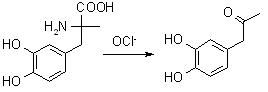
Look at that! A simple Strecker degradation with hypochlorite would produce 3,4-dihydroxyphenyl-2-proanone!!!

There would be no need for the Grignard as there is already an alpha methyl group present in Methyldopa.

As for the Phenylalanine->Phenylacetaldehyde, I have been discussing that route for some time now. And there has always been inherent problems with that procedure that would need some working (polymerization etc). Although more steps in the route above it is more user friendly.

hypnos

  • Dominant Queen
  • ****
  • Posts: 402
Re: The research chemical thread
« Reply #21 on: January 10, 2010, 10:44:38 PM »
y;know methydopa is a blood pressure medicine? i'm not sure but i believe its in many a bathroom cupboard :-\
"the two things you can give away and never lose, are what you know, and how you feel...."

Naf1

  • Foundress Queen
  • *****
  • Posts: 753
Re: The research chemical thread
« Reply #22 on: January 10, 2010, 11:10:39 PM »
Its prescription medicine, you would have to steal someones medication. Better off buying bulk methylone and reducing the carbonyl group of the ketone to a secondary alcohol which can be reduced easily enough to MDMA with some rp for example.

Goldmember

  • Subordinate Wasp
  • ***
  • Posts: 132
Re: The research chemical thread
« Reply #23 on: January 11, 2010, 12:26:24 AM »
I know someone who tried a Strecker degredation of Dopa and the results where not very promising. :-[
Not that that someone was a very good or qualified chemist or anything.
I was told TCCA(maybe a bit of nitrile formed),Bleaching powder,Ammonium persulfate,various reaction conditions and solvents where employed,sadly to no avail.

This is an interesting read regarding the (off)topic


reaction http://www.cazv.cz/attachments/3-Adamiec.pdf

Naf1

  • Foundress Queen
  • *****
  • Posts: 753
Re: The research chemical thread
« Reply #24 on: January 11, 2010, 12:35:55 AM »
3,4-Dihydroxyphenylacetone (VI)
A. Sodium Hypochlorite

To a stirred solution of 844 mg. (4.00 mmoles) of alpha-methyl-3,4-dihydroxyphenylalanine (I) in 20 ml. of 0.5 M borax buffer (pH 8.5)3 was added 10 ml. of benzene. Nitrogen was bubbled through the solution and 12.0 ml. of 0.34 N sodium hypochlorite solution added dropwise. The red solution was acidified with dilute hydrochloric acid and extracted with ethyl acetate. The latter extract was dried and concentrated to dryness. The residue was triturated with chloroform, the latter suspension filtered, and the filtrate concentrated to dryness in vacuo to give 3,4-dihydroxyphenylacetone, 235 mg (36%), with additional material still in the aqueous mother liquors. Acetylation of a probe (pyridine-acetic anhydride, 25°C, 18 hr.) gave 3,4-diacetoxyphenylacetone. The latter was identified as the diacetate by comparison with an authentic sample.

B. t-Butyl Hypochlorite
To a stirred suspension of 844 mg (4.0 mmoles) of alpha-methyl-3,4-dihydroxyphenylalanine in 10 ml. of water (under nitrogen) was added 340 mg. (4.00 mmoles) of sodium bicarbonate. t-Butyl hypochlorite (0.50 g., 4.5 mmoles) in 10 ml. of t-butyl alcohol was added dropwise over 30 min. The deep red reaction mixture was acidified with 5 ml. of 2 N hydrochloric acid and extracted thoroughly with ethyl acetate. Further work-up as in A led to 335 mg. (50%) of 3,4-dihydroxyphenylacetone; infrared spectrum was identical with that of an authentic sample.

http://www.erowid.org/archive/rhodium/chemistry/p2p.strecker.html

You are right they are not great yields, 3,4-Dimethoxy-alpha-methylphenylalanine yields 92% in the same reaction, and 3,4-Diacetyl-alpha-methylphenylalanine 72%.
« Last Edit: January 11, 2010, 12:39:03 AM by Naf1 »

timecube

  • Subordinate Wasp
  • ***
  • Posts: 230
Re: The research chemical thread
« Reply #25 on: January 11, 2010, 01:31:12 AM »
As for the Phenylalanine->Phenylacetaldehyde, I have been discussing that route for some time now. And there has always been inherent problems with that procedure that would need some working (polymerization etc). Although more steps in the route above it is more user friendly.
IIRC, the polymer can be broken by distillation.  Apparently, polymer formation can be prevented altogether by the addition of very smalls amounts (200 ppm) of a polybasic carboxylic acid.  See the attached patent.


Given the better yields with the dimethoxy, I wonder if methylenation is possible before performing the strecker without messing up something else and would improve the yields.
Apparently psychokitty thought it was better to methylenate after getting the amine.  All I've seen is a reference to her original work here:

http://dixie-flatline.org/thehive/serious/000002216.html
« Last Edit: January 11, 2010, 02:00:23 AM by timecube »

Naf1

  • Foundress Queen
  • *****
  • Posts: 753
Re: The research chemical thread
« Reply #26 on: January 11, 2010, 04:03:29 AM »
The Reaction of Grignard Reagents with Schiff Bases
BY KENNETHN . CAMPBELL, c. H. HELBINGM,~. PATRICIA FLORKOWSK13 AND BARBARA.K CAMPBELL
J. Am. Chem. Soc. 70, 3868 (1948)

http://sharebee.com/cbde6913

Analgesics. II.I The Grignard Reaction with Schiff Bases
BY ROBERTB RUCEM OFFETTA ND WILLAMR.D H OE"
J. Am. Chem. Soc. 69, 1792 (1947)

http://sharebee.com/4dd0497e

Naf1

  • Foundress Queen
  • *****
  • Posts: 753
Re: The research chemical thread
« Reply #27 on: January 18, 2010, 12:22:34 AM »
Auxins
Are plant hormones, they have an essential role in growth and behavioral processes. They can be purchased at some specialist nurseries and online at places like ebay for around a dollar per gram, rooting hormone is generally indole-3-butyric acid.

Indole-3-butyric acid
Indole-3-butyric acid (1H-Indole-3-butanoic acid, IBA) is a white to light-yellow crystalline solid, with the molecular formula C12H13NO2. It melts at 125 °C in atmospheric pressure and decomposes before boiling.

BA is a plant hormone in the auxin family and is an ingredient in many commercial plant rooting horticultural products.
For use as such, it should be dissolved in about 75% (or purer) alcohol (as IBA does not dissolve in water), until a concentration from between 10,000 ppm to 50,000 ppm is achieved - this solution should then be diluted to the required concentration using distilled water. The solution should be kept in a cool, dark place for best results.
This compound had been thought to be strictly synthetic; however, it was reported that the compound was isolated from leaves and seeds of maize and other species.[1]

Indole-3-Acetic acid
Indole-3-acetic acid, also known as IAA, is a heterocyclic compound that is an phytohormone called auxins. This colourless solid is probably the most important plant auxin. The molecule is derived from indole, containing a carboxymethyl group (acetic acid).AA is produced in cells in the apex (bud) and young leaves of a plant. Plant cells mainly synthesize IAA from tryptophan but can also produce it independently of tryptophan. Chemically, it can be synthesized by the reaction of indole with glycolic acid in the presence of base at 250 °C:[1] IAA has many different effects, as all auxins do, such as inducing cell elongation and cell division with all subsequent results for plant growth and development. There are less expensive and metabolically stable synthetic auxin analogs on the market for use in horticulture, such as indole-3-butyric acid (IBA) and 1-naphthaleneacetic acid (NAA).[citation needed]

Studies of IAA in the 1940s led to the development of the phenoxy herbicides 2,4-dichlorophenoxyacetic acid (2,4-D) and 2,4,5-trichlorophenoxyacetic acid (2,4,5-T). Like IBA and NAA, 2,4-D and 2,4,5-T are metabolically and environmentally more stable analogs of IAA. However, when sprayed on broad-leaf dicot plants, they induce rapid, uncontrolled growth, eventually killing them. First introduced in 1946, these herbicides were in widespread use in agriculture by the middle of the 1950s.

DMT from indoleacetic acid (IAA)
http://www.erowid.org/archive/rhodium/chemistry/indoleaceticacid.html

Synthesis of Deuterated N,N-Dimethyltryptamine (DMT) and 5-Methoxy-N,N-Dimethyltryptamine (5-MeO-DMT)
http://www.erowid.org/archive/rhodium/chemistry/deuterio-dmt.synthesis.html

1-Naphthaleneacetic acid
commonly abbreviated NAA, is an organic compound with the formula C10H7CH2CO2H. This colourless solid is soluble in organic solvents. It features a carboxylmethyl group (CH2CO2H) linked to the "1-position" of naphthalene. NAA is a plant hormone in the auxin family and is an ingredient in many commercial plant rooting horticultural products; it is a rooting agent and used for the vegetative propagation of plants from stem and leaf cutting. It is also used for plant tissue culture.[3]


As you can see this is the equivalent phenylacetic acid but with a naphthalene instead of a phenyl group.

6-Benzylaminopurine
benzyl adenine or BAP is a first-generation synthetic cytokinin which elicits plant growth and development responses, setting blossoms and stimulating fruit richness by stimulating cell division. It is an inhibitor of respiratory kinase in plants, and increases post-harvest life of green vegetables.
6-benzylaminopurine was first synthesized and tested in the laboratories of plant physiologist Folke K. Skoog.


4-Chloroindole-3-acetic acid ;D
4-Chloroindole-3-acetic acid (4-Cl-IAA) is a natural plant hormone.[1] It is a member of the class of compounds known as auxins and a chlorinated derivative of the more common auxin indole-3-acetic acid (IAA). 4-Cl-IAA is found in the seeds of a variety of plants, particularly legumes such as peas and broad beans.[2][3][4][5] It is hypothosized that 4-Cl-IAA may be a "death hormone" that maturing seeds use to trigger death of the parent plant by mobilizing nutrients to be stored in the seed.
« Last Edit: January 18, 2010, 12:40:13 AM by Naf1 »

shroomedalice

  • Guest
Re: The research chemical thread
« Reply #28 on: February 18, 2010, 04:46:21 AM »
I have posted a link to this thread at WD if this is a problem please let me know :)

might even get you a bit more traffic who knows :)

Vesp

  • Administrator
  • Foundress Queen
  • *****
  • Posts: 3,130
Re: The research chemical thread
« Reply #29 on: February 19, 2010, 03:59:07 AM »
"The reporter has made the following comment:
is more traffic what the staff wants? I'm very glad that this site isn't
wetdreams"

I suppose a few other members think this way, and so kindly remove it if you can, and perhaps share it with the more productive and contributing members.. or the ones who are at least taking an interest in the science, and doing their best.

They fear that it may become wetdreams.. which I would hope not -- mostly because of all of the off topic discussion... but I will also try my best to keep that and other WD things to a minimum. Just let me know if you start to see a problem and I'll try to fix it.
Bitcoin address: 1FVrHdXJBr6Z9uhtiQKy4g7c7yHtGKjyLy

shroomedalice

  • Guest
Re: The research chemical thread
« Reply #30 on: February 19, 2010, 06:23:07 AM »
no probs :)

thought it best I ask

Vesp

  • Administrator
  • Foundress Queen
  • *****
  • Posts: 3,130
Re: The research chemical thread
« Reply #31 on: February 19, 2010, 06:26:56 AM »
Yep :) Glad you did, and I'm glad others let me know what they felt about it.
Bitcoin address: 1FVrHdXJBr6Z9uhtiQKy4g7c7yHtGKjyLy

captainrush

  • Larvae
  • *
  • Posts: 17
Re: The research chemical thread
« Reply #32 on: March 06, 2010, 09:02:25 PM »
I would hate to see this site become wd. period. It would make me consider suicide! Because then the routes discussed here need to be hidden and the 2% of noobs that really want to learn the chemistry and not just get high would never get the chance to advance themselves (this and the fact that I cant ever find a mentor (dont mean someone to spoon feed me) is the reason I gave up all hope on the therapuetic MDx compounds and my love for phenethylamine, psychoactive or not, chemistry. but now ive found a new home, I have a trickle of hope again. thank you all for giving that to me).

On the topic of this thread I have seen some very interesting Phenyl type RCs that after a little cleaving would be great precursors, so I think this thread will go a long way.

headstrong

  • Pupae
  • **
  • Posts: 73
Re: The research chemical thread
« Reply #33 on: April 02, 2010, 05:05:56 AM »
Designer Drugs Directory, Karel Valter-Philippe.A, Institute of Ecotoxycology Geneva.
Contains 107 designer drugs with data sheet providing basic data of each drug: IUPAC name, human dosage, duration, type of action, toxicity ..., molecular structure. This book was recommended by Rhodium in Hive. Size 5,4 MB.

http://www.4shared.com/file/254948001/26804d90/DDD.html