


As everyone should be aware there are a plethora of OTC research chemicals available online, this thread was to try and decipher the good from the down right dangerous from the potential precursors and also how to avoid some dodgy vendors and law enforcement honey pots while enjoying the quality produce on offer.
* = Recreational drug
** = Dangerous recreational drug
*** = Potential presursor
****= Pretty lethal
I will list some of the more common RC chems you will find nowdays(with wiki quotes), then will get vendor specific.
Methylenedioxy compounds;
Methylenedioxypyrovalerone (MDPV)*, is a psychoactive drug with stimulant and aphrodisiac properties which acts as a norepinephrine-dopamine reuptake inhibitor (NDRI), reportedly with four times the potency of methylphenidate (Ritalin, Concerta).

MDPV is not specifically listed as a controlled substance in any country besides Denmark. Some people have claimed that because MDPV is most closely related in molecular structure to a Schedule V drug (Pyrovalerone) in the US, it is not controlled by the Federal Analog Act.[citation needed] The law requires it to be an "analog" that is "substantially similar" to that of a Schedule I or II drug and intended for human consumption. There are no legal cases currently known of in the USA concerning MDPV. Prosecutors in a federal US court may claim MDPV is an analog of MDMA under the Federal Analog Act, although they could not claim it is an analog of Pyrovalerone since it is not a Schedule I or II controlled substance. The prosecution could be difficult however, because MDPV has a pentyl side chain where MDMA has a propyl side chain, MDPV a beta-ketone group where MDMA has two hydrogen atoms, and a pyrrolidine, cyclic, tertiary amine where MDMA has a simpler methylamino group, a primary amine. This distinction between primary amines and tertiary amines was a major determining factor in the decision that AET was not an analog of DMT or DET in the first case prosecuted under the Federal Analog Act. In its effects, MDPV is quite dissimilar to MDMA, with MDPV being a DA/NA reuptake inhibitor rather than a releaser, and MDPV apparently lacking the strong serotonergic activity of MDMA. It would probably be extremely difficult to find an expert witness willing to testify on a defendant's behalf.
Other drugs with a similar chemical structure include ?-pyrrolidinopropiophenone (?-PPP), which has a shorter alkyl chain and no ring substitution, pyrovalerone, which has a 4'-methyl group instead of a methylenedioxy ring, as well as analogues with between 3 and 6 carbons on the alkyl chain.[4]
These compounds have been reported as stimulants of abuse mainly in Germany and other European countries since the early 2000s, but they have remained generally vaguely known and rarely used illicitly or encountered by law enforcement.[5]
No deaths or injuries caused by this substance have been reported.
3,4-methylenedioxy-N-methylcathinone (MDMC, BK-MDMA)*, is a psychoactive drug of the phenethylamine-related Cathinone chemical class that acts as an entactogen, mild psychedelic and stimulant. It is the ?-keto analogue of 3,4-methylenedioxy-N-methylamphetamine (MDMA; "Ecstasy", "Adam", "Molly", "XTC").

MDMC is not explicitly scheduled in the United States (U.S.), but possession may still result in prosecution under the Federal Analog Act as an MDMA analogue. In New Zealand, although MDMC is not explicitly scheduled and falls outside the strict definitions of an "amphetamine analogue" in the Misuse of Drugs Act, it is considered to be "substantially similar" to methcathinone and is thus considered by law enforcement authorities to be a Class C illegal drug.
MDMC is currently not specifically mentioned in United Kingdom (U.K.) law as the ?-ketone is not covered under the Misuse of Drugs Act.
MDMC was sold in New Zealand for around 6 months from November 2005 to April 2006 as an MDMA substitute, under the name "Ease". The product was withdrawn after legal disputes with the government.
Butylone, ?-keto-N-methyl-3,4-benzodioxolylbutanamine (bk-MBDB)*,is a psychoactive drug and research chemical of the phenethylamine chemical class that acts as an entactogen, psychedelic, and stimulant. It is the ?-keto analogue of methylbenzodioxylbutanamine (MBDB).
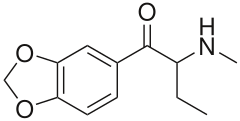
Butylone was first synthesized by Koeppe, Ludwig and Zeile which is mentioned in their 1967 paper.[1] It remained an obscure product of academia until 2005 when it was synthesized by a chemical supply company, and has since continued to be sold as a designer drug.[2] It has since been explored as a possible entheogen. Butylone shares the same relationship to MBDB as methylone does to methylenedioxymethamphetamine (MDMA; "Ecstasy"). The dosage range is not fully understood but seems to be lower than for MBDB. Formal research on this chemical was first conducted in 2009, when it was shown to be metabolised in a similar manner to related drugs like methylone.
Phenethylamines;
Mephedrone or 4-methylmethcathinone or 4-methylephedrone (4-MMC)**, is a stimulant and entactogen drug of the phenethylamine, amphetamine, and cathinone chemical classes. It is sometimes sold as "plant food" online, is reported to be contained in some legal highs and is sometimes sold mixed with methylone, also known as “Bubbles”,[3] "miaow miaow", "Top Cat"[citation needed], or MMCAT.[4]
It has been reported that manufacturers are making "huge amounts of money" from selling the drug.

On December 14, 2008, an 18-year-old Swedish woman died in Stockholm after taking mephedrone in combination with other drugs. The 18-year-old and some friends took the substance in combination with cannabis on the night of Friday, 12 December. An ambulance was soon called to Bandhagen after the girl went into convulsions and turned blue in the face, Svenska Dagbladet reported.[18] Mephedrone was scheduled to be classified as a "dangerous substance" in Sweden even before the girl's death at Karolinska University Hospital on Sunday, 14 December, but the death brought much more media attention to the drug. The handling of mephedrone became classified as a criminal offence in Sweden on Monday 15 December (2008).4-Methylmethcathinone is unscheduled in the United States.Australia: Mephedrone is not specifically listed as prohibited in Australia, Federal Police have stated that it is an Analog to methcathinone and therefore illegal. No one in Australia has yet been charged with possession of mephedrone as authorities are divided over its legality.
2,5-dimethoxy-4-ethylthiophenethylamine (2C-T-2)*
I will let Shulgin tell the story, with a quote from Pihkal;
(with 25 mg) I was at a +++ in an hour! It is most difficult to do even ordinary things. I took notes but now I can't find them. This is much too high for anything creative, such as looking at pictures or trying to read. Talking is OK. And to my surprise I was able to get to sleep, and a good sleep, at the seven hour point.

2,5-dimethoxy-4-ethyl-phenethylamine (2C-E)*, is a psychedelic drug and phenethylamine of the 2C family. It was first synthesized by Alexander Shulgin, sometimes used as an entheogen. 2C-E is typically sold as a white crystalline powder or in pill capsules.

It is commonly active in the 10–20 mg range, taken orally, and highly dose-sensitive. Insufflating (administering the chemical nasally) requires a much lower dose, typically not exceeding 5mgs, but this method of consumption elicits a noticeably painful or uncomfortable sensation in the nasal cavity for 10 minutes or so. Shulgin classified 2C-E as a member of the "magical half-dozen" in his book PiHKAL (Phenethylamines i Have Known And Loved). Many have reported that the general effects of 2C-E are similar to those of the other psychedelic phenethylamines, but far more intense. Vivid hallucinations similar to those experienced while under the influence of LSD are common, and many reports would indicate that the effects of this particular chemical may be overly intense for those not well experienced with psychedelics.
2C-E is unscheduled in the United States; however, there are currently several cases pending in U.S. federal court against vendors for selling research chemicals. These cases may address the question of whether this chemical could be legally defined as an analog of a scheduled substance.
It is a homologue of 2C-B, 2C-T-7 or mescaline (all three of which are scheduled substances), in which case sale for human consumption or possession to ingest or use for illicit non-medical or industrial intents and purposes could be prosecuted as crimes under the Federal Analog Act.
2,5-dimethoxy-4-iodophenethylamine (2C-I)*, is a psychedelic drug and phenethylamine of the 2C family.[1] It was first synthesized by Alexander Shulgin. It was described in Shulgin’s book PiHKAL (Phenethylamines i Have Known And Loved). The drug is used recreationally and as an entheogen but no medical or industrial uses have been reported yet. It is most commonly encountered in the form of its hydrochloride salt, a fluffy, sparkling white powder, and has also been pressed into tablet form.

2C-I is an illegal, controlled substance in several European nations, including Denmark, Germany, Greece, Ireland, the Netherlands, Poland, Spain and the United Kingdom.[4] In December 2003, the European Council issued a binding order compelling all EU member states to ban 2C-I within three months. 2C-I is unscheduled and unregulated in the United States, however its close similarity in structure and effects to 2C-B could potentially subject possession and sale of 2C-I to prosecution under the Federal Analog Act, if it is intended for human consumption. This seems to be the tactic the federal government is taking in the wake of the DEA's Operation Web Tryp.
Tryptamines:
O-Acetylpsilocin, 4-acetoxy-N,N-dimethyltryptamine, or 4-AcO-DMT*** and *, is a psychedelic (hallucinogenic). It is the acetylated form of the psychedelic mushroom alkaloid psilocin, and is a lower homologue of 4-AcO-DET and 4-AcO-DiPT. It may also be considered an analogue of psilocin, which is a Schedule I drug under the Controlled Substances Act of the USA, if there is evidence that it was being used for human consumption.

In the body 4-acetylpsilocin is evidently rapidly desacetylated to psilocin by acetylases and therefore has identical pharmacological properties to psilocin.
5-MeO-DMT (5-Methoxy-dimethyltryptamine), also known as O-Methylbufotenine (also see bufotenine)[*,is a powerful psychedelic tryptamine. It is found in a wide variety of plant and psychoactive toad species, and like its close relatives DMT and bufotenin (5-HO-DMT), it has been used as an entheogen by South American shamans for thousands of years.

On August 21, 2009, the DEA issued a Notice of Proposed Rulemaking to initiate placing 5-MeO-DMT into Schedule I of the Controlled Substances Act (the most restrictive category).[6] Comment DEA-2009-0008-0007.1 requested a 180 day extension of the period for public comment and requests for hearings, objected to the proposed rule on multiple grounds including Constitutional issues, identified the submitter as a person who would be "adversely affected and aggrieved by the proposed ruling" and requested an exemption for religious use if DEA did place 5-MeO-DMT in Schedule I "as an attempt to define and clarify some legal issues."[3]
On September 29 and 30, 2009, the DEA posted the Supporting & Related Materials for the NPRM while retaining the September 21, 2009 Due date for comments.[7]
On October 28, 2009 DEA reopened the period for public comment because it had not posted two Supporting & Related Materials documents online during the original period for public comment. Documents and comments were split between Docket ID: DEA-2009-0008 and Docket ID: DEA-2009-0013 in a manner which creates difficulty and in viewing all documents and determining where and how to submit comments online. The two Supporting & Related Materials documents were not posted to Docket ID: DEA-2009-0013 until November 3, 2009 but the 30 day period for public comment was not changed from November 27, 2009.
One company that stood out to be a law enforcement trap, would have to be '4 EVER RESEARCH' as they offer;
LSD 25,
Hydromorphone HCL,
Morphine sulfate,
Ketamine HCL,
Cocaine,
4-Acetoxy-DIPT 200.00 USD Gm
5-MeO AMT 120.00 USD Gm
5-MeO-DIPT 160.00 USD Gm
DMT 260.00 USD Gm
AMT 125.00 USD Gm
DIPT 150.00 USD Gm
2C-B 250.00 USD Gm
2C-1 240.00 USD Gm
2C-T-2 220.00 USD Gm
MDMA 200.00 USD Gm
MDEA 180.00 USD Gm
DOB 280.00 USD Gm
DOM 175.00 USD Gm
TMA-2 180.00 USD Gm
BZP 180.00 USD Gm
GHB 75.00 USD 150 Gm
They may well be legit and deliver your order of, 3 g LSD25, 14g Cocaine and 7g MDMA (but somehow I doubt it!). A better route for the methylenedioxy compounds would be through a well known supplier like;
http://www.research-chemicals.co.uk
There is always a small offering at EBay, although I have never bought any from there. Has anyone had any experience buying or taking research chemicals?
* = Recreational drug
** = Dangerous recreational drug
*** = Potential presursor
****= Pretty lethal
I will list some of the more common RC chems you will find nowdays(with wiki quotes), then will get vendor specific.
Methylenedioxy compounds;
Methylenedioxypyrovalerone (MDPV)*, is a psychoactive drug with stimulant and aphrodisiac properties which acts as a norepinephrine-dopamine reuptake inhibitor (NDRI), reportedly with four times the potency of methylphenidate (Ritalin, Concerta).
MDPV is not specifically listed as a controlled substance in any country besides Denmark. Some people have claimed that because MDPV is most closely related in molecular structure to a Schedule V drug (Pyrovalerone) in the US, it is not controlled by the Federal Analog Act.[citation needed] The law requires it to be an "analog" that is "substantially similar" to that of a Schedule I or II drug and intended for human consumption. There are no legal cases currently known of in the USA concerning MDPV. Prosecutors in a federal US court may claim MDPV is an analog of MDMA under the Federal Analog Act, although they could not claim it is an analog of Pyrovalerone since it is not a Schedule I or II controlled substance. The prosecution could be difficult however, because MDPV has a pentyl side chain where MDMA has a propyl side chain, MDPV a beta-ketone group where MDMA has two hydrogen atoms, and a pyrrolidine, cyclic, tertiary amine where MDMA has a simpler methylamino group, a primary amine. This distinction between primary amines and tertiary amines was a major determining factor in the decision that AET was not an analog of DMT or DET in the first case prosecuted under the Federal Analog Act. In its effects, MDPV is quite dissimilar to MDMA, with MDPV being a DA/NA reuptake inhibitor rather than a releaser, and MDPV apparently lacking the strong serotonergic activity of MDMA. It would probably be extremely difficult to find an expert witness willing to testify on a defendant's behalf.
Other drugs with a similar chemical structure include ?-pyrrolidinopropiophenone (?-PPP), which has a shorter alkyl chain and no ring substitution, pyrovalerone, which has a 4'-methyl group instead of a methylenedioxy ring, as well as analogues with between 3 and 6 carbons on the alkyl chain.[4]
These compounds have been reported as stimulants of abuse mainly in Germany and other European countries since the early 2000s, but they have remained generally vaguely known and rarely used illicitly or encountered by law enforcement.[5]
No deaths or injuries caused by this substance have been reported.
3,4-methylenedioxy-N-methylcathinone (MDMC, BK-MDMA)*, is a psychoactive drug of the phenethylamine-related Cathinone chemical class that acts as an entactogen, mild psychedelic and stimulant. It is the ?-keto analogue of 3,4-methylenedioxy-N-methylamphetamine (MDMA; "Ecstasy", "Adam", "Molly", "XTC").
MDMC is not explicitly scheduled in the United States (U.S.), but possession may still result in prosecution under the Federal Analog Act as an MDMA analogue. In New Zealand, although MDMC is not explicitly scheduled and falls outside the strict definitions of an "amphetamine analogue" in the Misuse of Drugs Act, it is considered to be "substantially similar" to methcathinone and is thus considered by law enforcement authorities to be a Class C illegal drug.
MDMC is currently not specifically mentioned in United Kingdom (U.K.) law as the ?-ketone is not covered under the Misuse of Drugs Act.
MDMC was sold in New Zealand for around 6 months from November 2005 to April 2006 as an MDMA substitute, under the name "Ease". The product was withdrawn after legal disputes with the government.
Butylone, ?-keto-N-methyl-3,4-benzodioxolylbutanamine (bk-MBDB)*,is a psychoactive drug and research chemical of the phenethylamine chemical class that acts as an entactogen, psychedelic, and stimulant. It is the ?-keto analogue of methylbenzodioxylbutanamine (MBDB).
Butylone was first synthesized by Koeppe, Ludwig and Zeile which is mentioned in their 1967 paper.[1] It remained an obscure product of academia until 2005 when it was synthesized by a chemical supply company, and has since continued to be sold as a designer drug.[2] It has since been explored as a possible entheogen. Butylone shares the same relationship to MBDB as methylone does to methylenedioxymethamphetamine (MDMA; "Ecstasy"). The dosage range is not fully understood but seems to be lower than for MBDB. Formal research on this chemical was first conducted in 2009, when it was shown to be metabolised in a similar manner to related drugs like methylone.
Phenethylamines;
Mephedrone or 4-methylmethcathinone or 4-methylephedrone (4-MMC)**, is a stimulant and entactogen drug of the phenethylamine, amphetamine, and cathinone chemical classes. It is sometimes sold as "plant food" online, is reported to be contained in some legal highs and is sometimes sold mixed with methylone, also known as “Bubbles”,[3] "miaow miaow", "Top Cat"[citation needed], or MMCAT.[4]
It has been reported that manufacturers are making "huge amounts of money" from selling the drug.
On December 14, 2008, an 18-year-old Swedish woman died in Stockholm after taking mephedrone in combination with other drugs. The 18-year-old and some friends took the substance in combination with cannabis on the night of Friday, 12 December. An ambulance was soon called to Bandhagen after the girl went into convulsions and turned blue in the face, Svenska Dagbladet reported.[18] Mephedrone was scheduled to be classified as a "dangerous substance" in Sweden even before the girl's death at Karolinska University Hospital on Sunday, 14 December, but the death brought much more media attention to the drug. The handling of mephedrone became classified as a criminal offence in Sweden on Monday 15 December (2008).4-Methylmethcathinone is unscheduled in the United States.Australia: Mephedrone is not specifically listed as prohibited in Australia, Federal Police have stated that it is an Analog to methcathinone and therefore illegal. No one in Australia has yet been charged with possession of mephedrone as authorities are divided over its legality.
2,5-dimethoxy-4-ethylthiophenethylamine (2C-T-2)*
I will let Shulgin tell the story, with a quote from Pihkal;
(with 25 mg) I was at a +++ in an hour! It is most difficult to do even ordinary things. I took notes but now I can't find them. This is much too high for anything creative, such as looking at pictures or trying to read. Talking is OK. And to my surprise I was able to get to sleep, and a good sleep, at the seven hour point.
2,5-dimethoxy-4-ethyl-phenethylamine (2C-E)*, is a psychedelic drug and phenethylamine of the 2C family. It was first synthesized by Alexander Shulgin, sometimes used as an entheogen. 2C-E is typically sold as a white crystalline powder or in pill capsules.
It is commonly active in the 10–20 mg range, taken orally, and highly dose-sensitive. Insufflating (administering the chemical nasally) requires a much lower dose, typically not exceeding 5mgs, but this method of consumption elicits a noticeably painful or uncomfortable sensation in the nasal cavity for 10 minutes or so. Shulgin classified 2C-E as a member of the "magical half-dozen" in his book PiHKAL (Phenethylamines i Have Known And Loved). Many have reported that the general effects of 2C-E are similar to those of the other psychedelic phenethylamines, but far more intense. Vivid hallucinations similar to those experienced while under the influence of LSD are common, and many reports would indicate that the effects of this particular chemical may be overly intense for those not well experienced with psychedelics.
2C-E is unscheduled in the United States; however, there are currently several cases pending in U.S. federal court against vendors for selling research chemicals. These cases may address the question of whether this chemical could be legally defined as an analog of a scheduled substance.
It is a homologue of 2C-B, 2C-T-7 or mescaline (all three of which are scheduled substances), in which case sale for human consumption or possession to ingest or use for illicit non-medical or industrial intents and purposes could be prosecuted as crimes under the Federal Analog Act.
2,5-dimethoxy-4-iodophenethylamine (2C-I)*, is a psychedelic drug and phenethylamine of the 2C family.[1] It was first synthesized by Alexander Shulgin. It was described in Shulgin’s book PiHKAL (Phenethylamines i Have Known And Loved). The drug is used recreationally and as an entheogen but no medical or industrial uses have been reported yet. It is most commonly encountered in the form of its hydrochloride salt, a fluffy, sparkling white powder, and has also been pressed into tablet form.
2C-I is an illegal, controlled substance in several European nations, including Denmark, Germany, Greece, Ireland, the Netherlands, Poland, Spain and the United Kingdom.[4] In December 2003, the European Council issued a binding order compelling all EU member states to ban 2C-I within three months. 2C-I is unscheduled and unregulated in the United States, however its close similarity in structure and effects to 2C-B could potentially subject possession and sale of 2C-I to prosecution under the Federal Analog Act, if it is intended for human consumption. This seems to be the tactic the federal government is taking in the wake of the DEA's Operation Web Tryp.
Tryptamines:
O-Acetylpsilocin, 4-acetoxy-N,N-dimethyltryptamine, or 4-AcO-DMT*** and *, is a psychedelic (hallucinogenic). It is the acetylated form of the psychedelic mushroom alkaloid psilocin, and is a lower homologue of 4-AcO-DET and 4-AcO-DiPT. It may also be considered an analogue of psilocin, which is a Schedule I drug under the Controlled Substances Act of the USA, if there is evidence that it was being used for human consumption.
In the body 4-acetylpsilocin is evidently rapidly desacetylated to psilocin by acetylases and therefore has identical pharmacological properties to psilocin.
5-MeO-DMT (5-Methoxy-dimethyltryptamine), also known as O-Methylbufotenine (also see bufotenine)[*,is a powerful psychedelic tryptamine. It is found in a wide variety of plant and psychoactive toad species, and like its close relatives DMT and bufotenin (5-HO-DMT), it has been used as an entheogen by South American shamans for thousands of years.
On August 21, 2009, the DEA issued a Notice of Proposed Rulemaking to initiate placing 5-MeO-DMT into Schedule I of the Controlled Substances Act (the most restrictive category).[6] Comment DEA-2009-0008-0007.1 requested a 180 day extension of the period for public comment and requests for hearings, objected to the proposed rule on multiple grounds including Constitutional issues, identified the submitter as a person who would be "adversely affected and aggrieved by the proposed ruling" and requested an exemption for religious use if DEA did place 5-MeO-DMT in Schedule I "as an attempt to define and clarify some legal issues."[3]
On September 29 and 30, 2009, the DEA posted the Supporting & Related Materials for the NPRM while retaining the September 21, 2009 Due date for comments.[7]
On October 28, 2009 DEA reopened the period for public comment because it had not posted two Supporting & Related Materials documents online during the original period for public comment. Documents and comments were split between Docket ID: DEA-2009-0008 and Docket ID: DEA-2009-0013 in a manner which creates difficulty and in viewing all documents and determining where and how to submit comments online. The two Supporting & Related Materials documents were not posted to Docket ID: DEA-2009-0013 until November 3, 2009 but the 30 day period for public comment was not changed from November 27, 2009.
One company that stood out to be a law enforcement trap, would have to be '4 EVER RESEARCH' as they offer;
LSD 25,
Hydromorphone HCL,
Morphine sulfate,
Ketamine HCL,
Cocaine,
4-Acetoxy-DIPT 200.00 USD Gm
5-MeO AMT 120.00 USD Gm
5-MeO-DIPT 160.00 USD Gm
DMT 260.00 USD Gm
AMT 125.00 USD Gm
DIPT 150.00 USD Gm
2C-B 250.00 USD Gm
2C-1 240.00 USD Gm
2C-T-2 220.00 USD Gm
MDMA 200.00 USD Gm
MDEA 180.00 USD Gm
DOB 280.00 USD Gm
DOM 175.00 USD Gm
TMA-2 180.00 USD Gm
BZP 180.00 USD Gm
GHB 75.00 USD 150 Gm
They may well be legit and deliver your order of, 3 g LSD25, 14g Cocaine and 7g MDMA (but somehow I doubt it!). A better route for the methylenedioxy compounds would be through a well known supplier like;
http://www.research-chemicals.co.uk
There is always a small offering at EBay, although I have never bought any from there. Has anyone had any experience buying or taking research chemicals?


 What are we talking about?