Right - the advent of comparatively low-cost (as predicted in the attached article) violet laser-diodes, means that it is possible that el-cheapo Raman Spectroscopy is on the horizon. If simple laser-diodes are used, then the elaborate laser control & cooling requirements go out the window, the use of 1800 lines/mm gratings (see the article) means that holographic gratings can compete equally with their more expensive ruled counterparts. Actually, if we could find the right laser diode (ie. one that only radiated on a very narrow wavelength), it wouldn't be strictly necessary to have either monochromator / gratings...
The difficulty I see arising is mainly what to do with the returned signal - I have NO FUCKING IDEA how to turn that into something the PC can utilize so as to map the peaks of the Raman Scattered light received by the CCD/Optics...
The lenses, for mine, are merely convex lenses, with specific focal lengths, that at least should be solveable...
If two or more, narrow-range laser diodes were utilized, one at a time, then there would be no need for notch filters, etc. as the reflected/incidental light (ie. that at the same wavelength as that emitted by the diode) wouldn't have to be blocked physically (I'm pretty sure the PC could be instructed to ignore all light within 10nm (+/-)5nm from the emitted light from that diode, same with the other diode(s)). Would merely mean programming the PC to ignore the specific region - separate them fairly well, say 50-100nm apart, anything that shows up in both is a legitimate peak, whatever doesn't might not be, although if it doesn't correspond with wavelengths X or Y (being the 10nm range of Diode X and Diode Y) whichever is in use at the time, then it should still be plotted.
The real problem is how to amp up the power of the available violet laser diodes so that the actual Raman Scatter Signal is able to be discerned effectively.
Here is another article on the basics of Raman Spectroscopy
What would be necessary though is paired biconvex lenses, firstly to capture then focus the laser light input to the cuvette, then a second set, to capture the scatter, then focus it upon the CCD/optical fibre/other capture device.*
Another thing would be the programming itself, to program a small robotic turntable to turn (so as to bring the other diode(s) into line with the sample - lightpath), then to program the capture device/CCD/optical fibre, to not only determine the wavelength of the light collected, but also to measure the intensity thereof. These together, with the added logic (alluded to above), would allow for the Raman Spectra to be plotted.
* Although not_important (over @SM) suggested a CCD could (he was suggesting a scanner/digital camera), by itself, be utilized to capture the entirety of the Raman Scatter - although how that would be programmed to identify the various colors, and then determine the relative population of each color (ie. part of the wavelength and intensity thereof when dealing with the focused version) remains a challenge. Of course, both scanners & digital cameras can and do (that is what they are designed for after all) determine the specific wavelength of the light incident upon them (that is what the colors in a photo / scanned copy of a document are), but how to get them to measure the intensity - ie the number of pixels of every specific color would allow us to determine the intensity of the peak corresponding to that color/wavelength. I suspect it "SHOULD" theoretically be possible to get a CCD of that type and use the data collected to spit out a graph showing the wavelengths of light captured and the volume/intensity thereof, after all, it is all data isn't it? What is given as data can be manipulated as data.
PS In the second paper, they used a 405nM diode laser of 5mW (such laser diodes are available ALL OVER THE INTERNET).
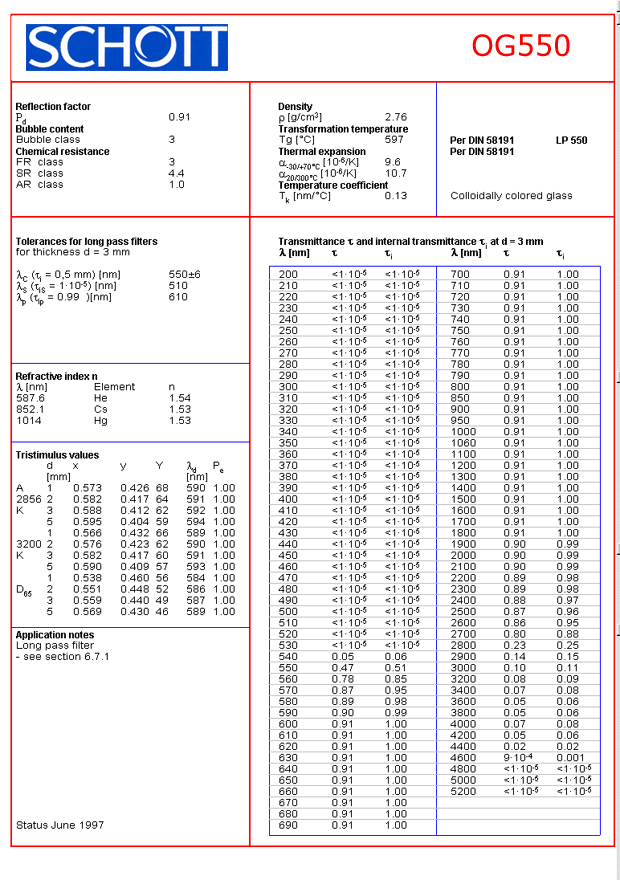
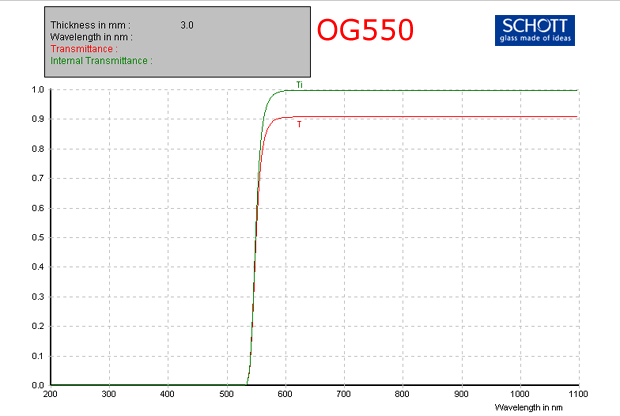
PPS I have added yet another article, which shows the idea, but they have improved it immensely - they have gotten rid of the lenses & used optical fibre probes to deliver the laser light and collect the reflected light from the sample, they use a bandpath filter to limit the range of light from the laser to a narrow range and a notch filter between the optical fibre (the collection one) and the spectrograph to remove the reflected light on the same wavelength as the laser. Thus all that gets to the spectrometer is the Stokes/Anti-Stokes or Raman scattered light...
Now what we need is some thought put into how to take the input from a CCD, which gives colors a value and their intensity is determined by a voltage, into a PC so as to remove the need for the most expensive remaining part of the system, the spectrometer itself. Good thing is, if we can work it out, probably by working out a way to set up a spectrograph that can not only split the light into its component parts, but also determine the intensity thereof (probably by the length of the line). The other alternative is to try and write some sort of program to take the raw data from the CCD itself (which splits the light into wavelengths & intensities all by itself without the need for spectrometry) and use that to graph the spectrum of the sample.
There are now two more papers, one on Students making their own spectrometers (cheap as shit) and viewing the results via webcam on the PC, and another on the use of a cheap grating spectrometer, CCD and software (which converts the digital image of the spectrum into the relevant wavelengths & intensities). I cannot find any reference to the software yet, hopefully shareware is available because this will make Raman Spectroscopy available to pretty much everyone for a couple of hundred bucks
The simplest route would be to utilise either the CCD from either (1) a scanner = rectangular - long, but only a few pixels high; or (2) a digital camera = rectangular, not as long, but a hell of a lot higher, plus huge number of pixels
The easiest way to determine the wavelengths we are dealing with would be to use a grating to split the light into its spectrum and then take a "photo" of that using the CCD - that would give the spectral wavelengths/colors. How to determine intensity is going to be harder
The difficulty I see arising is mainly what to do with the returned signal - I have NO FUCKING IDEA how to turn that into something the PC can utilize so as to map the peaks of the Raman Scattered light received by the CCD/Optics...
The lenses, for mine, are merely convex lenses, with specific focal lengths, that at least should be solveable...
If two or more, narrow-range laser diodes were utilized, one at a time, then there would be no need for notch filters, etc. as the reflected/incidental light (ie. that at the same wavelength as that emitted by the diode) wouldn't have to be blocked physically (I'm pretty sure the PC could be instructed to ignore all light within 10nm (+/-)5nm from the emitted light from that diode, same with the other diode(s)). Would merely mean programming the PC to ignore the specific region - separate them fairly well, say 50-100nm apart, anything that shows up in both is a legitimate peak, whatever doesn't might not be, although if it doesn't correspond with wavelengths X or Y (being the 10nm range of Diode X and Diode Y) whichever is in use at the time, then it should still be plotted.
The real problem is how to amp up the power of the available violet laser diodes so that the actual Raman Scatter Signal is able to be discerned effectively.
Here is another article on the basics of Raman Spectroscopy
What would be necessary though is paired biconvex lenses, firstly to capture then focus the laser light input to the cuvette, then a second set, to capture the scatter, then focus it upon the CCD/optical fibre/other capture device.*
Another thing would be the programming itself, to program a small robotic turntable to turn (so as to bring the other diode(s) into line with the sample - lightpath), then to program the capture device/CCD/optical fibre, to not only determine the wavelength of the light collected, but also to measure the intensity thereof. These together, with the added logic (alluded to above), would allow for the Raman Spectra to be plotted.
* Although not_important (over @SM) suggested a CCD could (he was suggesting a scanner/digital camera), by itself, be utilized to capture the entirety of the Raman Scatter - although how that would be programmed to identify the various colors, and then determine the relative population of each color (ie. part of the wavelength and intensity thereof when dealing with the focused version) remains a challenge. Of course, both scanners & digital cameras can and do (that is what they are designed for after all) determine the specific wavelength of the light incident upon them (that is what the colors in a photo / scanned copy of a document are), but how to get them to measure the intensity - ie the number of pixels of every specific color would allow us to determine the intensity of the peak corresponding to that color/wavelength. I suspect it "SHOULD" theoretically be possible to get a CCD of that type and use the data collected to spit out a graph showing the wavelengths of light captured and the volume/intensity thereof, after all, it is all data isn't it? What is given as data can be manipulated as data.
PS In the second paper, they used a 405nM diode laser of 5mW (such laser diodes are available ALL OVER THE INTERNET).
PPS I have added yet another article, which shows the idea, but they have improved it immensely - they have gotten rid of the lenses & used optical fibre probes to deliver the laser light and collect the reflected light from the sample, they use a bandpath filter to limit the range of light from the laser to a narrow range and a notch filter between the optical fibre (the collection one) and the spectrograph to remove the reflected light on the same wavelength as the laser. Thus all that gets to the spectrometer is the Stokes/Anti-Stokes or Raman scattered light...
Now what we need is some thought put into how to take the input from a CCD, which gives colors a value and their intensity is determined by a voltage, into a PC so as to remove the need for the most expensive remaining part of the system, the spectrometer itself. Good thing is, if we can work it out, probably by working out a way to set up a spectrograph that can not only split the light into its component parts, but also determine the intensity thereof (probably by the length of the line). The other alternative is to try and write some sort of program to take the raw data from the CCD itself (which splits the light into wavelengths & intensities all by itself without the need for spectrometry) and use that to graph the spectrum of the sample.
There are now two more papers, one on Students making their own spectrometers (cheap as shit) and viewing the results via webcam on the PC, and another on the use of a cheap grating spectrometer, CCD and software (which converts the digital image of the spectrum into the relevant wavelengths & intensities). I cannot find any reference to the software yet, hopefully shareware is available because this will make Raman Spectroscopy available to pretty much everyone for a couple of hundred bucks
The simplest route would be to utilise either the CCD from either (1) a scanner = rectangular - long, but only a few pixels high; or (2) a digital camera = rectangular, not as long, but a hell of a lot higher, plus huge number of pixels
The easiest way to determine the wavelengths we are dealing with would be to use a grating to split the light into its spectrum and then take a "photo" of that using the CCD - that would give the spectral wavelengths/colors. How to determine intensity is going to be harder
 Bisson.etal.LowCost.Raman.Spectroscopy.Violet.Laser.Diode.pdf