Author Topic: cutting glassware  (Read 217 times)

hypnos

  • Dominant Queen
  • ****
  • Posts: 402
cutting glassware
« on: February 15, 2010, 03:33:10 AM »
hey peeps need some ideas re; cutting glass esp; thick i.e ~2mm type glass jars/bottles----also, is it possible to cut pyrex? anyone tried? i've gotta go ghetto for some things and i'm gonna ttry and make some fittings--eg,,3necks are seriously hard to come by in my world at the moment but im gonna ttry and make something which "does the trick" 8)

ps. i gotta ssay i love this site and hope to give back more in the near future ::)
cheers hyppy ;D
"the two things you can give away and never lose, are what you know, and how you feel...."

Vesp

  • Administrator
  • Foundress Queen
  • *****
  • Posts: 3,130
Re: cutting glassware
« Reply #1 on: February 15, 2010, 03:39:48 AM »
Can you get claisian adapters? Often these make decent substitutions for 2-neck flasks, and I assume there are other varieties of adapters that will allow for a rigged up 3-neck flask.

I don't think cutting glassware that is thick, and intended for heating is a good idea, as you would likely need to fire polish and re-annealed to get rid of any tension, etc that cutting it would perhaps cause...

If the chemicals are not to reactive, and you don't need very big holes -- 3 holed stoppers might work, but I don't know what you are up too...

I do know that camphor is often used when it comes to drilling glass, and that tempered glass cannot, or should not be drilled. Other then that... I don't know very much about altering glass.

If you don't mind me asking, what is it you need the rigged 3 neck flask for?
Bitcoin address: 1FVrHdXJBr6Z9uhtiQKy4g7c7yHtGKjyLy

Sedit

  • Global Moderator
  • Foundress Queen
  • *****
  • Posts: 2,099
Re: cutting glassware
« Reply #2 on: February 15, 2010, 05:40:51 AM »
I cut bottles as so. Take a metal file and etch a notch about 1/4 the way around. Get nichrome wire and rest it in the notch and wrap it all the way around and tape it so its tight to the glass. Turn the power on and pop.... the bottle will be cut.
There once were some bees and you took all there stuff!
You pissed off the wasp now enough is enough!!!

timecube

  • Subordinate Wasp
  • ***
  • Posts: 230
Re: cutting glassware
« Reply #3 on: February 15, 2010, 07:16:34 AM »
Pick up a glass cutter..
http://www.youtube.com/watch?v=BoJc7gStA84

They also make drill bits if you need circles..
http://www.youtube.com/watch?v=y9UOlLSOqUI
« Last Edit: February 15, 2010, 07:19:43 AM by timecube »

Ventillator

  • Larvae
  • *
  • Posts: 40
Re: cutting glassware
« Reply #4 on: February 15, 2010, 05:24:05 PM »
Unbelievible that you post this thread hypnos. I Was going to make a thread just like it. Three-necked flasks are also near impossible to get around here. Was gonna post a thread to see where i can get them. I Wonder where? Hmm.. Making them would be difficult. Becoming a professional glass-blower or befriending one might be a good task. I Mean glassblowing is probably something us organic chemists should learn. Considering glassware is just as important in organic chemistry as chemicals are, i mean very advanced organic synthesis require extremely fancy and exotic glassware. Even to the extent of it being custom made.. That too is the basis of organic chem.
Organic Chemistry Is For People Who Like To Cook

iknowjt

  • Pupae
  • **
  • Posts: 75
Re: cutting glassware
« Reply #5 on: February 16, 2010, 02:42:23 AM »
When pyrex glassware is made, it is flameworked.  Cutting glass is one type of coldworking,
There are 5 - 10 known ways of cutting tubing and a handfull or so for cutting large bottle/large tubing.

Here's a very usefull example.  There came a time when i understood that I needed a glass funnel.  OK.  Orangina bottle is the perfect shape.  No matter which trick you use to cut it, there will always be two distinct steps.
1.  Start the fracture by scoring it, or heated wire or whatever works.
2.  Sudden impact, or thermal shock, will send the score evenly across as long as cold water is there to keep it from cracking all over the place


For the orangina bottle a good way is to score with a glass cutter, use a candle to get the score as hot as you can, and quickly submerge it in a sink full of water.
A fancy way is to make the score, wet it with water, and then heat the tip of a glass rod to yellow/white hot, and then press the hot tip right along the score, but in such a way so that only part of the score is contacting the heated tip.  The second part can also be done with even carefull tapping, better from inside the bottle.

Pyrex can absolutely be cold worked, but you don't wanna try dremeling a hole through a thin walled glassware.  The point thats being dremeled should also be under a thin stream of running cold water.
When working soft glass, don't try fire polish, instead use sandpaper, constantly dipping it in water.  This is a great way to finish off shaping either type of glass.
Some other laboratory equipment i've improvised via coldworking:
Drilled a hole half way up a glass coke bottle, glass tubing went in the hole sealed via vinyl grommet:  Distillation
Several glass nip bottle, with holes on the sides:  Self contained HCl gass bubbling
All sorts of dinky little contraptions for whatever purpose.

lugh

  • Global Moderator
  • Foundress Queen
  • *****
  • Posts: 876
Re: cutting glassware
« Reply #6 on: February 16, 2010, 06:08:09 PM »
People have been asking these questions for many years, that's why these two files were scanned:

http://www.erowid.org/archive/rhodium/djvu/labglaswork1.djvu

http://www.erowid.org/archive/rhodium/djvu/labglaswork2.djvu

It really seems that Rhodium's page has been ignored by many members from the threads that have been posted recently, that should be where a newbee looks first before anything else  ;)  Time and money were spent to answer these questions, but it seems like it was useless sometimes  ::)
Chemistry is our Covalent Bond

no1uno

  • Global Moderator
  • Foundress Queen
  • *****
  • Posts: 681
Re: cutting glassware
« Reply #7 on: February 16, 2010, 09:04:42 PM »
Yeah, the glassworking files are classics, but quite a few of the older texts also go into it in some detail...
"...     "A little learning is a dang'rous thing;
    Drink deep, or taste not the Pierian spring:
    There shallow draughts intoxicate the brain,
    And drinking largely sobers us again.
..."

iknowjt

  • Pupae
  • **
  • Posts: 75
Re: cutting glassware
« Reply #8 on: February 17, 2010, 01:23:54 AM »
i enjoyed sharing my actual experience and successes in this thread.  Yes those two files have helped me a lot, mostly in flameworking.  I have yet to see a comprehensive resource on ghetto improvized glassware, via coldworking in particuler.

lugh

  • Global Moderator
  • Foundress Queen
  • *****
  • Posts: 876
Re: cutting glassware
« Reply #9 on: February 17, 2010, 06:36:44 PM »
A Simple Glass-Blowing Machine

By Major C. E. S. PHILIPS, O.B.E., F.Inst.P., F.R.S.E.
J. Sci. Instrum. 21, p. 17 (1944)
The object of this contrivance, illustrated in Fig. 90, is to provide a means of doing certain glass-blowing jobs which often arise in a laboratory and normally require skill and experience. Unless the art, of working glass is frequently practised, technique rapidly deteriorates, and it is then that this machine is especially useful. It has been made largely from scrap and such odds and ends as could be got together. The general idea is that there must be a means of sup­porting the horizontal glass tubing at each-end and revolving it slowly and evenly while heat from a gas flame is applied locally at one or more points, with provision made for blowing into the tube if required. It must also be possible to shorten or draw out the glass tube when softened by heat and to handle tubing of various diameters and lengths (within practical limits). These conditions are realized in the way described below. Two 3-in. self-centring chucks are screwed facing each other to the ends of two co-axial horizontal tubular spindles (gas pipe carefully turned to 1 in. external diameter) which are supported in pairs of bearings as shown in the figure. An inch plank, 9 in. wide and 3 ft. long, carefully planed so as to have parallel sides, is screwed to a wooden base. At the left-hand end it carries two fixed substantial wooden columns 6 in. high, on which the bearings are mounted. At the right-hand side are two other wooden columns which stand upon a saddle that can slide upon the plank and be moved by a string fore and aft attached to winders. The distance between the chucks can be varied in this way ; the maximum separation is 14 in. The chucks are driven by cycle chain over 48-toothed bicycle sprocket wheels from a light countershaft which carries two small bicycle sprocket wheels each having 16 teeth. One of these smaller wheels is fixed to the shaft and the other is capable of sliding along it. Since the sliding sprocket wheel must continue to revolve equally with the fixed one while it is being moved forward or backward, it has a longitudinal slot cut in its centre which engages with a 1-in. metal rod sweated along the shaft. Thus for any position (within limits) of the movable wheel upon the shaft the two always rotate together. A metal arm projecting from one side of the saddle engages with a groove in the circumference of the boxwood centre of the movable sprocket wheel, so that if the position of the saddle is changed the sprocket wheel moves correspondingly and the chucks continue to to at exactly the same speed. The countershaft is carried in bearings made from bored brass plates brazed to the top of a pair of shelf brackets. It is belt-driven a 1/4-h.p. electric motor, the speed of which is controlled by a variable resistance consisting of two carbon rods from torch batteries lowered a weak solution of common salt. 40 r.p.m. seems to be the best working speed. Many simple operations can be done by the machine with great neatness, such as joining two glass tubes, drawing down a large tube and sealing a smaller one to it, etc. If, however, a bulb is required a small tube has to be sealed into position within a larger one, as instance in the case of a mercury trap or a filter pump, it is necessary be able to blow into the glass tube when it is softened locally and steadily revolving. For this purpose the device described below is fitted to the left­band spindle. Into the end remote from the chuck a solid wooden cylindrical bushing 3 in. long is tightly fitted and bored so as to take a four inch length of one quarter inch brass tubing. This can therefore be pushed partially into the hollow spindle through the wooden bush and fixed position by a set-screw. At its inner end a sweated-in nipple grapples a narrow rubber tube to be attached, and pass into the spindle as to project for a couple of inches beyond the open jaws of the chuck. A glass tube pushed into the free end of the rubber tube can drawn into the chuck by releasing the set screw and pulling the so tube to the left, thus drawing the rubber tube through the chuck bto the spindle and enabling the chuck jaws to be closed down lightly ut firmly upon the glass tube itself. Since all rotate together when the machine is started up, it is necessary to find some way of blowing into the brass tube while it revolves. This was done by sweating a small brass plug into the left-hand end of it which is beyond the spindle and boring it with a widely tapered hole into which the conical end of a short length of metal tubing was pressed by a horizontal spring held stationary. One can by this means blow down the fixed tube through a length of rubber tubing for cork or by heating it and the distance between the chucks reduced, it can be gripped in the right-hand chuck, and all is ready for the work to proceed. If the machine is then switched on and a blow-pipe flame used to soften the central portion of the glass tube, the saddle may be moved forward and the glass allowed to thicken in the well-known way and, when sufficient "metal" has accumulated, a light breath into the tube causes it to enlarge evenly. The saddle may be finally and slowly drawn back as the glass expands and a graceful pear-shaped bulb is and symmetry owing to the uniform heating of the glass and the fact obtained. that in spite of the softening at its centre both end portions are firmly supported and remain co-axial. Numerous modifications of this method will of course suggest themselves, depending upon the requirements, but thistle funnels and much other glass apparatus can thus be made with great neatness.
Chemistry is our Covalent Bond

lugh

  • Global Moderator
  • Foundress Queen
  • *****
  • Posts: 876
Re: cutting glassware
« Reply #10 on: February 17, 2010, 07:19:35 PM »
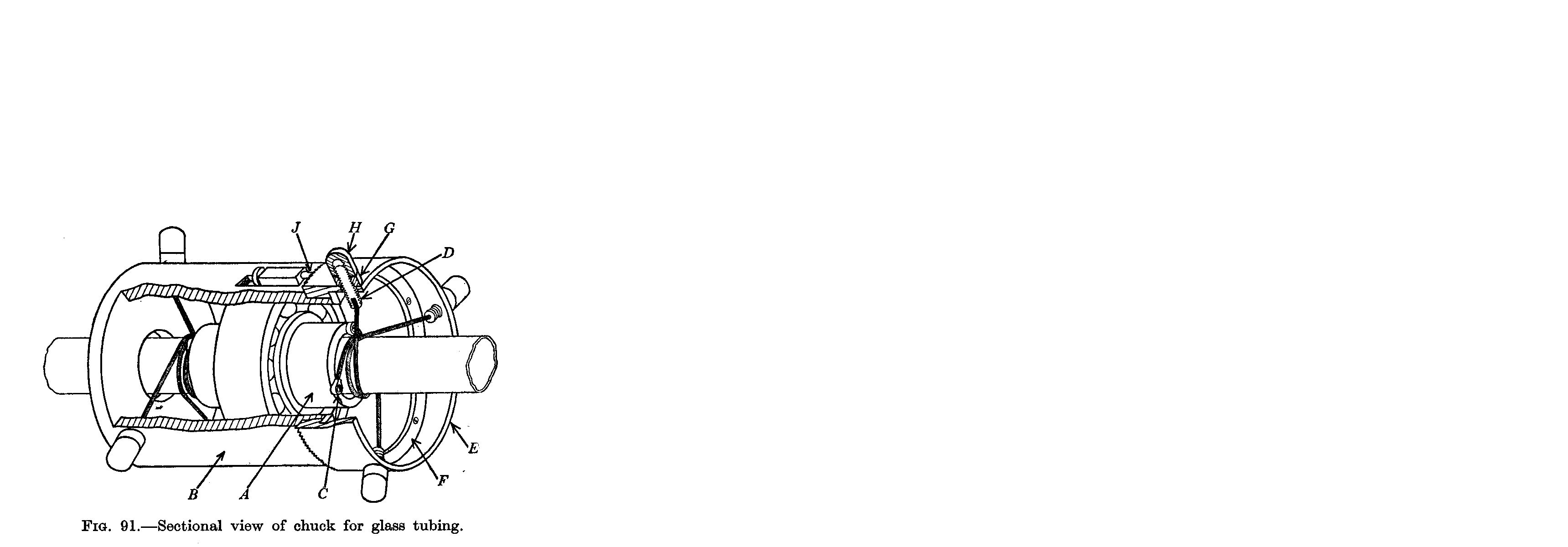
J. Sci. Instrum. 22, p. 114 (1945)
It is often necessary to hold glass tubing firmly so that it may be rotated in a glass-blowing lathe or similar device. The conventional three- or four-jaw chuck has the disadvantage of concentrating the stresses in the glass in a restricted region, and the glass is easily broken if a little too much pressure is applied in an effort to get a good grip. Wooden collets are sometimes used, but the tubing is readily broken unless it is accurately circular in cross-section and quite straight in the region gripped by the collet; commercial glass tubing often possesses neither of these properties. The chuck described below avoids concentrated stress since the grip on the glass is obtained by wrapping steel wires tightly round it, and there is no tendency to break tubing which is bent or not quite circular in section. It can grip tubing whose diameter varies along ite length and permits quick centring of slightly bent tubes. It may be made in a small workshop, since only simple turning and drilling processes and the cutting of a ratchet are required. A ball-race supports a tube A (Fig. 91) co-axially with the main barrel B of the chuck, and to each end-face of A three steel wires are attached by equally spaced collars C which can turn on bearings parallel to the axis of A. The other ends of the wires at the front of the chuck are attached to adjusting screws D radially mounted in the ring E which may be rotated relative to B but which is prevented from moving laterally by the flange F. The wires at the rear of A are attached to similar adjusting screws mounted on B. The radial positions of the screws are controlled by nuts G and lock-nuts H and each screw is prevented from rotating The glass tubing is inserted in the chuck as shown in Fig. 91 and the ring E is rotated so as to wrap the six steel wires round the glass. Since the ball-race allows the cylinder A to rotate freely, both front and back wires will be tightened at the same time. The ring E is prevented from turning backwards by the ratchet and spring-loaded pawl J, and the tension in the wires can thus be maintained. The glass is gripped very tightly, but with the chucks made and used in Sydney we have never broken a piece of tubing, although in trying to do so a wire has been wrenched from its hard soldered junction with the adjusting screw. If necessary the grip on the glass may be relaxed instantly by pulling out the pawl J when the ring E springs back and releases the tension in the wires. The chuck is not accurately self-centring but centring can be obtained quickly by a few adjustments of the screws D. Similar adjustment will centre the end of a piece of tubing which is slightly bent. We have found that in practice the setting of the rear adjusting screws may be fixed once and for all and all necessary adjustments made with the front screws. The chuck has handled satisfactorily a range of tubing diameters of between two and three to one. The chuck described takes tubing of diameter from 3/8 in. to 1 1/4 in. Since the tubing is gripped effectively at only two places it is clear that lack of straightness does not produce any stresses in the glass, nor need the diameters at the two places gripped be the same. The wires should be as flexible and strong as possible, and probably watch-springs would be as good or better than the stranded steel wires we have used ; the greater the flexibility the greater will be the accuracy of centring.
Chemistry is our Covalent Bond

hypnos

  • Dominant Queen
  • ****
  • Posts: 402
Re: cutting glassware
« Reply #11 on: March 01, 2010, 01:59:35 AM »
 thanx all,,i am familiar with most of these techniques and have done a bit of hot and cold glassworking in my time,,i havent used the method sedit suggests,these are the kind of "pro tips" i am "looking to hear"(yeah right ::)),
    have read about it tho and was wondering,, a) where do you get your nichrome wire? heater/toaster elements,,? and b) i guess you just use mains power but CAREFULLY eh?  but its sounds like a very good way to make nice clean cuts---have you tried it with pyrex?

  also lugh matey,,i am unable to open djvu files on the system i am using 98% of the time,,but when i get on somewher that does,,you can rest assured they WILL be read and copied so i can have access as required, so thanx anyway,,as 'iknowjt' says "Yes those two files have helped me a lot, mostly in flameworking." and it seems i am not alone in this as ventillator said "Unbelievible that you post this thread hypnos. I Was going to make a thread just like it. Three-necked flasks are also near impossible to get around here. Was gonna post a thread to see where i can get them."
   unfortunately  vesp,, in "my neck of the woods" even claisons are hard come by without weird looks and presumptuos questions--which i wish to avoid at any and every time ;D the LAST thing i want to do is 'redlight" myself in ANY way i CAN avoid ;D

  "why the 3 neck?"
well,, i want to try and convert some pyrex coffee jugs (that are cheap and easily come by) by making "lids" for the that are attatched with high temp adshesive i.e exhaust manifold cements etc,,--i was thinking of cutting the bottoms off some test tubes and making the 'lids' with the test tubes as the necks--and i figure its easier to close a hole i dont need rather than trying to open one if i do- plus if i fuck it up (always a possibilty,,hmmm even a 'probability!!!' ::)) they are cheap and easy to replace,,and they are quiite strong IMHO :)
i like the idea of multi hole stoppers but i imagine the size of the holes would be rather small and somewhat restricted in their applications--please let me know if this assumption is wrong/mistaken,,or if i am overlooking something,,which wouldnt suprise me at all  :o ::) i'm pretty good at missing the obvious :P

 as for the glassblowing machine lugh me man,,i dare say its WAY  over my abilities,,or needs!!! if i had to make HEAPS of stuff,,,(for lots of peoples) it could be good--hey if anyone esle here makes one or does make there own glassware and are interested in selling/giving some my way,,please let me know via a 'pm'
  as always,,thanx everyone
 happy flying my fellow wasps,,
hyppy

"the two things you can give away and never lose, are what you know, and how you feel...."

no1uno

  • Global Moderator
  • Foundress Queen
  • *****
  • Posts: 681
Re: cutting glassware
« Reply #12 on: March 01, 2010, 10:30:58 AM »
A lot of old textbooks encourage people to make their own glassware... It is far from easy but a useful thing to know. The advent of cheap PTFE/PEEK tube, rod and sheet (for stoppers, joiners, etc.) make a lot of stuff a LOT easier. Then you only need to learn the basics, get yourself some tubecutters (they cost fuck all), some hole-borers (for stoppers) and work out what size joints you want to try and make. Microscale is always going to be easier (plus the tube 6-10mm OD) is available online, as are cheap as fuck test tubes, some of which are threaded, which would allow for ultra-cool threaded microscale homemade glass. Personally (I'm in the process of looking into it), I think even domestic lightbulbs could be useful, they must be borosilicate to stand up to the temperatures they are running at (and IMHO the heat gradient would be too much for soda glass). With a custom built stopper into that, then you can do most anything...

Joining two different OD tubes is easiest if the larger barely fits over the inner, that also makes a fucking good socket for another thin tube... Joining two tubes at 90' is tricky as hell, but claisen type adapters allow for fuckups of that nature ;D.  Heating the ends of tubes then pushing them down onto a flat surface allows you to build up a lip, which would aid in joining bits.

Making our own glass, that would be fun and kind of enjoyable - I love the play side of chemistry (please, don't heat flammable liquids over naked flames in lightbulbs, I "THINK" they might hold up, I ain't gonna guarantee squat).

As for hollowing out lightbulbs, here is one instructable where they do so, and here is another useful site. I'd take the metal bit off completely and make up some waterglass paste and then let that form a threaded end onto the lightbulb. That would allow for a threaded connection (tip - use the connection to mold the waterglass - then it will fit, you'd probably need to use a fine layer of an oxide, like talc, to ensure it doesn't bond to the lid). Heavy duty HD Polypropylene lids are cheap and widespread.

Also have a look online - with a bit of care, these bulbs could be used to make neat separating funnels - need to add a cross-piece to the down tube, then make a turning-valve out of some PTFE. As long as it seals everything will work properly.
« Last Edit: March 01, 2010, 09:14:20 PM by no1uno »
"...     "A little learning is a dang'rous thing;
    Drink deep, or taste not the Pierian spring:
    There shallow draughts intoxicate the brain,
    And drinking largely sobers us again.
..."

hypnos

  • Dominant Queen
  • ****
  • Posts: 402
Re: cutting glassware
« Reply #13 on: March 02, 2010, 02:15:16 AM »
 lol :D   lightbulbs eh? sounds kinda delicate :o  tho i can see where you're comin from--once again thwarted by the fucking pdf aaargh--the price you pay for not paying a price!!! (free public computa's) also yeeah ptfe tubes i got a bunch of and yeah good ideas amigo...thanx 8)
i would be most interested to hear how you go if you 'go the globe route' tho no1
"the two things you can give away and never lose, are what you know, and how you feel...."

iknowjt

  • Pupae
  • **
  • Posts: 75
Re: cutting glassware
« Reply #14 on: March 12, 2010, 04:09:41 PM »
A lot of old textbooks encourage people to make their own glassware... It is far from easy but a useful thing to know. The advent of cheap PTFE/PEEK tube, rod and sheet (for stoppers, joiners, etc.) make a lot of stuff a LOT easier. Then you only need to learn the basics, get yourself some tubecutters (they cost fuck all), some hole-borers (for stoppers) and work out what size joints you want to try and make. Microscale is always going to be easier (plus the tube 6-10mm OD) is available online, as are cheap as fuck test tubes, some of which are threaded, which would allow for ultra-cool threaded microscale homemade glass.
search for glass flameworking/art glass supplies, any and all borosilicate tubing is available in 4 ft. pieces.  In the US there's at least one sit that will sell any odd amount, mix and match, whatever.  They also sell common sized ground glass joints for so very cheap.  Keep in mind only borosilicate glass can be worked over a torch, so far more than just laboratory glass will always be top notch borosilicate.


Quote
Personally (I'm in the process of looking into it), I think even domestic lightbulbs could be useful, they must be borosilicate to stand up to the temperatures they are running at (and IMHO the heat gradient would be too much for soda glass). With a custom built stopper into that, then you can do most anything...

True, but light bulbs are rarely thick enough to be worth messing with.  Considering the usage of the glass item is a smart idea though:
Candy thermometers - excellent
Glass candle/oil lamp holders - too thick to try to work but handy
glass baby milk bottles, borosilicate so that they can be easily sterilized
ampoules - same deal


Quote
Joining two different OD tubes is easiest if the larger barely fits over the inner, that also makes a fucking good socket for another thin tube... Joining two tubes at 90' is tricky as hell, but claisen type adapters allow for fuckups of that nature ;D.  Heating the ends of tubes then pushing them down onto a flat surface allows you to build up a lip, which would aid in joining bits.

seems easy until you try it.  make sure once joined that it the two tubes are air locked(via cork if needed)  Don't ever thicken one end by pressing against a flat surface, instead rotate evenly(slow is ok, even rotation is vital, think rotisserie)until the tip begins to gather.  This is also the way to taper down from a larger diameter to a smaller.  To make a weld, you must have both tips over the flame and rotating for a while, making  sure both tips are orange/yellow hot.  Then one motion makes the seal, continue rotating, gathering, blowing out a bit, gathering down again,. blowing out again.

If a bend is needed, that always comes last.  A bend can be made anywhere along the tubing, heat, gather, keep it strait, then when you're ready, press in one motion against a hard surface, then immediatelly blow out the bend.

By the way oxygen is not needed to work smaller stuff,air carburated  'mapp gas' will get you surprisingly far.

Quote

Making our own glass, that would be fun and kind of enjoyable - I love the play side of chemistry (please, don't heat flammable liquids over naked flames in lightbulbs, I "THINK" they might hold up, I ain't gonna guarantee squat).

As for hollowing out lightbulbs, here is one instructable where they do so, and here is another useful site. I'd take the metal bit off completely and make up some waterglass paste and then let that form a threaded end onto the lightbulb. That would allow for a threaded connection (tip - use the connection to mold the waterglass - then it will fit, you'd probably need to use a fine layer of an oxide, like talc, to ensure it doesn't bond to the lid). Heavy duty HD Polypropylene lids are cheap and widespread.

Also have a look online - with a bit of care, these bulbs could be used to make neat separating funnels - need to add a cross-piece to the down tube, then make a turning-valve out of some PTFE. As long as it seals everything will work properly.

sep funnel?  that's where I draw the line, if someone can do it I will be very impressed.

Sedit

  • Global Moderator
  • Foundress Queen
  • *****
  • Posts: 2,099
Re: cutting glassware
« Reply #15 on: March 13, 2010, 06:40:51 AM »
Best I found for a sep funnle getto style is a water bottle with a "click" top on it with PP tube over the valve.

I was gong to go into a long drawn out description but ill just take a picture if I get m camera working right
There once were some bees and you took all there stuff!
You pissed off the wasp now enough is enough!!!

iknowjt

  • Pupae
  • **
  • Posts: 75
Re: cutting glassware
« Reply #16 on: March 13, 2010, 10:40:12 AM »
when I finally got a real sep funnel, two definate conclusions where made:
1.  my suspicion, that rigging one of these is just not realistic, was further confirmed*

2. surprised to discover that my 3 dependable friends still remained in active duty:

-'enchanced' glass turkey baster(rubber bulb from desoldering iron, joined to glass body with teflon tape and ultra tight hose clamp....opening at tip reduced to pinhole size by rotating over torch)

-bucket of 10ml syringes with plenty of long tips(if you're carefull, just about all of the aqueous phase of the second step of an A/B can be sucked out.  Of course a few brief encounters with a NP will leach out the lubricant, seizing the syringe, but this isn't so hard to avoid.

-drug store eye droppers never fail for precise seperation of the last few drops


of course the sep funnel itself opened up all sorts of new doorways that otherwise where just not feasible .

* The furthest I got was an IV drip bag.  Or automotive funnel with draining-cock valve on the bottom.