


Muira Puama (Ptychopetalum olacoides) bark is an aphrodesiac from a tree in South America.
Caveat: I am still very much a beginner in chemistry - I tend to absorb a lot of information when I'm researching - digging up a trail only to lose the path that got me there. I'm also horrible at remembering the specific terms - please do your own research on any recipe I give or ask me to doublecheck on anything that sounds fishy.
I've been working on getting all my equipment setup etc and learning how to do distillation, vacuum filtering etc. I'm interested in broad range herbalism - prefer it to traditional medicine and my emphasis is on stuff that makes you feel good and keeps you healthy.
So if there's an interest, I'd enjoy sharing and discussing the research I'm doing both practical and theoretical on various herbs which may be of use to readers of this forum.
Here's a writeup on Muira Puama - (keep in mind these guys are trying to sell something)
http://www.rain-tree.com/muira-puama-extract.htm
It's also available from Mountain Rose for $6 a pound cut/sifted bark - I prefer cut/sifted because it gives you more options for extraction.
http://www.mountainroseherbs.com/bulkherb/m.html
(I'm not selling anything, but I see this stuff listed on shaman shops for 4$ an oz and that's highway robbery!)
It potentially has dopaminic effects, some research I have read suggested that it actually causes release as well as reuptake inhibition. There is a supplement called catuama that is a combination of muira puama and catuaba that is reputed to have anxiolytic and aphrodesic effects.
http://www.ncbi.nlm.nih.gov/pubmed/19067380
http://www.ncbi.nlm.nih.gov/pubmed/19815648
I've uploaded two pdfs - a patent and a research paper.
My experience with the plant is limited so far - I have brewed several teas using neutral grain vodka (40% EtOH) mixing it with catuaba and ascorbic acid. I found out brewing the two together seems to have a better effect, but is subjective and time will tell. Since I didn't have my lab setup, I experimented by simmering them together in vodka for about 20 minutes and leaving it sit over night then filtering. Then I evaporated the alcohol one serving at a time. Take it with about a gram of arginine - this enhances the effect. I don't know if the ascorbic acid is needed for the extraction - I read it enhances the drug somehow in a patent. Last time I made it I put it in the mix at brew time, that brew seemed to have a bigger punch.
Effects - The catuaba part seems to have the effect of moving the blood circulation to the peripherials - skin becomes more sensitive to touch, chills, flushing effects, tingles up the neck and spine - goes nice with sex! I believe the Muira Puama part does increase dopamine - mood mellows, anxiety is less, sexual desire increases.
Side Effects - your heart can have a sort of speed up when the blood starts moving out, I read up on it and apparently it is harmless and your heart is actually getting an easier load (sorry I lost that reference) I haven't found any writeups of any serious side effects - they put this stuff in drinks in South America.
Extraction Notes:
I've been researching various extraction techniques - all indicators are not to heat it too much or over process Muira Puama. The bark is tough as nails so if you don't have mill, order the powder. (I'm still working on my mill .. - nice inspiration from the one in the library)
It doesn't extract well unless you powder it - I tried freezing and wetting & freezing and neither of those softened it up.
I found a write up in an old pharmaceutical journal on extraction and they gave a nice recipe for percolation. (If anyone is interested I'll try to find it) So last night I setup a percolation using vodka. I've been interested in that technique for a while because sometimes too much heat and processing can destroy elements of a plant that are synergistic.
This book http://books.google.com/books?id=J_LZhWKeHj4C&lpg=PP1&pg=PA158#v=onepage&q=percolation&f=false has a really good writeup on percolation and how to pack a column - I plan on making one of the bottle percolation setups they describe as soon as I find my glass cutters. (the book is not downloadable but most of the stuff about percolation is readable.) I attached a picture of the percolation - I got a really beautiful reddish clear liquid from the vodka (might have been higher content - sometimes my vodka and everclear get mixed). After it was exhausted I ran hot water through the percolator and got a cloudy liquid that is separating - might be saponins.
Salat
If there's a help page on how to format these posts could you point me to it - I work with computers all day long and don't have a lot of patience with it in my spare time...
Caveat: I am still very much a beginner in chemistry - I tend to absorb a lot of information when I'm researching - digging up a trail only to lose the path that got me there. I'm also horrible at remembering the specific terms - please do your own research on any recipe I give or ask me to doublecheck on anything that sounds fishy.
I've been working on getting all my equipment setup etc and learning how to do distillation, vacuum filtering etc. I'm interested in broad range herbalism - prefer it to traditional medicine and my emphasis is on stuff that makes you feel good and keeps you healthy.
So if there's an interest, I'd enjoy sharing and discussing the research I'm doing both practical and theoretical on various herbs which may be of use to readers of this forum.
Here's a writeup on Muira Puama - (keep in mind these guys are trying to sell something)
http://www.rain-tree.com/muira-puama-extract.htm
It's also available from Mountain Rose for $6 a pound cut/sifted bark - I prefer cut/sifted because it gives you more options for extraction.
http://www.mountainroseherbs.com/bulkherb/m.html
(I'm not selling anything, but I see this stuff listed on shaman shops for 4$ an oz and that's highway robbery!)
It potentially has dopaminic effects, some research I have read suggested that it actually causes release as well as reuptake inhibition. There is a supplement called catuama that is a combination of muira puama and catuaba that is reputed to have anxiolytic and aphrodesic effects.
http://www.ncbi.nlm.nih.gov/pubmed/19067380
http://www.ncbi.nlm.nih.gov/pubmed/19815648
I've uploaded two pdfs - a patent and a research paper.
My experience with the plant is limited so far - I have brewed several teas using neutral grain vodka (40% EtOH) mixing it with catuaba and ascorbic acid. I found out brewing the two together seems to have a better effect, but is subjective and time will tell. Since I didn't have my lab setup, I experimented by simmering them together in vodka for about 20 minutes and leaving it sit over night then filtering. Then I evaporated the alcohol one serving at a time. Take it with about a gram of arginine - this enhances the effect. I don't know if the ascorbic acid is needed for the extraction - I read it enhances the drug somehow in a patent. Last time I made it I put it in the mix at brew time, that brew seemed to have a bigger punch.
Effects - The catuaba part seems to have the effect of moving the blood circulation to the peripherials - skin becomes more sensitive to touch, chills, flushing effects, tingles up the neck and spine - goes nice with sex! I believe the Muira Puama part does increase dopamine - mood mellows, anxiety is less, sexual desire increases.
Side Effects - your heart can have a sort of speed up when the blood starts moving out, I read up on it and apparently it is harmless and your heart is actually getting an easier load (sorry I lost that reference) I haven't found any writeups of any serious side effects - they put this stuff in drinks in South America.
Extraction Notes:
I've been researching various extraction techniques - all indicators are not to heat it too much or over process Muira Puama. The bark is tough as nails so if you don't have mill, order the powder. (I'm still working on my mill .. - nice inspiration from the one in the library)
It doesn't extract well unless you powder it - I tried freezing and wetting & freezing and neither of those softened it up.
I found a write up in an old pharmaceutical journal on extraction and they gave a nice recipe for percolation. (If anyone is interested I'll try to find it) So last night I setup a percolation using vodka. I've been interested in that technique for a while because sometimes too much heat and processing can destroy elements of a plant that are synergistic.
This book http://books.google.com/books?id=J_LZhWKeHj4C&lpg=PP1&pg=PA158#v=onepage&q=percolation&f=false has a really good writeup on percolation and how to pack a column - I plan on making one of the bottle percolation setups they describe as soon as I find my glass cutters. (the book is not downloadable but most of the stuff about percolation is readable.) I attached a picture of the percolation - I got a really beautiful reddish clear liquid from the vodka (might have been higher content - sometimes my vodka and everclear get mixed). After it was exhausted I ran hot water through the percolator and got a cloudy liquid that is separating - might be saponins.
Salat
If there's a help page on how to format these posts could you point me to it - I work with computers all day long and don't have a lot of patience with it in my spare time...
 US5516516.pdf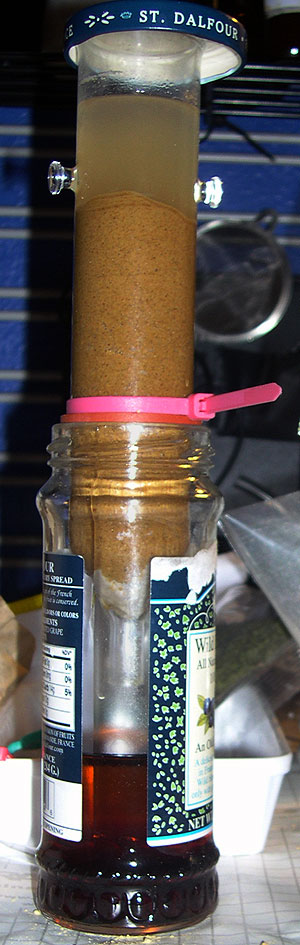
 ) that the pack needs to be elevated about an inch or so above the outlet so gravity does it's job.