
Author Topic: Stereospecific Route to Amphetamines  (Read 217 times)

no1uno

  • Global Moderator
  • Foundress Queen
  • *****
  • Posts: 681
Stereospecific Route to Amphetamines
« on: November 29, 2009, 10:59:06 PM »
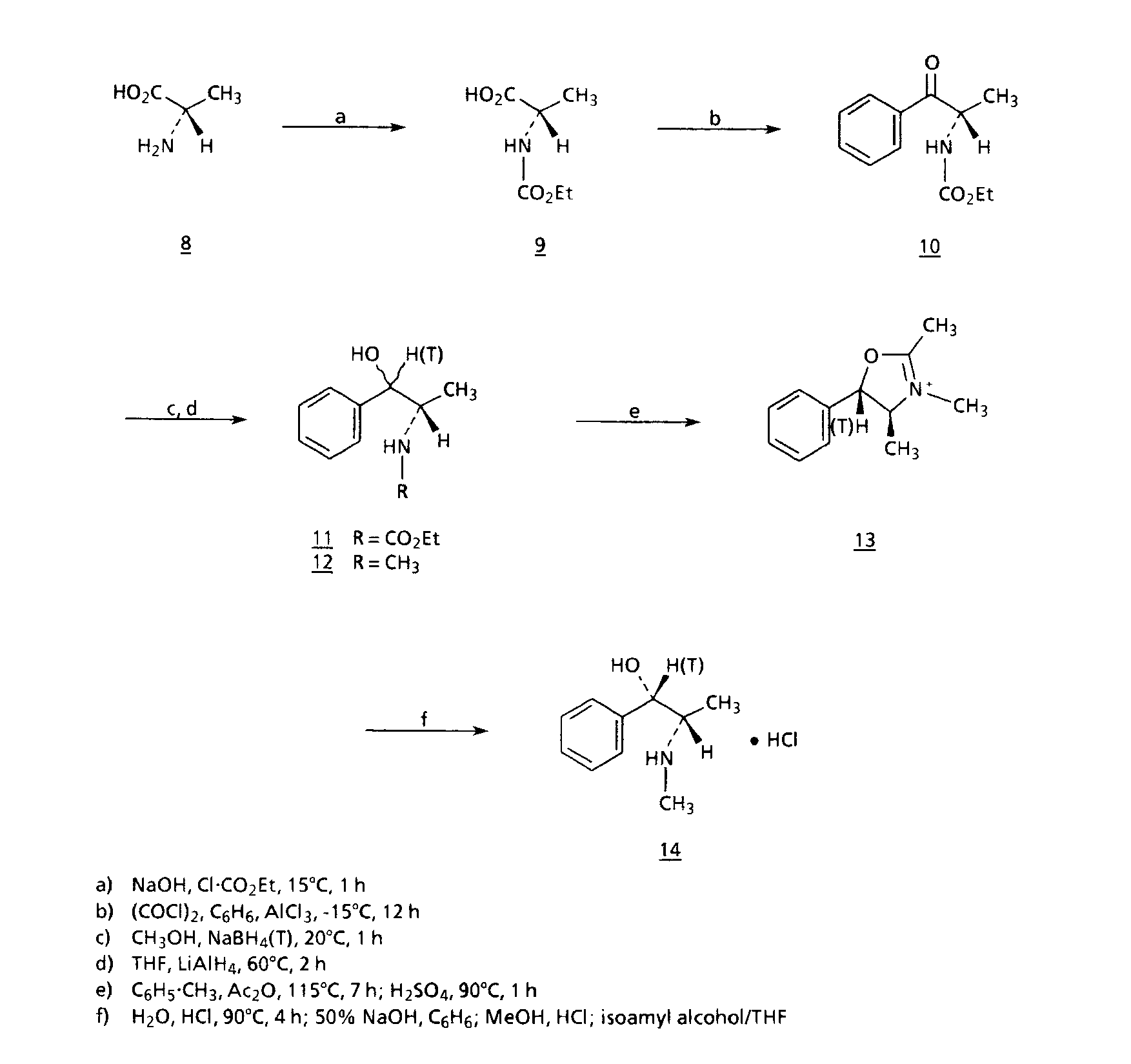
Java just uploaded (in the reference request thread) a paper by Rapoport, et al, which details the stereospecific preparation of ephedrine, pseudoephedrine & amphetamines (inc. methamphetamine) via the reaction of the acid chloride of the correspondent alanine/N-methylalanine and Phenyl Lithium or Phenyl Magnesium Bromide...

This of course will be of little interest to most - the reagents under discussion are not ones they'd care to play with or even acquire, but for those who are interested, it would allow for the preparation (and resolution) of the relevant alanine/N-methylalanine chloride ahead of time (neither of which is listed or in any way a problem to have on hand), my personal preference would be via the alkylation of the amine (ammonia/methylamine) with 2-iodopropane/2-chloropropane, followed by resolution of the intermediate (thus no reductive amination - so no imines to fuck with).

This would allow those who are interested to produce single-isomer methedrine without laborious (and time consuming) resolution of seriously problematic products (nobody wants product on hand any longer than necessary). Thus precluding the hydrolysis of the wrong isomer, the reamination, etc.

What is of note (or fucking well ought to be) is that Rapoport et al, show the reduction of Pseduo/Ephedrine to Meth/Amphetamine using Pd/C which is kind of interesting...
"...     "A little learning is a dang'rous thing;
    Drink deep, or taste not the Pierian spring:
    There shallow draughts intoxicate the brain,
    And drinking largely sobers us again.
..."

Wizard X

  • Lord of the Realms
  • Foundress Queen
  • *****
  • Posts: 1,224
Re: Stereospecific Route to Amphetamines
« Reply #1 on: November 29, 2009, 11:16:13 PM »
Can members here please start zipping into ONE zip file ALL the attachments. This save time and bandwidth by saving as ONE compressed file.
Albert Einstein - "Great ideas often receive violent opposition from mediocre minds."

no1uno

  • Global Moderator
  • Foundress Queen
  • *****
  • Posts: 681
Re: Stereospecific Route to Amphetamines
« Reply #2 on: November 29, 2009, 11:45:30 PM »
Just reread the paper - seems the author's didn't think anyone who could understand the chemical names would read their experimental section:

Quote
The following excerpts are taken from: Thomas F. Buckley & Henry Rappoport, 'a-Amino Acids as Chiral Educts for Asymmetric Products. Amino Acylation with N-Acylamino Acids', J. Am. Chem. SOC. 1981, 103, 6157-6163

Page 6/7 (p.6162), first column, third paragraph:

(S)-2-((EthoxycarbonyI)methylamino)propiophenone (9)*

To a magnetically stirred solution under N2 at 0'C of 8 (16.1 g, 0.1 mol) in CH2CI2 (300 mL) was added 0.5 mL of DMF and 10 mL (105 mol%) of oxalyl chloride in one portion. The reaction mixture was allowed to warm to room temperature with stirring and after 1.5 h was diluted with CH2Cl2 (150 mL) and benzene (1250 mL) and cooled -15'C. In one portion AIC13 (28.4 g, 210 mol%) was added and stirring was continued at -15'C for 12 h. The homogeneous solution was quenched with cold 1 N HCl (300 mL) and diluted with cold water (200 mL), the phases were separated,
and the organic layer was washed successively with cold lN HCl (2 X 300 mL), water (300 mL), and saturated NaHCO, (2 X 300 mL). Evaporation of the organic phase afforded an oil which was crystallized by triturating in warm hexane and cooling overnight at 0'C to yield 19.9 g, 90%, of 9: mp 62-63'C...

Page 7/7 (p.6163), column 1, paragraph 7:

(S)-2-((Ethoxycarbonyl)amino)-1-phenylpropane (25)

To a solution of 9 (6.63 g, 30.0 mmol) in EtOH (60 mL, absolute) was added ethereal HCl (10 mL) and 1 g of 10% Pd/C, and the mixture was shaken with H2 (55 psi, 4 h), filtered, and evaporated to a light yellow oil (6.15 g, 99% yield)...

Page 7/7 (p.6163), column 1, paragraph 8:

(S)-2-(Methylamino)-l-phenylpropane(26)**

To a magnetically stirred solution of 25 (3.0 g, 14.5 mmol) and dry THF (75 mL, N2) was added 1.65 g (300 mol %) of LAH. The mixture was warmed to 60'C for 2h, quenched with Na2S04-10H2O, filtered, and evaporated and the residue partitioned between CH2C12 (50 mL) and 1 N NaOH (50 mL). The aqueous phase was then extracted with CH2C12 (3 X 30 mL), and the combined organic layers were dried, filtered, acidified with ethereal HCl, evaporated, and triturated with acetone, yielding 2.55 g (95%) of 26.HCl...

* 2-((EthoxycarbonyI)methylamino)propiophenone (9) is also known as Methcathinone/Ephedrone.

** 2-Methylamino-1-phenylpropane (26) is also known as Methamphetamine


This paper demonstrates not only that it IS possible to build chiral pseudo/ephedrine fairly easily - provided we can (a) find a decent way to remove the ethoxycarbonyl/ethyl chloroformate protecting group off the amine; (b) build N-methylalanine in good enough yields; and (c) find a chlorinating agent that will form the acid-chloride of the a-amino acid that is easier to source than (COCl)2. Not only that, but the author's have quite helpfully provided the information that the l-alanine precursor, gives the d-amphetamine product.

This paper also shows that it is possible to reduce the product, Methcathinone/Ephedrone directly to Methamphetamine in good yields and in one pot using Pd/C @ 55Psi (about 4ATM). Which should be easily attainable in any home laboratory with a little mucking around.
« Last Edit: December 16, 2009, 01:06:29 PM by no1uno »
"...     "A little learning is a dang'rous thing;
    Drink deep, or taste not the Pierian spring:
    There shallow draughts intoxicate the brain,
    And drinking largely sobers us again.
..."

no1uno

  • Global Moderator
  • Foundress Queen
  • *****
  • Posts: 681
Re: Stereospecific Route to Amphetamines
« Reply #3 on: December 16, 2009, 02:32:25 PM »
The only real fly in the ointment is that the only USEABLE protecting group for the amino acid nitrogen was the ethyl chloroformate (made by condensing ethanol with phosgene - not nice)...

So I've had a wee look around and it seems that the same protecting group is attainable via Triphosgene, the name of which is something of a misonomer, as it is made by the exhaustive chlorination (claimed up to 99% yield) of [urlo=http://en.wikipedia.org/wiki/Dimethyl_carbonate]dimethyl carbonate[/url].

I know there are several procedures to make dimethyl carbonate from urea and methanol (ZnO or Polyphosphoric acid seem to be the main catalysts), so that should make that solveable, I'll just have to have a wee look for the chlorination procedure.

But for mine, if it is possible to build the l-N-Ethoxycarbonyl-N-methylalanine (dehydrogenation lactic acid to pyruvic acid, reductive amination with MeNH2, then protection), then it is possible to build up quite a lot of that raw material (it ain't listed and it ain't a drug or an analogue thereof). All we'd need then is a chlorinating agent to form the acyl chloride variant of the amino acid and benzene (+ AlCl3 of course).

Whole thing seems seriously scaleable... Benzene would be the hardest chemical to acquire and that is an oxidation of toluene to benzoic acid followed by decarboxylation away...
"...     "A little learning is a dang'rous thing;
    Drink deep, or taste not the Pierian spring:
    There shallow draughts intoxicate the brain,
    And drinking largely sobers us again.
..."

no1uno

  • Global Moderator
  • Foundress Queen
  • *****
  • Posts: 681
Re: Stereospecific Route to Amphetamines
« Reply #4 on: December 23, 2009, 11:16:09 PM »
Got it - I knew there'd be another useable protecting group for the nitrogen group in the alanine - in the stereospecific synthesis of bromodragonfly, etc. Nichols, et al used Rapoport's stereospecific route (using the alanine-choride/Freidel-Craft acylation of the difuranylbenzene), but get this, they protected the amine with CF3CO2H... Yeah I know, not exactly OTC is it? But if we could work out how to oxidise chloral (or trichloroethanol) to trichloroacetic acid, I suspect it would be a good-enough stand-in...

Any ideas on the oxidation of either chloral or trichloroethanol to trichloracetic acid? Copper? Or should we go with chlorination of acetic acid to trichloroacetic acid? Although, IIRC at least one of the references on the oxidative-pyrolysis of PTFE gives the major product as TFA...

[EDIT] Just found this paper, which uses the N-Methyl-N-TFA-alanine with benzene to give the d/l-Ephedrone via FC acylation, then reduces it using Pd/C directly to d/l-desoxyephedrine in good yield (with almost perfect ee's):

Quote
N-(Trifluoroacety1)amino Acids and N-(Trifluoroacetyl) amino Acid Chlorides

N-(Trifluoroacetyl)alanine, -valine, and -proline and their respective acid chlorides were prepared according to previously described methods.

(S)-N-(Trifluoroacetyl)-a-aminopropiophenon(e5 )

To a magnetically stirred solution of 4.0 g (21.6 mmol) of (S)-N-(trifluoroacety1)alanine in 100 mL of CH2C12 under N2 at 0 "C were added 4 drops of dry pyridine and 4 mL (5.82 g, 45.9 mmol) of oxalyl chloride (Aldrich) in one portion. The reaction mixture was allowed to warm to room temperature and stirred for an additional 2 h. After concentration of the mixture by rotary evaporation (temperature kept below 30 "C) the residue was diluted with 40 mL of CH2Cl2 and 250 mL of benzene and cooled to 0 "C. In one portion 5.8 g (4.35 mmol) of anhydrous AlCl3, was added, and the mixture was stirred at room temperature for 12 h. The solution was quenched with 60 mL of cold 1 M HC1 and diluted with 40 mL of cold water. The phases were separated, and the organic layer was washed successively with 2 X 40 mL of cold 1 M HCl, 60 mL of H20, and 2 X 40 mL of saturated NaHC0, solution. The organic phase was dried over MgSO, and concentrated by rotary evaporation to afford 5, which was recrystallized from petroleum ether to yield 3.2 g (68%) of pure product. mp 48-49 "C; IR and 'H NMR spectral data for all
racemic ketones can be found in ref 2. Proton NMR chiral shift analysis indicated the configurational purity to be >99.7% S (see text).

(S)-2-[N-(Trifluoroacetyl)amino]-l-phenylpropan(e11 )

To a 250-mL hydrogenation bottle was added 1.0 g (4.08 mmol) of ketone 5 in 15 mL of trifluoroacetic acid (doubly distilled over P205). To this solution was added 0.2 g of 10% Pd-C, and the mixture was shaken under H2 (55 psig) for 54 h. The solution was filtered and diluted with H20. The acid was neutralized with solid K2CO,, and the product was extracted with CHZCl2. Silica gel chromatography using hexanes and CH2Cl2 afforded, following recrystallization from hexanes, 0.6 g (71%) of pure 11: mp 79-81 "C (lit.13 mp 82-84 "C); lH NMR 6 1.20 (d, J = 6 Hz, 3 H, CH3), 2.80 (d, J = 6 Hz, 2 H, ArCH,), 4.25 (m, J = 6 Hz, 1 H, CHNH), 6.30 (br s, 1 H, NH), 7.20 (m, 5 H, Ar).

(S )-2-Amino- 1-phenylpropane (14)

(S)-2- [N-(Trifluoroacetyl)amino]-1-phenylpropane(11) was detrifluoroacetylated2 to yield the free amine 14 as a colorless oil: 'H NMR 6 1.01 (d, J = 6 Hz, 3 H, CH3), 1.67 (br s, 2 H, NHJ, 2.50 (dd, J = 5 Hz, 2 H, ArCH,), 3.00 (m, 1 H, CHNH), 7.06 (s, 5 H, Ar).14

Now all we need is one reference, then a decent route from lactic acid to either the a-halopropane (would Lucas Reagent work?) or Pyruvic acid, and thus N-methylalanine... Something a little easier to make than oxyalyl chloride for the chlorination would be nice too ::)
« Last Edit: December 24, 2009, 02:27:45 AM by no1uno »
"...     "A little learning is a dang'rous thing;
    Drink deep, or taste not the Pierian spring:
    There shallow draughts intoxicate the brain,
    And drinking largely sobers us again.
..."