


Intro:
This thread is about using the Claviceps paspali fungus to produce LSA. This fungus is very promising because even without optimization, it can produce LSA at a density of around 1g pure LSA per gallon of liquid medium. That makes 1 gallon of C. Paspali culture as alkaloid dense as 1 kilo of HBWR seeds... interested yet? This fungus is hypothesized to be the constituent of the ancient Kykeon sacrament. Another interesting thing is that this fungus can be easily mutated and isolated to a form that will produce only LSA as opposed to the more complex and dangerous alkaloids such as Ergometrine and Ergometrinine which are usually produced. This "alkaloid-blocked" mutant is very easy to identify and much safer to culture. Sterilization of seed liquid cultures can be done fast and easy in quart jars in a domestic pressure cooker. 5-15 liters can be sterilzed in under an hour. Once these cultures are colonized, 5 liters could be used to easily inoculate a 15 gallon fermenter. Using any number of extraction methods the LSA can be obtained and purified to a usable form. This method is very viable in our current day and age, information and technology are widespread, as well as efforts to control common precursors. Using this method we become self sustaining as our precursors exponentially multiply from a single culture sample and shared information drives us forward. YOU can end LSD prohibition!
Mutant isolation process (Refs: R1):
A high producing C. Paspali culture should be attained via academic routes (Easy peazy - if you are working in academia pm me).
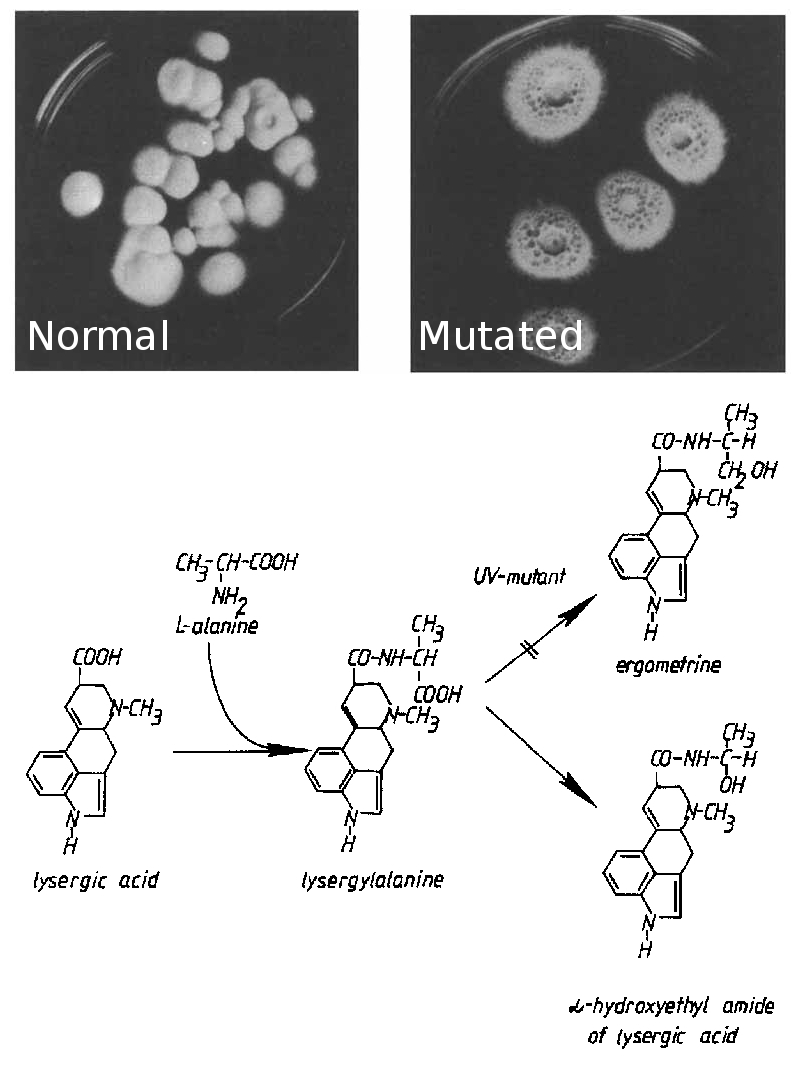
Mycelium is cut from the culture and introduced to a sterile .9% NaCl solution in a tall, round, glass container with a stirbar and broken peices of glass. It is stirred until the mycelium is broken into fragments then hit with UV light (300J/M^2) for long enough to kill most of the cells. The mycelium is filtered and grown out across many sterile agar plates. The target mutant strain colonies will be visually different, only the mutant colonies will produce "honeydew" droplets of polysaccharides. A few different "alkaloid-blocked" mutants are isolated and grown out on agar. Sterile liquid culture is prepared and inoculated with the various strains. This mutated form will form "swollen, arthrosporoid-like cells and showed a tendency to fragmentize" unlike the nonmutated form which will retain a filamentous structure throughout the fermentation. Seed culture jars are created and inoculated (note: use whatever nutrient mix here you would use for the production fermenter). Once these containers have fermented long enough a sample is taken from each and productivity is tested via the Van Urke reagent (Or FeCl3/H2SO4 or perhaps vanillin/FeCl3/H2SO4 according to Tsathoggua). If you are having trouble discerning the color of the solution, simply dilute the samples a known amount. A qualitative test for ergo alkaloids might be good just to be on the safe side.
Alkaloids present in blocked mutant:
LSA + Lysergic acid hydroxyethylamide usually about equal parts
In some mediums isoLSA and iso a-hydroxethyl amide are prominant which is undesirable.

Seed liquid culture: (Refs: R2)
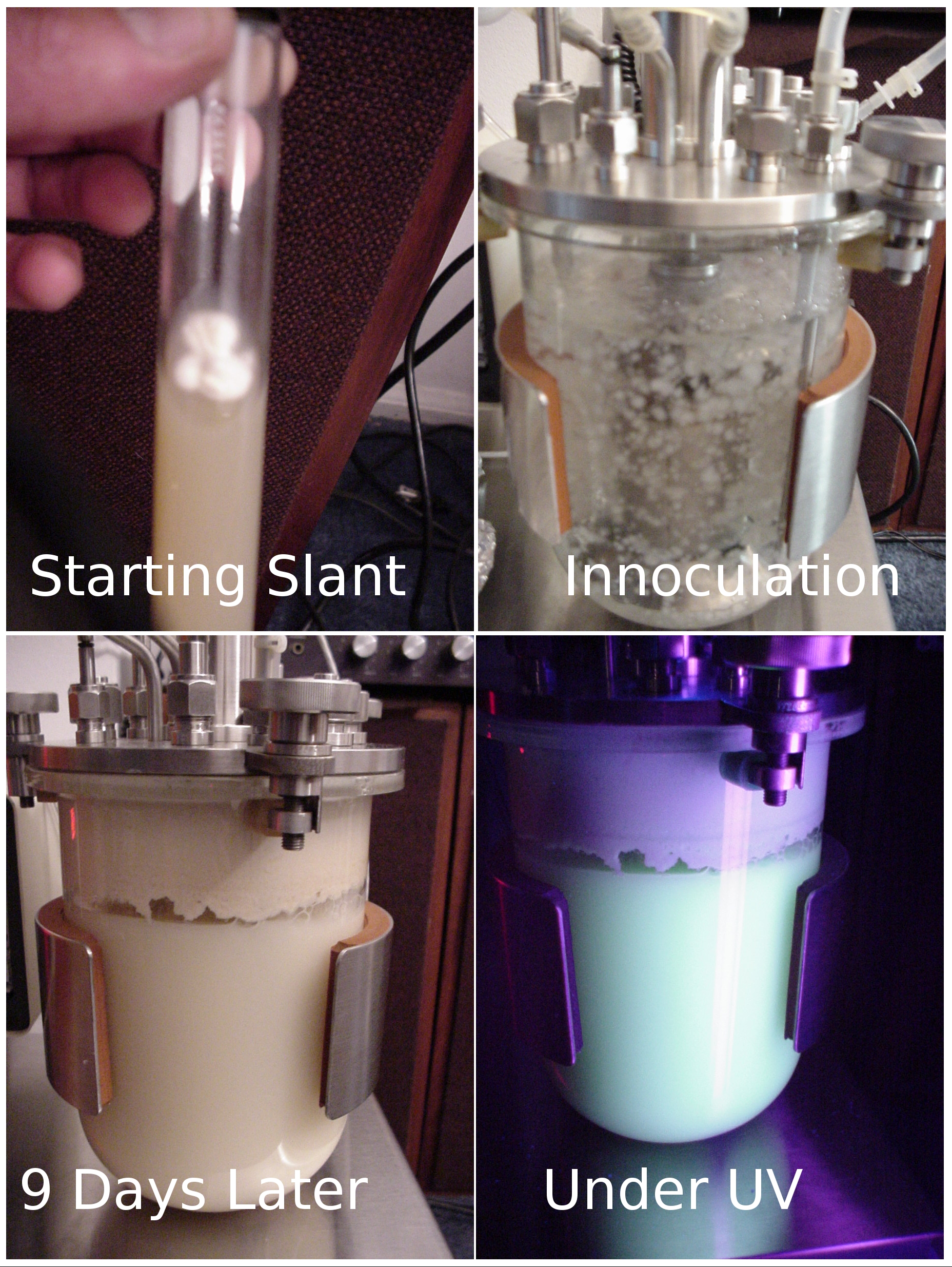
You first want to make seed cultures, size them based on the size of your production fermenter. You want to idealy innoculate your fermenter with 10+% of its volume as the seed culture. If your fermenter is 10 gallons, your goal is around 1 gallon+ of starting culture per cycle. While you can use the same nutrients for your seed cultures and your production fermenter, the seed fermenter needs a nutrient mix made for speed, not quality. Corn steep/Corn filter solids are recommended by Mr. Snow as a starting culture. These will encourage very fast growth in your seed cultures but is not very beneficial for alkaloid production. Your seed culture flasks can be made very simply:
Drill 3 holes in the glass quart canning jar lid, in 2 of these holes glue metal tubes with high temperature silicon. The third hole should be simply covered with ample silicoln, it will serve as an inoculation port. Make the tubes an inch or so long, at least 1/4" diameter, and stuffed with polyfill for air filtering. You may have to glue the polyfill in, just make sure not to glue the holes shut. In easy of these containers add a stir bar, your liquid medium, the lid and then a layer of foil. Put these containers in your pressure cooker for 15 minutes at 15psi to sterilize them. Let these cool off, will be fine to store until needed. As an alternative to magnetic stirring you can sink one of the metal tubes almost all the way to the bottom of the container. The bubbling should agitate and oxygenate the mixture sufficiently. Just make sure the tube is totally capped when pressure cooking or the pressure will cause the liquid medium will shoot out everywhere. Inoculate these liquid cultures from a parent liquid culture by withdrawing 1ml of the parent liquid culture, sterilizing the syringe, then poking it through the silicon covered 3rd hole and injecting. If you are going the magnetic stirring method, simply collect as many PC fans as you have jars and glue high powered rare earth magnets to the fans which will be mounted on plexiglass right under where the jars sit.

Production fermenter: (Refs: R3, R4)
This is a large container that will include a sterilized air flow as well as a stirrer for agitation/oxygenation. Preferably the container will include a heating element around it connected to a relay/ PID controller and insulated. This will allow you to fill the fermenter, use the PID to let it pasturize/sterilize itself and then introduce the seed liquid culture once cooled. It may be possible to just boil the nutrient solution and then introduce it to a fermenter if the seed culture is 10% or more of the final solution. The profile and amount of alkaloids produced will have a lot to do with the choice of nutrient mix. A nutrient solution optimized for C. Paspali (from hyperlab) contains: 150 g/l mannitol 50 g/l peptone “Torlak” (Sabouraud dextrose agar ) in distilled water, pH about 6.8 without regulation. There are many other nutrient solutions in literature as well as information as to what consistutes a good mix. Check out Otto Snows book, just keep in mind that the addition of Fe++ and Zn++ is recommended for C. purpurea but will hurt yields for the C. Paspali mutant employed here. Actually other then that small detail, techniques used for culturing C. purpure translate directly to the C. paspali mutant, and oh there are so many techniques... There are many tweaks mentioned in literature for these submerged liquid cultures. Antibiotics can be added, if you can read through the hyperlab 'lsd from ergot' posts on WD there is good info in there. Addition of sodium arsenate at levels between 1/50 - 1/20th the molar concentration of phosphate, 100% increase in yield - Ref R3. This is a real easy mod, overdoing the phosphate too much wont hurt yields, so set a level of phosphate and add KH2PO4:Na2HAaO4 at 50:1-20:1 ratios keeping your reasonable level of phosphate in mind. This is more about ratios then amounts. Antifoam agents can be added to keep the mycelium from caking above the nutrient mix inside of the fermenter as well as lowering the surface tension of the water to increase oxygen uptake/yields. Biotic/leucine/riboflavin/folic acid and tryptophan can also be added to boost yields. When looking for a vessel check out used electric pressure cookers as they already have heating coils, if you want to go totally DIY, get one of those full sized kegs and cut the top off, make a custom top. Ref R2 has good information about building large fermenters.
Extracting: (Refs: R5)
There are many ways to skin this cat, I am not gona bother with the obvious methods but will touch on one I found very interesting. Solid-liquid adsorption of alkaloids on activated carbon bentonite and other silicate sorbents. My understanding is with the right material, the broth from the production fermenter can be filtered and then directly ran through a packed tube. It is then washed with water and eluted with a suitible solvent. This drastically cuts down on solvent volumes and dirty work and provides a much higher yield then extracting with solvents right off the bat.
Additional relevant info:
Ergot Research: (Refs: R6)
Stirred Fermenters - (Refs: R2)
From Otto Snow's book - Culture medium info:
Well there you guys go, I'm totally open to questions and criticism, peace.
P.S.
I have some questions for the community:
Im not good with physical chem, what are the optimal solid sorbents and solvents for filtering the broth and eluting (Are LSA and LSH discernible in this way? What are the approximate volumes of sorbent/mass of LSA?)
What are some cheap, available antifoam agents that will change surface tension and increase oxygen uptake in this medium?
Anyone have advice for purification of alkaloids, as well as possibly converting LSH to LSA?
Can anyone speculate on techniques for stopping the metabolic pathway of the fungus at LSA?
This thread is about using the Claviceps paspali fungus to produce LSA. This fungus is very promising because even without optimization, it can produce LSA at a density of around 1g pure LSA per gallon of liquid medium. That makes 1 gallon of C. Paspali culture as alkaloid dense as 1 kilo of HBWR seeds... interested yet? This fungus is hypothesized to be the constituent of the ancient Kykeon sacrament. Another interesting thing is that this fungus can be easily mutated and isolated to a form that will produce only LSA as opposed to the more complex and dangerous alkaloids such as Ergometrine and Ergometrinine which are usually produced. This "alkaloid-blocked" mutant is very easy to identify and much safer to culture. Sterilization of seed liquid cultures can be done fast and easy in quart jars in a domestic pressure cooker. 5-15 liters can be sterilzed in under an hour. Once these cultures are colonized, 5 liters could be used to easily inoculate a 15 gallon fermenter. Using any number of extraction methods the LSA can be obtained and purified to a usable form. This method is very viable in our current day and age, information and technology are widespread, as well as efforts to control common precursors. Using this method we become self sustaining as our precursors exponentially multiply from a single culture sample and shared information drives us forward. YOU can end LSD prohibition!
Mutant isolation process (Refs: R1):
A high producing C. Paspali culture should be attained via academic routes (Easy peazy - if you are working in academia pm me).
Mycelium is cut from the culture and introduced to a sterile .9% NaCl solution in a tall, round, glass container with a stirbar and broken peices of glass. It is stirred until the mycelium is broken into fragments then hit with UV light (300J/M^2) for long enough to kill most of the cells. The mycelium is filtered and grown out across many sterile agar plates. The target mutant strain colonies will be visually different, only the mutant colonies will produce "honeydew" droplets of polysaccharides. A few different "alkaloid-blocked" mutants are isolated and grown out on agar. Sterile liquid culture is prepared and inoculated with the various strains. This mutated form will form "swollen, arthrosporoid-like cells and showed a tendency to fragmentize" unlike the nonmutated form which will retain a filamentous structure throughout the fermentation. Seed culture jars are created and inoculated (note: use whatever nutrient mix here you would use for the production fermenter). Once these containers have fermented long enough a sample is taken from each and productivity is tested via the Van Urke reagent (Or FeCl3/H2SO4 or perhaps vanillin/FeCl3/H2SO4 according to Tsathoggua). If you are having trouble discerning the color of the solution, simply dilute the samples a known amount. A qualitative test for ergo alkaloids might be good just to be on the safe side.
Alkaloids present in blocked mutant:
LSA + Lysergic acid hydroxyethylamide usually about equal parts
In some mediums isoLSA and iso a-hydroxethyl amide are prominant which is undesirable.
Seed liquid culture: (Refs: R2)
You first want to make seed cultures, size them based on the size of your production fermenter. You want to idealy innoculate your fermenter with 10+% of its volume as the seed culture. If your fermenter is 10 gallons, your goal is around 1 gallon+ of starting culture per cycle. While you can use the same nutrients for your seed cultures and your production fermenter, the seed fermenter needs a nutrient mix made for speed, not quality. Corn steep/Corn filter solids are recommended by Mr. Snow as a starting culture. These will encourage very fast growth in your seed cultures but is not very beneficial for alkaloid production. Your seed culture flasks can be made very simply:
Drill 3 holes in the glass quart canning jar lid, in 2 of these holes glue metal tubes with high temperature silicon. The third hole should be simply covered with ample silicoln, it will serve as an inoculation port. Make the tubes an inch or so long, at least 1/4" diameter, and stuffed with polyfill for air filtering. You may have to glue the polyfill in, just make sure not to glue the holes shut. In easy of these containers add a stir bar, your liquid medium, the lid and then a layer of foil. Put these containers in your pressure cooker for 15 minutes at 15psi to sterilize them. Let these cool off, will be fine to store until needed. As an alternative to magnetic stirring you can sink one of the metal tubes almost all the way to the bottom of the container. The bubbling should agitate and oxygenate the mixture sufficiently. Just make sure the tube is totally capped when pressure cooking or the pressure will cause the liquid medium will shoot out everywhere. Inoculate these liquid cultures from a parent liquid culture by withdrawing 1ml of the parent liquid culture, sterilizing the syringe, then poking it through the silicon covered 3rd hole and injecting. If you are going the magnetic stirring method, simply collect as many PC fans as you have jars and glue high powered rare earth magnets to the fans which will be mounted on plexiglass right under where the jars sit.
Production fermenter: (Refs: R3, R4)
This is a large container that will include a sterilized air flow as well as a stirrer for agitation/oxygenation. Preferably the container will include a heating element around it connected to a relay/ PID controller and insulated. This will allow you to fill the fermenter, use the PID to let it pasturize/sterilize itself and then introduce the seed liquid culture once cooled. It may be possible to just boil the nutrient solution and then introduce it to a fermenter if the seed culture is 10% or more of the final solution. The profile and amount of alkaloids produced will have a lot to do with the choice of nutrient mix. A nutrient solution optimized for C. Paspali (from hyperlab) contains: 150 g/l mannitol 50 g/l peptone “Torlak” (Sabouraud dextrose agar ) in distilled water, pH about 6.8 without regulation. There are many other nutrient solutions in literature as well as information as to what consistutes a good mix. Check out Otto Snows book, just keep in mind that the addition of Fe++ and Zn++ is recommended for C. purpurea but will hurt yields for the C. Paspali mutant employed here. Actually other then that small detail, techniques used for culturing C. purpure translate directly to the C. paspali mutant, and oh there are so many techniques... There are many tweaks mentioned in literature for these submerged liquid cultures. Antibiotics can be added, if you can read through the hyperlab 'lsd from ergot' posts on WD there is good info in there. Addition of sodium arsenate at levels between 1/50 - 1/20th the molar concentration of phosphate, 100% increase in yield - Ref R3. This is a real easy mod, overdoing the phosphate too much wont hurt yields, so set a level of phosphate and add KH2PO4:Na2HAaO4 at 50:1-20:1 ratios keeping your reasonable level of phosphate in mind. This is more about ratios then amounts. Antifoam agents can be added to keep the mycelium from caking above the nutrient mix inside of the fermenter as well as lowering the surface tension of the water to increase oxygen uptake/yields. Biotic/leucine/riboflavin/folic acid and tryptophan can also be added to boost yields. When looking for a vessel check out used electric pressure cookers as they already have heating coils, if you want to go totally DIY, get one of those full sized kegs and cut the top off, make a custom top. Ref R2 has good information about building large fermenters.
Extracting: (Refs: R5)
There are many ways to skin this cat, I am not gona bother with the obvious methods but will touch on one I found very interesting. Solid-liquid adsorption of alkaloids on activated carbon bentonite and other silicate sorbents. My understanding is with the right material, the broth from the production fermenter can be filtered and then directly ran through a packed tube. It is then washed with water and eluted with a suitible solvent. This drastically cuts down on solvent volumes and dirty work and provides a much higher yield then extracting with solvents right off the bat.
Additional relevant info:
Ergot Research: (Refs: R6)
Quote
It was reported [86] that addition of some surfactants of polyglycol structure
and Tweens to the submerged cultures of a highly productive strain of C. paspali
caused a change in the intensity of alkaloid synthesis. Pluronik (polyethoxy-
polypropoxypolymer) added in the range of 0.25–0.75% enhanced the alkaloid
production. Not only was the amount of alkaloid formed in the Pluronik sup-
plemented media double the amount formed in the control without this anti-
foam, but the maximal yield was also reached earlier by 1–2 days as compared
to the control. The effect of vitamins on the fermentative production ergot
alkaloids was studied [87]. Biotin, folic acid, and riboflavin enhanced the
production while pyridoxine inhibited the production.
The ergot alkaloid elaboration by the fungus is highly dependent on the level
of dissolved oxygen in the medium. It has been shown that the final conidial
concentration in batch fermentation depends on the end of the vegetative phase
which occurs when glucose is exhausted. The vegetative cells are then converted
into conidia. This process can be regulated by oxygen input [88]. In another
study [89] it has been shown that, for optimal fungal development and alkaloid
production, a balance between the uptake of oxygen from the liquid and
gaseous phase has to be established by a defined ratio between aeration and
agitation. Recently there has been efforts made to increase the transfer of
oxygen to the cells by the use of hydrocarbons in the fermentation media [90].
Stirred Fermenters - (Refs: R2)
Quote
Jacketed stainless-steel fermenters of 5001. total capacity, constructed in the
workshop of this Institute, were used with 300 1. of culture medium. Aeration
was effected through a ring sparger with an air flow varying from 200 to 300 l./min
at an overpressure of 1-4 atm. The oxygen concentration in the culture medium
during the fermentation was measured and recorded continuously by means of
the rotating brush electrode (see below) inserted into the fermenter, and the air
flow suitably adjusted to give an oxygen level of about 70 to 80 % saturation. The
fermenter was provided with a top-driven stirrer rotating at 280 rev/min and
fitted with an eight-bladed turbine propeller (ratio diameter of fermenter to
diameter of propeller 3:1). When the electrode indicated that the oxygen level
had fallen below 20 to 30 % saturation (usually about the seventh day) agitation
was started to raise the oxygen level to the initial value of about 80 % saturation.
The 500 1. fermenters were inoculated with 30 1. of a mycelial suspension grown in a
90l. fermenter (Paladino, Ugolini & Chain 1954) containing 40l. of culture
medium in the absence of mechanical agitation with an air-flow of 40 l./min and
an overpressure of 1 atm. The 90 1. fermenters in turn were inoculated with vegetative mycelium grown in a 3 l. shake flask for 2 to 3 days.
From Otto Snow's book - Culture medium info:
Quote
The culture medium for producing the lysergic acid alkaloids by
cultivation of the new strain of C. paspali be any one of several media,
since the organism is capable of utilizing different energy sources.
However, for economy of production, maximum yields of alkaloids, and
ease of recovery of the products, certain culture media containing rela-
tively simple nutrient sources are preferred. For example, the media
which are useful in the production of the alkaloids include an assimi-
lable source of carbon such as glucose, sucrose, starch, molasses, dex-
trins, corn steep solids, corn syrup liquor, sorbitol, mannitol, lactose,
and the like. A preferred source of carbon is mannitol. Additionally, the
media employed contain a source of assimilable nitrogen such as oatmeal
meat extracts, peptones, amino acids and their mixtures, proteins and
their hydrolysates, corn steep liquor, soybean meal, peanut meal and
ammonium salts of organic acids such as the citrate, acetate, malate,
oxalate, succinate, tartrate and like salts.
Mineral salts, for example those providing chloride, nitrate,
carbonate, sulfate, phosphate, calcium, magnesium, sodium, potassium,
iron, zinc, manganese and like ions are also incorporated in the media
with beneficial results. As is necessary for the growth and development
of other microorganisms, essential trace elements should also be included
in the culture medium for growing the organisms employed in this
invention. Such trace elements are commonly supplied as impurities
incidental to the addition of the other constituents of the medium.
Submerged aerobic cultural conditions are the conditions of choice
for the production of the lysergic acid alkaloids by the processes of this
invention. For preparation of relatively small amounts, shake flasks and
surface culture in bottles can be employed, but for the preparation of
larger quantities, submerged aerobic culture in sterile tanks is preferred.
The medium in the tank can be inoculated directly with the mycelium
obtained from the agar slant. However, in order to avoid the growth lag
experienced when this procedure is employed and the relatively
inefficient use of the fermentation equipment resulting therefrom, an
alternative procedure is preferably employed. Furthermore, it has been
found that higher yields of the lysergic acid alkaloids ultimately result
when a vegetative inoculum is grown in a suitable preculture medium,
the composition of which differs from that of the final production
medium. Accordingly, it is desirable to transfer the mycelium from the
agar slant into a preculture medium favorable for rapid mycelial
development and, after a well-developed vegetative inoculum has been
so obtained, to transfer the vegetative inoculum under suitable
conditions to the production medium in the large tank. Thus, for
example, a preculture medium containing corn steep solids and/or corn
syrup solids is especially suitable for the production of the vegetative
inoculum since large quantities of mycelium are produced in submerged
culture in a short time and excellent alkaloid yields result when this
mycelium is used as inoculum. However, the presence of corn steep or
corn syrup solids in the production medium has a detrimental effect
upon the yield of alkaloids produced in some production media. Conse-
quently, it is usually desirable to filter and wash the mycelium produced
in such a preculture medium prior to the inoculation of the production
medium therewith.
As is customary in submerged culture processes, sterile air is
blown through the culture medium. For efficient growth of the organism
and optimum alkaloid production, the volume of air employed in tank
production is preferably at least about 0.1 volume of air per minute per
volume of culture medium, and will generally range from about 0.2 to
about 2 volumes/volume/minute.
The organisms grow best at temperatures in the range of about
22° C. to about 28° C. Optimal production of alkaloids appears to occur
at a temperature of about 23° C. to 24° C.
The initial pH of the culture medium can vary some; what. How-
ever, it has been found desirable that the initial pH of the medium be
between about pH 4 and about pH 6, preferably from about pH 5 to
about pH 6. As is observed in other fermentation processes the pH of the
medium changes gradually throughout the growth period of the organ-
ism, the final pH being dependent at least in part upon the initial pH of
the medium, the buffers present in the medium, and the period of time
the organism is permitted to grow.
For optimum production of alkaloids, it is important that the
mycelium employed for the inoculation of a liquid culture medium be
maintained on solid media exclusively prior to transfer to submerged
culture. Thus, for example, yields are significantly depressed when the
mycelium has been transferred from a submerged culture to surface
culture on solid media prior to inoculation into submerged culture. The
optimum route for preparation of inoculum therefore is from surface
culture to submerged medium or from surface culture, through a series
of transfers on surface culture, to submerged medium...
Well there you guys go, I'm totally open to questions and criticism, peace.
P.S.
I have some questions for the community:
Im not good with physical chem, what are the optimal solid sorbents and solvents for filtering the broth and eluting (Are LSA and LSH discernible in this way? What are the approximate volumes of sorbent/mass of LSA?)
What are some cheap, available antifoam agents that will change surface tension and increase oxygen uptake in this medium?
Anyone have advice for purification of alkaloids, as well as possibly converting LSH to LSA?
Can anyone speculate on techniques for stopping the metabolic pathway of the fungus at LSA?
 R1 - Isolation and characterization of an alkaloid-blocked mutant of Claviceps paspali 1990.pdf


 If one were shipping ergot one would want to form the ascospores since they would need no nutrients
  A diagram of the ergot fungus life cycle is attached
 Claviceps Purpurea ascospores range from 40 X .4 micrometers to 176 X 1.2 micrometers in size so there's no way any border control agents are going to detect them unless they know exactly where they are
  Your mileage may vary