DMT can be made with PFA or aqueous formaldehyde (water is not a problem here) in THF (or AcOEt, DCE,DCM, ...) with triacetoxyborohydride as the reductant. This latter can be prepared by adding dropwise 3.2 eq. of AcOH into a suspension of NaBH4 in AcOEt (or another solvent). NaBH(AcO)3 is a white solid sparingly soluble in AcOEt and form a gel in toluene. You can also do the reduction in alcool but it will go too fast and reduce the good electrophilic formaldehyde. Therefore I suggest working with THF or DCM or AcOEt. Aqueous formaldehyde must be use in an excess of at least 3x. If you look into the experience page of erowid (under the DMT session) you will find someone who made DMT by this pathway :THF/NaBH(AcO)3.
-vanadium-
- Larvae

- Posts: 15
jon
- Foundress Queen


- Posts: 1,883
can you link this???
jon
- Foundress Queen


- Posts: 1,883
looks good if i ever get the materials/space i'll see if this is reproducable.
it looks like he knows what he's doing because he uses 5 eq formalin to prevent polyamine formation.
Enkidu
- Global Moderator
- Foundress Queen


- Posts: 677
Interesting, he uses the STAB because the NaBH4 will reduce formaldehyde to the alcohol. Perhaps that synthesis works(?) because of the rate differences between the cyclization and the reduction.
As for Baldwin's rules, I haven't looked over them extensively, but I don't think that the ring is nucleophilic enough to attack the the carbon in N-methyltryptimine
Methansaeuretierchen
- Larvae

- Posts: 27
looks good if i ever get the materials/space i'll see if this is reproducable.Well, good luck. I think the main problem is the water in the aq. formaldehyde. Triacetoxyborohydrides are unlike most other borohydrides extremly sensitive to moisture. Quenching borohydride solution with aq. acetic acid is very fast and common in literature to quit a reaction.
it looks like he knows what he's doing because he uses 5 eq formalin to prevent polyamine formation.
Also triacetoxyborohydrides are known to recude indoles to indolines. But maybe low reactions temperatures and good solvent could do the trick.
What are the polyamines you mean?
Methansaeuretierchen
- Larvae

- Posts: 27
New attempt (monoethylation):
0,01 mol 5- sub. tryptamine base was dissolved in about 200 ml cold methanol and about 0,5 ml acetaldehyde (about 0,013 mol) was added.
Solution was left for 10h while the color turned from slightly amber into a beautyful strawberry-red.
1,1g sodium borohydride was added in one portion. Color disappeared within several seconds (reduction of imine) and solution was shaked for about 30min until evolution of hydrogen stoped. About 200 ml cold tap water was added to stop the reaction and precipitate most of the product (it took several hours to form a waxy beige cristalline mass from the milky suspension).
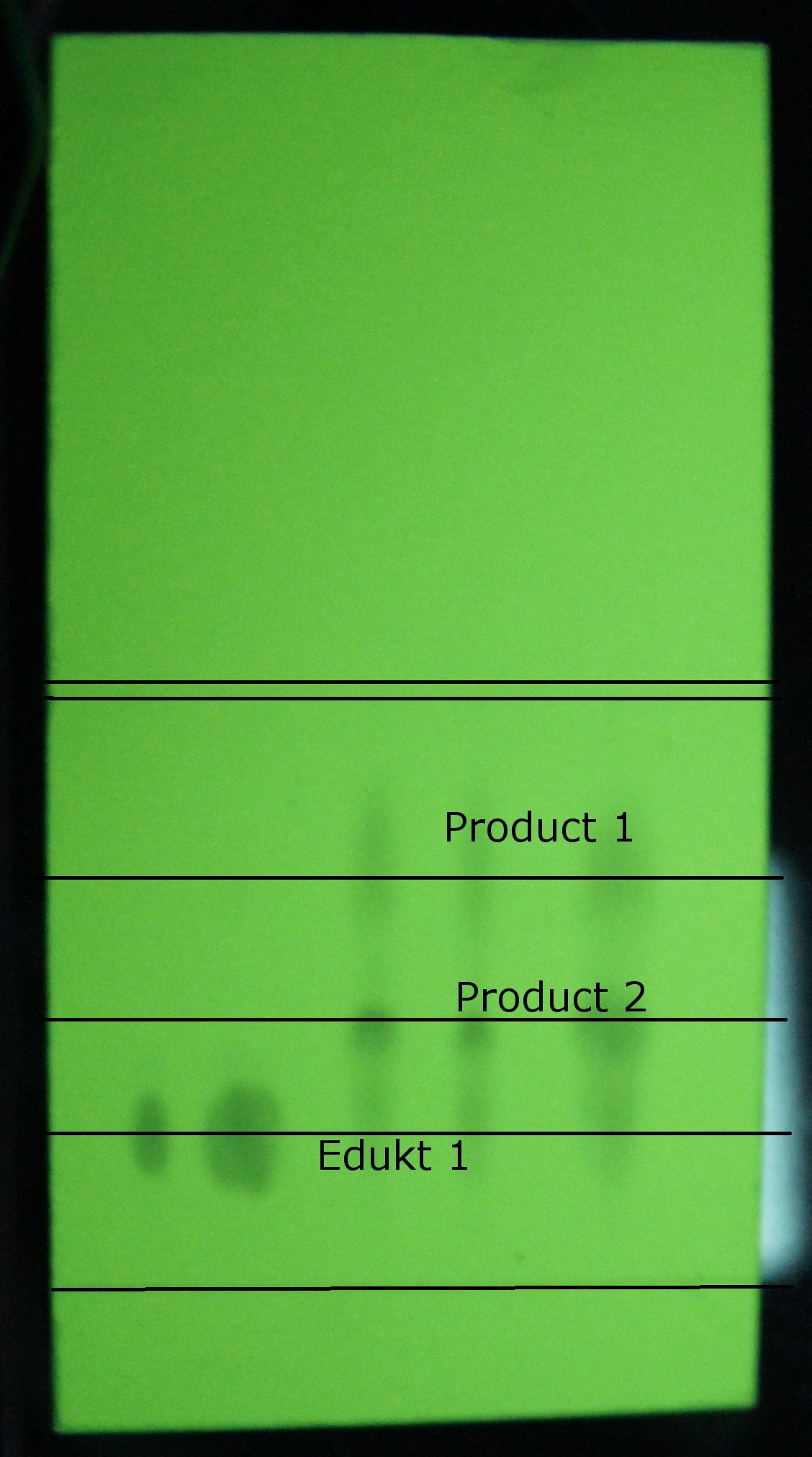
TLC was performed, which shows a little unreacted tryptamine and two products. One runs fast in the eluent (about 1:1 IPA/PE with some drops 25% aq. ammonia), largest spot runs not as fast and the educt nearly doesn't move. See picture.
Notes: I think too much methanol and too much acetaldehyde were used. 0,4 ml acetaldehyde and 100ml methanol should do the job even better. Reaction time was maybe too long; ~3h should also do the job. A inert gas should also improve the yield a little. Room temperature was about 15°C only; a higher temperature while reduction with NaBH4 would minimize risk of dialkylated side products, as NaBH4 reduces unreacted acetaldehyde considerably faster at ~20-25°C than at ~15°C.
Any suggestions for the workup? Should simple recristallisation from petrolether do the removal of the side products?
What is the byproduct ("Product 1"); Is it the N,N-Diethyl-T or could it be something else?
If yes, this might be a good way to the DETs without Indole, oxalyl chloride, diethylamine, NaCNBH3, DIPEA or EtBr and so on. Only lower temperature, much slower addition of some more NaBH4 and double amount acetaldehyde would give mostly the DET.
Also the workup has to be improved, because the DET may not cristallise by addition of water (dialkyl-Ts are harder to cristallise than monoalkyl-Ts and Ts, see Tihkal); maybe removal of MeOH and extraction with chloroform or ethyl acetate would be necessary.

0,01 mol 5- sub. tryptamine base was dissolved in about 200 ml cold methanol and about 0,5 ml acetaldehyde (about 0,013 mol) was added.
Solution was left for 10h while the color turned from slightly amber into a beautyful strawberry-red.
1,1g sodium borohydride was added in one portion. Color disappeared within several seconds (reduction of imine) and solution was shaked for about 30min until evolution of hydrogen stoped. About 200 ml cold tap water was added to stop the reaction and precipitate most of the product (it took several hours to form a waxy beige cristalline mass from the milky suspension).
TLC was performed, which shows a little unreacted tryptamine and two products. One runs fast in the eluent (about 1:1 IPA/PE with some drops 25% aq. ammonia), largest spot runs not as fast and the educt nearly doesn't move. See picture.
Notes: I think too much methanol and too much acetaldehyde were used. 0,4 ml acetaldehyde and 100ml methanol should do the job even better. Reaction time was maybe too long; ~3h should also do the job. A inert gas should also improve the yield a little. Room temperature was about 15°C only; a higher temperature while reduction with NaBH4 would minimize risk of dialkylated side products, as NaBH4 reduces unreacted acetaldehyde considerably faster at ~20-25°C than at ~15°C.
Any suggestions for the workup? Should simple recristallisation from petrolether do the removal of the side products?
What is the byproduct ("Product 1"); Is it the N,N-Diethyl-T or could it be something else?
If yes, this might be a good way to the DETs without Indole, oxalyl chloride, diethylamine, NaCNBH3, DIPEA or EtBr and so on. Only lower temperature, much slower addition of some more NaBH4 and double amount acetaldehyde would give mostly the DET.
Also the workup has to be improved, because the DET may not cristallise by addition of water (dialkyl-Ts are harder to cristallise than monoalkyl-Ts and Ts, see Tihkal); maybe removal of MeOH and extraction with chloroform or ethyl acetate would be necessary.
Enkidu
- Global Moderator
- Foundress Queen


- Posts: 677
What is your 5-subbed tryptamine? That information would have been very helpful to begin with: I assumed it was a methoxy sub, but your post at SM makes me doubt it.
The difference that you noted in color is interesting. (green when you tried to make the imine the first time, and red when you tried this time.)
Methansaeuretierchen
- Larvae

- Posts: 27
The difference that you noted in color is interesting. (green when you tried to make the imine the first time, and red when you tried this time.)Yes it's interesting indeed... I think it's because the double bond in the imine R-N=CH-CH3 of the ethyl analogue can swap to form R-NH-CH=CH2 but can't in the methyl analogon.
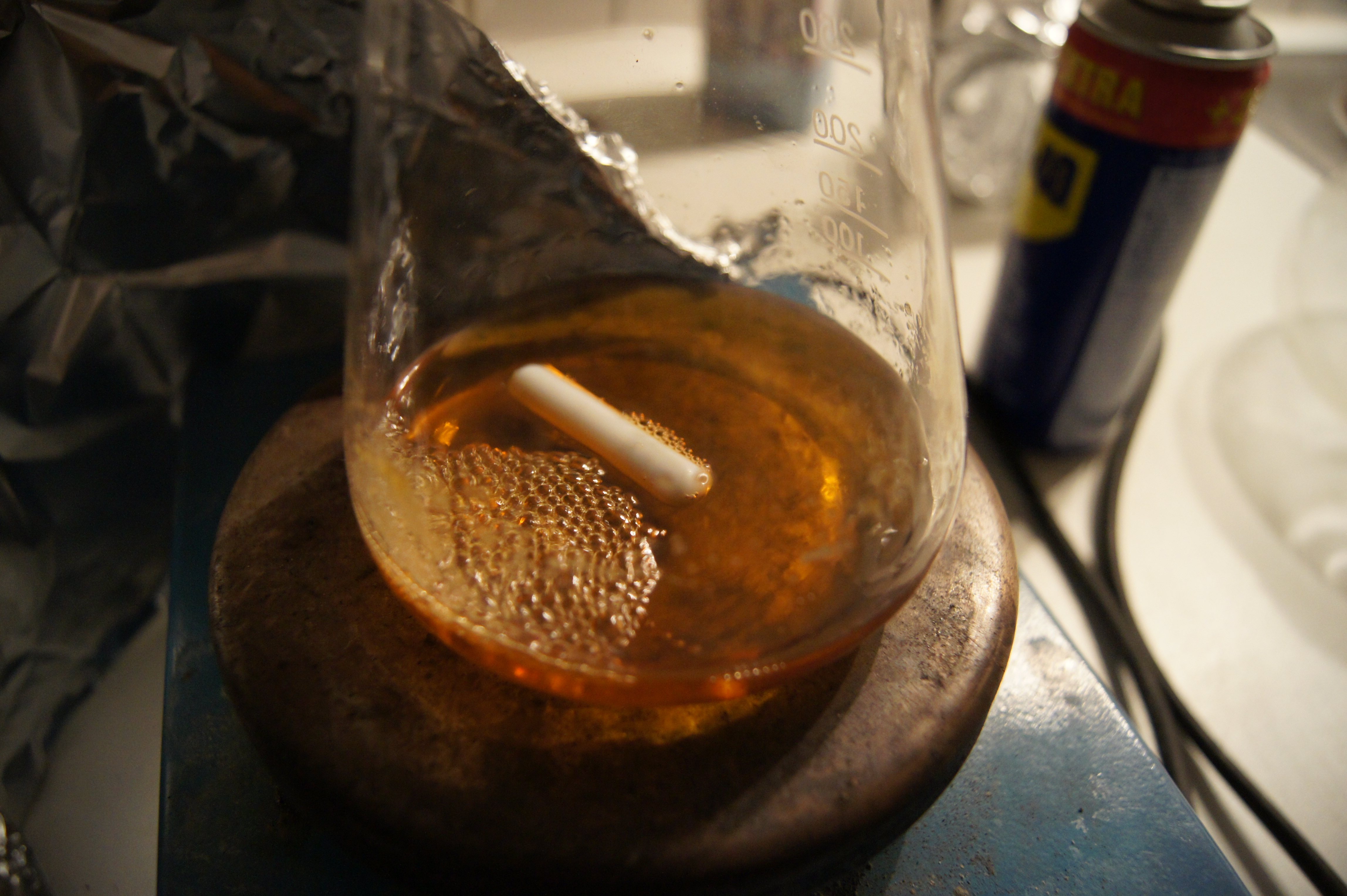
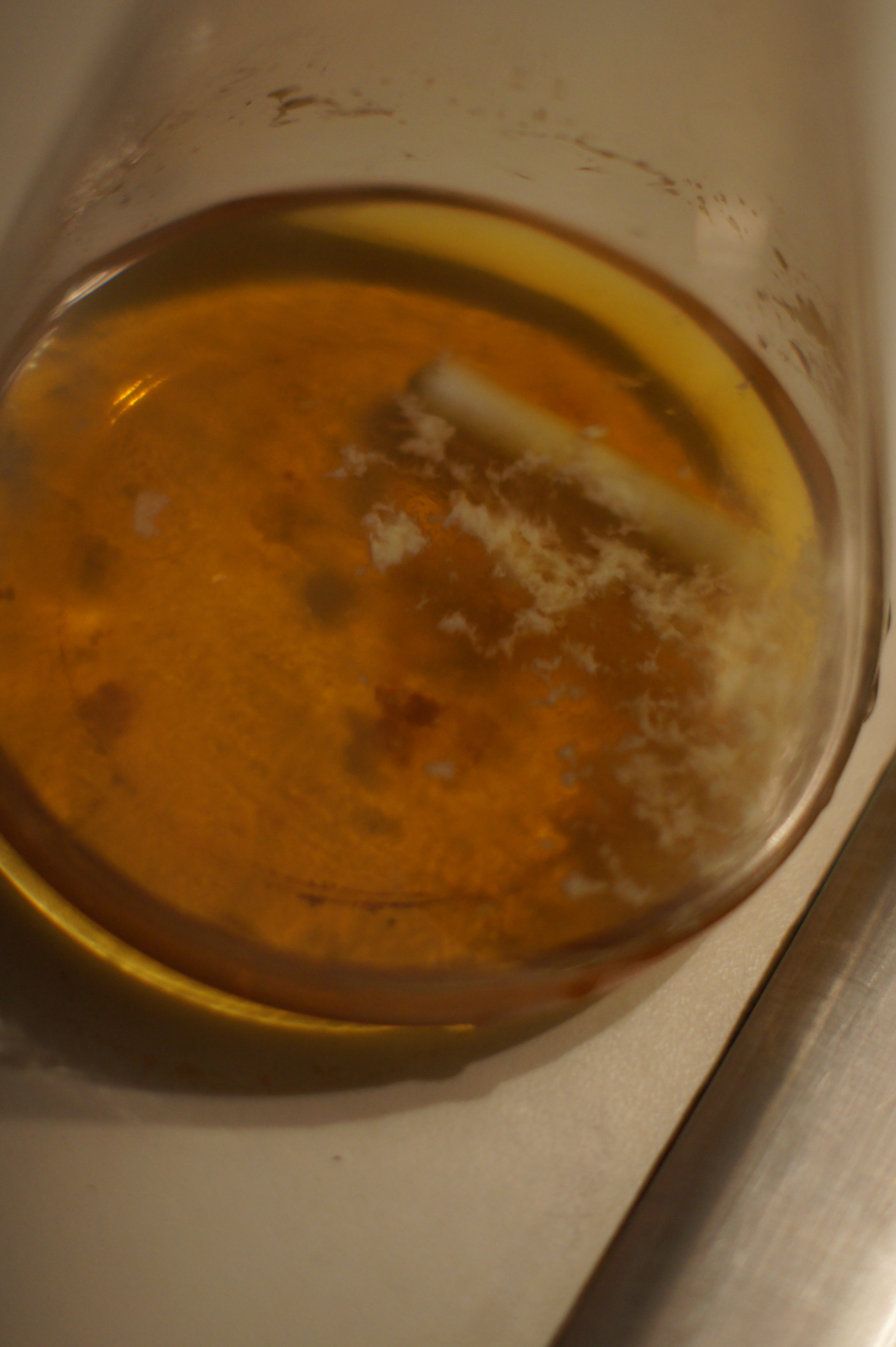
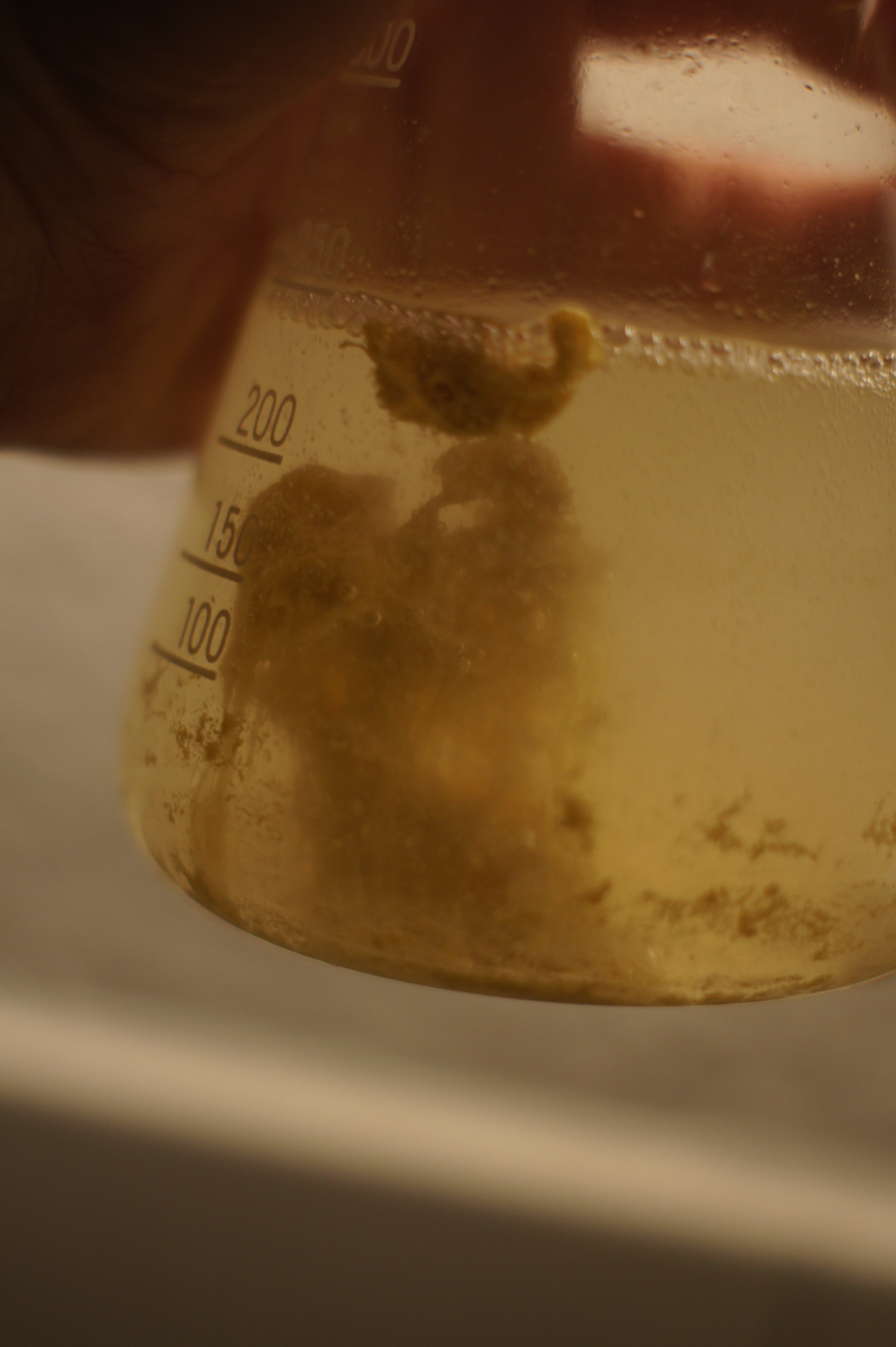
BTW: Here are some news and pics of the last procedure with the aq. formaldehyde/azeotropic destillation way (see page 1); A TLC was made... the product contains a some unreacted educt and one major product, which should be the wanted N-Methyl-Tryptamine (at least I hope so), but in cause of the very low yield (~about 20% only, maybe about 35% with a better workup) and the impurity (in recrystallisation in PE some more product will be lost) I see the synthesis as an failure.
Note: I think the alien mass is a cyclisation product of the imine caused by the heat of the boiling toluene. A solvent with a lower boiling point, for example DCM and a Dean-Stark trap (modified for heavier solvents than water in case of DCM of course) should produce a much better yield.
jon
- Foundress Queen


- Posts: 1,883
i was discussing this on SM i assume you raised the topic there also yes the indole ring is indeed nucleophillic enough to induce cyclization.
i would try another route what i suggested was the condesation with benzaldehyde because it's bulky you would get steric occlusion and electron repulsion between the two rings so no cylization is likely, quaternize that with a methylating agent like methyl iodide and hydrolyse.
this **should work**
another expirimental would be to use cesium bases in polar aprotic solvents and alkylating agents like methyl iodide over mol seives 4Angstom to get cesium promoted mono alkylation and also supressed polyalkylation of the primary amine.
cesium carbonates work in practice over the hydroxides because of their lesser hygroscopicity.
water interferes with this reaction so it's touchier than you might think.
i would try another route what i suggested was the condesation with benzaldehyde because it's bulky you would get steric occlusion and electron repulsion between the two rings so no cylization is likely, quaternize that with a methylating agent like methyl iodide and hydrolyse.
this **should work**
another expirimental would be to use cesium bases in polar aprotic solvents and alkylating agents like methyl iodide over mol seives 4Angstom to get cesium promoted mono alkylation and also supressed polyalkylation of the primary amine.
cesium carbonates work in practice over the hydroxides because of their lesser hygroscopicity.
water interferes with this reaction so it's touchier than you might think.
atara
- Dominant Queen


- Posts: 256
I agree that caesium is the way to go. Its salts are pretty unsuspicious as chemicals go, luckily.
Methansaeuretierchen
- Larvae

- Posts: 27
Thank you, but I don't like to work with methyliodide, dms or tmp as long as I can avoid it and I guess less toxic alkylation agents like dimethyloxalate or dimethylcarbonate can't be used.
Does anything speak against methylation with paraformaldehyde instead of acetaldehyde and NaBH4 like in my prelast post?
jon
- Foundress Queen


- Posts: 1,883
just guessing here but why would'nt dimethyloxalate work?
dimethylsulfate works in scheme I
the oxalate anion is fairly electronegative.
dimethylsulfate works in scheme I
the oxalate anion is fairly electronegative.
Methansaeuretierchen
- Larvae

- Posts: 27
just guessing here but why would'nt dimethyloxalate work?Hmmm you are right, it does not sound so bad... I first thought it doesn't work because oxalic acid would cause cyclysation... but there is no aldehyde so picted spengler should not occur and also a strong base (Cs2CO3) could be added.
dimethylsulfate works in scheme I
the oxalate anion is fairly electronegative.
There are some problems with the workup/recrist. with the 5-subst.-N-Ethyl-Tryptamine. It is only very sparingly solouble in PE (fraction 90-130°C) and soloubility in EtOH it too high. A system of both solvents forms a 2 phase system. There's no pure ethylacetate or Et2O available. Any suggestions what to do in this case?
jon
- Foundress Queen


- Posts: 1,883
i dunno why you want the mona alkylated product the diethyl tryptamine is plenty good.
i was thinking you might be able to quaternize it with dimethyloxalate.
that is just a stab in the dark i really don't know.
i was thinking you might be able to quaternize it with dimethyloxalate.
that is just a stab in the dark i really don't know.
Methansaeuretierchen
- Larvae

- Posts: 27
i dunno why you want the mona alkylated product the diethyl tryptamine is plenty good.With mono-alkylated Ts some other nice Ts could be made... for example the METs, EIPTs, MIPTs, EPTs, MPTs etc. which are even nicer because they are more potent and legal in most parts of europe... And BTW. DETs of 5-subst.-T sucks because at least 5-MeO-DET is a bad potential neurotoxic stuff (see Tihkal), I don't how about the 5-Ethoxy analogues etc., but I like to avoid any tests with potential neurotoxins.
i was thinking you might be able to quaternize it with dimethyloxalate.
that is just a stab in the dark i really don't know.
And if it's possible to find a easy workup for the monoalkylation-step products of these substsances it would be very easy to find an "easy" 2-step procedure which only involves the corresponding aldehydes (part. OTC), the corresponding T (part. OTC), MeOH (part. OTC) and some NaBH4 (part. OTC).
All educts would be OTC available for me.
jon
- Foundress Queen


- Posts: 1,883
says right here bis-tetramethylammonium **OXALATE** so yes dimethyloxalate will work.
i found it using this really cool site called google!
http://www.sacheminc.com/products-and-services/quaternary-ammonium-compounds.html
i found it using this really cool site called google!
http://www.sacheminc.com/products-and-services/quaternary-ammonium-compounds.html
Enkidu
- Global Moderator
- Foundress Queen


- Posts: 677
What? Those are PTCs, right? I did some heavy looking into dimethyl oxalate methylations, and I didn't see any N methylations. Additionally, the solvent (usually DMF) plays a role in the reaction. You will usually get transesterification when using dimethyl oxalate.
atara
- Dominant Queen


- Posts: 256
Quote
Thank you, but I don't like to work with methyliodide, dms or tmp as long as I can avoid it and I guess less toxic alkylation agents like dimethyloxalate or dimethylcarbonate can't be used.
The precious-metal catalyzed alkylation of amines by alcohols is probably the safest method here, but the reagents are essentially impossible to obtain, unless you feel like stealing some catalytic converters.
Quote
Primary and secondary alcs. alkylate primary and secondary alkyl and heterocyclic amines in the presence of Rh, Ir and Ru compds. at 100 to give monoalkylated products. Thus, BuNH2 was refluxed 8 h in MeOH with RhH(PPh3)4 (I) to give 98% BuNHMe. Heterocyclic rings were prepd. by inter- or intramol. alkylation. E.g., BuN(CH2)4OH was refluxed in dioxane with I to give 56% N-butyltetrahydropyrrole.
All you need is triphenylphosphine rhodium hydride!
jon
- Foundress Queen


- Posts: 1,883
enkidu there are no esters/alcohols present on our hypothetical molecule.
there is an amine, did you mean that it would form an amide?
in this case the amine is in the form of the shiff's base with benzaldehyde so i do'nt see how that could happen if the imine is'nt protic.
there is an amine, did you mean that it would form an amide?
in this case the amine is in the form of the shiff's base with benzaldehyde so i do'nt see how that could happen if the imine is'nt protic.