Author Topic: Them down an' dirty sassy bumpin' blues  (Read 691 times)

Methyl Man

  • Subordinate Wasp
  • ***
  • Posts: 143
Them down an' dirty sassy bumpin' blues
« on: April 14, 2011, 06:47:13 PM »
This is quite embarrassing, but the infamous Methyl Man is having trouble vac distilling safrole. It's very frustrating, and in fact he recalls this happening 10 years ago too and it eventually drove him to just use straight undistilled (albeit very high saf %, around 95%) oil in the wacker. This time, he is hoping to be more fastidious and really wants to distill his saf.

What happens is that even though the heat is carefully nudged up, everything is done well, good stirring, nothing rushed---as soon as the temp starts to climb, starts nearing dist temp, the oil bumps like crazy, just goes nuts and boils over into the receiving flask.  The first failure recently was with an oil bath, in fact twice he failed. Now, he just bought a mantle and controller, and I think the controller is mismatched for the mantle (1000 ml flask size) because the same thing happened today, and he had the controller set for almost the very lowest heat it could do. It happened when the head thermometer only said like 50C!! So something is weird. Why does it do violent bumping even when it's being stirred?? Is his vac actually too strong or something? Right before the big slosh-over occurred, it had actually started coming over at like 50C! That's crazy. The very same vac pump, a decade ago, the one or two times he succeeded brought it over at like 105C if I recall. In fact, it is the exact same oil too!

What is the hot tip here? He gives up trying to do it with the gear he has. Granted, he's using a small regular 3-way adapter.  I think he needs to use a column-like piece that increases the vertical distance from the distilling flask to the condenser by like at least 6 inches, so the boil-ups can't reach the takeoff of the adapter. Like a fractionating column, but without the fancy glass... like just an extending column. I assume they make those...? Have you guys used such a piece to avoid the dreaded bump-over?

He's about to try, out of frustration, the TDK oil purification (28% acetic acid wash thingy) from TS2. Anyone ever try this? Does it work well?

Thanks for any enlightenment...

EDIT: Now I'm looking at a 200mm 3-way Vigreaux distillation head ( http://cgi.ebay.com/New-24-40-200mm-3-Way-Vigreux-Distillation-Head-/360357346220?pt=LH_DefaultDomain_0&hash=item53e6f8bbac ) ... would this be the solution? It's only about 7.8" tall.
« Last Edit: April 14, 2011, 07:00:13 PM by Methyl Man »
There's a methyl to my madness...
==+==+==+==+==+==+==+==+==+==

Vesp

  • Administrator
  • Foundress Queen
  • *****
  • Posts: 3,130
Re: Them down an' dirty sassy bumpin' blues
« Reply #1 on: April 14, 2011, 07:00:53 PM »
Have you tried adding any boiling stones or something with nucleating points? That is something that might be worth trying - not too sure what would work well for this compound, or if it matters at all. Perhaps something like a bunch of  dried Plaster of Paris pellets might help?

That is what I would try -- does your liquid seem to be very very pure? Such that it would have no particles in it at all? it would make sense that stirring it would get rid of the bumping, but apparently that is not working - so I guess try using another known remedy to decrease bumping.
 

Bitcoin address: 1FVrHdXJBr6Z9uhtiQKy4g7c7yHtGKjyLy

lugh

  • Global Moderator
  • Foundress Queen
  • *****
  • Posts: 876
Re: Them down an' dirty sassy bumpin' blues
« Reply #2 on: April 14, 2011, 07:48:45 PM »
Capillary tubes work very well for distilling non air sensitive compounds such as safrole and isosafrole  8)
Chemistry is our Covalent Bond

Methyl Man

  • Subordinate Wasp
  • ***
  • Posts: 143
Re: Them down an' dirty sassy bumpin' blues
« Reply #3 on: April 14, 2011, 07:49:47 PM »
[fvck the "he" business...  ;D]

Hi Vesp, well since I have mag stirring, I'm not thinking about boiling stones. My (limited) experience with them indicated that stirring works much better (usually). In this case I suspect it would just do the same thing, but even worse with stones.

I keep thinking that if I just had another several vertical inches between the distilling flask and the part of the adapter that comes off heading to the condenser, I should be able to distill simply by virtue of the bumping boil-ups not being able to reach the vital part and spill into the condenser. It would be kinda rough, but would still get the job done.

The oil is over 10 years old, but I doubt that has anything to do with it, as it was stored well... plus, I did actually (somehow?!) pull off a successful distillation heated via an oil bath a few weeks ago, so we know it can be done with this material.

MM
There's a methyl to my madness...
==+==+==+==+==+==+==+==+==+==

Methyl Man

  • Subordinate Wasp
  • ***
  • Posts: 143
Re: Them down an' dirty sassy bumpin' blues
« Reply #4 on: April 14, 2011, 07:56:52 PM »
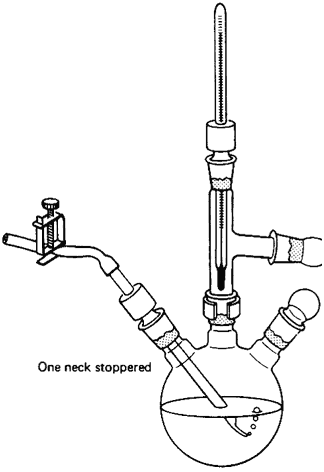
lugh! Thanks, wow, I had forgotten all about that technique, despite having seen it many times in the Zubrick book. So with sass/safrole, you're saying it's non-air sensitive and thus this could be done with an aquarium pump and a pipette as per the image?

I presume that the constant bubbling from the tube prevents pressure from forming, which would like to manifest in bumps. What I don't get is why isn't the egg shaped stirbar succeeding in doing the same thing?

I have to say though, despite this morning's frustrating failure, it sure is LOVELY not having to wait 2-plus hours for the heat to transfer from hotplate to pan to oil bath to flask to goods... this mantle got to the right temp range in like 10 minutes.

MM
« Last Edit: April 14, 2011, 08:02:09 PM by Methyl Man »
There's a methyl to my madness...
==+==+==+==+==+==+==+==+==+==

Sedit

  • Global Moderator
  • Foundress Queen
  • *****
  • Posts: 2,099
Re: Them down an' dirty sassy bumpin' blues
« Reply #5 on: April 14, 2011, 07:58:02 PM »
Acetic acid wash removes something and without proper ability to be sure what its removing I have to say that it works the was TSII suggest it does. What your left with is an oil that smells slightly different then Sassafrass oil. You must train your nose to smell below the over powering smell of Safrole but indeed there is something missing after an Acetic acid wash. If your oil is dark yellow then I suggest NaOH wash, NaOAc wash(for consistancy), followed with an Acetic acid wash. You will be left with a pale yellow oil at this point with much of the "bite" gone from the smell.


The bumping could have to do with the source of the oil. If there is a trace compound dissolved in a much higher BP compound however only in small amounts then as it attempts to boil off it gets trapped under the higher BP material. When it makes it out it does so with a Thump. Simular to placing a drop or so of water into cooking oil. The stirring should handle this but if not try adding a solvent that will boil off with the impurity as a last ditch effort. I would try boiling stones first. A bunch of very small Boiling stones.


PS: You where typing,
I would try the Stones as an addition and see where that gets you.

"The oil is over 10 years old, but I doubt that has anything to do with it, as it was stored well... plus, I did actually (somehow?!) pull off a successful distillation heated via an oil bath a few weeks ago, so we know it can be done with this material.

MM"

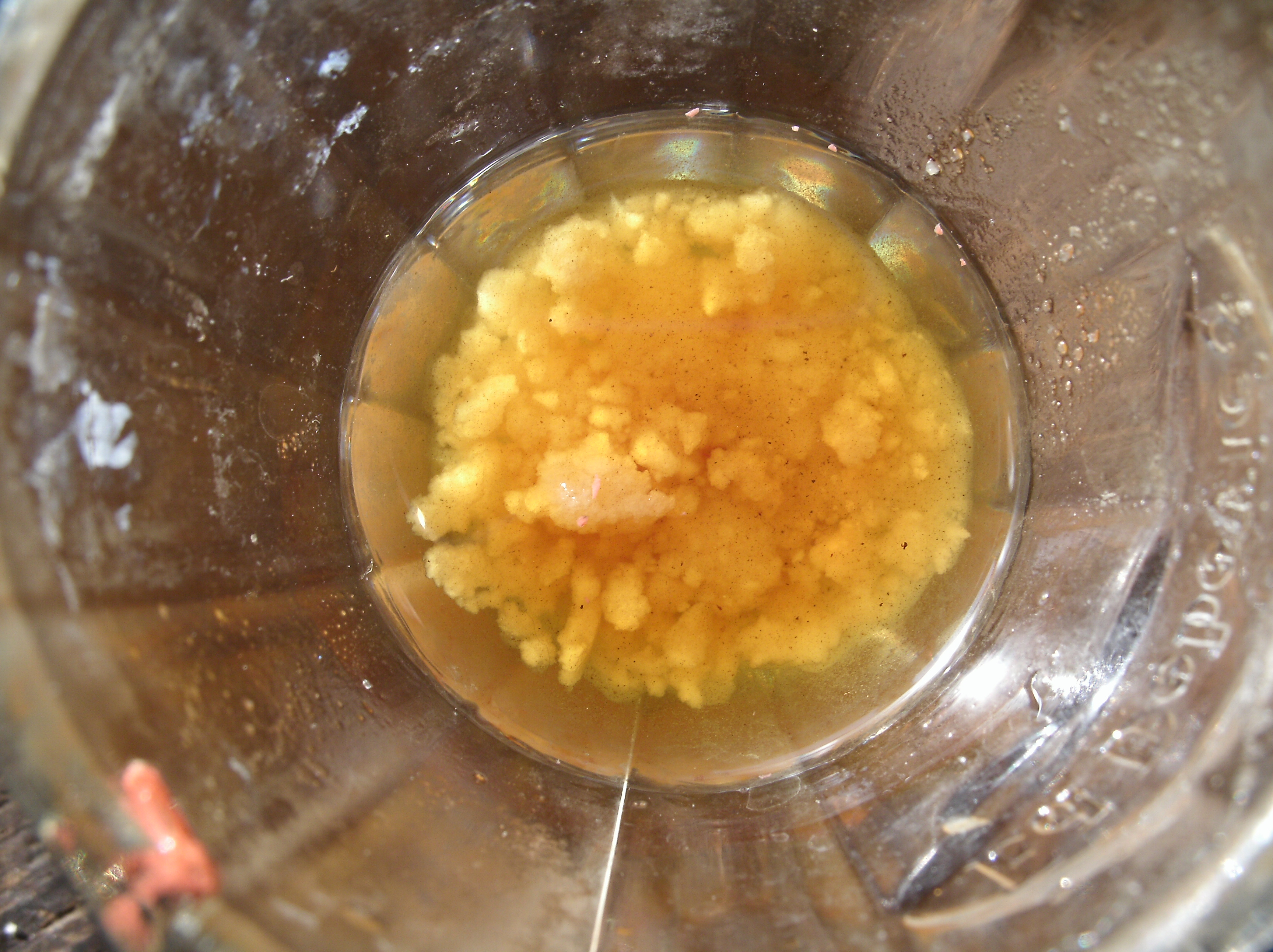
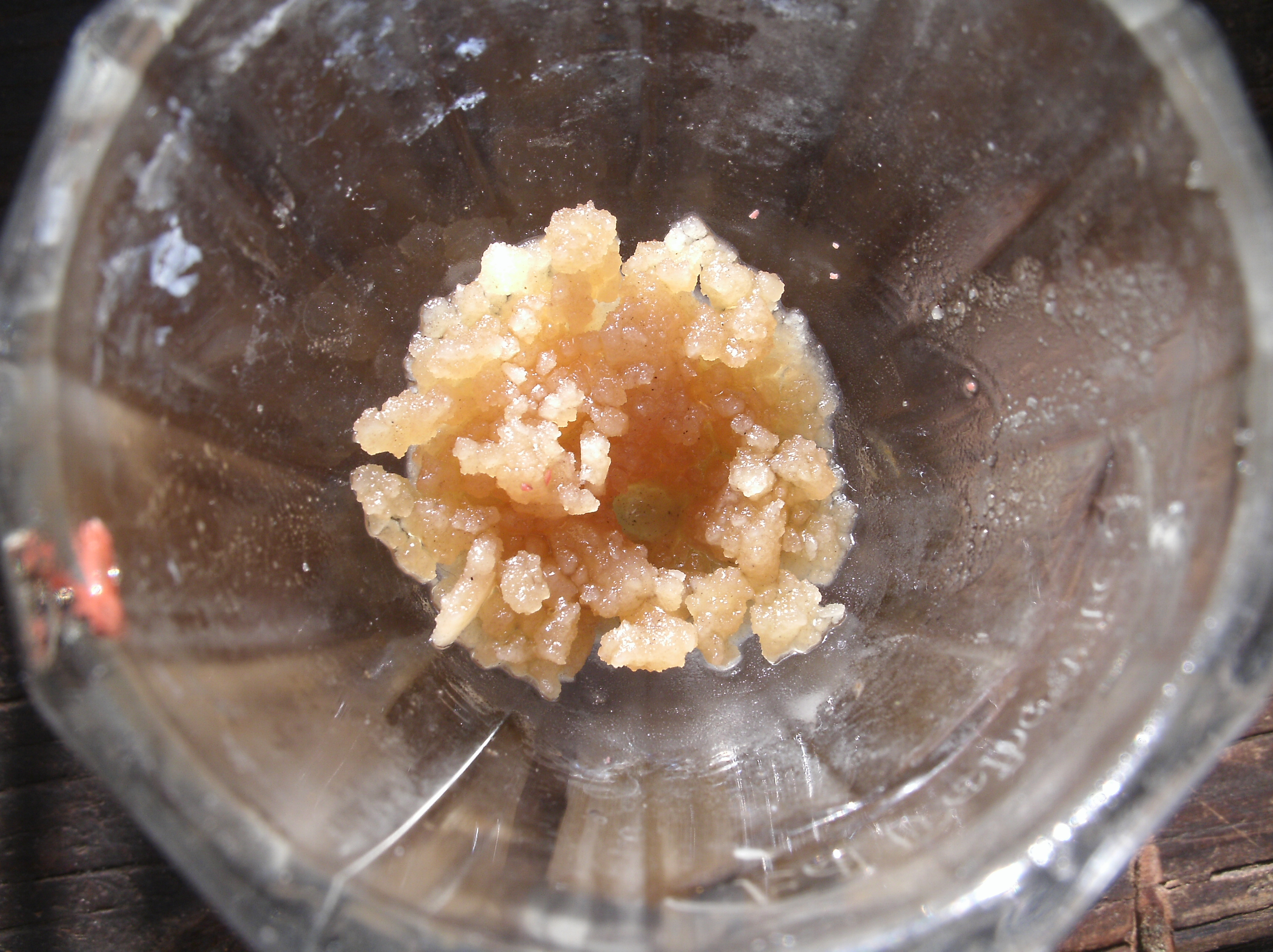
Odd because I found oil from only about 3 years ago in storage and the Safrole had crystalized out of the oil. I will take some pictures in a bit of it. Pretty cool I think. This oil was washed NaOH/AcOH BTW before it was stored.
There once were some bees and you took all there stuff!
You pissed off the wasp now enough is enough!!!

Vesp

  • Administrator
  • Foundress Queen
  • *****
  • Posts: 3,130
Re: Them down an' dirty sassy bumpin' blues
« Reply #6 on: April 14, 2011, 08:10:31 PM »
Are you sucking in bubbles with your magnetic stirrer?

Quote
Superheating is an exception to this simple rule: a liquid is sometimes observed not to boil even though its vapor pressure does exceed the ambient pressure. The cause is an additional force, the surface tension, which suppresses the growth of bubbles.[1]

Surface tension makes the bubble act a bit like a rubber balloon (more precisely, one that is under-inflated so that the rubber is still elastic). The pressure inside is raised slightly by the "skin" attempting to contract. For the bubble to expand — to boil — the temperature must be raised slightly above the boiling point to generate enough vapor pressure.

What makes superheating so explosive is that a larger bubble is easier to inflate than a small one, just as when blowing up a balloon, the hardest part is getting it started. It turns out the excess pressure due to surface tension is inversely proportional to the diameter of the bubble.[2] This means if the largest bubbles in a container are only a few micrometres in diameter, overcoming the surface tension may require exceeding the boiling point by several degrees Celsius. Once a bubble does begin to grow, the pressure due to the surface tension reduces, so it expands explosively. In practice, most containers have scratches or other imperfections which trap pockets of air that provide starting bubbles. But a container of liquid with only microscopic bubbles can superheat dramatically.
-- http://en.wikipedia.org/wiki/Superheating

Perhaps you can allow the surface tension to solve the problem? A non-foaming surfactant would perhaps do the trick? if you happen to have something around like that.

My thoughts were that since dry plaster of paris is porous and full of air, it would work great for preventing the flash boils/bumping

Bitcoin address: 1FVrHdXJBr6Z9uhtiQKy4g7c7yHtGKjyLy

Methyl Man

  • Subordinate Wasp
  • ***
  • Posts: 143
Re: Them down an' dirty sassy bumpin' blues
« Reply #7 on: April 14, 2011, 08:11:56 PM »
Sedit, thanks for your reply. The oil is dark yellow, yes. I know it to be around 95-97%. It is the same stuff that many bees got around  2000-2001 from a somewhat notorious Canadian essential oils seller on the web. It's O. cymbarum oil if I recall correctly. Back in the heyday I ended up just chucking it into wackers raw, without distillation and increasing the oil amount by 5% to try to offset the 5% impurity (which may or may not have worked).

Your description of the bumping is pretty dead-on, it is sudden and comes out of nowhere that same way.
There's a methyl to my madness...
==+==+==+==+==+==+==+==+==+==

Methyl Man

  • Subordinate Wasp
  • ***
  • Posts: 143
Re: Them down an' dirty sassy bumpin' blues
« Reply #8 on: April 14, 2011, 08:17:43 PM »
Vesp: No, the stirbar looked normal, and I saw bubbles from the spin vortex before things got hot as well as seeing normal-looking stir-bubbles when the heat got to be higher (but before it superboiled).

Right now the best things to try seem to me to be the capillary tube, or using a Vigreaux column, or both.
« Last Edit: April 14, 2011, 08:19:43 PM by Methyl Man »
There's a methyl to my madness...
==+==+==+==+==+==+==+==+==+==

lugh

  • Global Moderator
  • Foundress Queen
  • *****
  • Posts: 876
Re: Them down an' dirty sassy bumpin' blues
« Reply #9 on: April 14, 2011, 08:19:25 PM »
You don't need an air pump, what is generally used is a piece of rubber tubing almost completely closed by a pinchcock clamp  ;) Some useful information that was posted on the Hive long ago:
For reasons which are probably not fully understood it occasionally happens that the boiling of a liquid momentarily ceases. In consequence a portion of the liquid becomes somewhat superheated and this unstable condition is then relieved by the sudden formation of a correspondingly large volume of vapor, which causes the liquid to boil violently. Ordinarily a liquid will boil without bumping, for the rising bubbles of vapor keep it moving and thus prevent superheating. Evidently we shall have an infallible method for the avoidance of bumping if we can keep the liquid moving. For example, when the liquid is being boiled in an open beaker, it is sufficient to make use of a mechanical stirrer. But when we are distilling, mechanical stirring is not conveniently provided. Here we can use the method of distillation of by drawing through it a continuous current of dry air. This technique has become common practice for distillations under reduced pressure, but it cannot be used when the objective is accurate measurement of the boiling point of the liquid, or when some of the compounds are decomposed by air.  Another good method employs uses the capillary tube. They are best made from glass tubing having a thin wall and a bore of 2 - 3 mm. A suitable length of such tubing, supported at both ends and rotated, is heated at  the in the edge of a flame until the walls melt and and then quickly drawn apart. One end of the tube is then cut off. The over-all length of the tube is then tube should be such that, when the lower end is resting on the bottom of the flask in which it is being used, the upper end will be  supported by the neck of that vessel. The upper end of the tube may be closed by a rubber tube and a pinchcock clamp. The liquid in the flask must be deep enough to keep the lower end of the tube continuously submerged. It is advisable to shield the equipment against the cooling effect of a possible current of air. And if several of these tubes are used simultaneously, trouble that might arise from the failure of a single tube may he avoided. This technique also is limited by exposure of the distilland to air. Other methods for the prevention of bumping succeed by providing conditions favoring the formation of bubbles of vapor at one or more points where the liquid is in contact with the heated surface of the vessel containing it. Fragments of unglazed porcelain or a small piece of pumice recently tone that has been weighted with platinum wire. Bumping can also be prevented by the introduction of 7-mm. discs of Vapoglas (an air-conditioning fiberglass filter material) cut from 3/16-inch sheets with a cork borer. The discs were cleaned with hot dichromate cleaning solution and rinsed with distilled water before being added to the hot digestion mixture. The porosity of the discs promotes a vigorous boiling and, because of their lightness, they move about rapidly in the solution and prevent development of localized hot spots. The discs are easily pulverized by pressure from a stirring rod thus assuring extraction of absorbed material. A small sliver or shred of polytetrafluoroethylene, makes an excellent boiling chip for the prevention of bumping during evaporation operations in the laboratory. This material is chemically inert to nearly known reagents (including fluorine and hydrogen fluoride) and is nonporous in nalure. Gas bubbles form very readily on its surface, and this property does not disappear on continued use and reuse in aqueous solutions or organic solvents. The numerous devices proposed for the alleviation of bumping during vacuum distillation may be classified generally as ebullators, packings, external capillary leaks, or mechanical agitators. Most ebullators become ineffective with time or on momentary interruption of boiling. Their use also involves the risk of contamination. Packings interfere with quantitative work. The use of an external capillary leak is generally quite satisfactory in prevent bumping. However, this results in a false (low) boiling point and in seriously in the loss of material by entraininent. The loss has been found be appreciable over the period of time required for a precision vacuum fractionation. Agitation is the most satisfactory method, except for the mechanical difficulties involved. The external electrically or air driven magnet will spin the magnet in the flask over a distance of about an inch through an electric heating mantle, an oil bath, or any other heating arrangement free of magnetic interference. The device has been used successfully in this laboratory for fractionations and distillations of a number of high boiling, moderately viscous compounds in the range of I - 5 mm. The dimensions of the stirring      magnet(length and bulge) should be such as to provide fairly vigorous agitation. The following dimensions have been found to be satisfactory and are suggested as minima for the designated flasks:

      Flask Size(ml)         Diameter of Bulge(mm)         Length of Magnet(mm)
      50                                5                                         16
      100                              7                                          22
      500                             12                                         31
      1000                            16                                         42

      The agitation required will depend on the nature of the distilland and especially on the rate of heat input to the pot. Obviously, in carrying out a rapid distillation where a large amount of heat is supplied to the pot over a short period, more vigorous agitation is necessary to prevent superheating and bumping than is necessary in running a precision fractionation.


The distillation is under vacuum so air is drawn in through the rubber tubing  8)

Chemistry is our Covalent Bond

Methyl Man

  • Subordinate Wasp
  • ***
  • Posts: 143
Re: Them down an' dirty sassy bumpin' blues
« Reply #10 on: April 14, 2011, 08:27:30 PM »
lugh: got it. Yeah after a couple of minutes it occurred to me that with vacuum, if there was air being blown in under pressure (air pump), that would negate the vacuum (duh).

So the idea is to have the vac pulling in a dribbling of air bubble from the tube. Seems easy enough to try.

Another thing that might (or might not) be part of this is that there is a trick I do when I do vac distillations to prevent vacuum leaks: I use yellow teflon tape for gas lines, and seal off every joint. Maybe in doing this I am making my vac "too perfect"? Is there such a thing?

Another question: I'm unsure, when using a mantle, whether to use insulation (cloth, Al foil) on the top half of flask and 3-way adapter. I tried it both ways today, and the superboiling happened regardless.
There's a methyl to my madness...
==+==+==+==+==+==+==+==+==+==

lugh

  • Global Moderator
  • Foundress Queen
  • *****
  • Posts: 876
Re: Them down an' dirty sassy bumpin' blues
« Reply #11 on: April 14, 2011, 08:30:59 PM »
Another solution is to use what is known as a bump flask  8)
Chemistry is our Covalent Bond

Methyl Man

  • Subordinate Wasp
  • ***
  • Posts: 143
Re: Them down an' dirty sassy bumpin' blues
« Reply #12 on: April 14, 2011, 08:53:07 PM »
Well you're 2 for 2 now lugh in opening my mind to new things today... hadn't even heard of a bump flask before. Damn, if I had known of these back "then" I would have used one and been able to distill all of that saf... jeez. The photos I saw, though not detailed enough, make it appear that you place it between the distilling flask and the 3-way, and if the material bumps then it goes up into the bump flask and gets sort of deflected back down, while vapors can continue upward...? I'll keep looking for a detailed pic of the inner part of a bump flask.
« Last Edit: April 14, 2011, 09:02:25 PM by Methyl Man »
There's a methyl to my madness...
==+==+==+==+==+==+==+==+==+==

Methyl Man

  • Subordinate Wasp
  • ***
  • Posts: 143
Re: Them down an' dirty sassy bumpin' blues
« Reply #13 on: April 14, 2011, 08:55:12 PM »
A guy on sciencemadness said:

Quote
Once something really starts bumping, it can rocket through 600mm vigreux columns instantly. If it's bumping, it's often a sign that you're doing something wrong.

Wrong flask, no stir bar, no boiling chips (only works at atm pressure), too hard a vacuum, heating too rapidly etc... in general, too much aggression.

After reading that, I find myself again wondering if my vacuum is actually too strong for this job... and it seems to confirm that even a tall Vigreaux might not be a solution.

On the capillary tube, I just want to check---with those, you don't also use a stirbar, correct? Seems pretty obvious, but I don't like to assume things.
« Last Edit: April 14, 2011, 09:08:45 PM by Methyl Man »
There's a methyl to my madness...
==+==+==+==+==+==+==+==+==+==

Vesp

  • Administrator
  • Foundress Queen
  • *****
  • Posts: 3,130
Re: Them down an' dirty sassy bumpin' blues
« Reply #14 on: April 14, 2011, 09:07:07 PM »
I suppose use a cheaper water jet aspirator? Surely that would do the trick for lowering the boiling point, and hopefully prevent the bumping.
Bitcoin address: 1FVrHdXJBr6Z9uhtiQKy4g7c7yHtGKjyLy

Methyl Man

  • Subordinate Wasp
  • ***
  • Posts: 143
Re: Them down an' dirty sassy bumpin' blues
« Reply #15 on: April 14, 2011, 09:14:58 PM »
Vesp, that might be a good option if I were doing the work right where a sink is, but I'm not. However, as an alternative I know I can dial down my vac strength with a bleeder valve... I've seen pics of those. You turn a valve and it lets a little of the vac escape, lessening the vac strength. I guess I could try a combo of that, plus the capillary tube and I bet that would do it. It never occurred to me before today that my vac pump might be a little too strong for some operations. But maybe I should have known, because the last time I vac distilled some isopropyl, I was shocked at how low it came over... it distilled at about 90F. Not C, F---less than human body temp!
There's a methyl to my madness...
==+==+==+==+==+==+==+==+==+==

Sedit

  • Global Moderator
  • Foundress Queen
  • *****
  • Posts: 2,099
Re: Them down an' dirty sassy bumpin' blues
« Reply #16 on: April 14, 2011, 09:27:23 PM »
Sorry the pictures are large I can not resize them right now. Ignore the crude that found its way in after the stopper was eaten away due to dryrott and the oil.


Wash was performed as stated earlier and extraction was performed using DCM which was air evaporated. You can see in the first picture that not all of it crystalized and I am unsure as to why. I would like to think the washes removed all but the safrole but given what this shows I highly doubt that and atlest 1/4 of the oil did not crystalize.
There once were some bees and you took all there stuff!
You pissed off the wasp now enough is enough!!!

jon

  • Foundress Queen
  • *****
  • Posts: 1,883
Re: Them down an' dirty sassy bumpin' blues
« Reply #17 on: April 14, 2011, 11:17:19 PM »
i got a suspicion your working with albidum oil, it contains:
safrole
phelladrene
pinine
eugenol
camphor
and some other shit.
you probably got some phellandrene hanging around

Methyl Man

  • Subordinate Wasp
  • ***
  • Posts: 143
Re: Them down an' dirty sassy bumpin' blues
« Reply #18 on: April 14, 2011, 11:48:12 PM »
Hi jon, are you saying that because phellandrene is known to cause this kind of violent bumping? As I recall, it was sold as "Brazilian sassafras" -- O. cymbarum. Then again, I know people often sell things under the guise of a very similar yet different product. At any rate, I'm wondering whether a couple of washes of the right type would remove the constituent that's causing the gnarly bumping (assuming that's what's causing it). So you've seen oil that distills really easily? This particular oil happens to be the only batch I've ever had my hands on. A friend of mine bought a crapload of it back in the Hive days from the same place I got mine, and sat on it for the last 10 years.

lugh: I couldn't find a photo online that really showed the interior part of a bump flask. So I take it that the bump flask goes between the dist flask and 3-way, and that the bumps don't make it past the inner part while the vapors continue up? And what size bump flask would be appropriate with a 1000 mL dist flask? (hoping a 250 would cut it) Maybe I should try the capillary tube thing first... it'd be a lot cheaper.

Sedit: yeah that's trippy looking. Not sure what to make of that either.
There's a methyl to my madness...
==+==+==+==+==+==+==+==+==+==

akcom

  • Dominant Queen
  • ****
  • Posts: 430
Re: Them down an' dirty sassy bumpin' blues
« Reply #19 on: April 15, 2011, 12:57:52 AM »
Bump flasks and columns are going to help you prevent bumping from ruining your reaction, but you really should figure out why its bumping to begin with.

Forget boiling chips with a reduced pressure distillation.  A partially closed polypropylene tube would definitely suffice, but let me share something that has worked well for me in the past.  I use rubber septums like  these.  Then just spinal needles like these.  Insert one through the septum to as far into the solution as it will go.  Closer to the bottom the better.  Works perfect as a capillary.  Results will vary though according to your vacuum.

Hope no one has any issues with those links... unless you guys have a sigma aldrich acct.