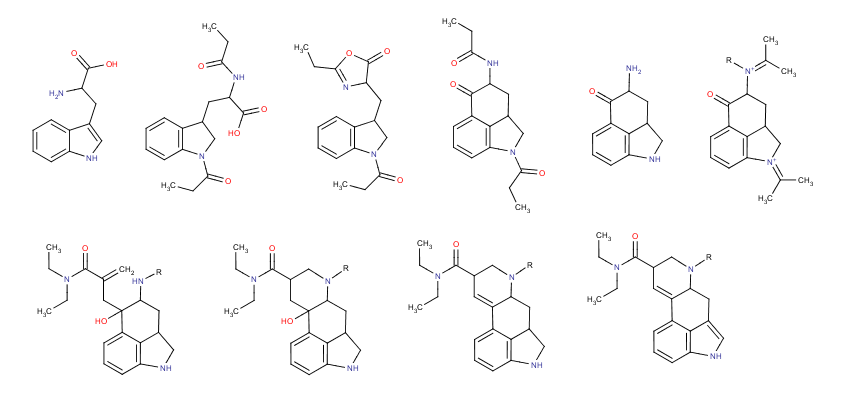
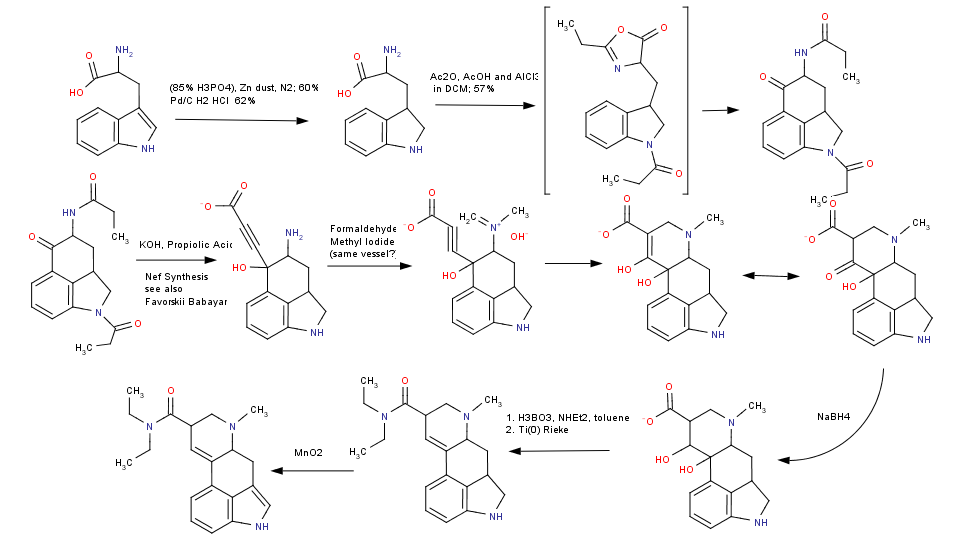
I know I make an ass of myself with my speculation. I'm no chemist, but I sometimes I think about things and get "unduly enthusiastic". I hope this isn't such a time, I don't want to waste your times. This is all by the books, I just put the pieces together and it's only a skeleton yet.
The methacrylamide type allyl anion is known, see the reference, made with an organolithium base. It's reaction with electrophiles is there too. The 2,3-dihydrotryptophan, benzoylated, cyclised, all as per Rebek's synthesis, then hydrolysed to the intermediate in the picture. MnO2 dehydrogenation is also documented in the same paper. MnCl2 hydroamination is attached as well.
Relatively simple/accessible. Few steps. My fingers are crossed, but it couldn't be this easy, what am I missing!?
[Edit- see response 17 "lament" for why it might not work. Essentially 5-exo seems preferred to 6-endo in many similar cases.]
The methacrylamide type allyl anion is known, see the reference, made with an organolithium base. It's reaction with electrophiles is there too. The 2,3-dihydrotryptophan, benzoylated, cyclised, all as per Rebek's synthesis, then hydrolysed to the intermediate in the picture. MnO2 dehydrogenation is also documented in the same paper. MnCl2 hydroamination is attached as well.
Relatively simple/accessible. Few steps. My fingers are crossed, but it couldn't be this easy, what am I missing!?
[Edit- see response 17 "lament" for why it might not work. Essentially 5-exo seems preferred to 6-endo in many similar cases.]
 lithiation of acrylamides.pdf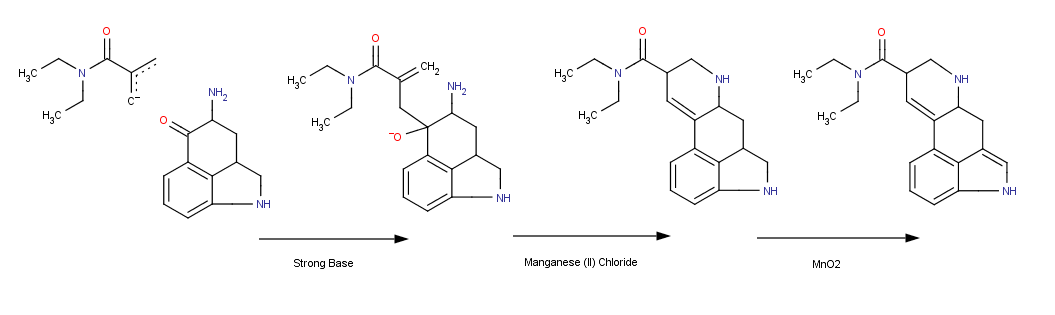
 Ran a few numbers and the illustrious Dr. Rebek's method of getting to the ketone is the most practical: Tryptophan, Pd/C, H2, (60-70% yield) then Ac2O, AcOH and AlCl3 in DCM (57% on top of that). Later on MnO2 dehydrogenation at 75% yield, even then I think it's better. But the nitrogen has to be alkylated separately too. Instead of benzoyl, propionyl protection on the amines might be easier.
 I've never had a fire thank god, but on the occasions I've worked with n-butlit its definitely caught kimwipes on fire when the last drop in the syringe touches it.