KOR reference for saliva attached, Ray's project on the psychedelic receptors.
4.00 = maximum affinity
Salvinorin A: 4.00 KOR; 0.00: 5ht2a, 5ht2b, 5ht2c, 5ht1b,
5ht1d, 5ht1e, 5ht5a, 5ht1a, 5ht7, D1, D2, D3, D4, D5, Alpha1A,
Alpha1B, SERT, DOR, 5ht6, Beta1, Beta2, M2, DAT, M4, M5,
H1, M1, M3, MOR; ND: Alpha2A, Alpha2C, Sigma2, Alpha2B,
NET, Imidazoline1, Sigma1, H2, CB2, CB1,
I think LSD is the only ergoline in the paper though. I've heard 4-aco-dmt (acetyl psilocin from 4-ho-dmt) described as the perfect "inbetween" between mushrooms and LSD, leans more on the cosmic side of things like LSD. I may not get the chance to try LSM, but I believe 4-aco-dmt is our best hope in an RC that can be ranked among the classics mescaline, acid & mushrooms. Like the best of mushrooms with some more good stuff, and none of the sucky stuff from mushrooms, way less anxiety and more euphoric. Remember ALD-52? that was the acetyl of LSD, believed by many (see wikipedia) to be like a more euphoric LSD with less anxiety, compare 4-ho-dmt with 4-aco-dmt (acetyl psilocyn). Acetyl-psilocin is like a more euphoric mushrooms with way less anxiety....Hey, i'd be happy with mescaline the rest of my life but I only have a limited supply having only a few kg of good skins left, and I don't have the patience to wait forever to pick a live cactus. I'll prefer to mix it with 4-aco-dmt if i have to, to make my supply of it lasts longer, or use it with 25i-nbome.
ALD-52, also known as N-acetyl-LSD, is a chemical analogue of lysergic acid diethylamide (LSD). It was originally discovered by Albert Hofmann but was not widely studied until the rise in popularity of psychedelics in the 1960s.
In TiHKAL, Shulgin touches briefly on ALD-52 in entry 26, LSD. His writings are vague, second hand accounts, saying doses in the 50-175 µg range have resulted in various conclusions. One found that there was less visual distortion than with LSD and it seems to produce less anxiety and was somewhat less potent than LSD. Another report claimed it was more effective in increasing blood pressure. Yet another could not tell them apart.
It has the same characteristics as LSD, but supposedly "without the anxiety, tenseness, and other problems inherent to it".
[edit] Dangers
In The Hallucinogens by Hofmann and Osmond (1967), ALD-52 (D,L-acetyllysergic acid diethylamide) is listed as having a lower (approximately 1/5) intravenous toxicity (in rabbits), a lower (approximately 1/8) pyretogenic effect, an equal psychological effect in humans, and double the "antiserotonin" effect as compared with LSD.
It is possible ALD-52 was the active chemical in the "Orange Sunshine" LSD that was widely available in California through 1968 and 1969. The Sonoma County underground chemistry lab of Tim Scully and Nicholas Sand was the source for "Orange Sunshine." It was shut down by the police, and Scully was arrested and prosecuted. This resulted in the first drug analogue trial, where Scully claimed that he and his partners did nothing illegal, because they were producing ALD-52 which was not an illicit drug. However, as the prosecution claimed, there were problems with such a rationale: first, ALD-52 readily undergoes hydrolysis to LSD, and second, the synthesis of ALD-52 required LSD (this was based on the methods available in the scientific literature at the time). Scully was convicted and served time in prison.
25i-nbome has "some" affinity for KOR, but it is considered weak at 288:
The ligand 25i-Nbome had low affinity for most receptors, with the following reported Ki values (nM) for receptors where it had significant affinity: (the lower the number, the greater the binding):
5-HT2a (0.044)
5-HT2c (2)
5-HT6 (73, +/-12)
5-HT2B (231, +/-73)
u opiate (82, +/-14)
H1 (189, +/-35)
kappa opiate (288 +/-50)



 chap6.pdf
 The potency of some LSD analogs is in the attached table from the 1994 NIDA Monograph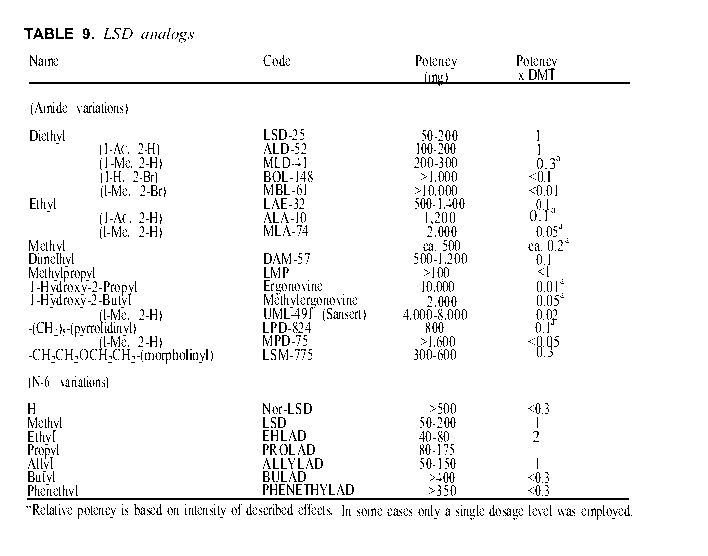

 . Salvia is a potent and rather selective KOR agonist.