Permonid (aka Desomorphine/Dihydrodesoxymorphine-D) can be made a couple of ways, the most well known of which involves hydrogenation of a-chlorocodide (made with thionyl chloride and codeine) and subsequent demethylation of the dihydrodesoxycodeine-D to dihydrodesoxymorphine-D.
Now, thanks to several people, we have a shorter, much more OTC and amateur friendly route to this substance...
Step 1 - Codeine.H2O to 8-Bromomorphide (from the first attached paper, page 4/4, bottom of the left column)
(8S)-8-Bromomorphide (16) Hydrobromide from Codeine.H2O (7).
A solution of 30% HBr in acetic acid (7.5 mL) was added to a solution of codeine.H2O (3, 1.58 g, 5 mmol) in glacial acetic acid (7.5 mL). The procedure was the same as that used for the preparation of 15%HBr. The 16âHBr crystals from the reaction mixture were obtained as a white solid (2.10 g, 98%). TLC of the crude material showed 2 minor impurities at Rf 0.26
and 0.55. The impurity of Rf 0.55 was isolated by column chromatography with solvent: CHCl3/MeOH/NH4OH (100:10:1). It was identified as desoxymorphine C (20, Scheme 2), which was found to be identical with Small’s sample 16 using TLC, MS, and 1H NMR. Free base 20 was crystallized from ethyl acetate: mp 192-193 °C (lit.16 mp 189-190 °C)....
Now, the tricky bit was working out the name Small, et al would have used for this substance, which it was discovered, was B-bromomorphide, so another article was sourced:
Hydrogenation of Bromomorphide
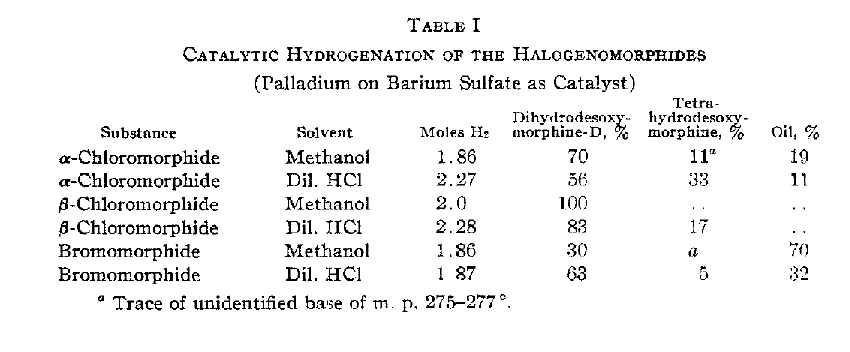
Bromomorphide was prepared by the method of Schryver and Lees and purified from methanol. It sintered and darkened at 164', and melted above 200". In methanol it showed [or]: +73.9" (c = 2.788). When bromomorphide was hydrogenated in methanol, with Pd-BaSO4, 4.85 g. of alkaloid took up 1.86 moles of hydrogen, and yielded 1.0 g. of dihydrodesoxymorphine-D hemihydrate. The remaining material was a viscous oil, containing a trace of the high-melting base mentioned under a-chloromorphide. The oil did not give a crystalline ether on treatment with diazomethane. The methylation product in benzene with methyl iodide gave a methiodide of m. p. 235-238", which appeared to be amorphous, and could be purified only by washing with acetone. It was not the monomethiodide of a dimolecular base, for analysis showed 29.51% iodine, and its properties were not those of bis-dihydrodesoxycodeine dimethiodide. The hydrogenation of bromomorphide in methanol with platinum oxide gave only a small amount of crystalline product, which. proved to be tetrahydrodesoxymorphine.
Hydrogenation of bromomorphide in dilute hydrochloric acid gives more crystalline material than in methanol. From 4.85 g. of bromomorphide, absorption of 1.87 moles of hydrogen, 2.4 g. of dihydrodesoxymorphine-D hemihydrate, 0.2 g. of tetrahydrodesoxymorphine, and 1.2 g. of uncrystallizable oil were obtained.
The yields seems like shit, but it actually equates to some 78%, which could probably be improved upon, but given Rice's starting procedure is cited as giving a 98% yield, that means that the entire process gives about a 75% yield from GAA/HBr, dilute.HCl (and I'd be disposed to using Rice's improved hydrogenation technique using 10%Pd/C, 20psig (just above STP) with a stirrer over Small's dated procedure, the yields would probably improve too - similarly, increases in yield have been reported using EtOAc as solvent too, probably in this case with 1N HCl).
With a little work, this could be made to be the biggest find of quite some time - Codeine is still cheap and plentiful, anyone with a distillation setup (not me atm :'() and some CaCl2 can purify EtOAc from the sheepworths-select-homebrand non-acetone nail-polish remover (pink IIRC). Using EtOAc it is possible to concentrate AA (liquid-liquid extraction from vinegar and the EtOAc allows for the preparation of PURE GAA by forming a low-boiling azeotrope with any remaining water).
The only things that are even slightly hard to acquire is HBr and Pd/C... But this would sure as fuck beat the living shit out of the homebake demethylation of codeine, both in terms of yield and the potency of the product. I wonder, what would the 6-monoacetyl variant be like?
Now, thanks to several people, we have a shorter, much more OTC and amateur friendly route to this substance...
Step 1 - Codeine.H2O to 8-Bromomorphide (from the first attached paper, page 4/4, bottom of the left column)
(8S)-8-Bromomorphide (16) Hydrobromide from Codeine.H2O (7).
A solution of 30% HBr in acetic acid (7.5 mL) was added to a solution of codeine.H2O (3, 1.58 g, 5 mmol) in glacial acetic acid (7.5 mL). The procedure was the same as that used for the preparation of 15%HBr. The 16âHBr crystals from the reaction mixture were obtained as a white solid (2.10 g, 98%). TLC of the crude material showed 2 minor impurities at Rf 0.26
and 0.55. The impurity of Rf 0.55 was isolated by column chromatography with solvent: CHCl3/MeOH/NH4OH (100:10:1). It was identified as desoxymorphine C (20, Scheme 2), which was found to be identical with Small’s sample 16 using TLC, MS, and 1H NMR. Free base 20 was crystallized from ethyl acetate: mp 192-193 °C (lit.16 mp 189-190 °C)....
Now, the tricky bit was working out the name Small, et al would have used for this substance, which it was discovered, was B-bromomorphide, so another article was sourced:
Hydrogenation of Bromomorphide
Bromomorphide was prepared by the method of Schryver and Lees and purified from methanol. It sintered and darkened at 164', and melted above 200". In methanol it showed [or]: +73.9" (c = 2.788). When bromomorphide was hydrogenated in methanol, with Pd-BaSO4, 4.85 g. of alkaloid took up 1.86 moles of hydrogen, and yielded 1.0 g. of dihydrodesoxymorphine-D hemihydrate. The remaining material was a viscous oil, containing a trace of the high-melting base mentioned under a-chloromorphide. The oil did not give a crystalline ether on treatment with diazomethane. The methylation product in benzene with methyl iodide gave a methiodide of m. p. 235-238", which appeared to be amorphous, and could be purified only by washing with acetone. It was not the monomethiodide of a dimolecular base, for analysis showed 29.51% iodine, and its properties were not those of bis-dihydrodesoxycodeine dimethiodide. The hydrogenation of bromomorphide in methanol with platinum oxide gave only a small amount of crystalline product, which. proved to be tetrahydrodesoxymorphine.
Hydrogenation of bromomorphide in dilute hydrochloric acid gives more crystalline material than in methanol. From 4.85 g. of bromomorphide, absorption of 1.87 moles of hydrogen, 2.4 g. of dihydrodesoxymorphine-D hemihydrate, 0.2 g. of tetrahydrodesoxymorphine, and 1.2 g. of uncrystallizable oil were obtained.
The yields seems like shit, but it actually equates to some 78%, which could probably be improved upon, but given Rice's starting procedure is cited as giving a 98% yield, that means that the entire process gives about a 75% yield from GAA/HBr, dilute.HCl (and I'd be disposed to using Rice's improved hydrogenation technique using 10%Pd/C, 20psig (just above STP) with a stirrer over Small's dated procedure, the yields would probably improve too - similarly, increases in yield have been reported using EtOAc as solvent too, probably in this case with 1N HCl).
With a little work, this could be made to be the biggest find of quite some time - Codeine is still cheap and plentiful, anyone with a distillation setup (not me atm :'() and some CaCl2 can purify EtOAc from the sheepworths-select-homebrand non-acetone nail-polish remover (pink IIRC). Using EtOAc it is possible to concentrate AA (liquid-liquid extraction from vinegar and the EtOAc allows for the preparation of PURE GAA by forming a low-boiling azeotrope with any remaining water).
The only things that are even slightly hard to acquire is HBr and Pd/C... But this would sure as fuck beat the living shit out of the homebake demethylation of codeine, both in terms of yield and the potency of the product. I wonder, what would the 6-monoacetyl variant be like?
 Rice.etal.dihyrocodeine.to.dihydromorphine.HBr.pdf