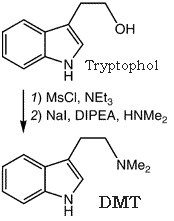
In reference to the Strecker degradation of Tryptophan, it is reportedly possible, though the degree of self condensation would be interesting to discover - although the imine/dimer(s) should hydrolyze easily enough...
no1uno
- Global Moderator
- Foundress Queen


- Posts: 681
quetzalcoatl
- Larvae

- Posts: 42
oooooooooohhhh *boohiss* sorry. Ester / Ether not the same thing at all.
Yes, the Ester you were talking about.
timecube
- Subordinate Wasp


- Posts: 230
In reference to the Strecker degradation of Tryptophan, it is reportedly possible, though the degree of self condensation would be interesting to discover - although the imine/dimer(s) should hydrolyze easily enough...
Thanks for the ref., that's a hell of a lot of solvent for 4g of product. And yeah I don't think the self-condensation is that big of a concern at least until the point when you start trying to condense it with dimethylamine.
@Evilblaze: What do you know about making that ether from IAA? because you can buy IAA straight OTC - or is that what you allready posted? because it seemed overly complex and involving buying from chem stores (not something I want to ever do, ever.)
I may have missed something, but what are you trying to accomplish with the methyl ester, an alpha-methoxy dmt derivative?
Baba_McKensey
- Subordinate Wasp


- Posts: 109
Some useful information http://www.jbc.org/content/88/3/659.full.pdf
quetzalcoatl
- Larvae

- Posts: 42
thanks everyone.
has anyone tried this so far?
Naf1
- Foundress Queen


- Posts: 753
In Tihkal the synthesis for what Shulgin calls alpha,N-Dimethyltryptamine;

He goes from Indole-3-Acetic acid, to indole-3-acetone;
--->
SYNTHESIS: (from indoleacetone) To a solution of 1.55 g NaOAc in 5 mL acetic anhydride there was added 2.0 g 3-indoleacetic acid and the mixture was heated at 135-140 °C for 18 h. Removal of all volatiles on the rotary evaporator under vacuum produced a pale yellow residue that was the 1-acetylindole-3-acetone. This was dissolved in MeOH to which 0.93 g MeONa was added, and the solution held a reflux several hours. After removal of the solvent under vacuum, the residue was suspended in H2O and extracted with several portions of Et2O. These extracts were pooled, and removal of the solvent under vacuum gave 0.41 g (21%) indole-3-acetone as a white solid, mp 115-117 °C. MS (in m/z): indolemethylene+ 130 (100%); parent ion 173 (16%). IR (in cm-1): 691, 753, 761, 780. 1017, 1110, 1172, and a broad C=O at 1710.
Then from Indole-3-Acetone to the methamphetamine analog of tryptamine, with methylamine. One could always substitute for dimethylamine or ammonia for example;
--->
To 1 g shredded aluminum foil there was added a solution of 20 mg HgCl2 in 15 mL H2O. After 15 min the amalgamated aluminum was drained free of the mercury solution, well washed with fresh H2O, and shaken as dry as possible. There was then added, in sequence, a solution of 1.5 g methylamine hydrochloride in 2 mL H2O, 3 mL of 25% NaOH, 5 mL of IPA, and finally 1 g of indol-3-ylacetone in 20 mL IPA. This was stirred for 1 h, then heated briefly on the steam bath. After cooling, the reaction mixture was filtered and the solids washed with MeOH, the washing and filtrate combined, and stripped of solvent under vacuum. The residue was dissolved in 200 mL H2O, made acidic with HCl, washed with CH2Cl2, treated with aqueous NaOH to a pH of greater than 9 (becomes cloudy), and extracted with 2x50 mL CH2Cl2. Removal of the solvent from the combined extracts gave a light brown oil which distilled at 125-135 °C at 0.4 mm/Hg to give 0.74 g of a viscous oil. This was dissolved in 5 mL IPA, neutralized with concentrated HCl and diluted with anhydrous Et2O to the point of turbidity. After standing, the solids were removed, washed with Et2O and air dried, to yield 0.87 g of a,N-dimethyltryptamine hydrochloride (a,N-DMT) as white crystals. MS (in m/z): C3H8N+ 58 (100%); indolemethylene+ 131-130 (19, 14%); parent ion 188, just above noise level.
Alternately, the indol-3-ylacetone can be catalytically reduced in the presence of methylamine. A solution of 3.3 g indol-3-ylacetone in 100 mL EtOH was hydrogenated over Pd-C catalyst in the presence of an excess of methylamine. After 2 h the catalyst was removed by filtration, the filtrate stripped of solvent under vacuum, the residue dissolved in H2O and made acidic. After washing with Et2O, the aqueous phase was made alkaline, and the solids that formed removed by filtration and recrystallized from a mixture of hexane and THF. The product, a,N-dimethyltryptamine (a,N-DMT), was a tan solid that weighed 2.2 g and had a mp of 93-94 °C. The picrate is brick red from EtOH, and melted at 207-208 °C.
Tihkal
http://www.erowid.org/library/books_online/tihkal/tihkal08.shtml
Also indole-3-acetone (basically indole P2P), is actually quite readily available too.

He goes from Indole-3-Acetic acid, to indole-3-acetone;

SYNTHESIS: (from indoleacetone) To a solution of 1.55 g NaOAc in 5 mL acetic anhydride there was added 2.0 g 3-indoleacetic acid and the mixture was heated at 135-140 °C for 18 h. Removal of all volatiles on the rotary evaporator under vacuum produced a pale yellow residue that was the 1-acetylindole-3-acetone. This was dissolved in MeOH to which 0.93 g MeONa was added, and the solution held a reflux several hours. After removal of the solvent under vacuum, the residue was suspended in H2O and extracted with several portions of Et2O. These extracts were pooled, and removal of the solvent under vacuum gave 0.41 g (21%) indole-3-acetone as a white solid, mp 115-117 °C. MS (in m/z): indolemethylene+ 130 (100%); parent ion 173 (16%). IR (in cm-1): 691, 753, 761, 780. 1017, 1110, 1172, and a broad C=O at 1710.
Then from Indole-3-Acetone to the methamphetamine analog of tryptamine, with methylamine. One could always substitute for dimethylamine or ammonia for example;
--->
To 1 g shredded aluminum foil there was added a solution of 20 mg HgCl2 in 15 mL H2O. After 15 min the amalgamated aluminum was drained free of the mercury solution, well washed with fresh H2O, and shaken as dry as possible. There was then added, in sequence, a solution of 1.5 g methylamine hydrochloride in 2 mL H2O, 3 mL of 25% NaOH, 5 mL of IPA, and finally 1 g of indol-3-ylacetone in 20 mL IPA. This was stirred for 1 h, then heated briefly on the steam bath. After cooling, the reaction mixture was filtered and the solids washed with MeOH, the washing and filtrate combined, and stripped of solvent under vacuum. The residue was dissolved in 200 mL H2O, made acidic with HCl, washed with CH2Cl2, treated with aqueous NaOH to a pH of greater than 9 (becomes cloudy), and extracted with 2x50 mL CH2Cl2. Removal of the solvent from the combined extracts gave a light brown oil which distilled at 125-135 °C at 0.4 mm/Hg to give 0.74 g of a viscous oil. This was dissolved in 5 mL IPA, neutralized with concentrated HCl and diluted with anhydrous Et2O to the point of turbidity. After standing, the solids were removed, washed with Et2O and air dried, to yield 0.87 g of a,N-dimethyltryptamine hydrochloride (a,N-DMT) as white crystals. MS (in m/z): C3H8N+ 58 (100%); indolemethylene+ 131-130 (19, 14%); parent ion 188, just above noise level.
Alternately, the indol-3-ylacetone can be catalytically reduced in the presence of methylamine. A solution of 3.3 g indol-3-ylacetone in 100 mL EtOH was hydrogenated over Pd-C catalyst in the presence of an excess of methylamine. After 2 h the catalyst was removed by filtration, the filtrate stripped of solvent under vacuum, the residue dissolved in H2O and made acidic. After washing with Et2O, the aqueous phase was made alkaline, and the solids that formed removed by filtration and recrystallized from a mixture of hexane and THF. The product, a,N-dimethyltryptamine (a,N-DMT), was a tan solid that weighed 2.2 g and had a mp of 93-94 °C. The picrate is brick red from EtOH, and melted at 207-208 °C.
Tihkal
http://www.erowid.org/library/books_online/tihkal/tihkal08.shtml
Also indole-3-acetone (basically indole P2P), is actually quite readily available too.
Naf1
- Foundress Queen


- Posts: 753
If one did not want that alpha methyl group, I would suggest looking up a great reference posted by no1uno posted in the other thread (DMT from indole-3-carbinol, rough draft), for Strecker degradation of readily available tryptophan to indole-3-acetaldehyde! Using tryptophan and hypochlorite! Which a Schiff's base could be prepared from dimethylamine and indole-3-acetaldehyde, the aldimine is then reduced to DMT.
edit;Baba McKensey posted a link that describes producing Tryptophol by reducing tryptophan with bakers yeast. Or reducing the methyl or ethyl esters of indole-3-acetic acid to tryptophol;
Synthesis of DMT via Tryptophol
http://127.0.0.1/rhodium/Rhodium/chemistry/tryptophol.html

Vesp had also posted a link that had a fairly good synth using the methyl ester of indole-3-acetic acid, as long as you can acquire dimethylamine and lithium aluminum hydride.
edit;Baba McKensey posted a link that describes producing Tryptophol by reducing tryptophan with bakers yeast. Or reducing the methyl or ethyl esters of indole-3-acetic acid to tryptophol;
Synthesis of DMT via Tryptophol
http://127.0.0.1/rhodium/Rhodium/chemistry/tryptophol.html

Vesp had also posted a link that had a fairly good synth using the methyl ester of indole-3-acetic acid, as long as you can acquire dimethylamine and lithium aluminum hydride.
quetzalcoatl
- Larvae

- Posts: 42
Nope, LiAlH4 Is too corrosive for my child-like hands and eyes! also sometimes I like to bite my fingernails and I never wear gloves when working with reducing agents
... oops? 
Thanks for the info though, This synth seems very useful. recently there was a mimosa hostillis scare, with some vendors (bouncing bear botanicals) being raded. but, now pharalius brachystacy can be used and it contains a whopping 3% alkaloids! (MHRB is ~1%) straight to base method works fine with no defat!
... oops? 
Thanks for the info though, This synth seems very useful. recently there was a mimosa hostillis scare, with some vendors (bouncing bear botanicals) being raded. but, now pharalius brachystacy can be used and it contains a whopping 3% alkaloids! (MHRB is ~1%) straight to base method works fine with no defat!
Vesp
- Administrator
- Foundress Queen


- Posts: 3,130
But isn't the phalaris brachy pretty rare and hard to get? Also -- it isn't very reliable as a source for DMT, is it? I know other grasses of the phalaris type can vary greatly in concentration and type of tryptamine derivatives.
Bluebottle
- Subordinate Wasp


- Posts: 125
Quote
Stainless steel pressure bombs assembled from piping are doable at home, just not the safest things in the world.
Certainly this is a dangerous method, but I can't be the only one to have considered that as the trouble with direct methylation is breaking up the quaternary iodide salt, the use of a bomb containing the easily made alkyl chloride and tryptophan/tryptamine would circumvent this (the former would then be decarboxylated). Why wouldn't that work?
German
- Subordinate Wasp


- Posts: 228
And the DMT... You can't take the DMT orally, it should be taken intravenously. Because the monoamine oxidase enzyme will decompose it.
Taking it orally is the best way to take it. Smoking it or injecting it lasts just 5 to 15 minutes, whereas taking it orally it lasts 3 hours. The catch? If you take it orally you have to take it with an MAOI that's all.
TooCold
- Larvae

- Posts: 32
Some people consider the short duration of DMT as an advantage. Plus, if you have a bad trip it isn't that long.
61-50-7
- Larvae

- Posts: 10
Here's what you want to work on.
https://www.hyperlab.info/inv/index.php?s=0465ba62c6d1fa6e2b8269e8ca369def&act=ST&f=17&t=29119&hl=zerol
Here is the text:
Zerol and betaine
After noticing a similarity between the chemical structures of alkylbenzenes (ie. Zerol Alkylbenzene Refrigeration Oil http://www.nucalgon.com/nucalgon/nucalgon_...9E?OpenDocument ) and diphenylmethane, SWIH decided to try using some Zerol 150 to decarboxylate tryptophan. When about a half gram of tryptophan was heated in about 50 ml of Zerol 150, it remained in powder form until the temperature went over about 250 degrees where the tryptophan changed into a black tar. The mixture was heated for about a half hour to 45 minutes (about a third of the Zerol 150 evaporated), cooled and some toluene was added. It was gassed with HCl gas (from NaCl and H2SO4) to precipitate tryptamine hydrochloride. The precipitate was filtered with suction (Buchner funnel) and dried. It was then mixed with about 3 times its weight of betaine and heated. The temperature was gradually raised over time to about 250 degrees for about 2-3 hours to methylate the tryptamine. Betaine produces trimethylamine when heated to decomposition which should convert the tryptamine to the free base before its methylated. Betaine can be used to methylate primary aromatic amines according to JCS 1942, p48-55 so I thought it might work with other amines such as tryptamine. The product was biotested (smoked) and found to produce a strong intoxication with kinesthetic distortion similar to LSD and made colors look brighter. It was a lot stronger than the product formed in some other experiments using magnesium metal and formaldehyde in methanol to methylate tryptamine.
This seems to good to be true? Can anyone speculate as to the product produced? This reaction would have to be done in a reflux or otherwise sealed chamber of the dmt would boil off?
I've yet to see mention of using copper (II) acetate to decarboxylate tryptophan. Copper (II) acetate is cheap and easily available.
If Betaine can dimethylate tryptamine it would seem fairly straightforward to synthesize dmt in large quantity.
madprossor
- Larvae

- Posts: 27
4 years ago on WD i posted results of indole-3-ethanol in very good purity (MP 57C white crystals) by the Erlich method using distillers yeast + h2o + tryptophan + sugar. it was a 5 day fermentation and i used 1/3 as much water as Erlich because my yeast could live up to 18% alcohol but his only produced 6%.
long story short, the solvent volume and workup is worse than for the Strecker degradation. i lost some yield trying to extract with petroleum ether. but then i tried extracting the gum left over with boiling diethyl ether. on cooling about 1g tryptophol was obtained from maybe 6-7g starting tryptophan. i believe yields would be higher if i didn't bungle the workup.
i was interested to try the Russian raney nickel reductive amination of tryptophol with the dean-stark apparatus. http://127.0.0.1/rhodium/Rhodium/chemistry/tryptophol.html the yeilds in the original ref (thanks Antoncho) were 93% which is worth pursing and the synth is elegant. i was gonna try with urishibara nickel. i was most interested to bioassay DET before deciding whether to commit more effort into it.
question- considering that indole-3-acetaldehyde is the actual intermediate in the Russian reference, can we substitute it for the tryptophol and supply hydrogen as gas, or as potassium or ammonium formate?
of course there are other ways to process tryptophol, PBr3 will give bromoethyl-indole. this will react with dialkylamine at RT over several days (or weeks?). but tosylation or mesylation is less messy, higher yielding, and the intermediate is (from what i read) 100x or 1000x as reactive toward dialkyamines as bromo-ethyl-indole is. the pharmaceutical companies mesylate in the patent for Sumatriptan.
i see nothing wrong with obtaining DMT from plants. the 2% concentration found in certain roots is just begging to be harvested. if it was 0.2% i would be less sure. it takes quite an economy of scale to produce synthetic dmt at less than the cost of a plant extraction. thankfully it's not as ridiculous as synthesizing thc from scratch instead of extracting it- that IMHO is a waste of time and the companies that make their profit that way (at the expense of the sick!) should bee fucking ashamed of themselves. there is of course no "one right way" to dmt. it all depends on your own facilities, capabilities, output requirements, and access to feedstock.
there is a possible alternative synth of indole-2-propanone from IAA utilizing Methyl Lithium. that stuff looks pretty scary to me though so perhaps making your own Ac2O would be preferable.
long story short, the solvent volume and workup is worse than for the Strecker degradation. i lost some yield trying to extract with petroleum ether. but then i tried extracting the gum left over with boiling diethyl ether. on cooling about 1g tryptophol was obtained from maybe 6-7g starting tryptophan. i believe yields would be higher if i didn't bungle the workup.
i was interested to try the Russian raney nickel reductive amination of tryptophol with the dean-stark apparatus. http://127.0.0.1/rhodium/Rhodium/chemistry/tryptophol.html the yeilds in the original ref (thanks Antoncho) were 93% which is worth pursing and the synth is elegant. i was gonna try with urishibara nickel. i was most interested to bioassay DET before deciding whether to commit more effort into it.
question- considering that indole-3-acetaldehyde is the actual intermediate in the Russian reference, can we substitute it for the tryptophol and supply hydrogen as gas, or as potassium or ammonium formate?
of course there are other ways to process tryptophol, PBr3 will give bromoethyl-indole. this will react with dialkylamine at RT over several days (or weeks?). but tosylation or mesylation is less messy, higher yielding, and the intermediate is (from what i read) 100x or 1000x as reactive toward dialkyamines as bromo-ethyl-indole is. the pharmaceutical companies mesylate in the patent for Sumatriptan.
i see nothing wrong with obtaining DMT from plants. the 2% concentration found in certain roots is just begging to be harvested. if it was 0.2% i would be less sure. it takes quite an economy of scale to produce synthetic dmt at less than the cost of a plant extraction. thankfully it's not as ridiculous as synthesizing thc from scratch instead of extracting it- that IMHO is a waste of time and the companies that make their profit that way (at the expense of the sick!) should bee fucking ashamed of themselves. there is of course no "one right way" to dmt. it all depends on your own facilities, capabilities, output requirements, and access to feedstock.
there is a possible alternative synth of indole-2-propanone from IAA utilizing Methyl Lithium. that stuff looks pretty scary to me though so perhaps making your own Ac2O would be preferable.
psychexplorer
- Subordinate Wasp


- Posts: 138
From what I'm seeing, IAA is far too expensive for the small OTC quantities to be worth it.
Some people insufflate it, for a trip somewhere on the order of 45-60 minutes, although this hurts intensely.
I have just a little bit left (need to do something about that), and I've been thinking of exploring a transdermal approach with DMSO. I don't recall ever hearing of any attempts.
Taking it orally is the best way to take it. Smoking it or injecting it lasts just 5 to 15 minutes, whereas taking it orally it lasts 3 hours. The catch? If you take it orally you have to take it with an MAOI that's all.
Some people insufflate it, for a trip somewhere on the order of 45-60 minutes, although this hurts intensely.
I have just a little bit left (need to do something about that), and I've been thinking of exploring a transdermal approach with DMSO. I don't recall ever hearing of any attempts.
myCH3
- Pupae


- Posts: 77
i was interested to try the Russian raney nickel reductive amination of tryptophol with the dean-stark apparatus. http://127.0.0.1/rhodium/Rhodium/chemistry/tryptophol.html the yeilds in the original ref (thanks Antoncho) were 93% which is worth pursing and the synth is elegant. i was gonna try with urishibara nickel. i was most interested to bioassay DET before deciding whether to commit more effort into it.
question- considering that indole-3-acetaldehyde is the actual intermediate in the Russian reference, can we substitute it for the tryptophol and supply hydrogen as gas, or as potassium or ammonium formate?
I can't seem to follow this link can anyone help me out with that? Are you, is he referring to something like Rhodium is talking about here hxxp://parazite.pp.fi/hiveboard/tryptamine/000006702.html ? "This is the article from J Org Chem USSR, 5, 2158 (1969) mentioned above
General procedure for the preparation of dialkyltryptamines:
Into a flask fitted with a Dean-Stark recieving trap were placed 0.1 moles of tryptophol [2-(3-indolyl)-ethanol], 0.1 moles of a secondary amine [dimethylamine for DMT], 4ml of skeletal nickel suspension in water and 100ml of benzene or xylene [I assume toluene is good too]. The reaction mixture was refluxed, and the condensed water collected for four hours, the hot solution filtered and the catalyst washed repeatedly with benzene or xylene [or toluene] and the mother-liquor concentrated under vacuum. The product was either distilled in vacuo or isolated as the hydrochloride by acidifying with an equivalent of hydrogen chloride solution [they are probably referring to a non-aqueous HCl solution here]. The yields were in the 82-98% range. "
Vesp
- Administrator
- Foundress Queen


- Posts: 3,130
myCH3
- Pupae


- Posts: 77
Thank you vesp
I'm a tad coonfused by two contradictory references in degradation to 3-indoleacetaldhyde using hypochlorite
it states that "The reaction is based on that studied by Langheld (6) who showed that
when an a-amino acid is treated with sodium hypochlorite it is converted
into an aldehyde containing one less carbon atom than the original amino
acid." Yet here https://www.erowid.org/archive/rhodium/chemistry/p2p.strecker.html
which is the reference cited but it shows that that strecker degradation gives 1-(2,3-dihydro-1H-indol-3-yl)propan-2-one.
Maybee I am missing something but would one of you wiser wasps help me figure out whats going on?
I'm a tad coonfused by two contradictory references in degradation to 3-indoleacetaldhyde using hypochlorite
it states that "The reaction is based on that studied by Langheld (6) who showed that
when an a-amino acid is treated with sodium hypochlorite it is converted
into an aldehyde containing one less carbon atom than the original amino
acid." Yet here https://www.erowid.org/archive/rhodium/chemistry/p2p.strecker.html
which is the reference cited but it shows that that strecker degradation gives 1-(2,3-dihydro-1H-indol-3-yl)propan-2-one.
Maybee I am missing something but would one of you wiser wasps help me figure out whats going on?
Enkidu
- Global Moderator
- Foundress Queen


- Posts: 677
Because there is an alpha-methyl group in the amino acid shown on the rhodium page, the degradation leads to a ketone instead of an aldehyde.
myCH3
- Pupae


- Posts: 77
Thank you, wow I feel dumb I read that page like a hundred times and didn't notice that. In trying to find the answer to said retard question. Reading in this thread http://127.0.0.1/talk/index.php/topic,448.0.html in the reference that can be found in reply number 3 posted by java, on page 3 of said reference, it shows the steps the reduction would take and it proceeds though the imine. How much would this be affected by pictet-spengler ring closure? The following step requires water which I think could provide the H+ needed for it.