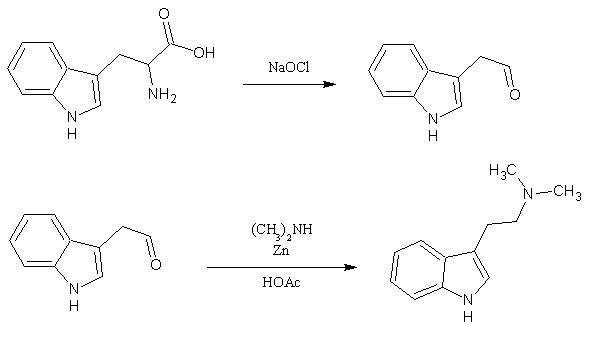
Most of the earlier schemes I had been working through turned out to be rather poorly thought out.
I don't really like starting out with the plain carboxylic acids because whatever you do to them, you're always going to end up with some leftover hydroxyl or aldehyde you then have to get rid of.
If you can source indole, the C-3 position (the one we're after) is relatively easy to add to, and as luck would have it there is an OTC supplement called DMAE (2-dimethylaminoethanol, or dimethylethanolamine) which is cheap, readily available, and pretty much exactly what we would want to add.
I could have sworn I saw a reference at some point showing that indole reacts with primary alcohols and goes through a rearrangement to alkylate C-3. That wouldn't make much sense to me, but I remember it not making much sense when I first saw it. I haven't been able to find the reference again, so I may have just misread something. If that's a real reaction of indole, someone please let me know.
[Edit: I believe I was looking at the synthesis of indole-3-acetic acid, although I'm not sure if the same reaction is applicable here.
http://en.wikipedia.org/wiki/Indole-3-acetic_acid]
If that isn't a real reaction, I believe DMAE should be halogenated and made into a grignard without too many problems, and then added to indole to give what you want. I've had a lot of trouble finding indole, though. It's not listed but occasionally rumored to be watched. It just doesn't seem to have many commercial uses. You can probably find it if you look hard enough.
Decarboxylating tryptophan I believe turned out to be a bust due to the cyclization potential. A possible alternative might be to perform a strecker degradation on tryptophan to get indole-3-acetaldehyde. Then add methylamine, reduce, add MeI or MeBr.
That should give you the N,N,N-trimethyltryptammonium salt Shulgin talks about, and a couple of his methods for converting it to what you want are doable OTC.
http://www.erowid.org/library/books_online/tihkal/tihkal06.shtml


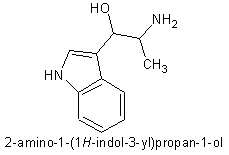
 via
via 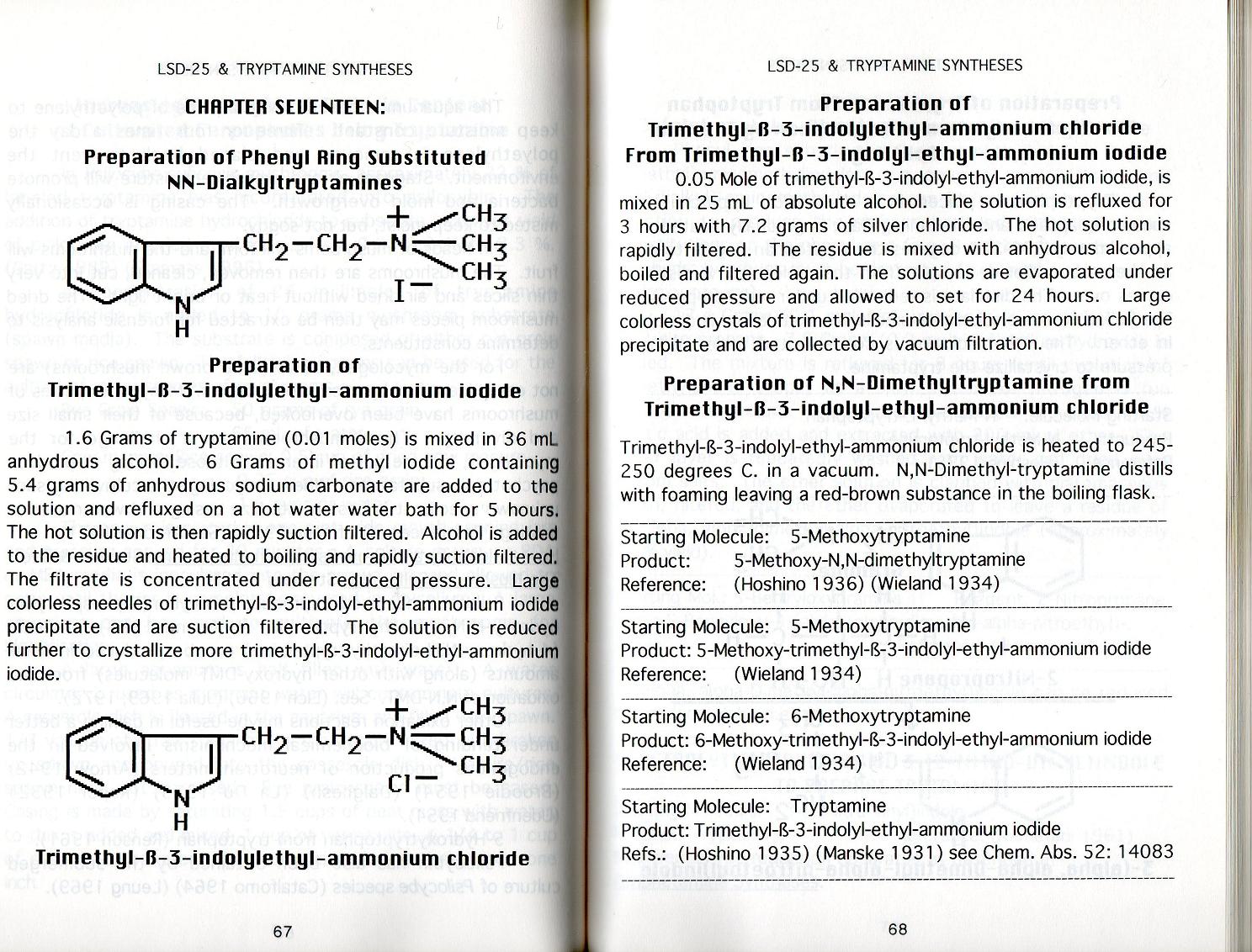
 JCS1942-betaine.pdf