Author Topic: loperamide is it possible to form a grignard complex of???  (Read 654 times)

Vesp

  • Administrator
  • Foundress Queen
  • *****
  • Posts: 3,130
Re: loperamide is it possible to form a grignard complex of???
« Reply #20 on: December 26, 2009, 08:18:41 AM »
Quote
Maybe just rent a helium tank from a party supply store?

They add oxygen so the little suckers don't pass out.. just an FYI
Bitcoin address: 1FVrHdXJBr6Z9uhtiQKy4g7c7yHtGKjyLy

jon

  • Foundress Queen
  • *****
  • Posts: 1,883
Re: loperamide is it possible to form a grignard complex of???
« Reply #21 on: December 26, 2009, 03:55:55 PM »
thanks for that tip vesp, i think plain ol co2 is fine as log as everything is dry actually loperamide costs about 8$ a gram on a popular auction site.  ;)


timecube

  • Subordinate Wasp
  • ***
  • Posts: 230
Re: loperamide is it possible to form a grignard complex of???
« Reply #22 on: December 26, 2009, 06:58:27 PM »
The cheapest I had seen there worked out to 12-15/g and I figured a working quantity was around 10g so my cursory estimation was a bit on the high side, but any fuck-ups will start adding up pretty quickly.

I had no idea about the oxygen in the helium.  I had always figured it was a viable replacement for nitrogen blankets.

Most grignard reagents need to be kept separate from the air, but don't require too much special care because they're formed in ether or similar, which is so volatile that it creates a protective vapor blanket.  Maybe a similar effect could be achieved by using a more volatile solvent for the organolithium formation.

Vesp

  • Administrator
  • Foundress Queen
  • *****
  • Posts: 3,130
Re: loperamide is it possible to form a grignard complex of???
« Reply #23 on: December 26, 2009, 09:37:50 PM »
CO2 reacts with grignards, doesn't it? RMgX + CO2 -> RCO2H

 Also - having just skimmed over this thread... why wouldn't the grignard react with the OH or the amide to form some very nasty polymeric junk since it is a strong base?

Consider using butane or propane gas for the protective blanket... shouldn't react with anything, and you've probably already have some....
Bitcoin address: 1FVrHdXJBr6Z9uhtiQKy4g7c7yHtGKjyLy

jon

  • Foundress Queen
  • *****
  • Posts: 1,883
Re: loperamide is it possible to form a grignard complex of???
« Reply #24 on: December 26, 2009, 10:15:52 PM »
we are now disussing metalation with lithium metal
it will form the aryl lithium, an alkoxide at the OH and, upon quenching we have dechlorinated product.

also there are organolithium  coumpounds with amide functions on them whether they were specifically prepared in this manner, i can't comment, that would warrant further investigation.
pondering the subject of base induced enolization of the dimethylamido moiety i realized that the O atom is electron rich because of the neighboring methylgroups.
additionally the alphacarbon to the amide is bonded to two benzene rings imparting further electron density via sigma bond induction.
which makes this even less prone to proton abstraction, enolization, followed by some weird radical polymer chemistry: which is probably beyond my comprehension.
afterall, i'm just a lowly unemployed construction worker, what would i know?
« Last Edit: December 27, 2009, 12:03:34 AM by jon »

timecube

  • Subordinate Wasp
  • ***
  • Posts: 230
Re: loperamide is it possible to form a grignard complex of???
« Reply #25 on: December 27, 2009, 07:54:32 AM »
From what I've been reading, it looks like the aryl lithium generally reacts just like a grignard reagent, but is even more reactive.

According to section 3 of this:
http://www.cem.msu.edu/~reusch/VirtualText/crbacid2.htm

Quote
The acidity of carboxylic acids and 1º & 2º-amides acts to convert Grignard and alkyl lithium reagents to hydrocarbons (see equations), so these functional groups should be avoided when these reagents are used.

Third degree amides aren't mentioned and maybe don't react as you've pointed out.

jon

  • Foundress Queen
  • *****
  • Posts: 1,883
Re: loperamide is it possible to form a grignard complex of???
« Reply #26 on: December 27, 2009, 08:08:20 AM »
right because see the alkyl lithium is producing an orgonolithium amide another organic base because the prim and sec amides have protons this is a special case.
 i say it's a green light,  GO!!!

shroomedalice

  • Guest
Re: loperamide is it possible to form a grignard complex of???
« Reply #27 on: December 27, 2009, 04:24:19 PM »
what about organo tin hydrides ?

found wial looking for answers to my prob. kinda the same thing realy.

jon

  • Foundress Queen
  • *****
  • Posts: 1,883
Re: loperamide is it possible to form a grignard complex of???
« Reply #28 on: December 27, 2009, 05:27:50 PM »
metal hydridrides work also but that's being very vaugge oh let me gather my senses i have a few references.


jon

  • Foundress Queen
  • *****
  • Posts: 1,883
Re: loperamide is it possible to form a grignard complex of???
« Reply #30 on: December 27, 2009, 06:03:27 PM »
i think it's easiest to bang it up with some lithium in a sonication bath really don't have to prepare anything it's just mix and go it would be wise to esterify the OH first then do the metallation but the exotherm from the formation of the alkoxide might drive the reaction too see.
because they require a little energy of activation to get going.
nah it's smarter to esterify that OH sonicate monitor temps and when the induction is up and the exotherm kicks in let it go then heat for a few more hours spot it on tlc to judge completion.
that's most logical i think they like to run in the 50 C range

jon

  • Foundress Queen
  • *****
  • Posts: 1,883
Re: loperamide is it possible to form a grignard complex of???
« Reply #31 on: December 29, 2009, 03:41:36 AM »
hmmm on pondering the subject further cth using either hydrazine or potassim formate as the hydride source and pd/c as the catalyst  would in fact leave that benzylic alcohol untouched it's only resonance stabilized as a leaving group if it's protonated very strongly.

since we are talking about basic conditions that would be probably the most user friendy route since you don't have to play with fire (pyrophoric reagents and flammable solvents watch out!!!) i'll get out the refs i have them wriiten down.

shroomedalice

  • Guest
Re: loperamide is it possible to form a grignard complex of???
« Reply #32 on: December 29, 2009, 04:10:33 AM »
im realy starting to like the idea of using pd/c as well as it will work as both an oxidizing agent and a reducing agent.

works real well for acid to I bet.

Naf1

  • Foundress Queen
  • *****
  • Posts: 753
Re: loperamide is it possible to form a grignard complex of???
« Reply #33 on: December 29, 2009, 04:18:07 AM »
Does it have be reduced to the aromatic ring, or could you for example use an alkyl halide to alkylate it (removing the halogen, and therefore removing the ability for Pgp to transport it) ???

jon

  • Foundress Queen
  • *****
  • Posts: 1,883
Re: loperamide is it possible to form a grignard complex of???
« Reply #34 on: December 29, 2009, 04:49:57 AM »
you mean a gringnard alkylation??? like rmgX + aryl CL = r aryl?
it's possible but why go through the elbow just to get to your asshole because that would be a tricky reaction to actually pull off.
when you can just "bang it with lithium and then hydrolyse it very carefully mind you under a protective blanket with 10% HCl @ 0 C)
exothermic, hydrogen gas is generated keep that in mind)

in response to:im realy starting to like the idea of using pd/c as well as it will work as both an oxidizing agent and a reducing agent.

works real well for acid to I bet.

if it will strip chloro it will snip bromo off with ease.
« Last Edit: December 29, 2009, 05:28:45 AM by jon »

shroomedalice

  • Guest
Re: loperamide is it possible to form a grignard complex of???
« Reply #35 on: December 29, 2009, 06:16:40 AM »
ye thats what I thought.

im going to have to look into how to make the stuff palladium is not that hard to come by.

lugh

  • Global Moderator
  • Foundress Queen
  • *****
  • Posts: 876
Re: loperamide is it possible to form a grignard complex of???
« Reply #36 on: December 30, 2009, 12:46:35 AM »
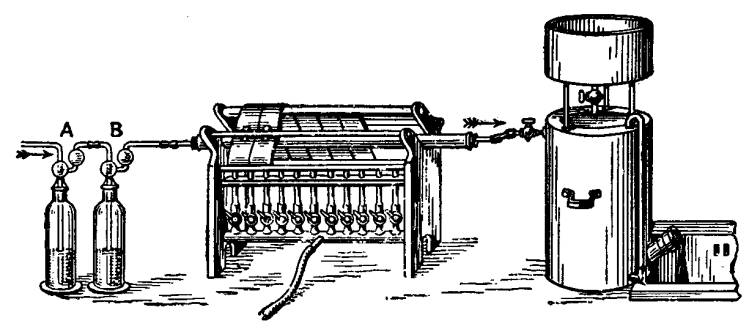
Argon is the best gas for blanketing oxygen sensitive reactions, because it's inert and very dense  ;) Members of Hyperlab have successfully used hydrocarbons such as propane, but it's inherently more dangerous because it's flammable  :( Helium is inert but not very dense :P Nitrogen can be made from compressed air:
Air freed from carbon dioxide in a wash bottle of sodium hydroxide, A, and from moisture by passage through sulphuric acid, B, is then passed through a red-hot tube containing copper turnings. The copper removes the oxygen and forms cupric oxide 2Cu+02=2CuO. The nitrogen passes on to be collected in a gas jar, or gasholder, etc. In the diagram, the air is supposed to be drawn over the copper, the gasholder being filled with nitrogen. If the gasholder were placed at the end A, and air forced along the tubes, the nitrogen gas could be collected in gas jars. Cold boiled water should be, used in the gasholder so as to lessen the risk of contamination owing to the presence of oxygen dissolved in ordinary water.
Chemistry is our Covalent Bond

Naf1

  • Foundress Queen
  • *****
  • Posts: 753
Re: loperamide is it possible to form a grignard complex of???
« Reply #37 on: December 30, 2009, 12:58:50 AM »
"you mean a gringnard alkylation???"

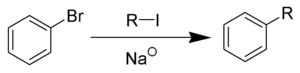
No, I was talking along the lines of a Wurtz-Fittig type reaction.


"Nitrogen can be made from compressed air:"

Nice! Also a cheap second hand paintball canister bought from e-bay, can be easily refilled. There are CO2 ones and Nitrogen ones!

jon

  • Foundress Queen
  • *****
  • Posts: 1,883
Re: loperamide is it possible to form a grignard complex of???
« Reply #38 on: December 30, 2009, 01:00:23 AM »
this is done in molten sodium???
no way that willnot work i donnot belive to harsh conditions.

Naf1

  • Foundress Queen
  • *****
  • Posts: 753
Re: loperamide is it possible to form a grignard complex of???
« Reply #39 on: December 30, 2009, 01:08:54 AM »
"this is done in molten sodium???"

Sorry I put the wrong reaction mechanism up, I should have put a clearer one up!