Author Topic: loperamide is it possible to form a grignard complex of???  (Read 654 times)

jon

  • Foundress Queen
  • *****
  • Posts: 1,883
loperamide is it possible to form a grignard complex of???
« on: December 20, 2009, 06:26:38 AM »
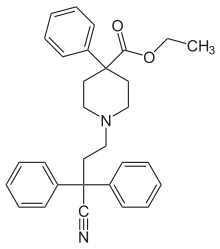
you know that pesky p-chlorsustitutuent on the loperamide molecule?
looking at the structure one might be i'll advised to attempt grignard rxn directly on loperamide.
since is has an active proton.
however, what if one were to esterify it then form the grignard ( inknow it would be tough to get it to form because of chlorine's reduced reactivity to mg complexes vs other halogens.
if this were possible could this then be quenched with dilute acid to yeild the unsubstituted aryl ring?
structure here:

http://en.wikipedia.org/wiki/File:Loperamide.svg

the reason we want to snip the chlorine of is thus, it imparts p-glycoprotein affinity to the molecule barring most of it from getting across the bbb.

http://www.scribd.com/doc/19106940/Synthesis-and-characterization-of-meperidine-analogs-at-the-Pglycoprotein-efflux-transporter

they hint at it here by mentioning m-hydroxy groups enhancing glycoprotein affinity.

me thinks lithium granular suspended in dry petro ether, add the loperamide ester all at one bang on a small scale and heat.
this would form the aryl lithium then just add water (carefully!)
and the result would be removal of chlorine from the para position on the benzene ring
« Last Edit: December 20, 2009, 07:31:18 AM by jon »

timecube

  • Subordinate Wasp
  • ***
  • Posts: 230
Re: loperamide is it possible to form a grignard complex of???
« Reply #1 on: December 20, 2009, 10:47:33 AM »
Do you think it seems reasonable that the actual hydroxyl group may be inhibiting BBB crossing as well, with methylation to a methoxyl group or some form of removal helping as well?

jon

  • Foundress Queen
  • *****
  • Posts: 1,883
Re: loperamide is it possible to form a grignard complex of???
« Reply #2 on: December 20, 2009, 04:07:19 PM »
it does in the thread below thier is discussion and results of making it's propionoxy ester which helps but the main thing is'nt lipophilicity it's the fact that that chlorine subtituent makes the molecule a p-glycoprotein substrate.
this is also known as mdp or multidrup resistant protein removing this and esterifying the 4-oh would make for a straight up mu agonist with some serious action.
and it could quite possibly be easily done by mettalation with lithium followed by hydrolysis

Sedit

  • Global Moderator
  • Foundress Queen
  • *****
  • Posts: 2,099
Re: loperamide is it possible to form a grignard complex of???
« Reply #3 on: December 20, 2009, 04:49:07 PM »
I have had concerns about the amide function as well since it does not lay over well with Fentanyl. I have considered Hydrolysis and decarboxylation but the scales we are working on prehibit alot of quantative experimentation.
There once were some bees and you took all there stuff!
You pissed off the wasp now enough is enough!!!

jon

  • Foundress Queen
  • *****
  • Posts: 1,883
Re: loperamide is it possible to form a grignard complex of???
« Reply #4 on: December 20, 2009, 06:12:30 PM »
ok no i don't mean hydrolysis under harsh conditions.
 treatment with cold 0 C 10 hcl will cleave off the lithium atom from the ring and leave us with something unsubstituted plus lithium is avaialable otc
it's like this:
take loperamide bsify it dissolve in petro ether (dried by distilling from CaH for ex) (everythings gotta be dry bone dry.
blanket and inert gas over th rxn vessel and dump in lithium granules under tetro ether gently heat.
in these kind of reactions sometimes they don't work on a small scale because of the law of mass action but it might with a nugde from a little heat and excess Lithium.
maybe some of the old grignard tricks work on this like sonication, dce, iodine crystals etc.
the reult would be the para cloro would now be an organolithium and the oh group would be a oLi group on treatment with dil acid (cold) and really careful (pyrophoric) you would have an unsub. ring like the other prodines.
then you can esterify it to get some wicked ass prodine analouge.
read the above article it suggests that this chloro sub is the main reason it does'nt cross the bbb
« Last Edit: December 20, 2009, 09:33:49 PM by jon »

jon

  • Foundress Queen
  • *****
  • Posts: 1,883
Re: loperamide is it possible to form a grignard complex of???
« Reply #5 on: December 21, 2009, 06:09:50 AM »
Sedit how would you go about decarboxylating this?

Sedit

  • Global Moderator
  • Foundress Queen
  • *****
  • Posts: 2,099
Re: loperamide is it possible to form a grignard complex of???
« Reply #6 on: December 21, 2009, 06:24:26 AM »
Decarboxylation can be carried out in a high boiling point solvent in the presence of a carbonyl containing compound and there are some syntehsis that use various Cu(II) salts to lower the activation enery needed. Carvone and a few others are prime examples of solvents since they are high boiling point Ketones which will decarboxylate readily in many cases.

Perhaps even consider plain hydrolysis since its possible that the Carboxylic acid will not prevent absorbtion in the body and in may cases if it fits there is an enzyme to perform it for you.
There once were some bees and you took all there stuff!
You pissed off the wasp now enough is enough!!!

jon

  • Foundress Queen
  • *****
  • Posts: 1,883
Re: loperamide is it possible to form a grignard complex of???
« Reply #7 on: December 21, 2009, 07:29:34 AM »
those example using the cylcoheneone you mention as a decarboxylation reagent in all instances were employed on amino acid substrates.
the carbonyl moiety would condense to give the imine this imine then depratonates carbpxylic acid forming CO2- leaving group i don't see an adjacent nitrogen (primary or sec not tert)adjacent to the hydrolysis product of loperamine resultant from the hydrolysis of the dimethylamido group.
so this would not be feasible, due to aforementioned mechaism can you propose another system?
i was reading that certan copper compounds work i'll have to investigate that.
 i digress this is sterically sandwhiched betwixt two phenyl rings so polar or not it's pribably shileded and does'nt have any reall impact on lipophilicity.

Sedit

  • Global Moderator
  • Foundress Queen
  • *****
  • Posts: 2,099
Re: loperamide is it possible to form a grignard complex of???
« Reply #8 on: December 21, 2009, 09:03:11 AM »


No Im suggesting hydrolysising the Amide first to a carboxylic acid, The dimethylamido group should undergoes hydrolysis under dilute H2SO4 reflux I would assume. This would leave a carboxylic acid moiarity in place of the amide cleaving Dimethylamine off I think... Bear with me here folks its a long night.....

I say form the NaSalt of this acid and attempt to decarboxylate it simular to benzoic acid is done.

U suggest its sandwhiched between the phenyls rings but you seem to be picturing the molecule as a flat structure which it most certinely is not. The Hydrogens on the end of the Dimethyl group are going to repel to alkyl chain on the one side of this leading to at the vary lest and small divetion from the axis of the rest of the molecule. I would have to assume the amide function to be tilted so that the oxygen is popping out of the screen(not exactly but just to give you a visual of what im saying here). 


These are all just late night assumptions at the moment but its still food for thought.

BTW everyone assumes that OH prevents BBB crossing. Think people.... This is not Pseudophedrine and there are many substances with OH that can cross the BBB..... Morphine comes to mind doesn't it. The esterfication of it to heroin is not to make it cross the BBB more its done to slow the metabolism of it. It makes it ascross eitherway.
There once were some bees and you took all there stuff!
You pissed off the wasp now enough is enough!!!

jon

  • Foundress Queen
  • *****
  • Posts: 1,883
Re: loperamide is it possible to form a grignard complex of???
« Reply #9 on: December 21, 2009, 10:02:41 AM »
ok let me explain even if the oxygen is x axis or perpendicular to the rings the lone pairs resonate with the delocalised rings so this negates polarity there the nitrogen having pyrimidal geometry would be on the backside with respect to the oxygen atom.
this lone pair would also be somewhat inducted to the delocalized pi electron system of the to rings.
so i just prooved that does'nt preclude lipophilicty.
the problem is that the n,n, dimethyamide is metabolized almost quantitatively by the liver's p450 enzymes to the nor desmethy ie. the liver demthylated the amide this introduces polar nitrogen protons hence why this comound (the ester is not active per orum p.o.)
or by mouth.
diphenoxylate has a similar group off the butyl side chain a nitrile which is quite polar yet it retains activity.
not to say that hydrolysis folllowed by decaarboxylation would hurt to make it orally active.


*morphine comes to mind doesn't it. The esterfication of it to heroin is not to make it cross the BBB more its done to slow the metabolism of it. It makes it ascross eitherway.*
wrong heroine reaches the recepeter 10,000 times faster than morphine hence the "rush"

look at diphenoxylates structure see any similarities with maybe one exceptiion it lacks the p-chloro substituent
also the ester is'nt reversed as would be the case with the loperamide derivative and it's acetoxy which is 5 fold weaker than propionoxy
« Last Edit: December 21, 2009, 10:43:33 AM by jon »

jon

  • Foundress Queen
  • *****
  • Posts: 1,883
Re: loperamide is it possible to form a grignard complex of???
« Reply #10 on: December 21, 2009, 10:46:08 AM »
the nitrile would have two pi systems resonating with the two rings same as with loperamide ecxept there are lone pair on O and N atoms resonating with the delocalized electrons. hopefully this clarifies things a little bit

timecube

  • Subordinate Wasp
  • ***
  • Posts: 230
Re: loperamide is it possible to form a grignard complex of???
« Reply #11 on: December 24, 2009, 07:06:25 AM »
If you had access to LAH, you could probably reduce the amide and strip the chlorine in one step.

A few other ways to remove the chlorine..

The chorine should be removable via catalyzed reduction
http://www.orgcatal.dicp.ac.cn/pdf/Pd-C-catalyzed%20hydrodehalogenation%20of%20aromatic%20halides%20in%20aqueous%20solutions%20at%20room%20temperature%20under%20normal%20pressure.pdf

and apparently via a dissolving metal reduction using calcium
http://pubs.acs.org/doi/abs/10.1021/es010716%2B


Quote from: Sedit
I say form the NaSalt of this acid and attempt to decarboxylate it simular to benzoic acid is done.

Isn't this going to result in not having any fourth group on the central carbon anymore?  How do you get from there back to an amine?

jon

  • Foundress Queen
  • *****
  • Posts: 1,883
Re: loperamide is it possible to form a grignard complex of???
« Reply #12 on: December 24, 2009, 07:27:14 AM »
i personally woul'dnt mess woth LAlH4 a lot of people don't realize how pyrophoric it is and ususally in combination with solvents that have more btu's than dynamite.
but i like that calcium system those are good suggestions.
her's the rub, pcb's are higly activated rings and probably lose chlorine under milder conditions.
that paldium system is actually viable the closest thing to our substrate on table 2 is chloro toulen apparrantly it worked well, good suggestions thanks!

also LAH would strip that OH off the piperidine ring too.
« Last Edit: December 24, 2009, 07:50:35 AM by jon »

Sedit

  • Global Moderator
  • Foundress Queen
  • *****
  • Posts: 2,099
Re: loperamide is it possible to form a grignard complex of???
« Reply #13 on: December 24, 2009, 07:42:47 AM »
Quote
Quote from: Sedit
I say form the NaSalt of this acid and attempt to decarboxylate it simular to benzoic acid is done.

Isn't this going to result in not having any fourth group on the central carbon anymore?  How do you get from there back to an amine?

Sure will.....

WHY do you want to get back to the amine. That fucking function right there is nothing but in the way if ya ask me!
There once were some bees and you took all there stuff!
You pissed off the wasp now enough is enough!!!

timecube

  • Subordinate Wasp
  • ***
  • Posts: 230
Re: loperamide is it possible to form a grignard complex of???
« Reply #14 on: December 24, 2009, 08:11:44 AM »
Quote
Quote from: Sedit
I say form the NaSalt of this acid and attempt to decarboxylate it simular to benzoic acid is done.

Isn't this going to result in not having any fourth group on the central carbon anymore?  How do you get from there back to an amine?

Sure will.....

WHY do you want to get back to the amine. That fucking function right there is nothing but in the way if ya ask me!

Then you don't have a tertiary nitrogen with a small alkyl group as would satisfy the "morphine rules."  Of course there are always exceptions to "rules" like that, but it seems to be in staying somewhat true to the original structure, the carbon attached to the phenyls and amide should be the quarternary carbon and the amide an amine.

jon

  • Foundress Queen
  • *****
  • Posts: 1,883
Re: loperamide is it possible to form a grignard complex of???
« Reply #15 on: December 24, 2009, 04:24:31 PM »
i don't think decarboxylation under drastic conditions with NaOH and CaO @ 300 C would be a very good idea.
if you can strip the chlorine atom off the ring and esterify it it would be very active removing the chlorine atom increases mu receptor affinity 40 fold
« Last Edit: December 24, 2009, 04:49:24 PM by jon »

timecube

  • Subordinate Wasp
  • ***
  • Posts: 230
Re: loperamide is it possible to form a grignard complex of???
« Reply #16 on: December 24, 2009, 09:46:33 PM »
Is the chlorine in particular the problem, or does any group hanging off of there decrease receptor affinity?

Hopefully we're not just engineering some super-Imodium that stops jon up for the rest of his life.

jon

  • Foundress Queen
  • *****
  • Posts: 1,883
Re: loperamide is it possible to form a grignard complex of???
« Reply #17 on: December 25, 2009, 04:02:49 PM »
no chlorine is what makes this not permeate the blood brain barrier so well because it makes it a substrate for p-glycoprotein also known as multi drug resistant protein removing this would make a super prodine once esterified.
infact the propionoxy ester is on par with heroin just ask 2bfrank he recently tried this mad science and was quite pleased with the outcome.
this novelty has created nothing but satisfied customers.

once again i elude you too this:

http://www.scribd.com/doc/19106940/Synthesis-and-characterization-of-meperidine-analogs-at-the-Pglycoprotein-efflux-transporter

in this abstract they mention certain ring sustituteuents as enhancing p-glycoprotein afffinity eg. meta hydroxy substituents fore example

this is probably the best way becuase it is done in 1 minute using cth and supported catalysts (meaning no need to set up parr bomb)

"Microwave-enhanced aromatic dehalogenation studies: a rapid deuterium-labelling procedure"

http://www.sciencedirect.com/science?_ob=ArticleURL&_udi=B6THS-4221FNJ-1N&_user=10&_rdoc=1&_fmt=&_orig=search&_sort=d&_docanchor=&view=c&_searchStrId=1146622083&_rerunOrigin=google&_acct=C000050221&_version=1&_urlVersion=0&_userid=10&md5=50ed8c0b3266dcdd9b59416faca40c4f

alll of that aside catalysts can easily be poisoned etc.
so the path of least resistance is lithium from batteries under inert gas in petro ether on microscale exotherm would',nt be much of a problem,even the hydrochloride could be added as the salt as long as excess lithium is employed
also those catalytic reduction schemes could possibly strip that tertiary OH because it's teritiary for one (stable cation) and it's' BENZYLIC TOO IMPARTING EVEN greater ELeCTRON DENSITY TO THE OH
« Last Edit: December 25, 2009, 08:36:43 PM by jon »

jon

  • Foundress Queen
  • *****
  • Posts: 1,883
Re: loperamide is it possible to form a grignard complex of???
« Reply #18 on: December 26, 2009, 04:58:41 AM »
this is the most practical explanation,
 dealing with these kind of reagents on a small scale not a big deal i wonder coul'dnt one use a blanket of CO2 instead of renting cyliders of argon gas regulators flow meters fuck that.
also there is an induction period then it goes exotherm a cool bath during sonication followed by a 50 C bath after the exotherm subsides seems logical.

http://www.ehow.com/way_5512638_preparation-organolithium.html

funny thing is they mention that grignard trick i alluded to earlier, sonication to initiate small scalle rxns.
 hmmm fellas does anyone see the possibility? the propionoxy ester pretty close to heroin iv'ed strip that chlorine off and it enhances mu affinity 40 X so now you have some uber heroin.
« Last Edit: December 26, 2009, 05:53:26 AM by jon »

timecube

  • Subordinate Wasp
  • ***
  • Posts: 230
Re: loperamide is it possible to form a grignard complex of???
« Reply #19 on: December 26, 2009, 08:15:31 AM »
Maybe just rent a helium tank from a party supply store?

It seems like the lithium route should work.  I don't know if maybe iodine or HgCl can be used to initiate the reaction similar to a grignard.  It seems like the main problems would be with mechanical losses unless you just plan to buy a lot of loperamide.  Of course a couple hundred dollars for 15g or so of starting material is probably more than worth it if it's as strong as you believe.

What I was getting at earlier is that if it's just the chlorine causing problems, it can likely be replaced with a methoxy group without too much trouble.  But the organolithium route looks better overall and probably produces a stronger end product.